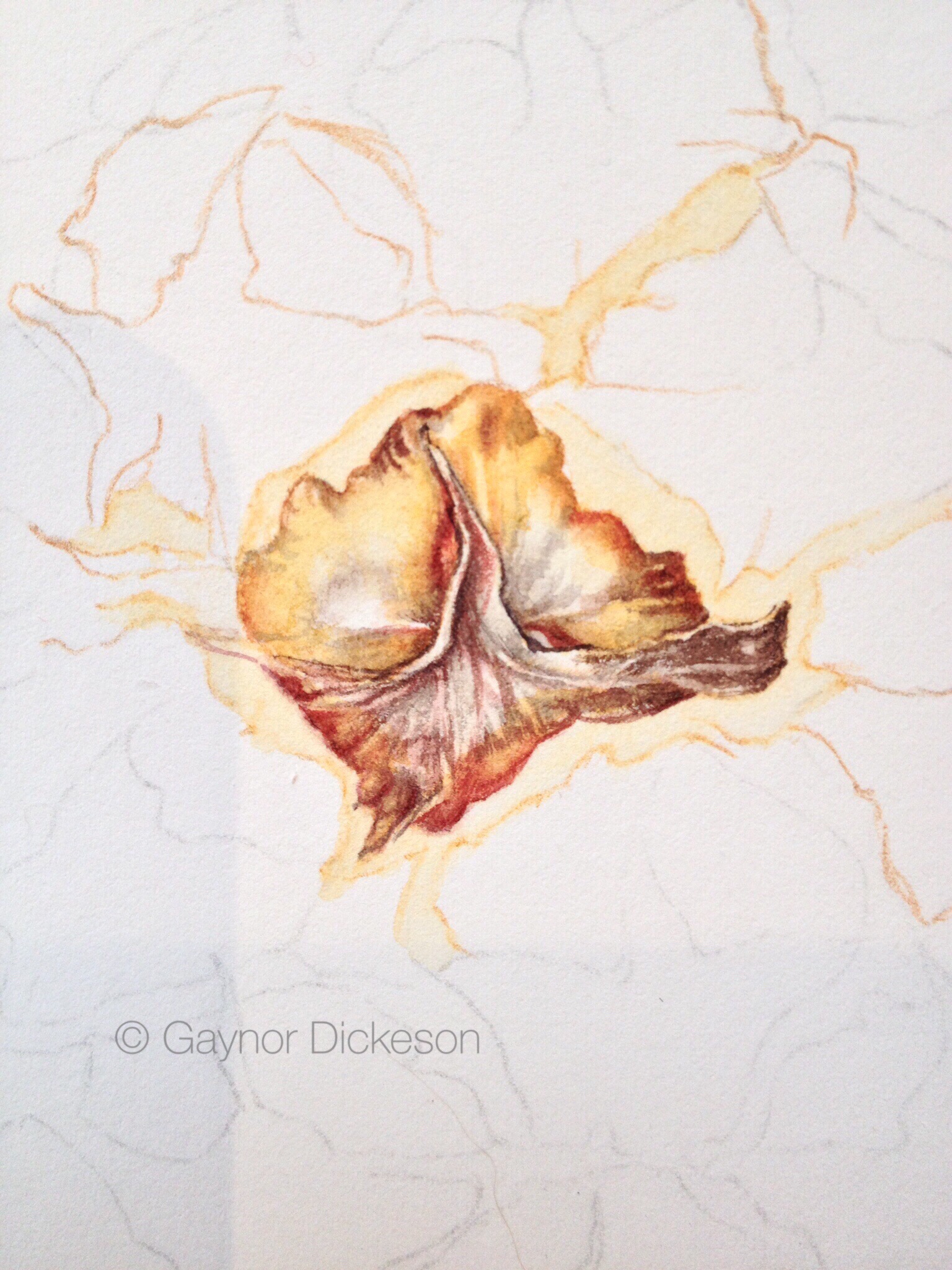
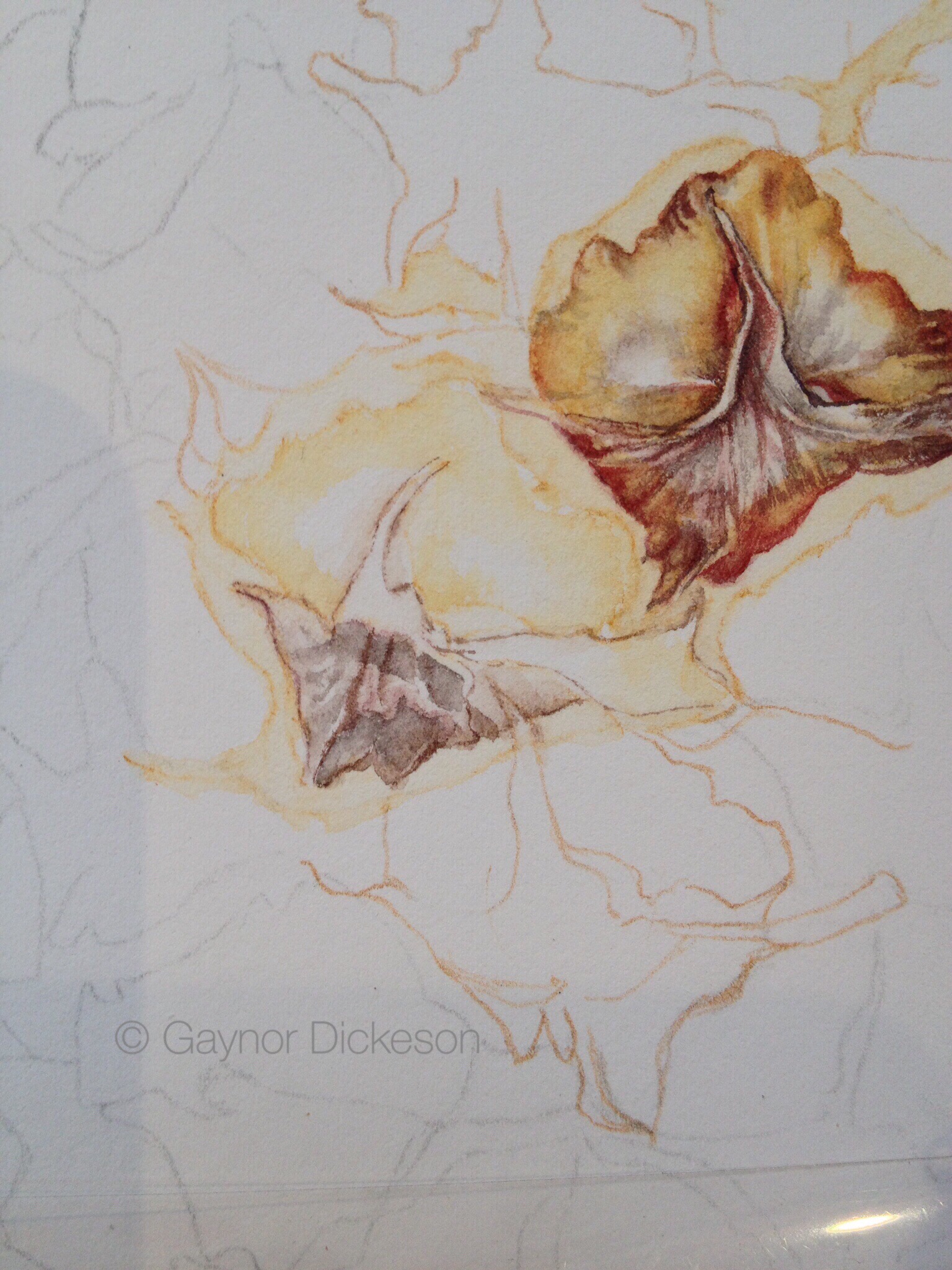
The pineapple and arrival of Rory McEwen vellum

This week has been and will continue to be quite eventful. On Sunday, we drove up to London to deliver pictures for the SBA exhibition in April at Westminster. Several assignments have arrived from London Art College to mark and I have started these. This morning I had my usual weekly class and this afternoon a friend arrived from Norway ready to take part in the workshop I am holding this weekend – Friday to Sunday.

Tomorrow we plan to go to Kew and of course the highlight will be to visit the Shirley Sherwood Gallery of botanical art. Hopefully I will be able to write a bit about it in the evening.

But today there was a big knock on the door. I could see the sun flooding in through the glass in the door and the shadow of a person standing outside. I opened the door and there stood our very smiley ( and helpful) postman with a parcel in his hand. I saw straight away that it came from the Hunt Institute, Pittsburgh. It was the vellum! I was so excited and the poor man got dragged inside to be told the story behind it all.

I understand that not everyone is entirely sure what vellum is. It is animal skin – often goat or lamb, which has been collected from abattoirs and prepared by specialists for painting or writing on. It is parchment, the same material that old documents were written on. In fact all acts of Parliament are still written on parchment.

Why use vellum/parchment rather than paper? Well, the archival properties of parchment are far greater than that of paper. For important documents this is an important consideration. For artwork this too is very important, but there are additional benefits ( and difficulties). Watercolour is applied with a dry brush technique as unlike paper, the pigment lies on the surface of the skin. In doing so, the pigment reflects its colour well as it is not absorbed into the skin and dulled in any way. Rory McEwen’s pictures really do show this fact very well.

But as I haven’t yet decided what to paint on the vellum, it is likely to be a few months before I get started with it.

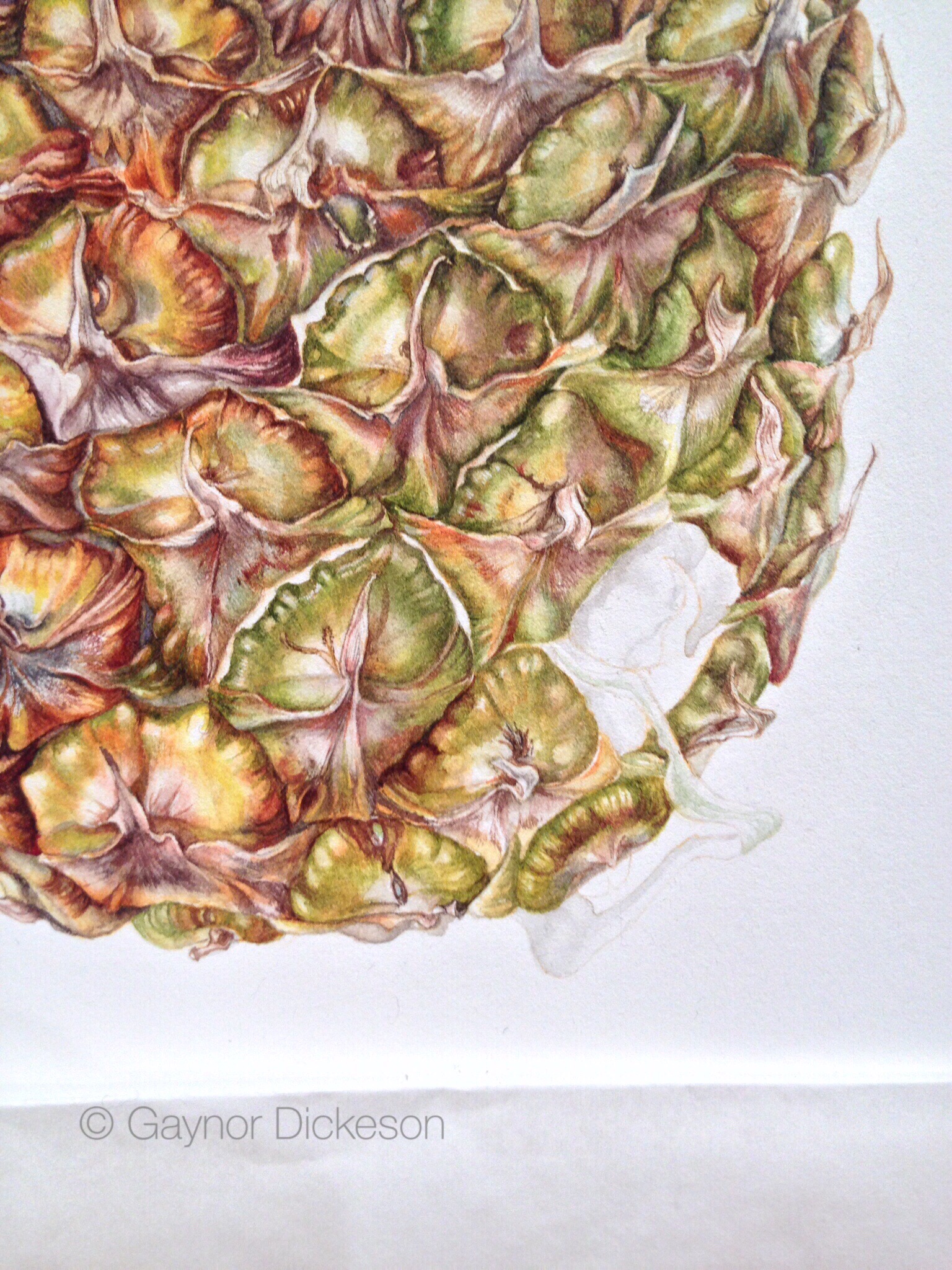
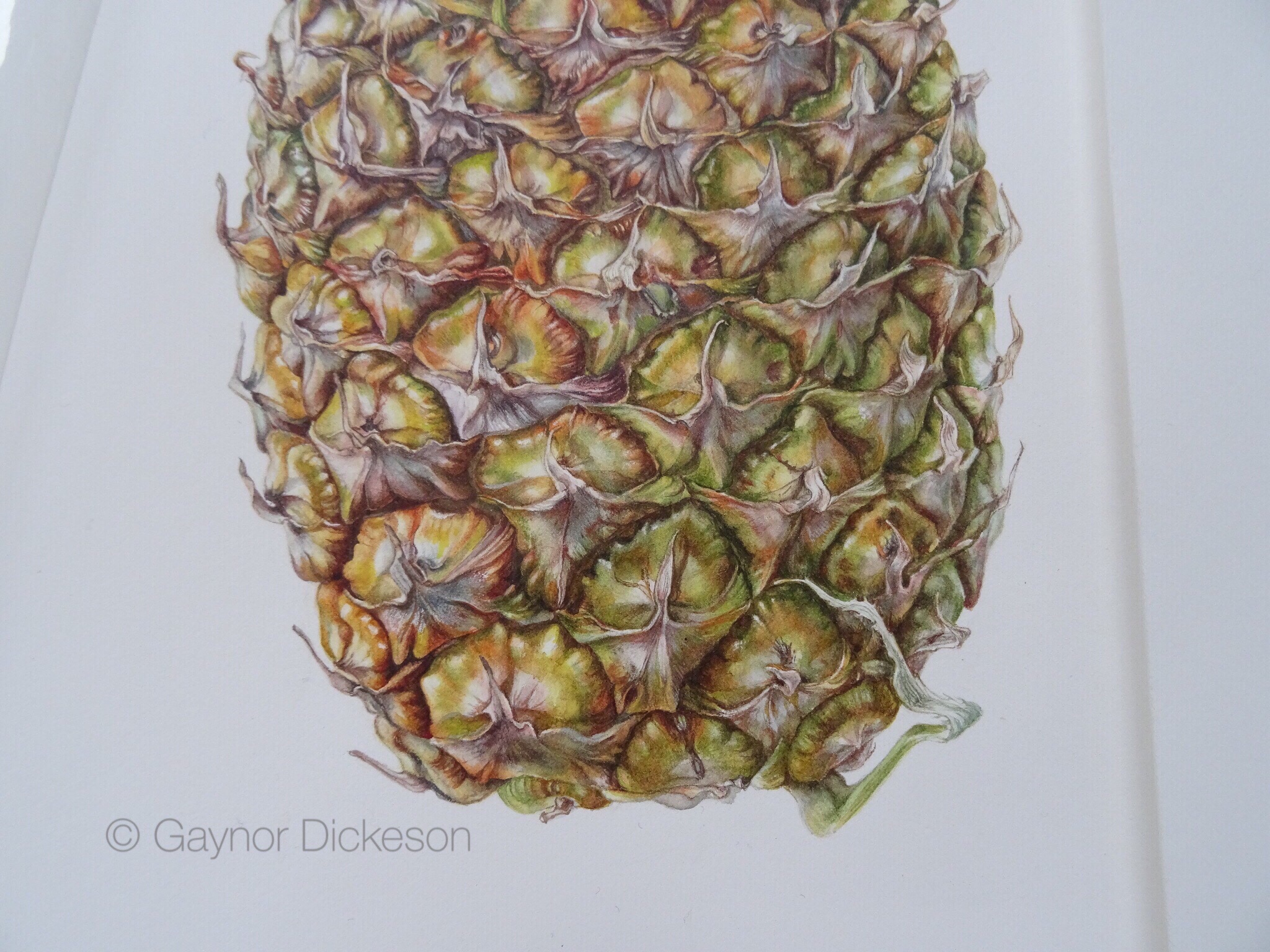
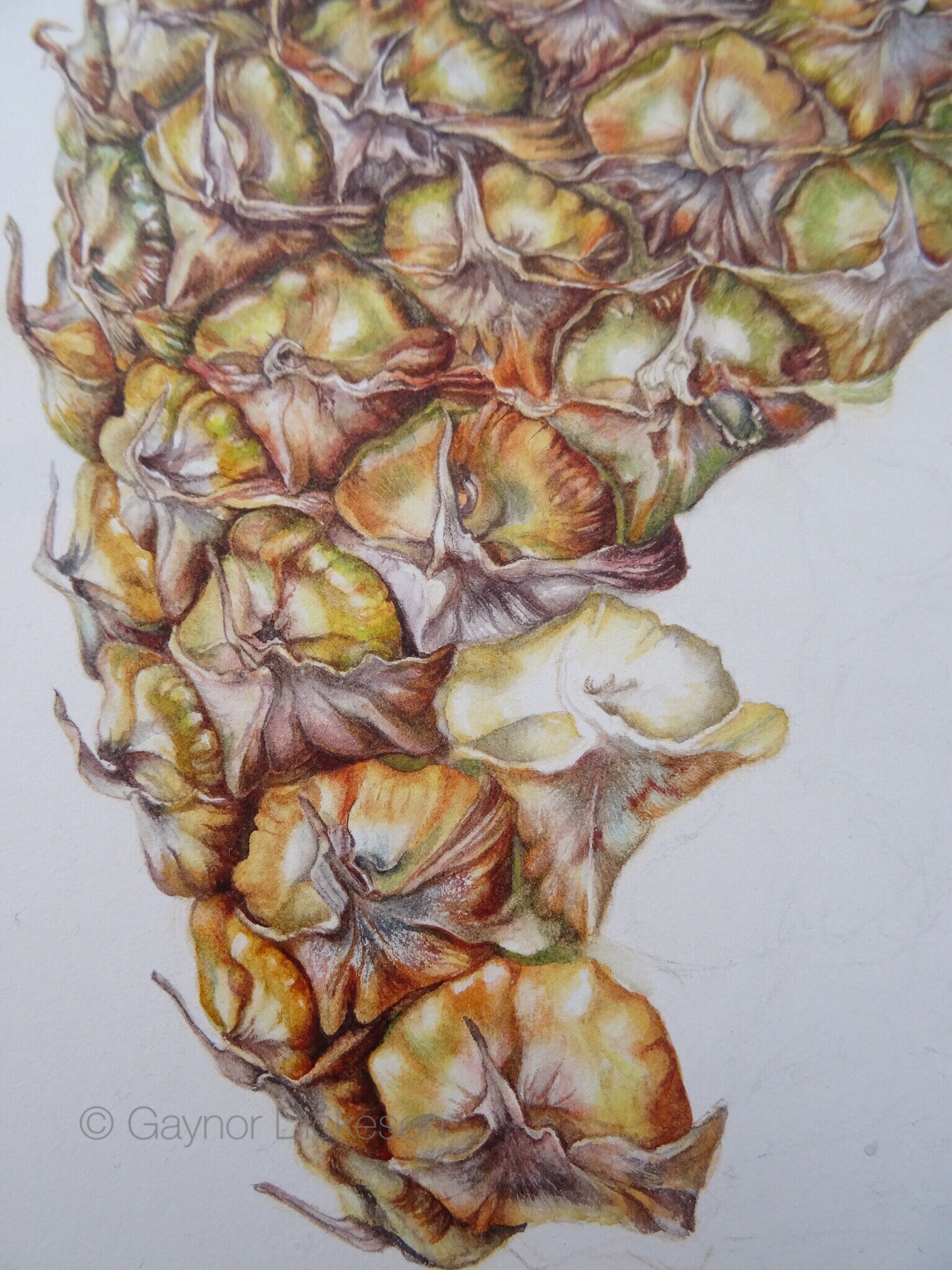
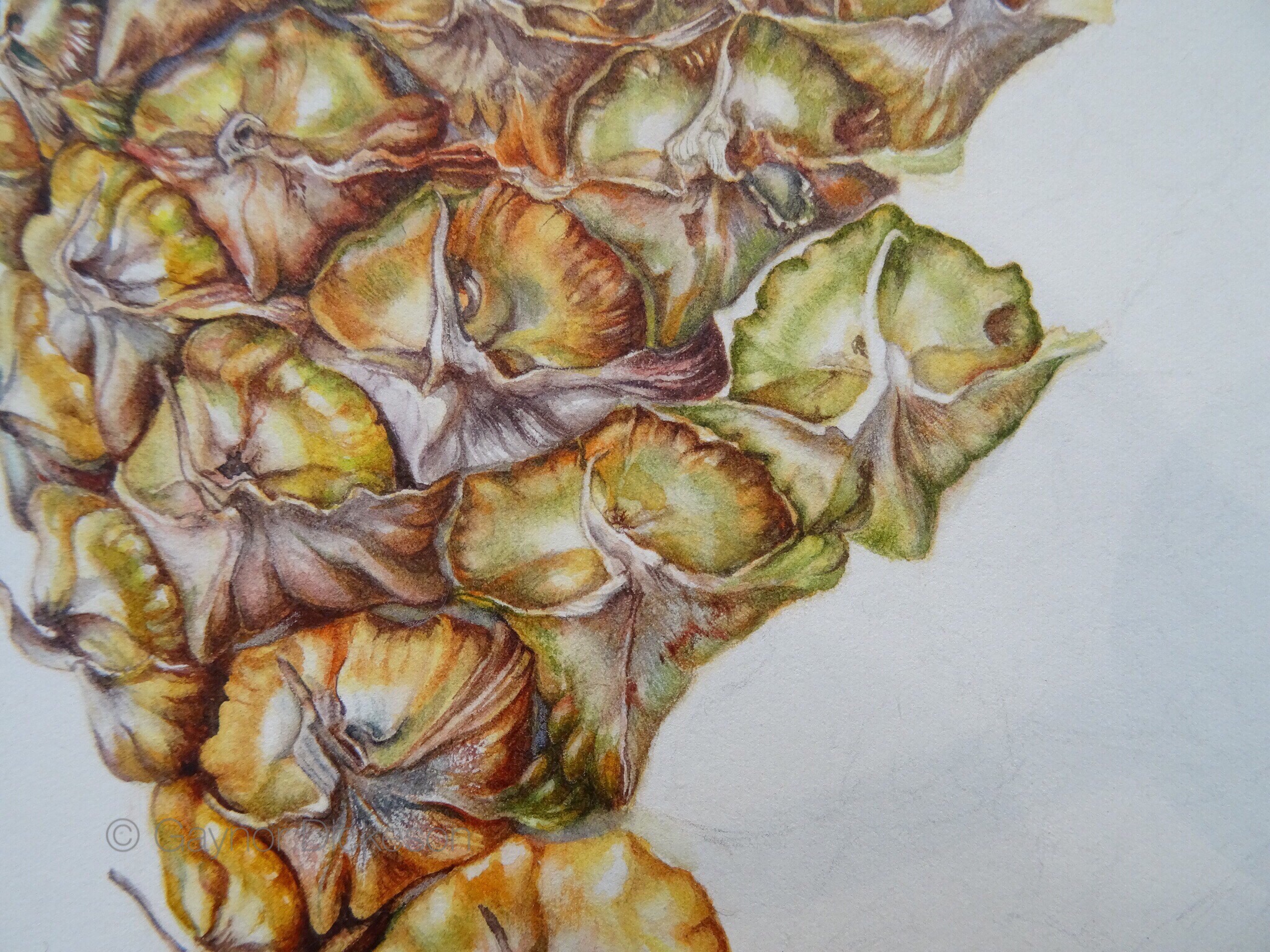
Last of all, how is the pineapple doing? In showing these pictures, I am being careful not to show how I have pulled the painting together as a whole. I think it important that the person who is to receive it, should see it first as a complete picture. Once that happens, I will then post it on my blog.

More pictures!

IMG_0073

IMG_0074

IMG_0075

From the fruit to the leaves. I read somewhere the other day about someone needing to get into the ‘zone’, when painting a picture. That really struck me with this pineapple, because it was so different from the last piece of work I did. It had to feel right before I actually started putting paint on the paper. I had to feel confident that the colours I was going to use were the right ones, and that the sequence of colours and the way I laid them, were right for this picture too.

I now had this feeling all over again. I was going to use exactly the same colours as I used for the fruit, but in different mixes. The textural effect I wanted would be completely different. It felt like starting from the beginning and needing to get in the ‘zone’ – but more importantly I couldn’t afford to make any mistakes at this stage. I had to be confident of what I was doing, before I did it.

I started off with painting the shadows in a neutral mix. This was to establish where the light came from, and therefore how the shadows would have an effect on the shape of the leaves. I couldn’t do this in the same way with the fruit part of the picture, because I knew I would be using a series of pineapples and painting each segment from the ‘fresh pineapple of the moment’. By the way, I used four pineapples for the fruit.

Have you noticed how the pineapple fibre really gets caught between your teeth?

Back to painting the leaves. Once I had established where the shadows would be, I started painting the leaves where I could see the upper surface, which was a darker green and quite shiny. I needed to make sure I had some good tonal contrasts in these areas. Am I succeeding?

IMG_0076

Painting a Pineapple – a labour of love!

I love painting, be it with watercolour, coloured pencil ink or just graphite. Many consider using some of these materials is ‘mark making’, rather than painting, but…….

Today I haven’t been painting at all. I have been getting things ready to take some work up to London tomorrow; hand-in for the annual SBA botanical art exhibition at Westminster central hall in April. I hate this aspect of painting, getting work ready for exhibitions! But tomorrow I get to meet old friends and other members of the SBA when they also hand in their work.

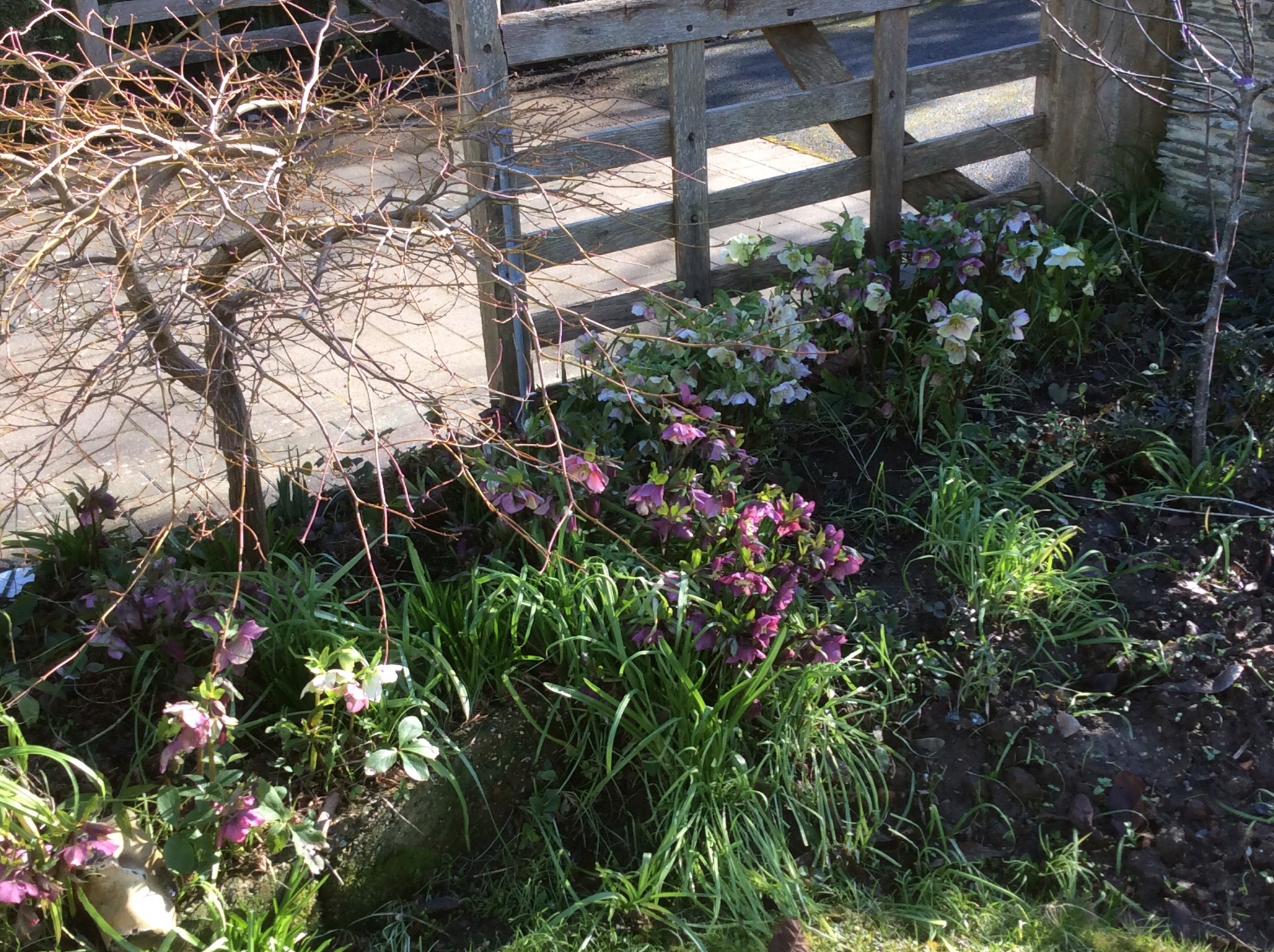
Then back to painting. But before I show a couple more pictures of the pineapple, a touch of Spring!

IMG_0536

IMG_0565

IMG_0542

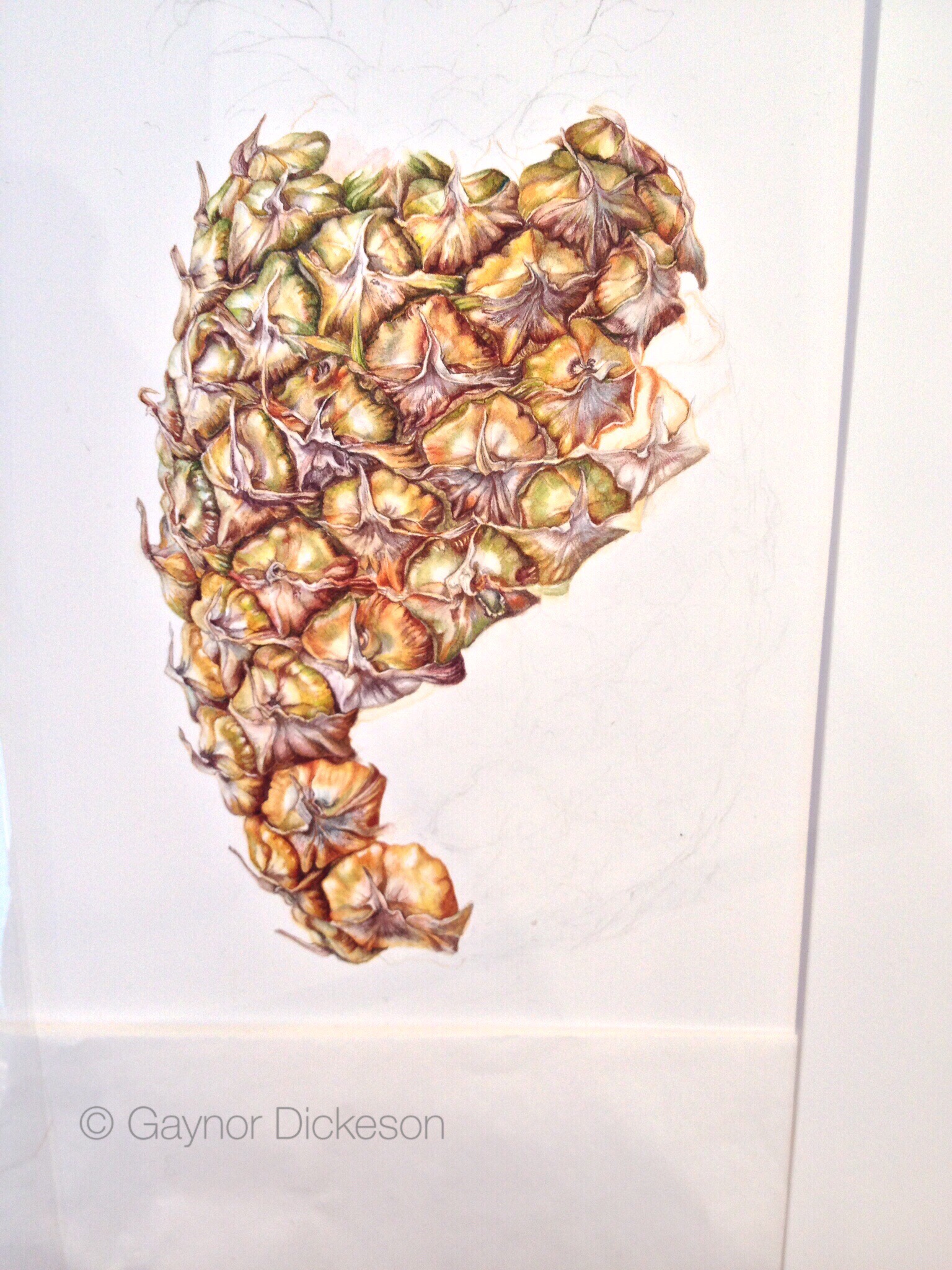
Some more pictures of the pineapple progression. I don’t know whether you notice this or not, but once I have had the first wash on an area, I use a lot of fairly dry brush work to do the detail for each segment. As I mentioned above, starting to paint a pineapple is a labour of love. But every single segment is so different and of course each one faces in a different direction.

IMG_0069

IMG_0070

IMG_0071

IMG_0072

More pineapple segments

I have a feeling that posting the progression of this pineapple might be just a little boring for some. But on the other hand it also portrays the amount of work necessary and how I have to continually adjust the colours and the segments in relation to each other.

Knowing how I paint each segment in a rapidly changing pineapple is interesting in itself. Obviously I paint what I see, but I have to bear in mind that once all the segments are done, they need to be moulded into a complete shape. I can envisage that being the tricky part.

For this past week I have been painting every spare moment. My pineapple is somewhat further advanced than I am showing you here, but as this is a commission, I don’t feel it is right to show the completed work until the client has received the picture. The picture is far from being complete, although to date we have eaten four pineapples that were rather the worse for wear. They still tasted good though!

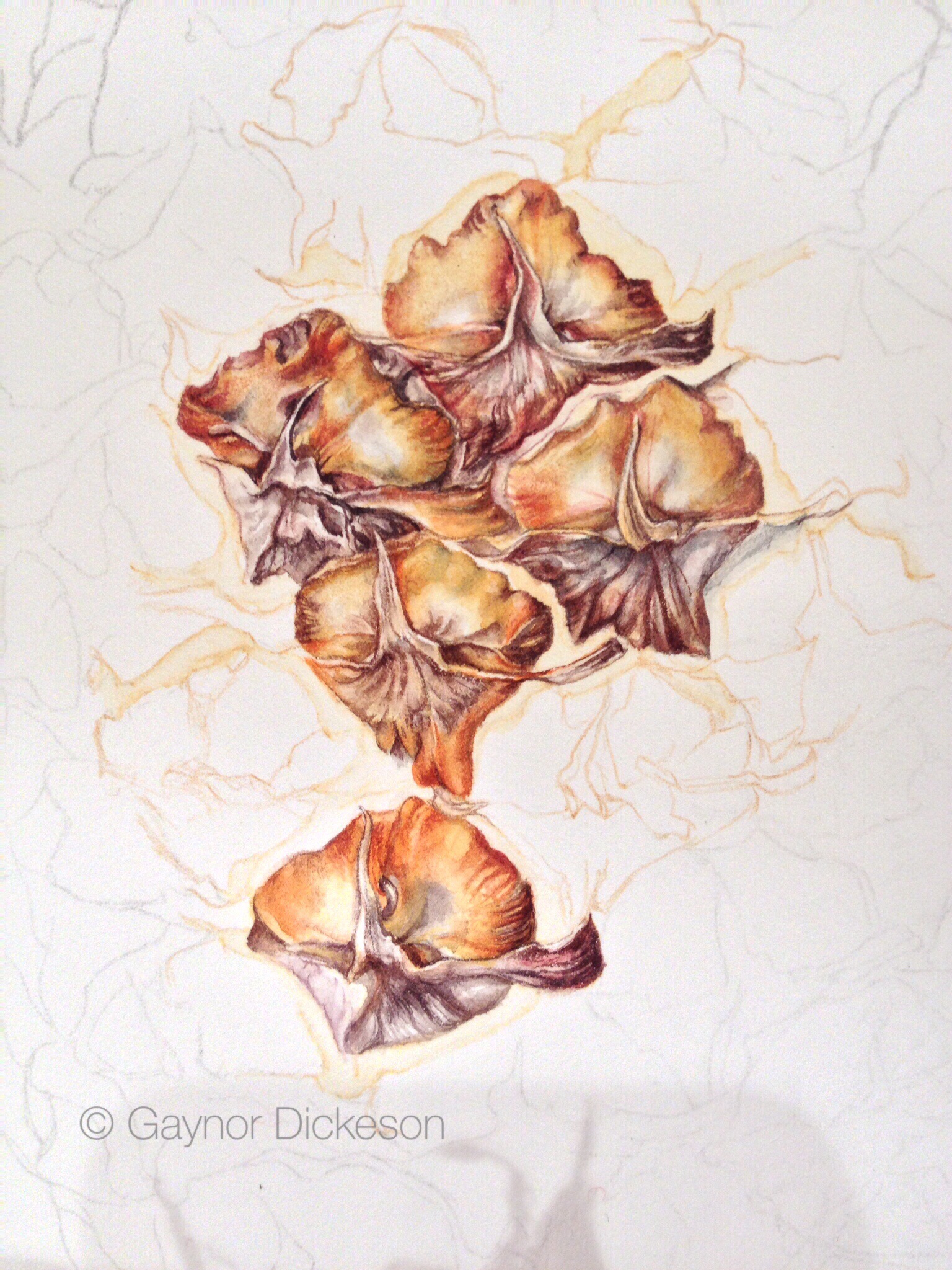
I mentioned that I take pains to draw the pineapple and arrange the segments appropriately. Once that is done I transfer this to my watercolour paper. But what happens then, particularly when I have to change pineapples? This is why I draw the segments in so they can easily be adjusted. I paint from life, therefore when I begin a new pineapple, I place it in such a position as to be able to find segments facing the same direction as on my original drawing.

Sometimes it can be quite difficult as every segment is different, and may not fit in too well. But so far it is going OK.

I have just had a thought. The Norwegian Botanical Art holiday workshop is over a longish period where one can work continuously and with guidance. A pineapple (although not of Norwegian origin) would be something one could work on. Do you fancy having a go? Look at http://www.gaynorsflora.com/page10.htm for details.

IMG_0062

IMG_0063

IMG_0064

IMG_0061

Botanical art workshop report from Twigs and things.

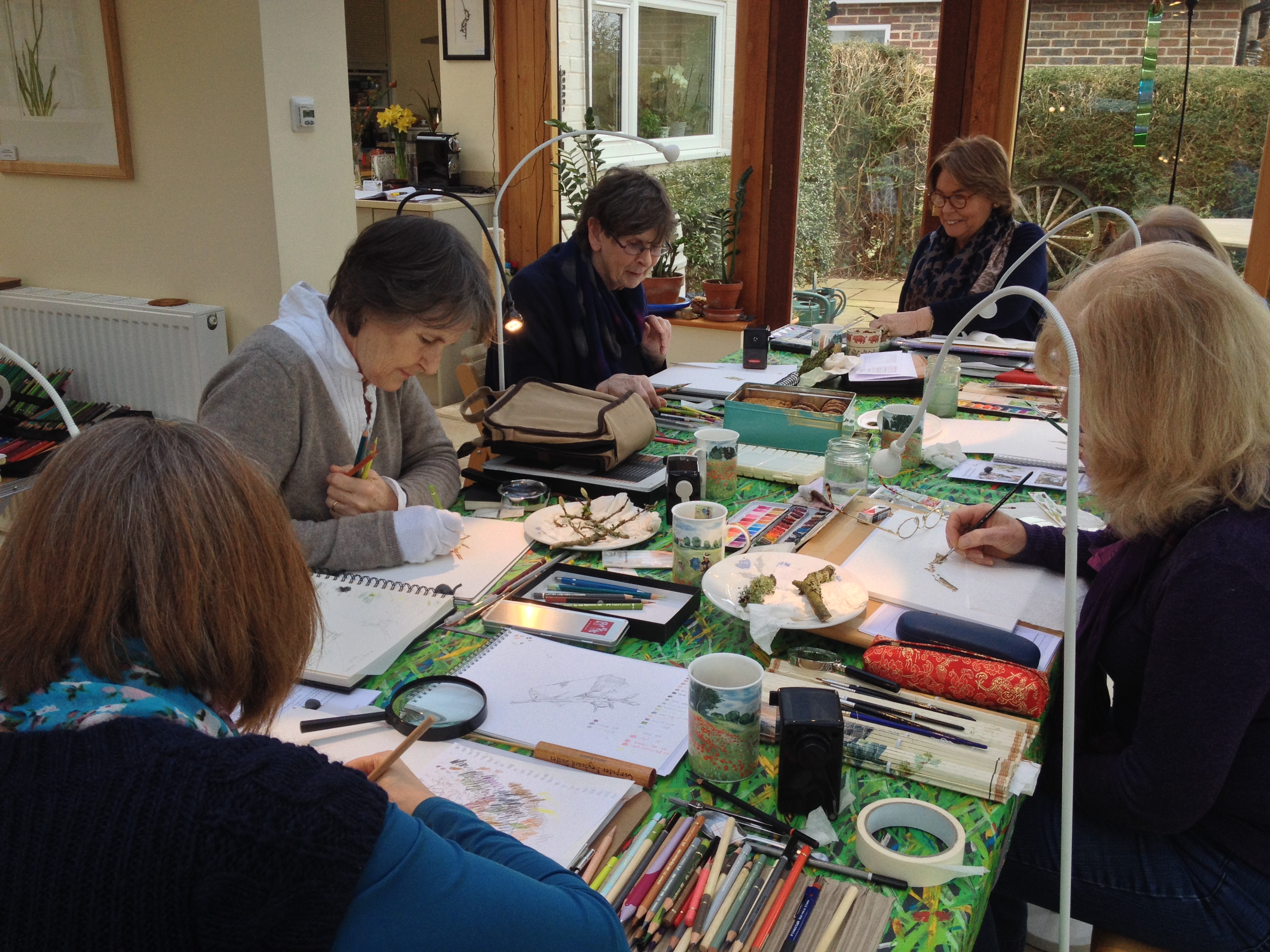
We have just finished the botanical art workshop and I thought I would get the pictures resulting from it, onto the blog before I started marking London Art College assignments.

From my perspective we had a very enjoyable workshop. But then I would say that wouldn’t I? Hopefully someone will confirm or deny this when they read the blog!

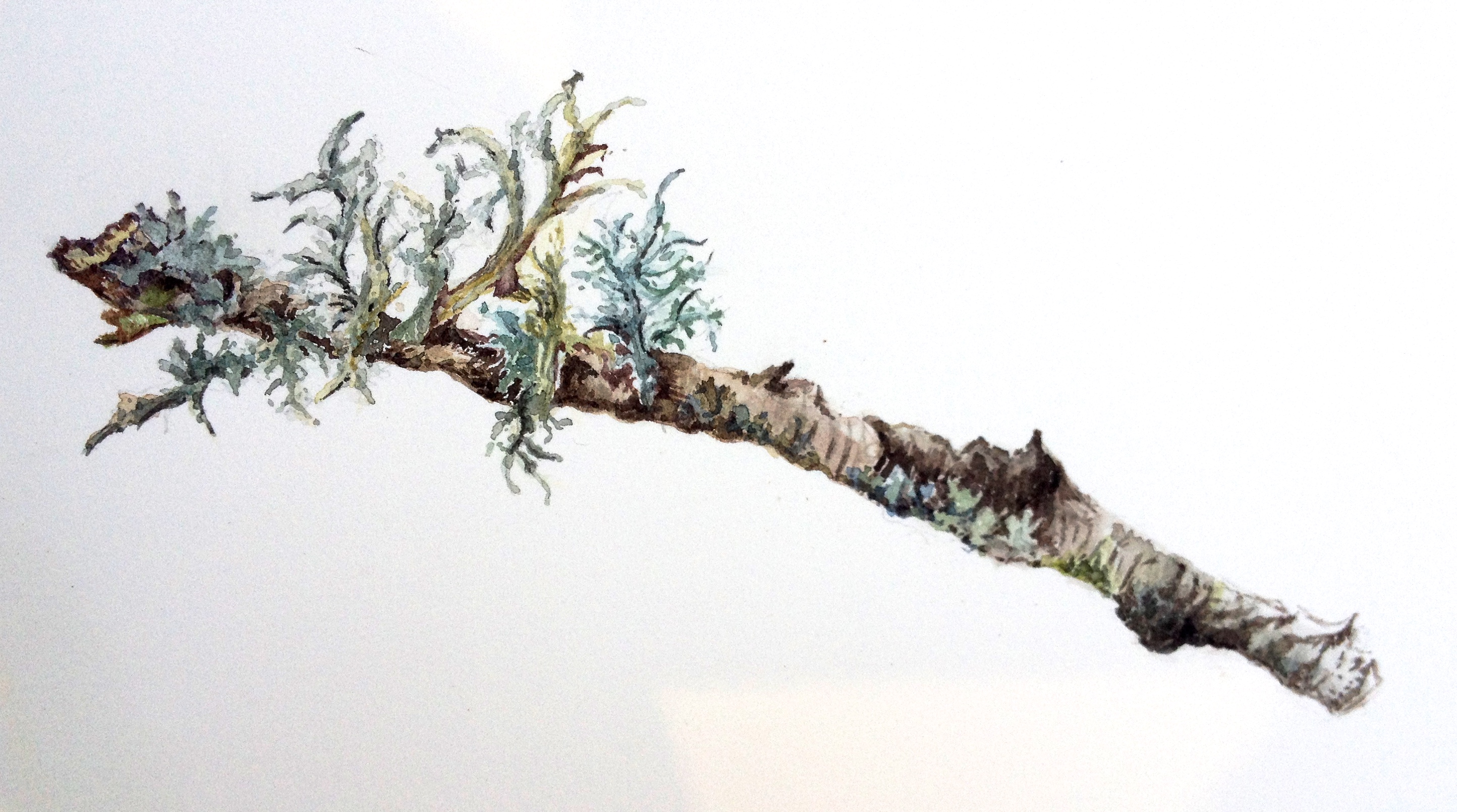
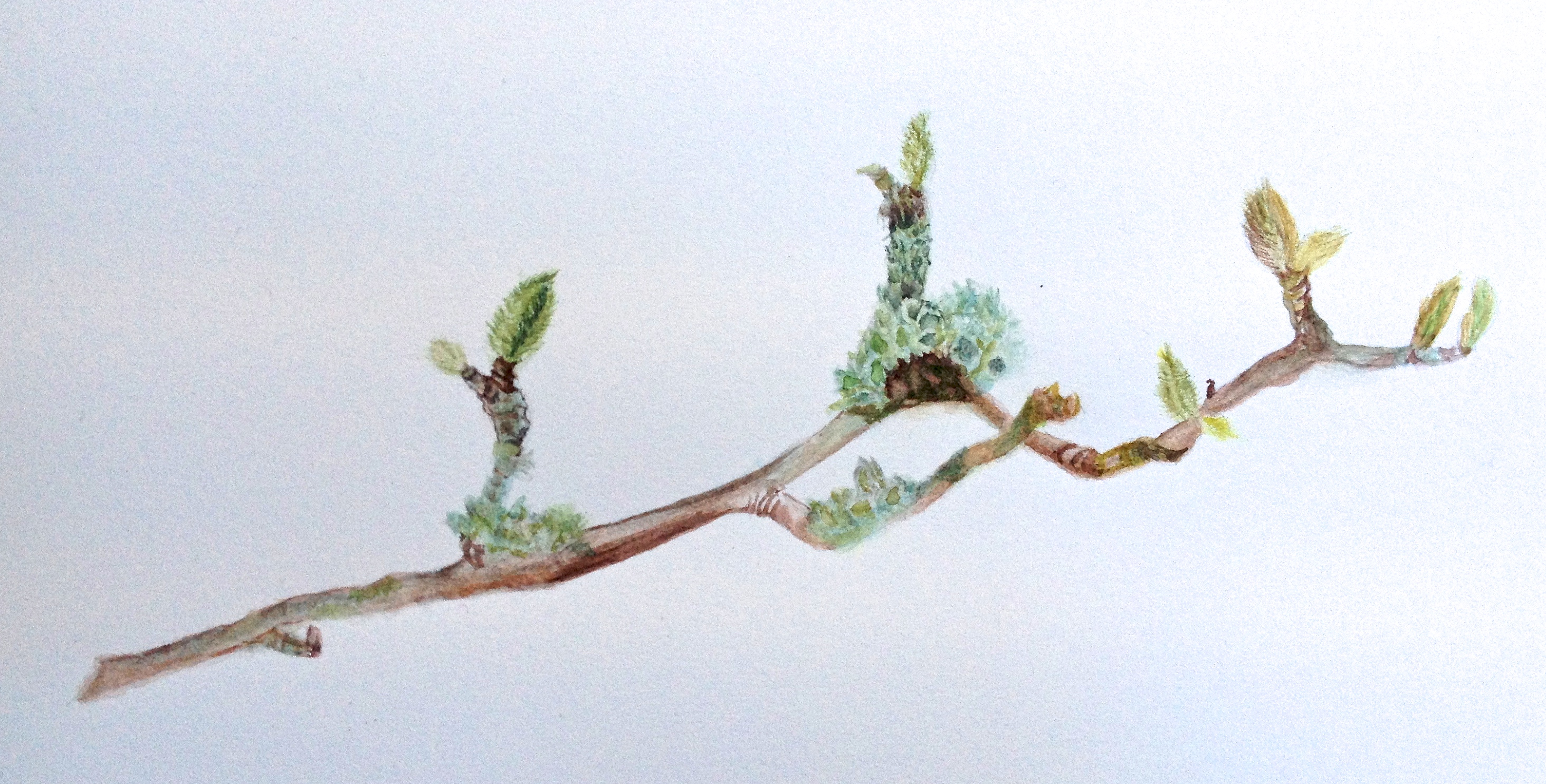
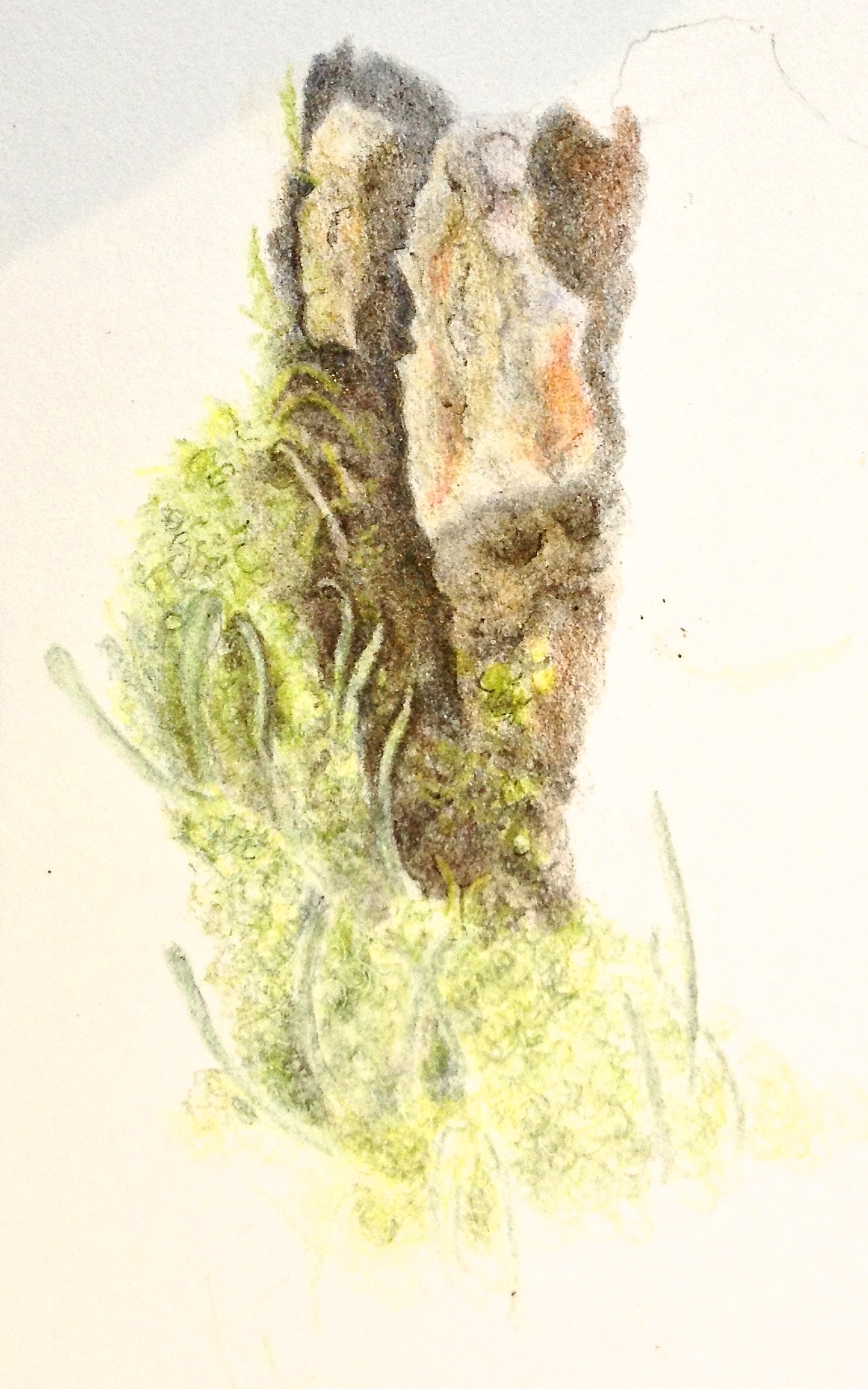
When painting a serious botanical subject that has gnarled branches with lichen or moss growing on it, I feel that I can play with the painting of it – as long as I stay true to the form, growth habit and type of lichen etc. I wanted to convey this to the group as well as get them to see the multitude of colours within such a specimen. I had two days to do this. Half of the group worked with watercolour and half with coloured pencil. Therefore it was exciting demonstrating the same topic in each of the media.

On one occasion I showed the group how to paint the furry terminal bud of a Magnolia soulangeana, first in watercolour and then in coloured pencil. It was quite amusing to hear the comments and the competition in assessing which bud looked best and which medium best suited that topic.

I was very glad to see that there were quite a few different types of lovely specimens which excited the group in different ways. There were some lovely colours observed, hidden in nooks and crannies. Red, pink, blues, oranges etc. A touch of some of these fresh colours, lifted a picture without dominating it. Anyway, I hope that you enjoy the following pictures.

The next botanical art workshop is Floating Hellebores (exposed faces), 27 February to 1 March. We already have a lot of Hellebores flowering in the garden, from very pale to very dark. There are available places, so do get in touch and book.

The brave class
The brave class
A piece of bark with several lichen types growing on it. The main one is identified as Cladonia cornuta.
IMG_2089
At work
Gnarled birch branch with a variety of lichen forms. Watercolour.
A branch of Magnolia stellata in watercolour.
A variety of types of licjhen and moss on another branch from a Magnolia stellata tree. Coloured pencil.
Start of a very complicated piece of work in Coloured pencil. The difficulty of portraying Cladonia cornuta amongst the other lichen growing on the bark piece. Quite a challenge.
Rosehips in Watercolour
Both Birch twig and bark from a tree, with small amounts of lichen growing on it. Coloured pencil
Branch with lichen very happily in situ. Watercolour

The Pineapple and a new workshop

I was reminded today by a friend that I have been remiss in my blogging. I am sorry for that. Therefore to catch up-

Last Saturday Robin and I were at the Society of Floral Painters(SFP), AGM and lunch. It was a very good meeting and lunch finishing off with an interesting talk by Roy Lancaster. It is the first such meeting I have been to and I gained a lot from it – as well as meeting lots of other botanical and floral painters.

The SFP have their next exhibition in Chichester Oxmarket arts Centre 20 May – 7 June. Look at my website http://www.gaynorsflora.com for details.

But since Saturday I have been continuing with the Pineapple picture – when time has allowed. I am adding a few more pictures at the end of this blog.

Tomorrow I am having a new two-day workshop here in Bosham. The topic is ‘Twigs and things’. It will be very interesting to see what people bring with them. I hope to be able to post some pictures after the workshop.

The next workshop is Friday 27 February – Sunday 1 March and the topic is Hellebores – floating. This means one has the opportunity to paint the flowers face up, showing their beautiful and colourful detail. There are a very few vacant places, so do contact me or look at my website (details above) for more information.

The pineapple-

2015/01/img_0059.jpg

2015/01/img_0060.jpg

2015/01/img_0055.jpg

2015/01/img_0056.jpg

2015/01/img_0057.jpg

2015/01/img_0058.jpg

Another Pineapple in watercolour

It is now several years since I painted my last pineapple and I have been asked to paint another one. I started the drawing before I went to Norway and today have got back to it having caught up (sort of) with other outstanding tasks that accumulated whilst I was away.

The trouble is, we had to eat the last pineapple before we went away! So what do I do? It was delicious by the way.

When you buy a pineapple, it has been cut and removed from the parent plant. This of course is obvious, but what is less understood is that it will not become riper after it has been cut. As far as I understand the pineapples are cut at their ripest. Some buyers prefer to buy them green and if the golden yellow colour is wanted they are sprayed about a week prior to harvest with a plant growth regulator. If you want to check this up read http://en.wikipedia.org/wiki/Pineapple.

The pineapples that I have bought are mainly from Costa Rica and I think are the cultivar “smooth cayenne”.

I normally take pictures of my subject first so that I have an idea of what it originally looked like, so that when it dies or rots too much, I can replace it with a fresher specimen. In this instance my original drawing and placing of segments will be different to any other pineapple I get. But, I can use segments in the new pineapple, making sure that they are in a similar position and lit in a similar way to the original specimen. Thus I can continue to paint from life – which for a botanical artist is far the best thing to do.

My initial work:

Initial pineapple drawing.

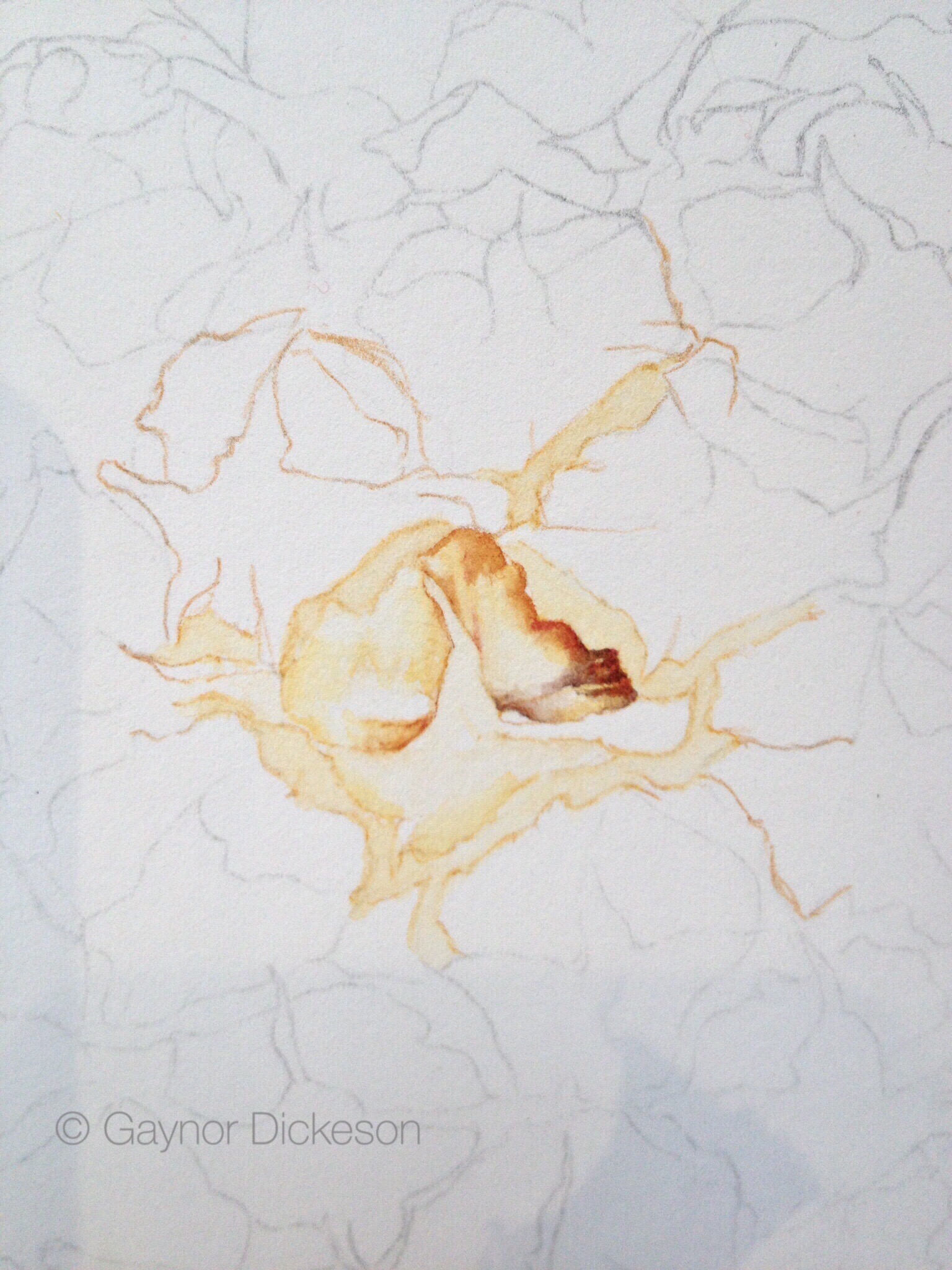
Note the tramlines in a Fibonacci spiral. I observe the lines, draw the crossing tramlines and at each intersection place a segment. Once a tracing has been made, I do a very rough shading on the original sketch to indicate the form of the fruit.

The tracing of the original drawing.

I traced over onto a Fabriano Classico HP 640gsm paper in a manner that I have previously described in one of my blogs. This leaves no indentations from the pencil and is easily removed before painting.

03.IMG_1985


I used a watercolour pencil to lightly outline my segments in an area of the pineapple I can manage initially. When I begin to paint, this colour will be absorbed into the painting avoiding lines. I don’t do too many at once in case I really need to change any of the segments in a later pineapple.


Palmengarten botanical art exhibition – Wednesday last week

A good class this morning and progression with the brochure for the Norwegian botanical art holiday.

I have heard from Sue Henon that we have two further red dots on pictures. I am so glad that botanical art is being so warmly appreciated in Frankfurt. It would be lovely if we could awaken a similar interest in Norway.

Some more pictures. This time they are three pictures by Norma Gregory. I first met Norma when I first exhibited with the RHS. She won another Gold Medal with her fantastic paintings of roots. Amongst others was a Rhubarb plant which I will never forget. The RHS added that picture to their Lindley collection.

Solanum tuberosum 'Potato'. Watercolour by © Norma Gregory
Solanum tuberosum ‘Potato’. Watercolour by © Norma Gregory
Cynara scolymus 'Globe artichoke'. watercolour by © Norma Gregory
Cynara scolymus ‘Globe artichoke’. watercolour by © Norma Gregory
Rosa gallica 'Versicolor' Rosa Mundi. Watercolour by © Norma Gregory
Rosa gallica ‘Versicolor’ Rosa Mundi. Watercolour by © Norma Gregory

But now you are possibly ready for a couple of pictures in a different style coloured pencil than those shown yesterday. These two pictures are by Sue Henon and are on coloured paper.

Hyacinthus orientalis , 'Hyacinth I'. Coloured pencil by © Sue Henon
Hyacinthus orientalis , ‘Hyacinth I’. Coloured pencil by © Sue Henon
Hyacinthus orientalis , 'Hyacinth II'. Coloured pencil by © Sue Henon
Hyacinthus orientalis , ‘Hyacinth II’. Coloured pencil by © Sue Henon


Palmengarten exhibition – Last Tuesday

In trying to catch up my own paperwork today (not that I have succeeded), I have at least put in the forms for the Chichester Open Studio event starting the weekend of the May Bank holiday in 2015. One box ticked off.

Since then I have been putting together my brochure for the Botanical Art Holiday in Norway 28th June to 5th July at Åsgårdstrand, near Tønsberg in south eastern Norway. A beautiful area, with lovely light and very peaceful. The brochure still isn’t finished.

People who might have their pictures returned from Palmengarten after the exhibition are arranging dates with me for collection. That is good as I will want to put my family up for Christmas!

I have my weekday class tomorrow morning and then its back to the grindstone in the shed.

Many of the artworks at Palmengarten have made quite an impression on me and some the artists have helped me considerably on my journey. The pictures that I will show for the rest of the week are a mix of these.

I love working with coloured pencil and although all of these pictures are not CP, the ones I am showing you today are by the artist who first taught me to use this medium – Susan Christopher Coulson.

The fourth picture by Maggie Fitzpatrick is just a picture that stood out for me. It isn’t big and flamboyant, but beautifully delicate. Please enjoy them as much as I have. Sorry they are wonky!


The Dose Makes the Poison - Coloured pencil. Susan Christopher Coulson
The Dose Makes the Poison – Coloured pencil. Susan Christopher Coulson
Medieval Medicinals from an Apothecary’s Garden. Coloured Pencil by Susan Christopher Coulson
Cures from the Potager Garden. Coloured pencil by Susan Christopher Coulson
 Ivy &White Bryony on Horse Chestnut branch. Watercolour by Maggie Fitzpatrick
Ivy &White Bryony on Horse Chestnut branch. Watercolour by Maggie Fitzpatrick

The first Monday of the Palmengarten exhibition

The van was returned to Portsmouth, but this time trains didn’t connect, so I followed Robin in the car. Our drive now only contains our car. The bedrooms are reclaimed, the mess has yet to be cleared up – until we get unsold pics back in a months time.

Up until close of play yesterday, 17 deposits have been made on botanical art pictures painted by SBA members and associate members. Although not necessarily photos of the pictures mentioned above, I am attaching some photos of pictures from the exhibition as they hang in the Palm House at Palmengarten.

Please enjoy.

Digitalis purpurea - watercolour - Gael Sellwood SBA
Digitalis purpurea – watercolour – Gael Sellwood SBA
Colchicum autumn ale - watercolour - Charlotte Linder SBA
Colchicum autumnale – watercolour – Charlotte Linder SBA
Lonicera periclymenum - pen & ink and coloured pencil - Rachel Munn SBA
Lonicera periclymenum – pen & ink and coloured pencil – Rachel Munn SBA
Fragaria x ananassa - watercolour- Yvonne Glennister Hammond SBA CPGFS
Fragaria x ananassa – watercolour- Yvonne Glennister Hammond SBA