Foraging plants in the norwegian mountains – 26. Bearberry Pt. 2

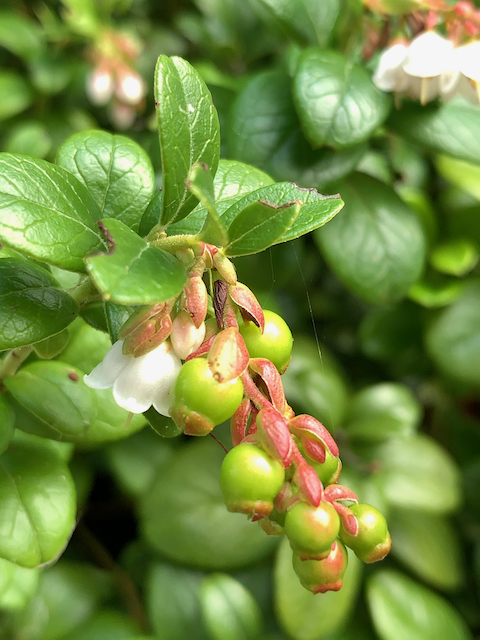
Depending upon where one lives and picks fruit in Norway, some people are not aware of the bearberry and its identification problems. In fact, initially I had real problems finding an example of the bearberry to draw from.

The first find of the Bearberry plant in 2017

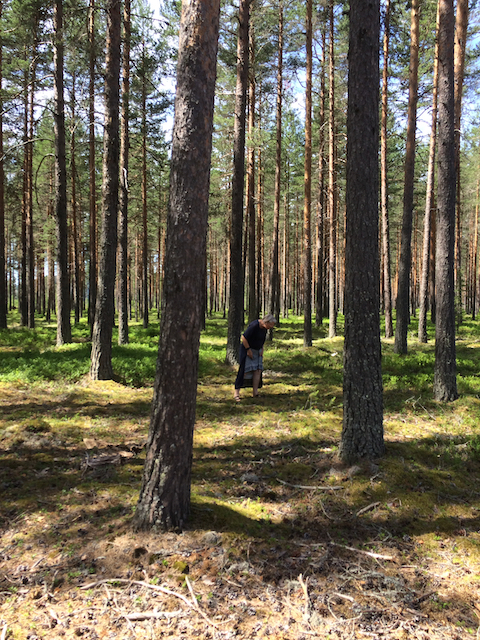
Many years ago I had experienced the misfortune of mixing up the two berries and knew that they could grow in similar locations. But to begin with I didn’t find any near the cottage we had rented. We therefore went on a field trip in the car and drove to an area where I knew they had grown 50 years before. Unfortunately, things had changed, and we found houses instead!

Eventually, in the next valley, we found both bearberry and lingonberry growing together on a sandy forest floor.

The following year in 2018 my poor husband enjoyed a solo 200km return journey to get a sample for me! Fortunately I was using GPS to record the position of every specimen found and he used this to find the forest area.

It was with relief that in 2019 we eventually found some growing very well, close to the main road below our rented cottage up in the mountains. Now I could truly say that all of the plants were from the same area!

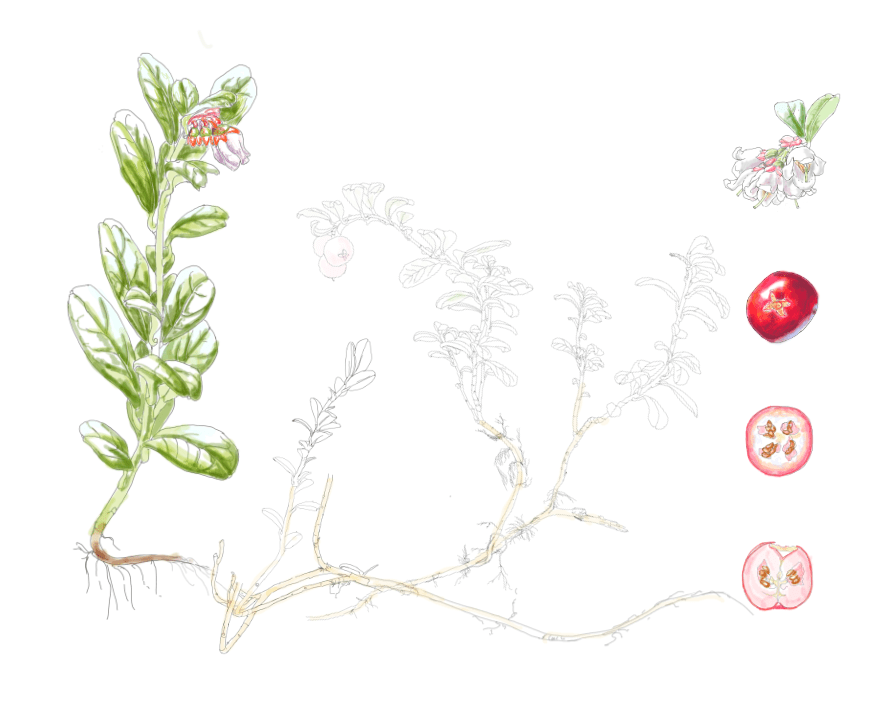
Bearberry sketch from my ‘perpetual diary’

I did quite a few different sketches of this plant and like so many of the  plants in this series, found that it often starts setting its buds in the autumn in preparation for the following season.

I therefore decided to wait until the following year to try and get an immature fruit. As it happens, I had to wait four years until I could get a sample at the right level of maturity. But at least I managed it and got some good detail.

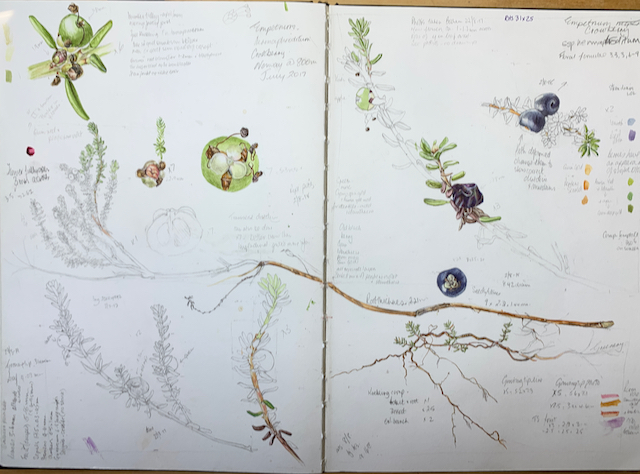
Bearberry sketchbook page. As usual a lot of research found space along the bottom of the page.

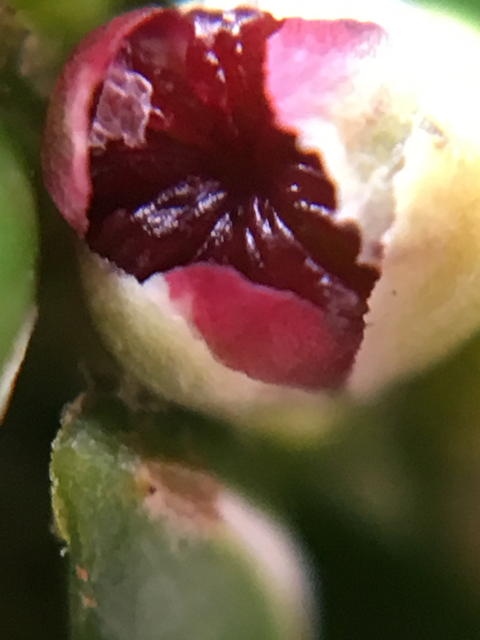
But I think one of the biggest headaches when collecting information was doing a transverse section (TS) of the fruit. The fruit contains relatively large hard seeds, as it is a stone fruit. Carrying out a LS on a ripe fruit was simple as I had no need to cut through any seeds.

But the TS was another kettle of fish! Each seed was about 2.3 mm long and very hard. There was no way I could cut through this without crushing the whole fruit and destroying the chance to draw this section as I had for every other picture. 

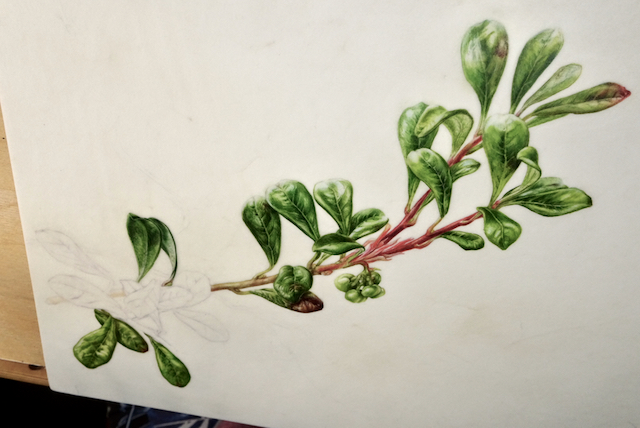
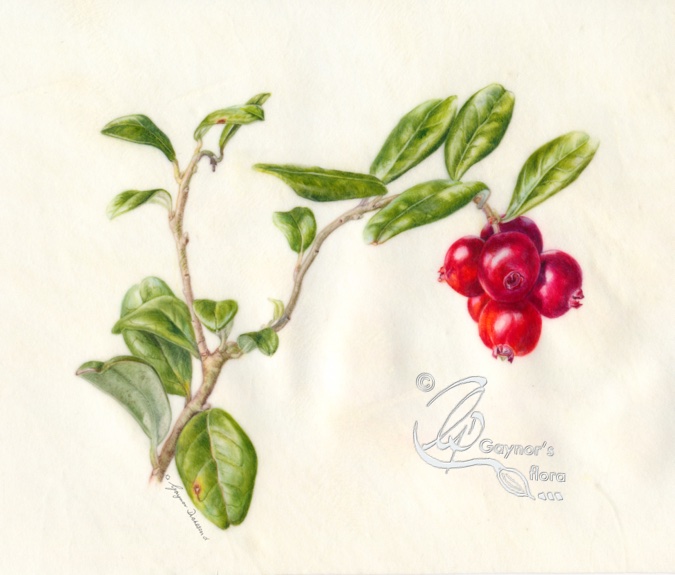
My trial piece on vellum helped me with my colour decisions for the final artwork. I started the sketches in 2017 and in June 2022 I started the final piece, finishing it in October 2022. 
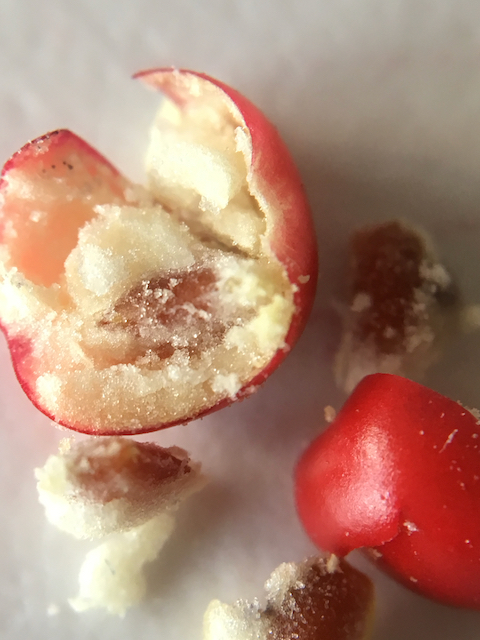
A squashed TS!
Bearberry trial piece on vellum

The native range of this species is Subarctic to N., W. & Central U.S.A. including the UK and Norway.  It is a subshrub and grows primarily in the temperate biome.

Source: Kew – Plants of the World Online

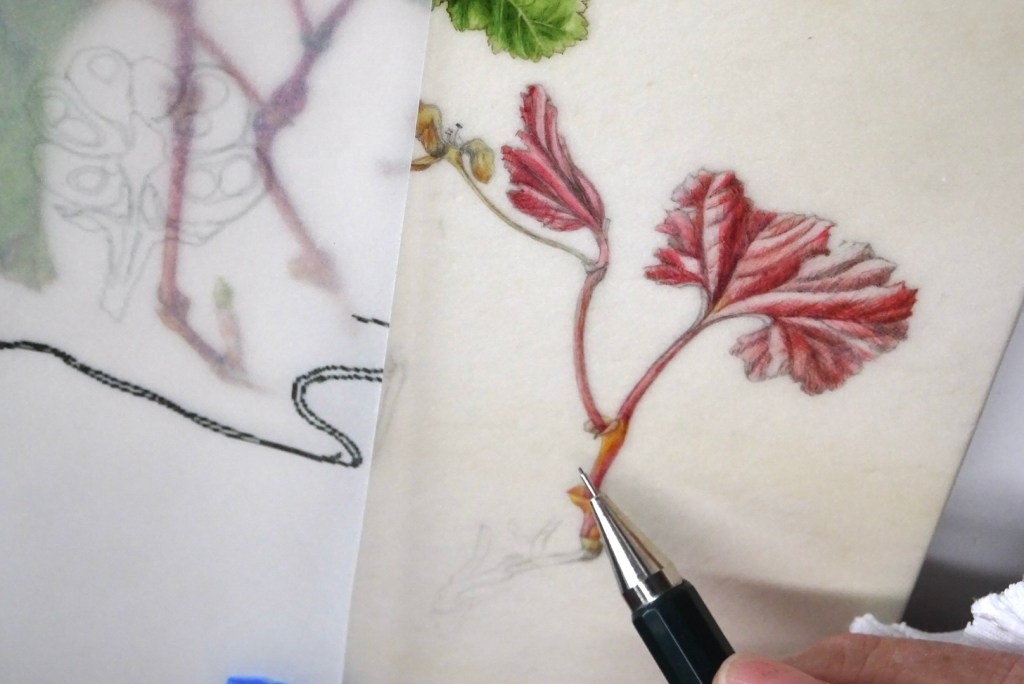
The photos above are a quick reminder of my process for this series. The various elements are traced to the vellum block and sometimes I go over these with a non-permanent watercolour outline. The main branch has generally been completed at twice the natural size and the sections in graphite or graphite and watercolour wash are normally natural size to show habit. Graphite is used to allow these sections to fall into the background making the overall picture less heavy.

Bearberry leaf tea infusion

Pour 150ml of boiling water over 2.5g of finely chopped or coarsely powdered, fresh or dried bearberry leaves and strain after 10 to 15 minutes. If you want to keep the content of tannins as low as possible, prepare a cold-water maceration. To do this leave the leaves in the cold water for 6 to 12 hours, then strain and heat the tea.

Uses

Inflammatory diseases of the urinary tract – NOT KIDNEY problems – “if treatment with antibiotics is not necessary.” Bearberry leaf infusion is classified as traditional herbal medicinal. Based on many years of experience, bearberry leaves can be used to treat symptoms of recurrent cystitis (e.g. burning sensation during urination and/or frequent urination in women), if there are more serious causes or symptoms remain, seek medical attention.

Tea infusion: drink a warm cup of bearberry leaf tea up to 4 times a day;

See https://arzneipflanzenlexikon.info/en/bearberry.php for more information.

Bearberry preserve

Ingredients:

  • 2 quarts bearberries, rinsed and without stems
  • Sugar (see instructions for amount of sugar)
  • 1 teaspoon lemon juice
  • 1 package pectin (about 3 ounces)

Instructions:

Put the berries in a pot and cook over medium heat until soft; about 5-10 minutes. Crush the berries, then run them through a sieve or cheesecloth to remove the seeds. Retain as much of the pulp as possible.

Return the juice and pulp to the pot, adding one cup of sugar for every cup of juice and pulp. Add the lemon juice, mix thoroughly, and heat to a boil.

Boil for a minute or two, then stir in the pectin. Allow the preserves to cool and set.

www.virily.com

My last blog about this series of pictures is scheduled for 15 June 2023. It is the day we get the results of the RHS judging, so I hope to include my result. I will show the final pictures which I have been keen to conceal until the judging process is complete.

Foraging plants in the norwegian mountains – 24. Lingonberry Pt. 2

Vaccinium vitis idea – Lingonberry plants in dry moss.

The reason for even thinking of doing a series of plants like this was because of this plant – Vaccinium vitis idaea (Lingonberry/Cowberry) and the next plant in this blog series Arctostaphylos uva-ursi (Bearberry). They are fairly similar and their habitats cross over into each other’s. So unless you know what you are looking for you can easily make a mistake.

Lingonberry leaf back.

It isn’t a ‘dangerous’ mistake to make, but it can spoil a recipe!

Above is a photo of the Lingonberry in its typical habitat. Both species have leathery leaves as well as similar flowers and fruit. But the Bearberry prefers even drier surroundings than the Lingonberry.

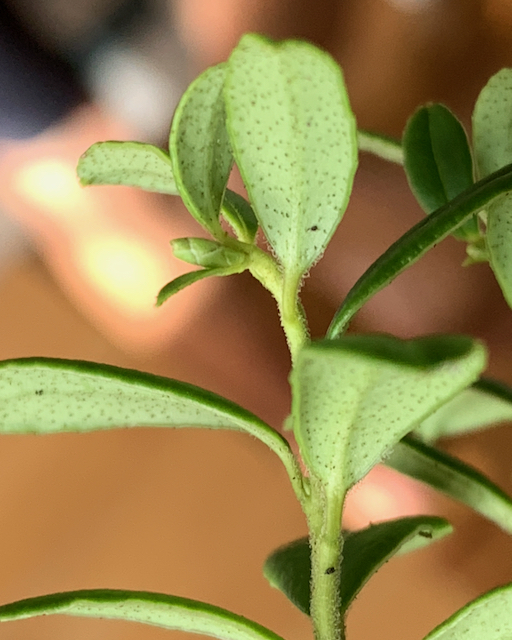
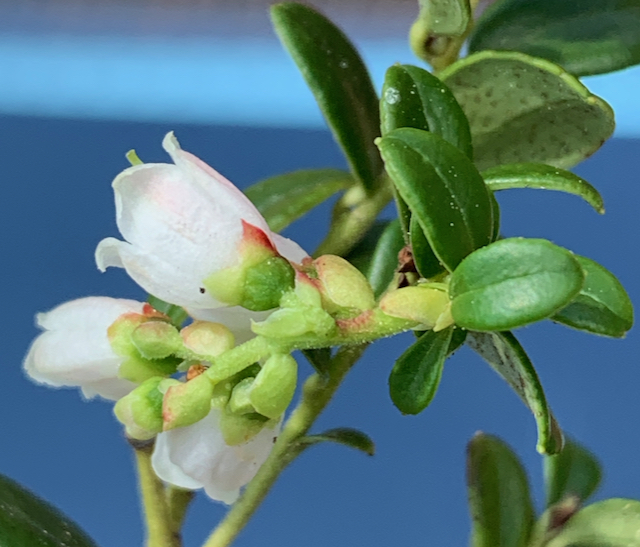
The Lingonberry leaves are oval as you see above, whereas the Bearberry leaves are paddle-shaped; The Lingonberry leaves have small dots on the underside, whereas the Bearberry leaves are finely veined; Both sets of flowers are typically Heather-like, but the Lingonberry flower is bell-shaped and the Bearberry flowers are more urn-shaped. The rhizomes of the Lingonberry sit deeper in the humus than the Bearberry, which are prostrate and limply creep across a surface.

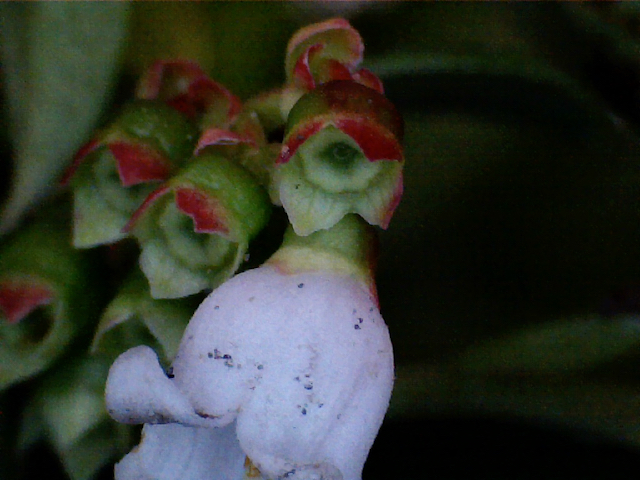
The fruit for both plants are in clusters, but the Bearberry fruit has a slightly flatter spherical shape than that of the Lingonberry. Most importantly the Lingonberry has an inferior ovary (the flower parts arise above the ovary), meaning that the remains of the sepals are at the bottom of the hanging fruit, distal to the pedicel (stalk). The opposite is true of the Bearberry where the calyx (sepals) remain on the fruit around the pedicel. 

Fruit developing. Petals fallen off to reveal shape of distal end of fruit formed with sepals.

If you look at the painted berry at the beginning of the last blog when I started discussing the species, you can see the remnants of the sepals. Compare it with these three pictures showing the development of the flower and swelling of the ovary in its inferior position.

At the end of the previous blog I showed you some of the sketches I did from various Lingonberry plants. Here you see additional ones and you may notice that they were part of the basis for my final artwork.

Below you see my first compositional plan for the Lingonberry picture, but I didn’t really like it. I suppose in this plan I wanted to avoid painting so many small, but detailed leaves. As you now know they have several diagnostic elements to them, but at the same time are quite shiny. The composition just didn’t give me the right ‘feeling’ of the plant.

One weekend I had been out picking fruit with my daughter and we were discussing the way the plants grew and the impression they gave. We again looked at my planned composition and she suggested I replace the flower on the stem with a fruit cluster.

That was the answer – the series emphasis was about the fruit. I decided to do a trial on vellum of the new piece of stem with the berries and this became the basis for the final composition.

My first sketches of this plant were done in March 2017, but I didn’t start painting the final picture until October 2022 (after harvesting), finishing December 2022. Because this plant is not deciduous, it allowed me to work on the leaves right up until the first fall of snow.


The native range of this species is Subarctic & Temp. Northern Hemisphere including the UK and Norway. It is a subshrub and grows primarily in the temperate biome.

Source: Kew – Plants if the World Online

The species in my next blog scheduled for 8 June 2023 is the Bearberry, favoured by bears when they wake up from their hibernation – or so I am told.

Eva’s Raw Lingonberry Jam

300g Lignonberries

100gm sugar

Blend together the berries and the sugar until berries well macerated. If possible let it stand for few hours in the fridge before being used.

Eva Biringvad gave me this recipe and sent me on a ‘no-return’ journey. Her father made the most delicious bread, so we ate chunks of his bread with sour cream and the raw lingonberry on top. Delicious!

This is also used with meals instead of Cranberry sauce – and it is much nicer.

Foraging plants in the norwegian mountains – 20. Mountain crowberry Pt. 2

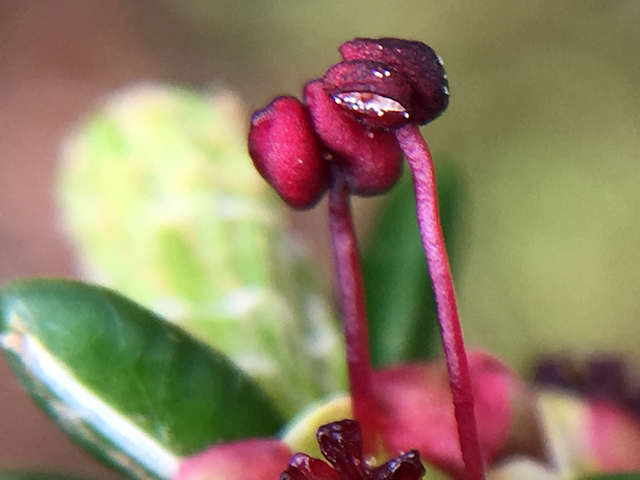
One day, I woke up to find that the male part of the flower which projects an anther over the flower, had been eaten off. I was lucky enough to find other buds I hadn’t noticed before and managed to keep the eating insects away until the stamens shrivelled up of their own accord. This allowed me to complete the picture as I had hoped.

Of course this process was so exciting that it kept me motivated to paint all the tiny leaves!

I used quite a bit of my sketch page information in the final artwork, even the small immature berries I had found when starting to sketch in July 2017 and the trial piece on vellum.

Working out my composition and creating line drawing to trace over.

 When researching more on this plant recently, particularly in relation to its use in food, I discovered that although the berries are edible, apparently there is a potential for the leaves to poison the immediately local environment, making its own habitat more secure; the jury is still out on this question but it is wiser to leave the leaves alone.

But, the berries are fine and because the seeds are quite big and the skin quite tough, it is used mostly for juice, either cooked or raw. Additionally, it is suggested that whilst out walking in the mountains that picking and chewing the fruit is very thirst quenching. I will have to remember that.

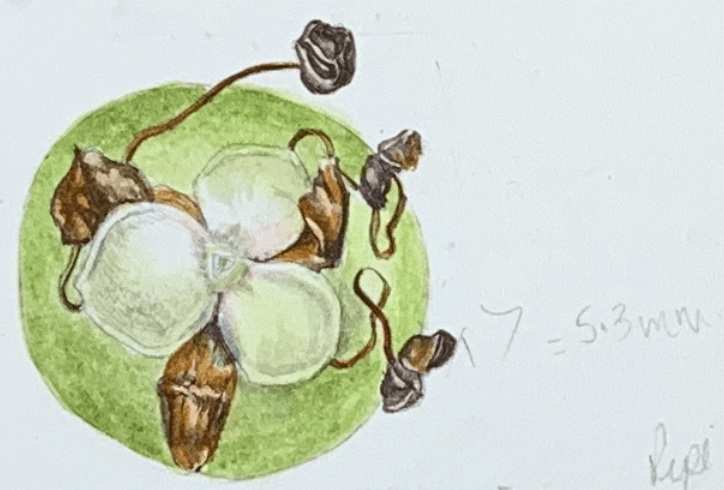
Unripe fruit. Actual size 5.3mm

One sketch I didn’t use in the final artwork was this one from my initial drawings. It is very interesting but, in some respects, didn’t give any more information to the final picture. It is an unripe fruit, enlarged (the original fruit was 5.3 mm across), containing the sepals , the remainder of the female flower and the shrivelled stamens. Compare this with the ripe fruit at the beginning of the previous blog where the same parts are also just visible.

The native range of this subspecies is Subarctic to Subalpine Northern Hemisphere including Great Britain and Norway. It is a subshrub and grows primarily in the temperate biome. 

Source: Kew – Plants of the World Online

Having collected enough data and sketches, I started painting the final picture on vellum  August 2021 and finished it January 2022.

recipies

Mountain Crowberry jelly

Crowberry contains little pectin. This means that it is difficult, if not impossible, to make Mountain crowberry jelly based only on the berries. To get Mountain Crowberry jelly stiff, mix the berries with other types of berries that are rich in pectin, for example lingonberries. It is also possible to mix with apples, which contain a lot of pectin or gelatine sheets.

3 dl raw mountain crowberry juice (see recipe below)

Juice of a lemon

1-2 dl water

6-7 sheets of gelatine

  1. Soak the gelatine sheets for 5-10 minutes. 
  2. Pour off most of the water and dissolve them in a small amount of warm water. 
  3. Mix the cold Mountain crowberry juice, lemon juice and water. 
  4. Whilst continuously stirring, slowly and carefully pour the juice mixture into the melted gelatine. 
  5. Pour into clean small glasses. 

This is an excellent accompaniment to venison.

 Raw Mountain Crowberry juice

This is a fresh and colourful juice but not very durable, and requires a lot of sugar and a cold storage place. It is easier to freeze the juice in small portions and thawed when needed.

 1 kg Mountain Crowberries – or the amount picked.

5 dl boiled and cooled water – equivalent 1:2 of berries

10 grams of citric acid – 25-30 gm per litre raw juice.

750 grams of sugar per litre of raw juice

  1. Rinse and crush the berries well. 
  2. Put the berry pulp in a large bowl or bucket, and add pre-boiled, cold water and citric acid. 
  3. Leave the mixture covered and chilled overnight.
  4. Pour the mass into a strainer and let the juice drain well. 
  5. Measure the amount of juice and add sugar. 
  6. Stir well until all the sugar has dissolved. 
  7. Skim and pour it into clean bottles/containers.

Can be mixed to taste with water – or something else. 

The next blog will be 28 May 2023

Foraging plants in the norwegian mountains – 14. Cloudberry part 2

Rubus chamaemorus – Cloudberry -Multe

Planning the artwork.

The piece of mounted vellum I had ready was 25 x 31 cm and I had seven mounted blocks all the same size. Finished, they needed to look like one series of pictures, but the Cloudberry was a plant so unlike the other ones. The element that linked was the habitat. As an example, I only found the Vaccinium microcarpum when following the rhizomes of the Cloudberry because the roots were completely intertwined.

Once I felt I had all the information I needed for each subject, I scanned the sections and manipulated them with editing software on my computer. I then compared them so that I knew each picture had similar information. The Cloudberry was the only one that was Dioecious. The series was about the fruit, so it was these that were prioritised, although I did include pictures of the flowers. 

Because each cloudberry plant was either male or female and had male or female flowers, I needed to show the differences. The male flower is generally slightly larger than the female and the centre of the flower is completely different. 

The male flower. Stamens in a ring at the base of the sepals. the centre is concave.
The female flower. A ring of false, white stamens around the centre with several pistils arising from the centre.

Both male and female flowers have the same number of sepals and petals, but the male flower has a ring of stamens round the base of the petals, with the very centre dipped and smooth. The female flower displays the gynoecium (female reproductive organs) with a ring of white, false stamens round the base of the petals. 

From a distance and once you know what to look for, it is easy to tell the difference between a lot of male or female plants.

This sketch page shows more cloudberry sketches (with additional ones from the small cranberry). You will find both the deep red male plant and the sketches of the small cranberry in their respective final pieces of artwork.

In 2018 when these sketches were done, the summer had been hot and tough for the plants. The Cloudberries ripened very early and by the time we arrived they were long gone. All that remained were some dry leaves and soggy berry remnants. But the sun had really worked well on leaves in the open, changing them from lush green to orange and fiery reds.

More sketches including the two berries we were given in 2018.

Once I had decided which elements were important for the picture, I did line drawings and moved them around digitally until I felt reasonably satisfied with the arrangement. Of course, in some instances adjustments were necessary and easily done on the computer. The line drawing composition above was almost the last one I made whilst well into the artwork.

In my final artwork I used several sketches as a basis. The sketches are used as a template whilst painting from an actual plant. Having the plant in front of me for the final artwork, enables me to paint its portrait as I see it, getting its botanical detail right at the same time as conveying texture and three-dimensionality. These are all things not easy to do from a photo.

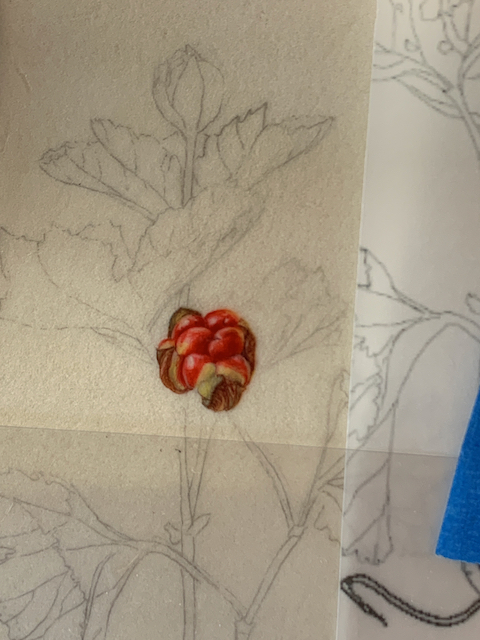
I traced the whole composition to get the placing correct on my mounted vellum block, then each element was traced onto separate pieces of paper.

The vellum needed protection as I worked, and I used one of the old tracings that I had no use for, plus a clear acrylic sheet. All surfaces against the vellum are completely clean.  

Once the image is traced over to the vellum I lifted off much of the loose graphite from the transfer process. I generally start with a pale wash, allowing this to dry completely, then remove the remaining graphite. I continue painting with a dry technique being sure to lay this very lightly.  

Sketching was started in June 2014, the final artwork on vellum started July 2022 and finished in August 2022 except for the scalebars. 

Cloudberries are a circumpolar boreal plant, occurring naturally throughout the Northern Hemisphere including the UK and Norway, although there is little fruit produced in the UK.

Source: Kew – Plants of the World online

Cloudberry cream recipe

This recipe for ‘Mountain Gold’ is served on very special occasions including Christmas. It is served with cakes/biscuits often made in the period leading up to Christmas. Many of the recipes include almonds .

500ml whipping cream 
2 ss sugar
2 ts vanilla sugar (see recipe at end)
300ml Cloudberries

  1. Whip the cream together with the sugar until light and fluffy. 
  2. Stir in Cloudberries and sprinkle with vanilla sugar to taste.
  3. Place in the fridge until serving.
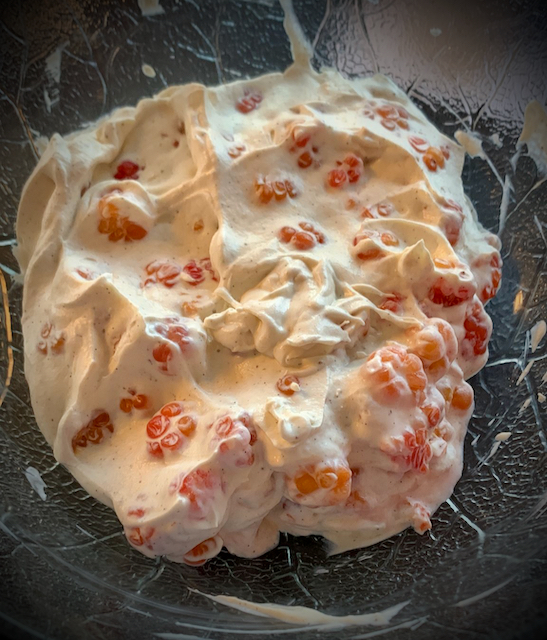
Serving:
Extra Cloudberries, Shortcake Biscuits

(from https://www.detsoteliv.no)

Vanilla sugar (vanilje sukker)

2 Vanilla beans

300gm sugar

  1. Split the vanilla beans in half lengthwise and scrape out the seeds. 
  2. Put the seeds into a blender with the sugar. 
  3. Blend with the blades until the sugar has become completely fine-grained and well mixed. 
  4. Put it into a glass with a lid and add to recipes as needed. 

The next blog post about the Small cranberry will be on the 7th May 2023.

Foraging plants in the norwegian mountains – 11. My working practice

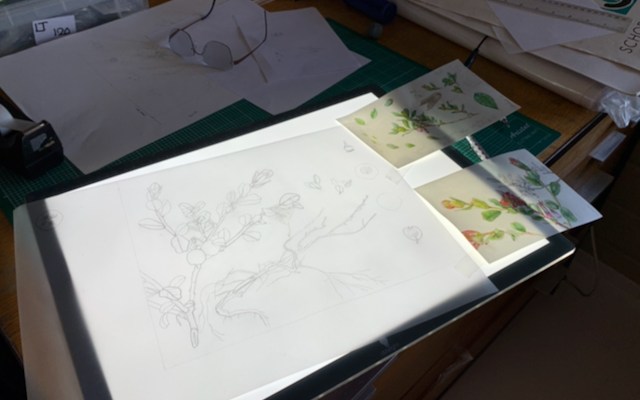
Using a lightbox to make an overall transfer for the bog bilberry picture.

Transfer process

For this series my transfer process hasn’t been very straightforward. Once I knew which sketches I wanted to repeat in the final artwork, I made line drawings of each, scanned them and arranged them on my computer, constantly comparing and assessing. Once I was happy with each composition, I traced each sketch into its place on a sheet of tracing paper (see picture at the top), then transferred the composition to a vellum mounted block. In some instances, I continued to make further adjustments underway.

I also made separate tracings of each element in the design and used these once the overall placement was sorted.

To make a transfer I trace the line drawing onto the right side of tracing paper, and then repeat the process carefully and with a sharp pencil on the backside of the tracing. This allows me to use the tracing several times should it be necessary and leaves only a light line of graphite on my artwork. 

This way of transferring reduces the amount of excess graphite that tends to float around. The pictures to the left demonstrate the transfer process. 

See links to videos and blogs giving more detail on my ‘Online Tutorials’ page. https://gaynorsflora.com/tuition-2/my-tutorials/. ‘How to trace an image to art paper’ contains links to two blogs and a video.

Painting process

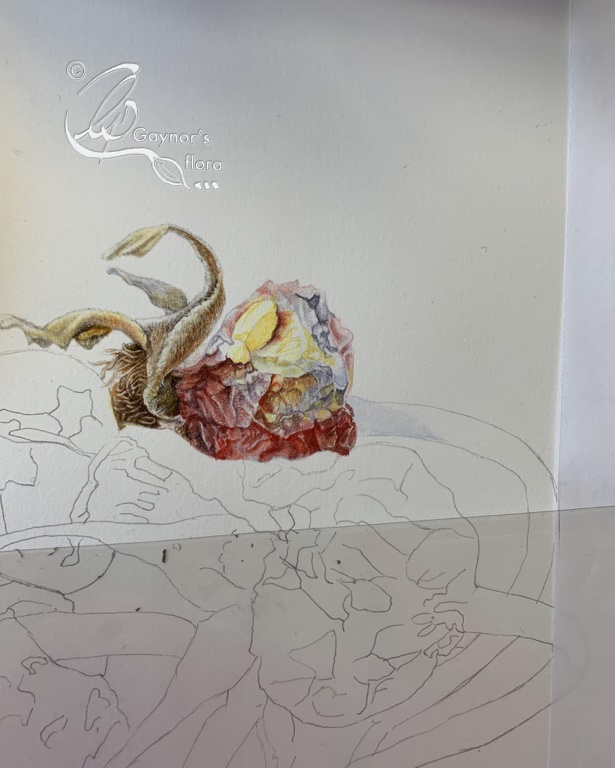
Before I start to paint, I arrange some form of cover so that only the section I’m painting is available to me. I might use a sheet of tracing paper, layout pad or clear acrylic sheet – or even a combination. Its easy for accidents to happen, the slip of a brush  or even dropping a laden brush onto the artwork. Accepting this and preparing against there being too much damage is essential for a good result. I have spent time scrubbing out mishaps and I’m sure many others have too.

Bog bilberry covering to protect rest of artwork from splashes and dropped brushes!

Here is my covering for the Bog bilberry picture. I have used a combination of acrylic sheeting and layout paper whilst trying to avoid too much taping directly to the vellum.

Painting on vellum

Painting on vellum is very different to painting on watercolour paper as the pigment lies on the surface rather than absorbing into the paper. Therefore except for the very first layer it is important to paint as dry as possible, otherwise any other layers will lift the preceding layers.

Arctic Tern fired on Ceramic. From an island reserve in the Stavanger fjord in 1989

In some respects, it is a little like painting several layers on porcelain – as I did in the 80’s. Porcelain is very smooth and carefully layering colour on top of an un-fired layer is paramount, or the lower layers are whisked away.

For painting on vellum I use a variety of brushes depending on the level of detail. My first ‘go-to’ brush is a Rafael Kolinski sable brush with a beautiful point; series 8408. The other makes of brushes I use are DaVinci 1505 and Rosemary brushes series 8 and 66. They are all kolinski sable. To lift out I use various synthetic brushes. 

Importantly for all these brushes is a curl free and sharp tip. Brushes wear quickly and the long tip disappears gradually – but the brush still has many useful functions, so they almost never get thrown away.

The watercolours I use are all artist quality but from different suppliers. Most are single pigment and transparent. I have occasionally used Chinese white as an underlay in areas where I need to control ‘lifting out’ as in the Cloudberry flowers.  When lifting off it might leave  a very slight sheen. If I don’t lift the Chinese white off, it mixes with the other colours and dulls them, therefore I have to lift off very carefully to create highlights.

In my next blog I talk a little about the opportunities I had to learn about applying graphite to vellum – That is planned for 27 April 2023.

This is a very short YouTube slideshow from a demonstration I made to some of my students when they were learning to paint on vellum. I painted the tiniest of crab apples on a vellum remnant.

Outside my comfort zone

I love painting small plants; plants that seem insignificant but are beautiful and worth noticing.

I love the challenge of painting the detail of these small plants so that everyone gets a chance to admire them and perhaps look out for them whilst out and about.

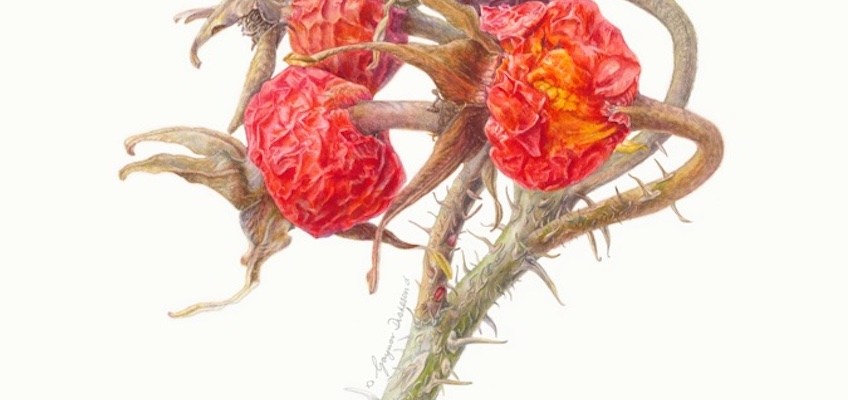
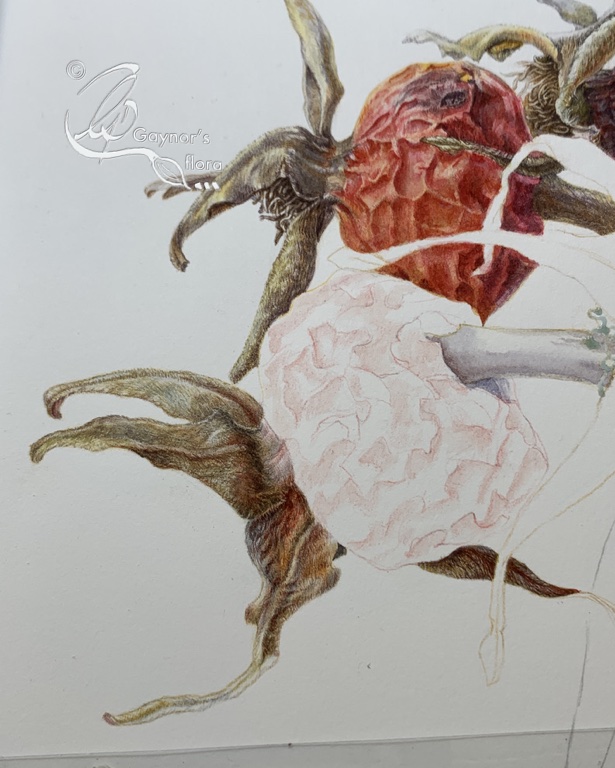
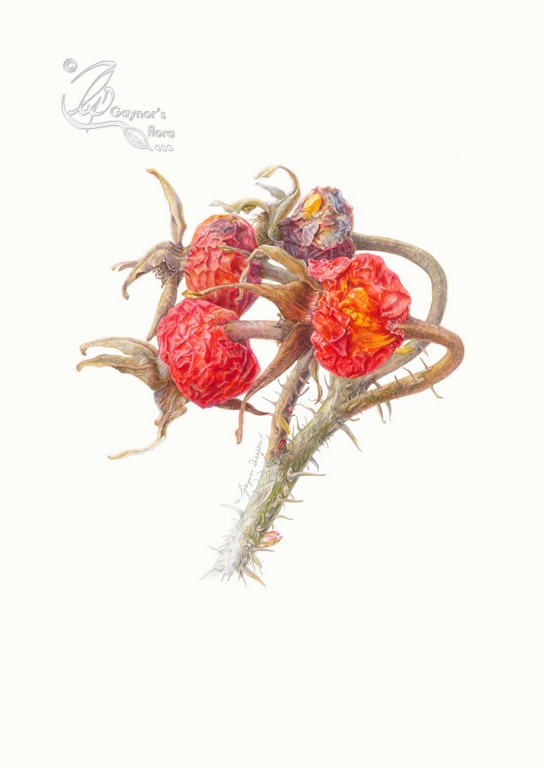
One day I was walking near the station in Tønsberg, Norway and saw some shrivelled Rosa rugosa hips in the snow. I picked one little branch thinking I might paint it on vellum. However my daughter thought I should accept a challenge outside my normal comfort zone; She felt I should portray it much enlarged on paper.

The thought of doing this felt very uncomfortable as I have noticed that some artists who suddenly go large do not increase the amount of detail and the picture doesn’t do the plant justice. I have drawn and painted parts of some compositions scaled up so that the viewer can actually see the detail, but have never done a whole painting like this. Was this going to work for me?

Sketching the Rosa rugosa

I started sketching the hips into my sketchbook, then once I had a good line drawing I transferred this to my Fabriano paper; Luckily I have quite a lot of the ‘old’ batches of both Artistico and Fab 5. This is done on Artistico Extra white.

Ready to start painting

You can see here that I really look after my paper whilst painting. It is so easy to get splashes or ‘dropped brush’ marks if one isn’t careful.

I normally cover the art paper with layout paper hung from the top. Then I cut it into about three strips so that I only have the part I’m painting, uncovered. On the lower part I tape clear acetate.

First stage of painting

I always lift out the graphite tracing before I start the first layer of paint and lay the clearest colours first. However, in this picture I decided to lay a neutral tint wash(made of three primaries) under my colours to indicate the direction of light and form.

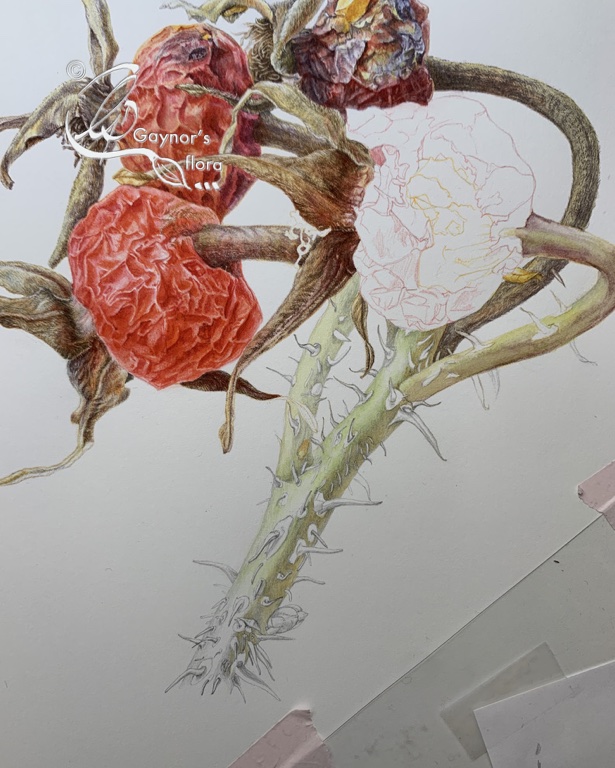
For the next rose-hip in the bunch of four, I decided to replace the graphite outline with a watercolour pencil. I sometimes do this if I am a little unsure of where I am going in the painting, but I use only a pale colour. I lift off the excess pigment with a putty rubber and using a slightly dampened brush I soften the watercolour pencil edge making sure no water goes outside the line of my subject.

… And so the third rose-hip….

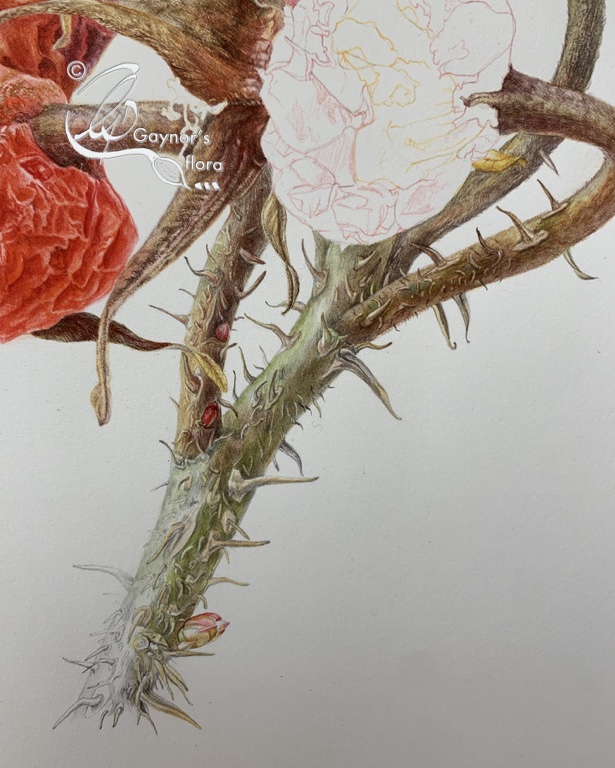
I wanted to do some of the picture in graphite, leading into the main part with the hips. Sometimes using graphite towards the background can reduce the heaviness of a picture. The stem of the Rose-hip is very prickly and therefore doing some of it with various graphite pencils made sense. I used graphite along the whole length of main stem and then colour washed part of it.

I did this picture five times life-size and it comfortably fits an A3 sheet of paper. Does it succeed?

One final comment; Rosa Rugosa grows everywhere in southern Norway and it is not a native species, therefore they are being removed wherever possible. This is because they take over the habitat from other species that belong here. I remember with shame that I was one of those people in the early seventies who planted a Rosa Rugosa hedge in the front garden – across the fjord from where I live now. My children were small at the time and I knew that the hips provided a lot of Vitamin C. But I know now that it is not a good enough reason to introduce a foreign species.

Dying Rosa rugosa

The Blackberry on Vellum ‘take-outs’

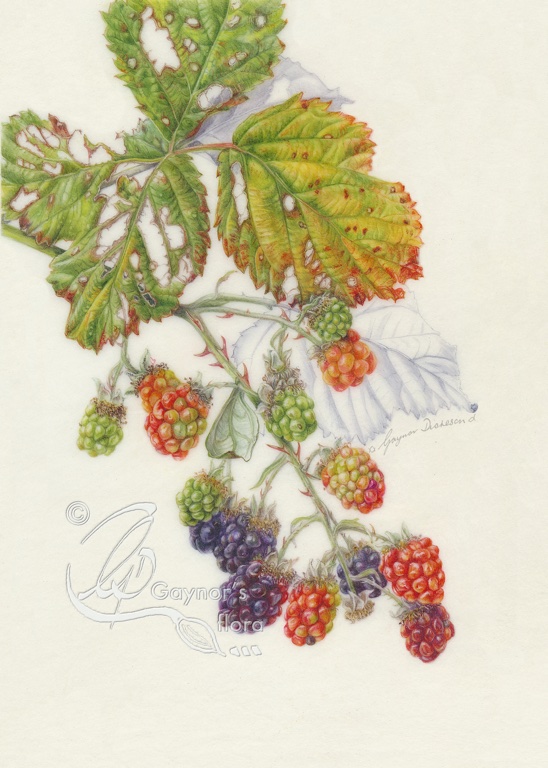
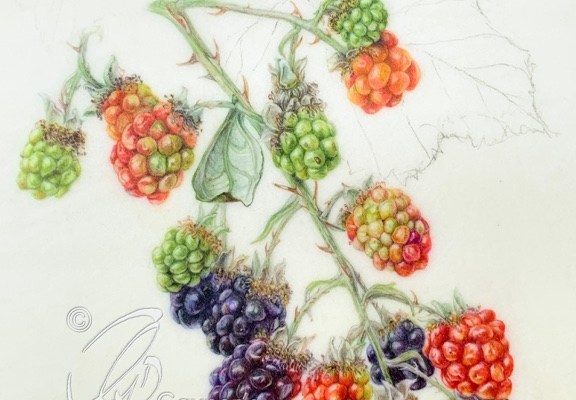
The finished ‘Autumn Blackberry Branch

This blog is about all the mistakes I made whilst painting the Autumn Blackberry Branch on vellum. Above is the finished piece.

Since I started working on vellum I realised that there is a huge difference when working on the different types. This applies both to painting on the vellum and the ability to take things out.

From watching some artists who paint on vellum, they always seemed to use pumice to prepare the vellum. But each time I used this and however gently, I found it more difficult to paint on the surface afterwards and therefore to get a nice smooth result. Even when cleaning up after a mistake, I found it very difficult, but thought this was me!

Early in the year I did a workshop with Denise Walser-Kolar and the first thing she said was that vellum bought from Cowley’s in the UK, is so well prepared that it doesn’t need any preparation; i.e. no need to go over it with pumice.

The biggest difficulty is conveying grease from your hands if you handle it too much. But think about it; one doesn’t handle art paper either if one wants a good result, so why would one need to handle the vellum any more?

Just this little bit of advice has made all the difference to me. Not only do I try to avoid mistakes(!!), but if I do make one I am as gentle as possible with moving the offending pigment.

I will be painting on natural vellum when I do my RHS series and it is definitely more difficult to remove some pigments from this, than to remove from Kelmscott vellum. The blackberry is on Kelmscott vellum and I had absolutely no problems lifting any of the pigments from this. But I had to be very careful and not use more water than necessary. Even being careful, I could still ‘feel’ a slight difference when re-painting these areas.

I found that the mistakes I made were in relation to overdoing it or painting with too thick a layer because I wanted to darken something. In each instance, when I got to the stage I felt I had overdone, I took out the offending part with dampened cottonwool buds. I then painted the whole section again being very mindful of why I was doing so. All the time I said to myself, ‘gently does it’ and ‘the more thin layers, the better’.

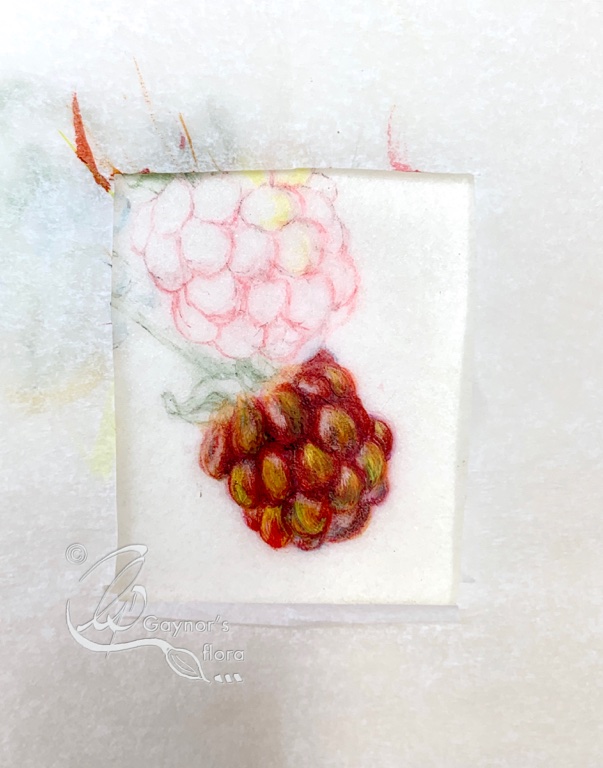
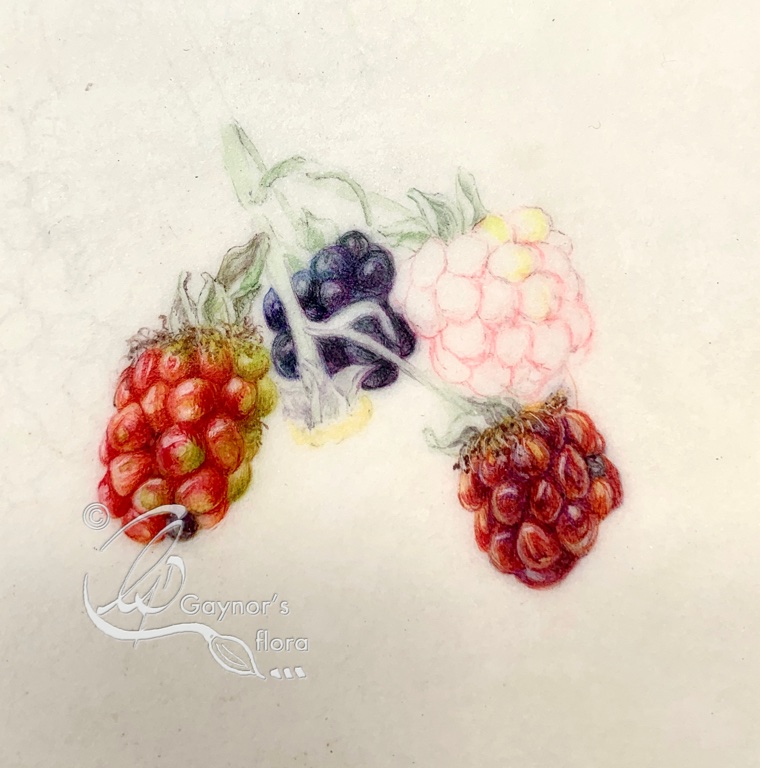
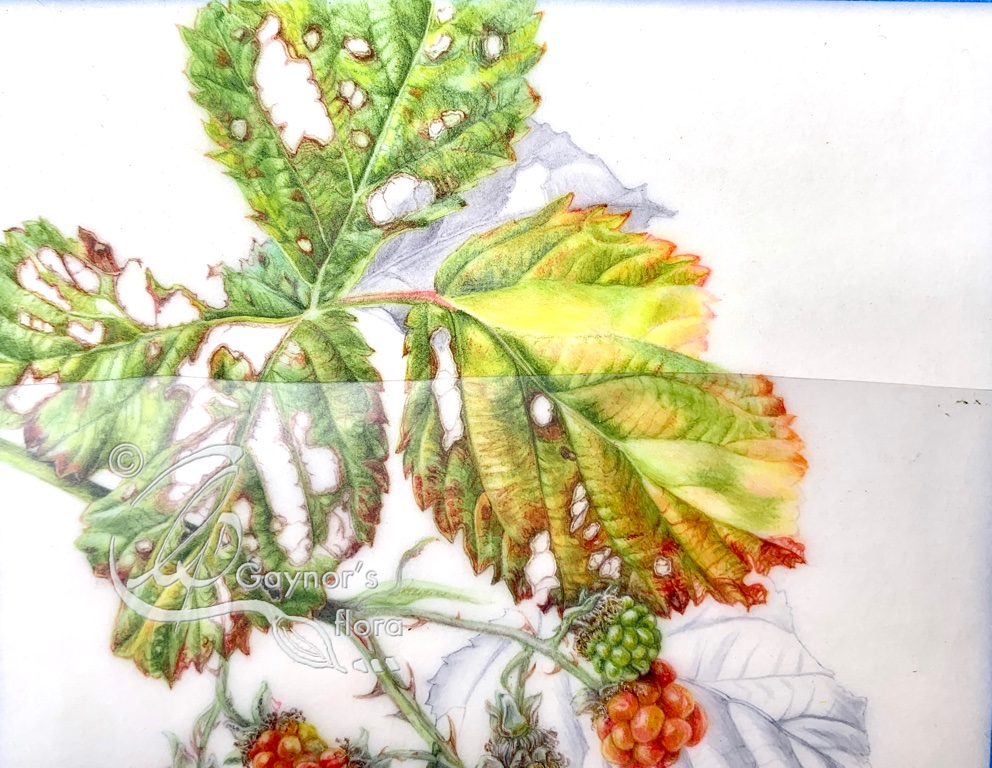
These are the before and after sections. With some, you may think there is no or little difference, however a photo may not always show what I can see with the naked eye (and glasses!).

Hopefully this will be useful and an encouragement to those starting out on vellum.

Before

After


Before

After


Before (1st attempt)

After (Third attempt)


Right side of leaf before.

Right side of leaf with two upper sections removed and the first section re-done.

The offending sections are redone.

6th part of the Blackberry on vellum story.


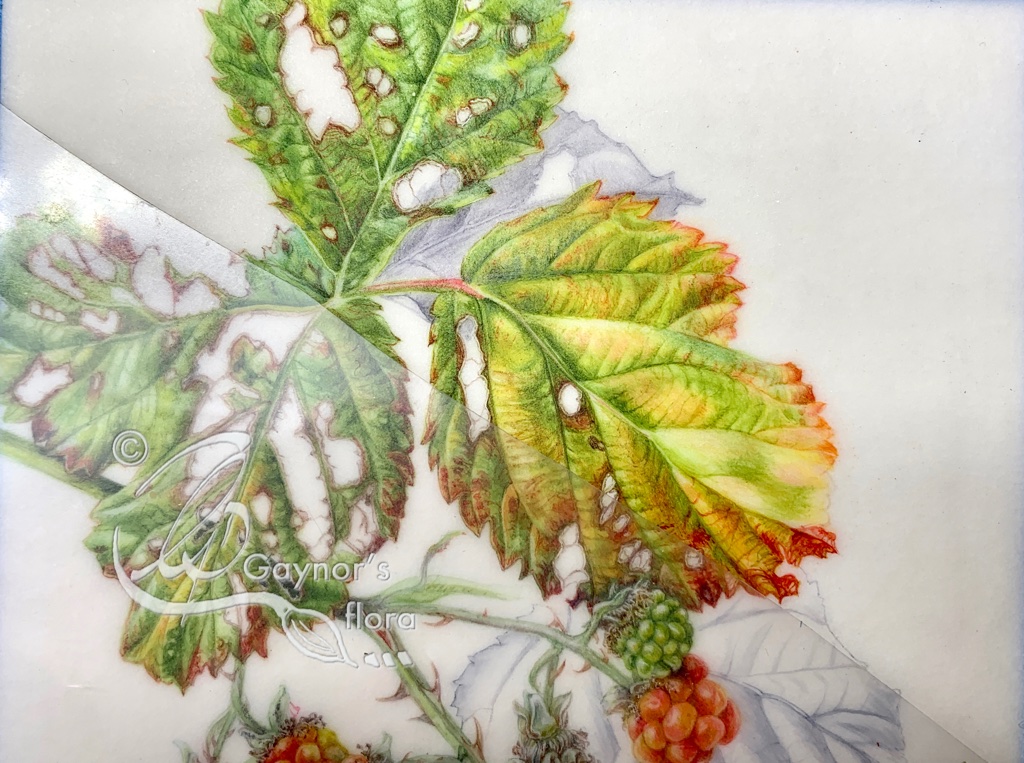
Painting the leaves

I am told that often people hate painting leaves. But the leaves on the Blackberry are really exciting to paint.

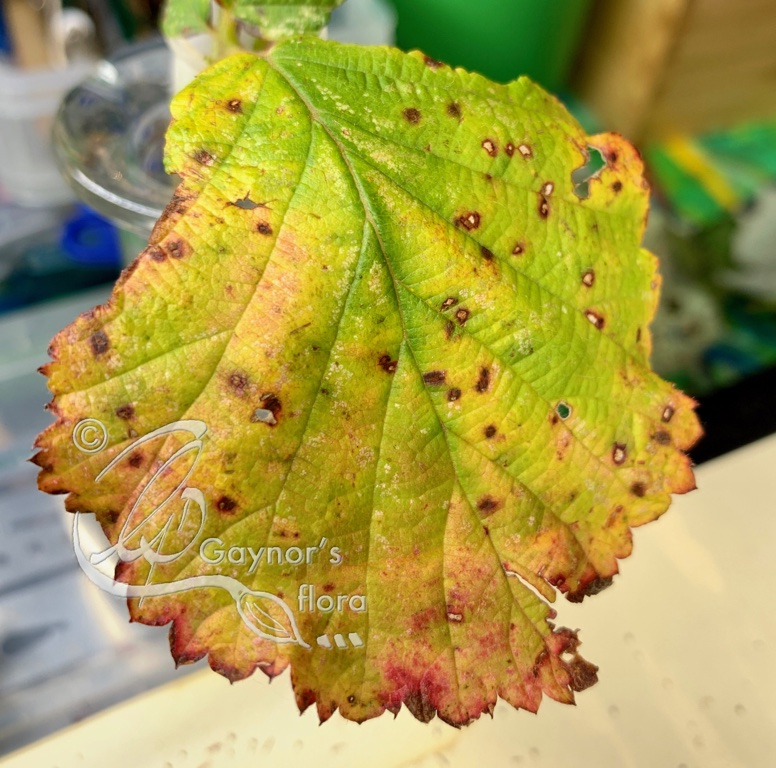
The original set-up for this picture had green leaves, although partly eaten up by various bugs. As it has been a few weeks since I started this picture, I needed to find some replacement leaves, which I found from the same plant; they were really beautiful. This picture is one of the new leaflets showing the colouration I introduced into the leaf set I had already drawn. The other two leaflets remained predominantly green.

When painting on vellum, one of the things I was taught was to keep the first layers of colour as pure as possible. The reason for this is somehow obvious, although I often forget in my haste; it is easy to dull colours, but it is not easy to restore them to their original brilliance.

But it’s not just about colour; for best results the brush needs to be as dry as possible so that the pigment is laid finely with the very tip of the brush.

The technique for painting on vellum is similar to the purely dry technique (as opposed to wet-on-wet or dry-on-wet) used when painting watercolour on paper.  Even better, the paint is laid using a cross-hatch stroke in many layers when painting on vellum. This is a necessity if wanting to achieve a depth of colour (particularly dark colours) without getting a thick layer of paint that is visible when viewing the picture at different angles.

By the way, I use a brush with plenty of body to hold the pigment and an exceptionally good point; normally a Rafael 8408 size 4. But Rosemary brushes series 8 also work well, this time no smaller than a size 2 even for the finest detail.

Below you can see the steps I took when painting the leaves.

Next time, I intend to show you the mistakes and take-outs I made. Making mistakes is where one learns. Learning to deal with them is as important as realising you have made them. The ideal is of course not to make them in the first place; but that comes with time!

This slideshow requires JavaScript.

My next workshop in Bosham is ‘Hedgerow Colour’ 27-28 September. Get in touch via the contact form below quickly if you would like to join us. If you would like to follow my blogs, put your email address in the ‘Follow’ section on the right hand side of this page.

Go back

Your message has been sent

Warning
Warning
Warning
Warning

Warning.

5th part of the Blackberry on vellum story.

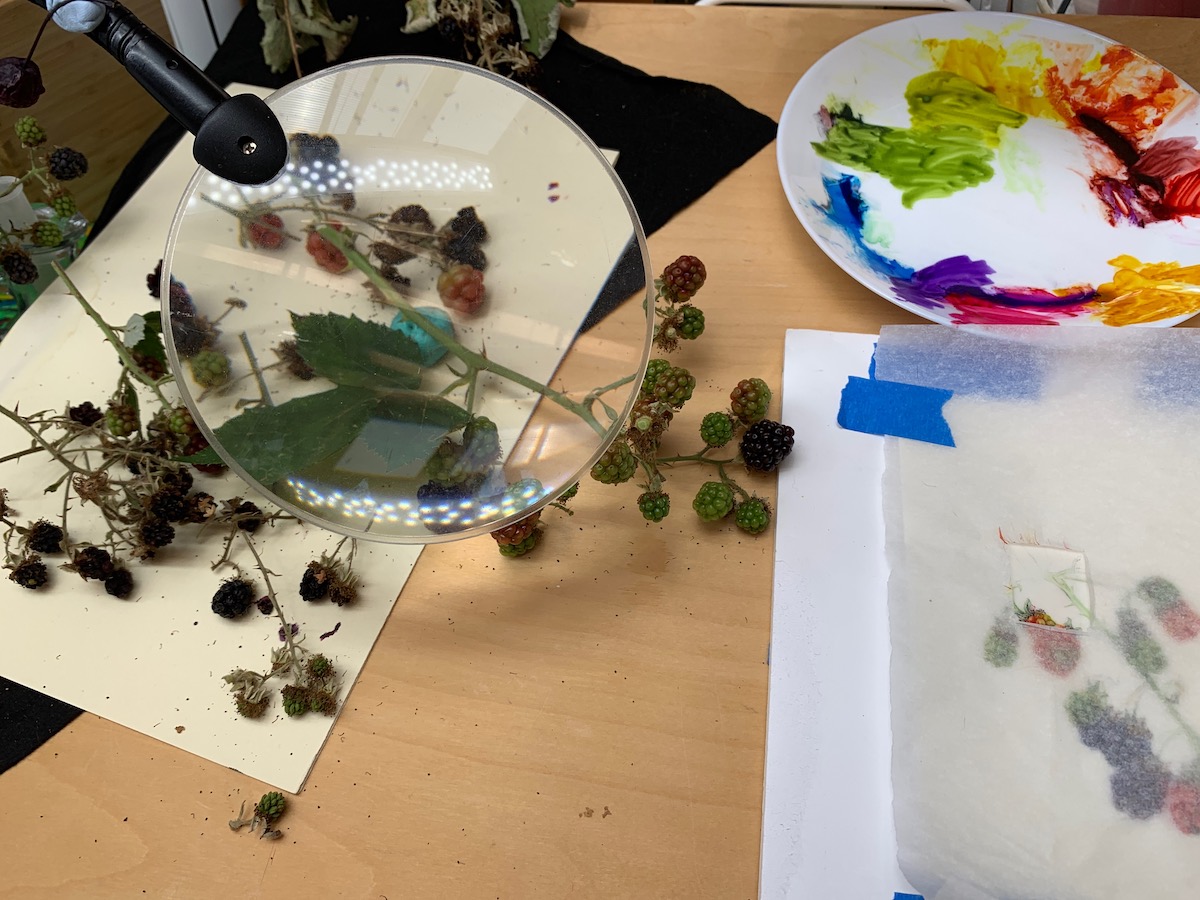
This is not a pretty sight; It is my desk easel at this stage of the painting.

I haven’t disposed of the original stem or leaves, nor the the additional berries used underway. As I said before, once part of the subject is past caring, I replace it with a fresh sample. There have been many fresh samples so far, therefore, although the set-up looks similar, the details are not. You will see even more when I get to the leaves!

But why have I kept onto the old berries? Because, every one is different. The arrangement of the drupelets is different even though they follow the Fibonacci pattern. They also contain different numbers in each berry. I might want that information at a later stage, even though the berries have dried out.

The picture also shows how I check the connections on my plant. Under the magnifying glass is the connection between a branch, a new stem and the adjoining leaf. The sample is in the opposite direction to my drawing, so I need to transpose the information as I paint. It’s no good me turning the stem over as the information is different on the other side.

You can see the developing painting on the right and my refreshed colour palette as well.

This time I will finish the blackberries and make a start on the leaves.

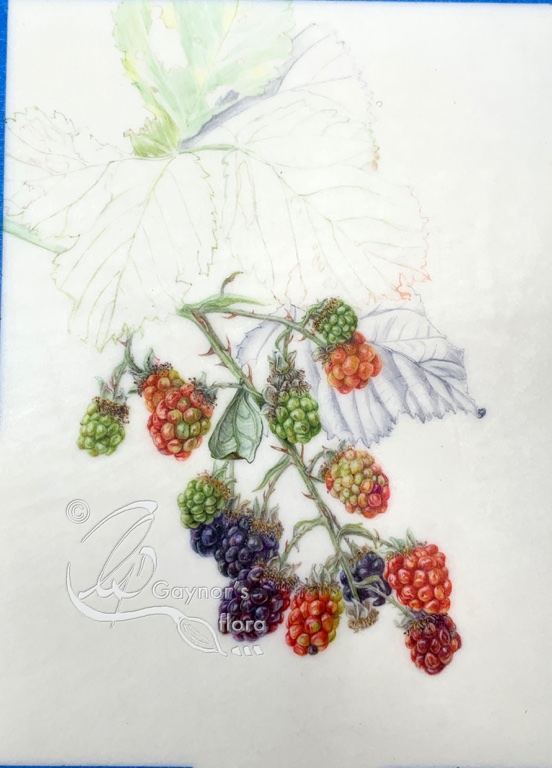
If I had been doing this on paper, I would have used graphite for the leaf right in the background, but it doesn’t look so good on vellum. Its a useful exercise as I will be using something similar when I do my Norwegian plant pictures for my RHS exhibit.

I have been trialling different methods and different pigments. For once I realised that graphite was not good enough for what I needed, I knew I would have find a pigment I felt I could use in a controlled manner. So which pigment should I use? I tried Daniel Smith’s ‘Graphite Grey’ and several natural earth pigments by several manufacturers, but each time the pigment felt too sticky for what I wanted to do with it. I needed to get a consistent fine line and be able to do delicate monotone shading. In the end I reverted to my own neutral grey that I often make using Perylene Violet and Maimeri’s Cyan; the latter is the same pigment as W&N Blue, green shade and works well for me. I can vary the grey from cold to warm and very pale to dark. By the way, the earth colours didn’t look quite right and didn’t recede enough in the background for my liking.

Now the berries. These are the remaining berries that are gradually ripening through red. I love the variation in colours here, but this is one of the areas in which I experienced problems. I will write an additional blog about my mishaps! Suffice it to say that each drupelet is a different colour. I always started off fine, keeping the colour fairly pure to begin with. But then I invariably overworked it to show the different colours. You won’t (I hope) see that on the final version of what you see here, but it is certainly something to bear in mind.

This slideshow requires JavaScript.