Foraging plants in the norwegian mountains – 26. Bearberry Pt. 2

Depending upon where one lives and picks fruit in Norway, some people are not aware of the bearberry and its identification problems. In fact, initially I had real problems finding an example of the bearberry to draw from.

The first find of the Bearberry plant in 2017

Many years ago I had experienced the misfortune of mixing up the two berries and knew that they could grow in similar locations. But to begin with I didn’t find any near the cottage we had rented. We therefore went on a field trip in the car and drove to an area where I knew they had grown 50 years before. Unfortunately, things had changed, and we found houses instead!

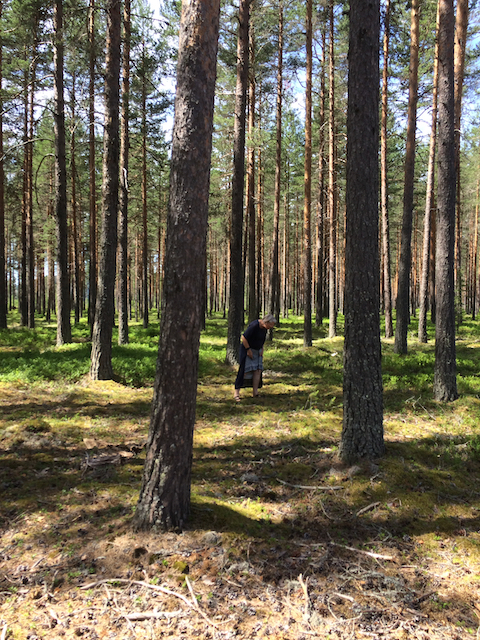
Eventually, in the next valley, we found both bearberry and lingonberry growing together on a sandy forest floor.

The following year in 2018 my poor husband enjoyed a solo 200km return journey to get a sample for me! Fortunately I was using GPS to record the position of every specimen found and he used this to find the forest area.

It was with relief that in 2019 we eventually found some growing very well, close to the main road below our rented cottage up in the mountains. Now I could truly say that all of the plants were from the same area!

Bearberry sketch from my ‘perpetual diary’

I did quite a few different sketches of this plant and like so many of the  plants in this series, found that it often starts setting its buds in the autumn in preparation for the following season.

I therefore decided to wait until the following year to try and get an immature fruit. As it happens, I had to wait four years until I could get a sample at the right level of maturity. But at least I managed it and got some good detail.

Bearberry sketchbook page. As usual a lot of research found space along the bottom of the page.

But I think one of the biggest headaches when collecting information was doing a transverse section (TS) of the fruit. The fruit contains relatively large hard seeds, as it is a stone fruit. Carrying out a LS on a ripe fruit was simple as I had no need to cut through any seeds.

But the TS was another kettle of fish! Each seed was about 2.3 mm long and very hard. There was no way I could cut through this without crushing the whole fruit and destroying the chance to draw this section as I had for every other picture. 

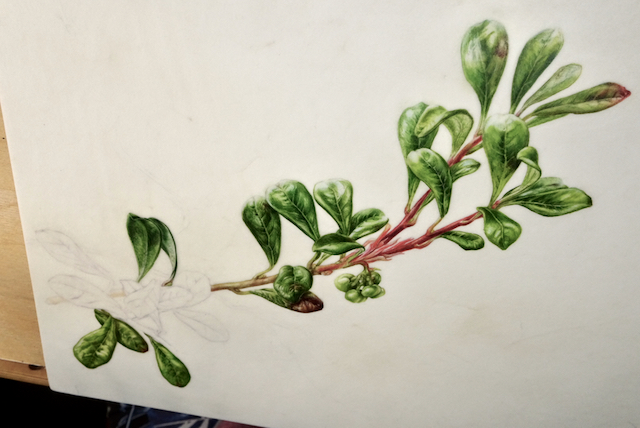
My trial piece on vellum helped me with my colour decisions for the final artwork. I started the sketches in 2017 and in June 2022 I started the final piece, finishing it in October 2022. 
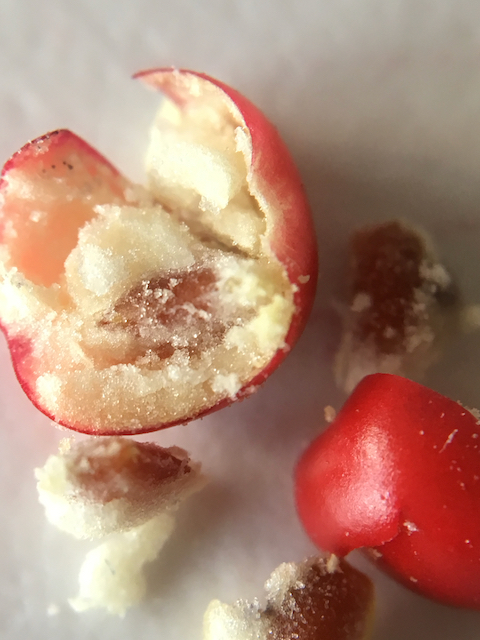
A squashed TS!
Bearberry trial piece on vellum

The native range of this species is Subarctic to N., W. & Central U.S.A. including the UK and Norway.  It is a subshrub and grows primarily in the temperate biome.

Source: Kew – Plants of the World Online

The photos above are a quick reminder of my process for this series. The various elements are traced to the vellum block and sometimes I go over these with a non-permanent watercolour outline. The main branch has generally been completed at twice the natural size and the sections in graphite or graphite and watercolour wash are normally natural size to show habit. Graphite is used to allow these sections to fall into the background making the overall picture less heavy.

Bearberry leaf tea infusion

Pour 150ml of boiling water over 2.5g of finely chopped or coarsely powdered, fresh or dried bearberry leaves and strain after 10 to 15 minutes. If you want to keep the content of tannins as low as possible, prepare a cold-water maceration. To do this leave the leaves in the cold water for 6 to 12 hours, then strain and heat the tea.

Uses

Inflammatory diseases of the urinary tract – NOT KIDNEY problems – “if treatment with antibiotics is not necessary.” Bearberry leaf infusion is classified as traditional herbal medicinal. Based on many years of experience, bearberry leaves can be used to treat symptoms of recurrent cystitis (e.g. burning sensation during urination and/or frequent urination in women), if there are more serious causes or symptoms remain, seek medical attention.

Tea infusion: drink a warm cup of bearberry leaf tea up to 4 times a day;

See https://arzneipflanzenlexikon.info/en/bearberry.php for more information.

Bearberry preserve

Ingredients:

  • 2 quarts bearberries, rinsed and without stems
  • Sugar (see instructions for amount of sugar)
  • 1 teaspoon lemon juice
  • 1 package pectin (about 3 ounces)

Instructions:

Put the berries in a pot and cook over medium heat until soft; about 5-10 minutes. Crush the berries, then run them through a sieve or cheesecloth to remove the seeds. Retain as much of the pulp as possible.

Return the juice and pulp to the pot, adding one cup of sugar for every cup of juice and pulp. Add the lemon juice, mix thoroughly, and heat to a boil.

Boil for a minute or two, then stir in the pectin. Allow the preserves to cool and set.

www.virily.com

My last blog about this series of pictures is scheduled for 15 June 2023. It is the day we get the results of the RHS judging, so I hope to include my result. I will show the final pictures which I have been keen to conceal until the judging process is complete.
Foraging plants in the norwegian mountains – 16. Small cranberry Pt.2

The marshy area where the small cranberry was found.

Planning the artwork

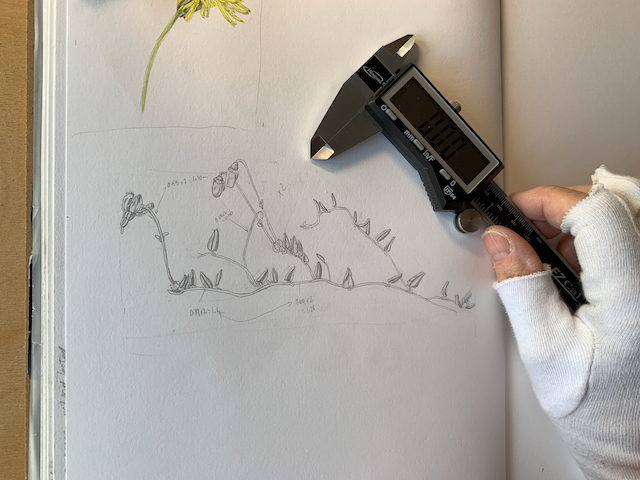
Digital callipers shown in an earlier blog. I use gloves so that fat from my hand is not transferred to the vellum, making it more difficult for pigment to adhere to the surface.

I began sketching the Vaccinium oxycoccus subsp. microcarpum (Small cranberry) in August 2018. The measurements of the tiny details were done using my trusty and accurate digital callipers.

Everything about the plant is tiny – except for the fruit, which is about the same size as a bilberry 5-8 mm.

When I first saw the plant and fruit meandering through the top of the moss, I couldn’t believe that such a slender plant could actually bear the weight of its fruit. As it happens, it doesn’t as everywhere I looked the fruit was either lying on top of the moss or supported by other structures in the marsh. The stems are so tender they are smaller than a blade of grass.

As with each of the other pictures I chose which sketches I would utilise from my sketchbook and arranged them with the help of the computer. I made continual adjustments to all of the plans so that visually they would appear as one exhibit. 

Can you see some of the parts sketched in the final artwork?

Digital plan of the composition. It is nearly the same as the final piece of work.

Each picture in the series was to hang ranged according to habitat from boggy and wet to sandy and dry.

The small cranberry was intended to start off the boggy end. But as the series has taken so long in the making, the criteria for exhibition has changed and I am allowed no more than six pictures.

Unfortunately, although completed, this picture will not be in the exhibit at the Saatchi gallery in June this year, but is still part of this series and will be treated as such in these blogs. I intend to show you all seven of the completed pictures after the judging process.

As with most of the pictures I did small trials on unmounted vellum to make sure I was choosing the right colours.

If you have read all the blogs about this series so far, you will have seen the finished trial piece in section 7, the last part of the history of the project.

The next photo is of that trial piece being worked on. I painted it twice natural size, the same as on the final artwork; you can see the flower sprig used as my model, lying on the vellum. Perhaps now you will have a better understanding of how tiny the species is.

Trial piece on vellum – in progress.

The colours I used: 

  • Quin Magenta PV122
  • Quin red PR209
  • Perylene violet PV29
  • Quin Gold PO49 (I don’t think single pigment can still be obtained)
  • Winsor Blue Green PB15.
  • Lemon Yellow PY175

Most of the trial pieces were painted at the cottage we rented, where I could easily source my subjects. I took over the dining table, with windows and light coming from the left. The family had to accept eating meals either outside or from a low coffee table. I was happy though!

My ‘studio table’ in the mountain cottage.

One of the biggest challenges with this plant was the root system. I remember a comment a judge once made about a botanical art piece; where the roots were likened to something having been put under the tap!

The Cranberry roots lie in very boggy wet areas and the hair-like system seems to fall away from the main stem lying along the upper layer of moss. The hair-like roots do plunge vertically down giving the appearance of having been under a tap! The Cloudberry coming from a similar environment and often intertwined, is not like this.

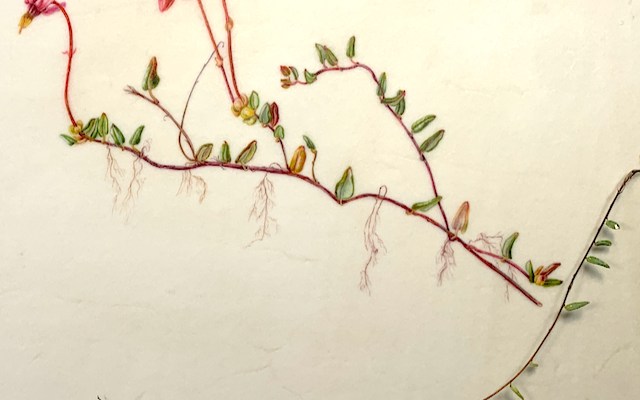
During the annual stay at the cottage in the mountains, in addition to my sketchbook and painting materials I had also cut a piece of Perspex to the exact size of my vellum block. I used this to try out samples of my subject to see how they would flow naturally across the picture.

Here you see a thread-like piece of small cranberry plant together with a couple of line drawings from my sketchbook; one drawing is the enlarged section in the trial piece and the other is actual size.

Compare this both with the compositional plan above and the final artwork. The more ways one can look at composition whilst planning a picture, the better will be the result.

I started sketching the small cranberry in August 2018, started work on the final artwork July 2021 and except for scalebars, finished in January 2022. 

The native range of this species is Subarctic to Temp. Northern Hemisphere. It is a subshrub and grows primarily in the temperate biome. This includes Great Britain and Norway.

Kew – Plants of the World Online

Fruit of the Forest liqueur

From Randi and Arne Christian Halseth, Skoppum (thank you)

  • 500 ml Bilberry
  • 50 ml Bog bilberry
  • 150 ml Mountain Crowberry
  • 100 ml Lignonberry
  • 700ml 60% spirit
  • 500 ml sugar.
  1. Put well-ripened berries into a suitable glass and sprinkle with sugar. The berries don’t need to be meticulously cleaned of leaves and tiny stalks. 
  2. Top up with the alcohol. Shake well then refrigerate. 
  3. Turn the jars as often as possible for 4 – 6 weeks.
  4. Strain and pour into bottles. 
  5. Age for a few weeks.
  6. Enjoy

I will start the detail about the Bog bilberry plant in my next blog 14 May 2023

A new Youtube video

Happy New Year!

What have  I been doing of late? You probably think that I haven’t been doing anything at all – but I have been working on my new online botanical art course. Poor Robin, he hardly sees me these days!

For those of you living in the UK you know that the weather has been very mild – and very wet. I live on the south coast and although we haven’t suffered the same floods as further north, it has been wet. All the plants in the garden are in turmoil. Everything is sodden and the cats leave muddy paw prints everywhere – they get the blame as they can’t answer back! A lot of the daffodils have finished flowering and if we get some cold weather now, goodness knows what will happen to those in bud.

IMG_3249We spent Christmas in Norway and had a really super time with my daughter (the hostess) and my son. We even got some lovely snow there – which was refreshing. we enjoyed some very special Norwegian food such as Lutefisk, had a Norwegian Christmas Eve supper of delicious cod and an English Christmas Day meal of Roast pork with all the trimmings. My children are fantastic cooks; they obviously felt they had to learn as I am such a bad cook.
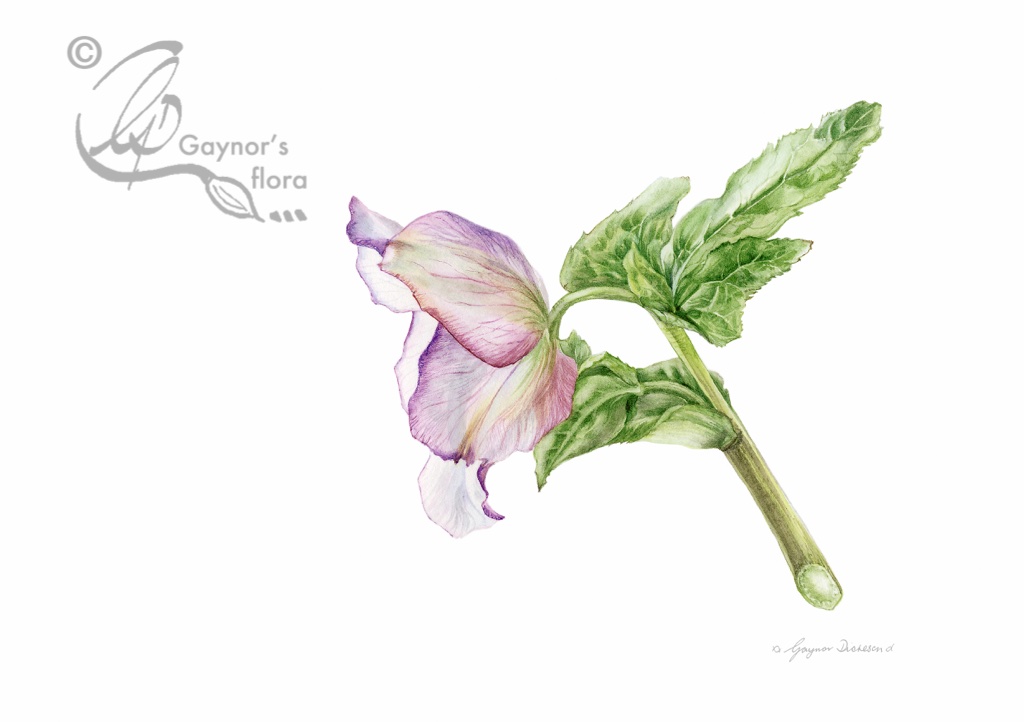
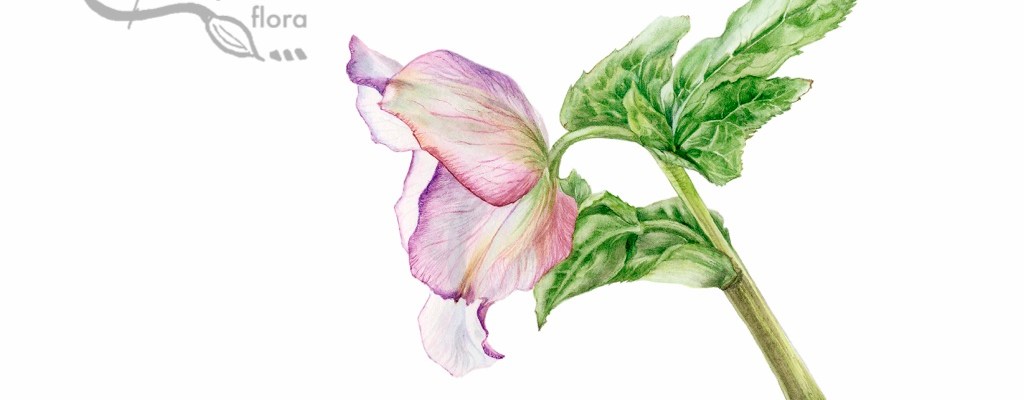
We came back home before the new year to see the Hellebores, Daffodils and Snowdrops in full flower! Starting on the watercolour module of my online botanical art course, I therefore had plenty of subjects to paint from. I chose the Hellebore after picking off a live caterpillar! Several of the flowers had their stamens chewed right off. I’ve pulled this picture off the video, so it isn’t too clear. I wish I had taken a picture of the caterpillar too.

Hellebore chewed
From painting the Hellebore I have done a whole series of videos for the course right from : Stretching light to medium weight watercolour paper (I hope you find it useful), sketch to line drawing, colour matching, tracing over to art paper, tonal value reference study to actually painting the picture. All of the videos are on Youtube, but only the one about stretching paper is available to the public. The rest will only be available to students doing the course, although I am considering doing a very fast one showing the painting. I still have a load of writing to do yet, so I will see how it goes.

I may not be keeping up too well with my own artwork, but I am keeping my hand in when doing the videos.

The December Hellebore


A new botanical art video: How to draw a Poppy seedcase in graphite

In actual fact, I ought to make a correction to the above title straight away; its How I draw a poppy seedcase in graphite.

Since we came back from Italy, I have been chasing my tail as usual. But there is a result, so the time wasn’t wasted.

I’m in the process of writing a new, online botanical art course starting off with graphite, moving to pen & ink and then either watercolour or coloured pencil (one or the other – the choice being the student’s). I have put a lot of work into the sections I have done so far and knowing that different people learn in different ways, I have thought a lot about this quite a bit.

My husband has been a beautiful model in some sections so that I have been able to explain in words and show in photographs, different techniques. That is the reading and seeing bit. But then we have audio input too, and that is where videos come in.

Some of the videos I have done so far are very short and will not be available unless through the course, but today I have actually finished one that shows how I do a botanical graphite drawing from line drawing to finished piece.

This is the finished artwork – only small and as yet I haven’t really found a title for it other than Poppy seedcase. But if you have some imaginative titles, please give me a prod. At the moment I am a little brain dead!


Poppy seedcase in graphite
Here is the link to the YouTube video. Comments are welcome: How to draw a Poppy seedcase in graphite. By the way, does anyone know the name of the species? It is rather unusual in that it doesn’t have the typical pepper-pot top. Apparently, the seeds remain within the capsule and it is a species that is collected as a source for poppy seed in cooking. I was told its name, but I didn’t make a note of it.