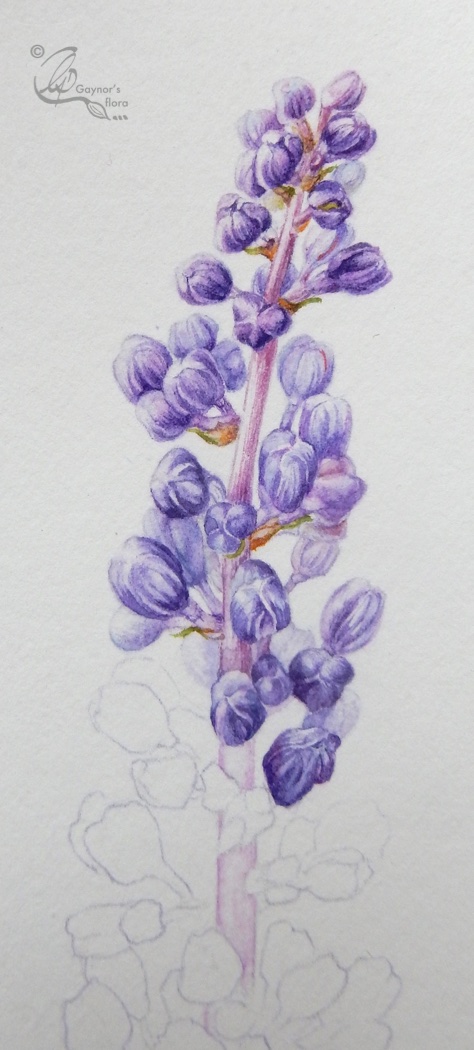
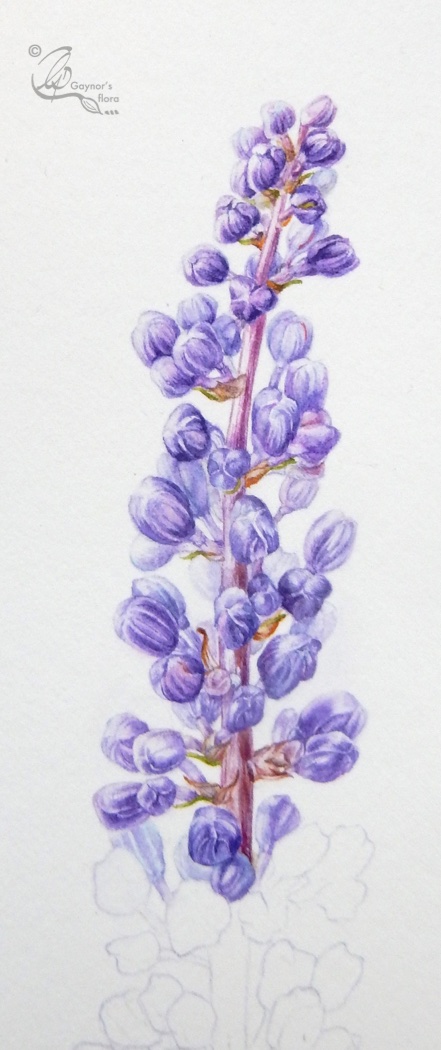
Today I have spent the whole time painting the Liriopa muscari. There is still much to do but the intention is to have it finished by Thursday evening, to deliver on Friday. I think that the wee small hours might be used as well a the long daytime hours.
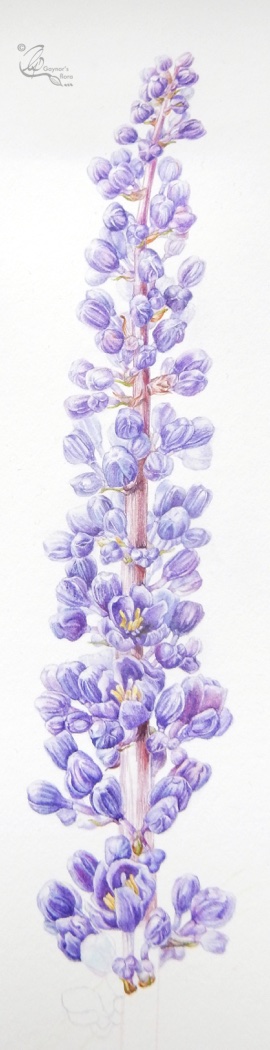
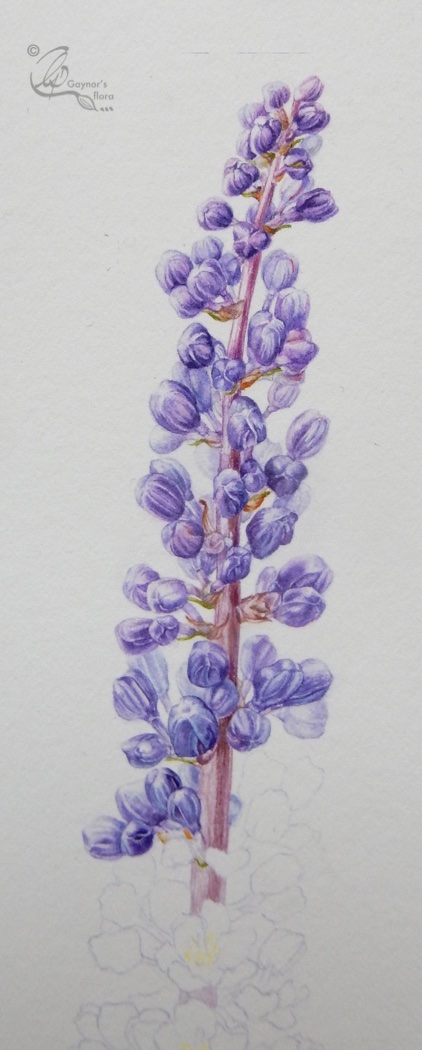
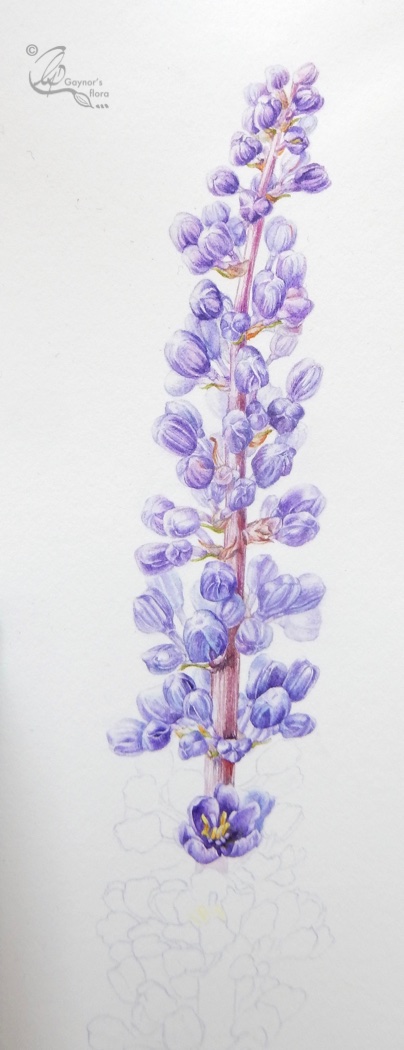
Photos from the days seven and eight follow. I’m sorry that the quality of the picture is not the best, but you can see the development of the enlarged flower spike.
Thank you to all the lovely people who have visited us over the weekend during the Open Studio event. It was good to meet new faces, put faces to names and of course see those who come regularly. It was a lovely weekend and the weather also put on a smiling face.
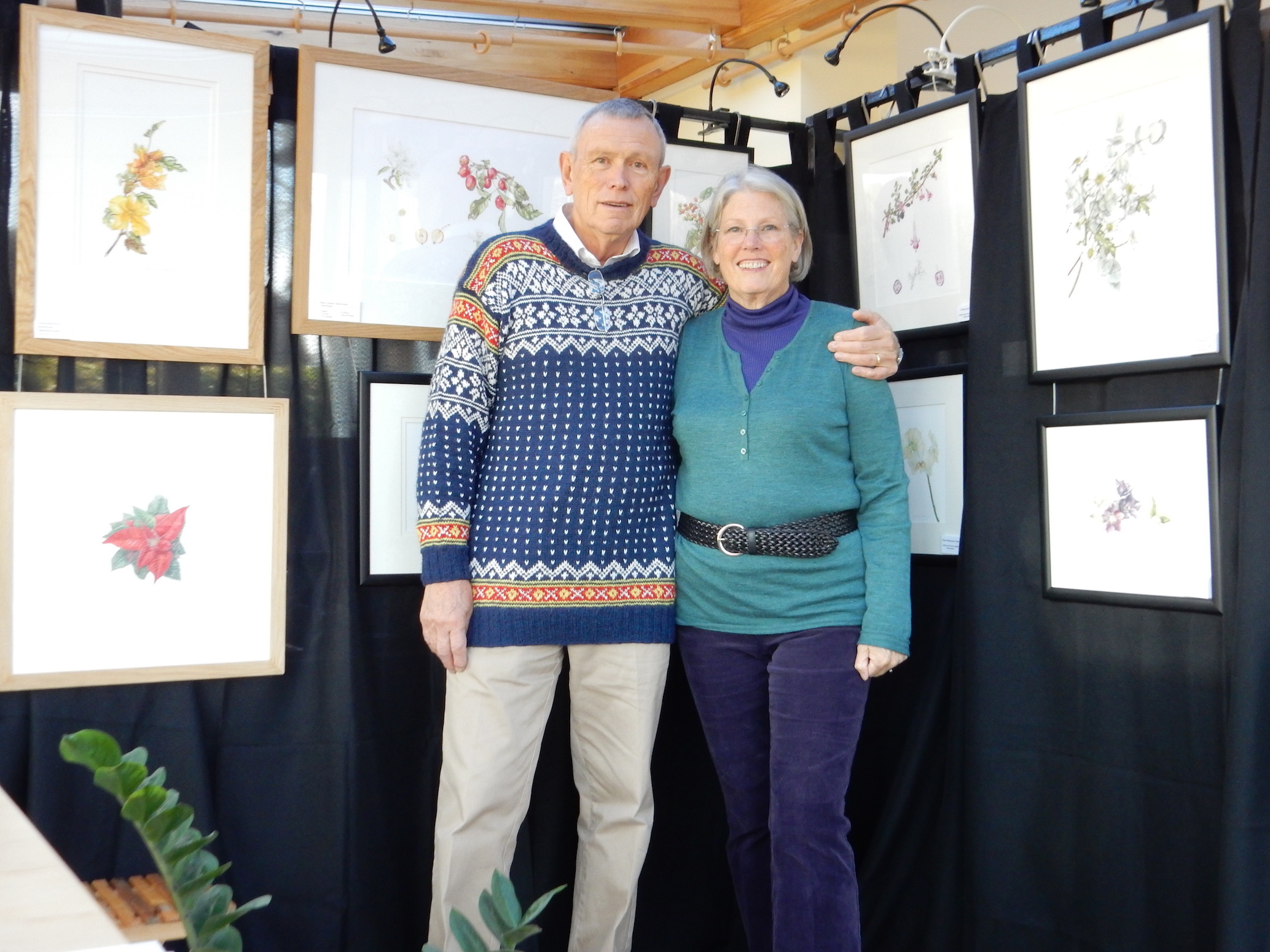
We still have a lot to put away, but this is Robin hard at it!
Robin doing the heavy work after Open Studio
I have continued to work on the Liriope muscari picture. But continuing on from the last photos, these are days 5 and 6.
What a busy life, but who would have it any other way! This is both a progress report on the Liriope picture. Two days worth again, although I didn’t get anything done yesterday as we were preparing to welcome all those wise people who have decided to come and visit our home this weekend.
We are now ready and waiting for your visit during the Open Studio event – or at any time. Welcome!
Robin and I welcome you!
But what you are really wanting to see is the Liriope muscari. Come and see me working on it this weekend.
I’m painting this on Strathmore 500 Bristol vellum. This is a 100% cotton paper which I have used successfully previously. This is instead of my favourite, the old Fabriano Artistico.
Unfortunately, the surface of the ‘new’ paper does not allow for detail in the same way as the ‘old’ paper and this is because of a production change in Italy. We are told that Fabriano have now acknowledged that there is a difference to their paper which affects us botanical artists more than they thought possible. In the meantime I am trying out different papers to help me advise my students.
I will show you here the result of two days work on the enlarged flower spike. I have been trying to take a picture at the end of each day’s work. It is a long process. The quality of the pictures will vary according to the light. I have taken photographs rather than scanning. But it gives a good idea of the progression of the artwork.
There are a number of artists in Bosham and each year we get together just before Christmas to create an art trail. As I am the only fine artist, and all the others are makers, we have decided to call it the “Bosham Christmas Craft Trail”.
For those who have visited Bosham at this time in years gone by, you will know this is a trail worth doing.
Robin and I will welcome you in our home whether you are just looking at my work or want to buy. There is plenty to choose from for that special present; a single card, a print, an original, or even a voucher for a workshop or the workshop holiday at Le Manoir next September.
Browse or buy with a warm mince pie and mulled wine or a nice cup of tea. Donations go to St Wilfrid’s Hospice. At the same time I will be continuing this picture from these sketches. See how far I’ve got by the time you arrive.
This slideshow requires JavaScript.
I hope to post the painting of the Liriope muscari picture as it develops. It is in watercolour on paper and includes an enlargement of the flower spike as it is so small, but with the growth habit in natural size.
Which artists to visit on the trail, and where you can find them. I look forward to seeing you:
Each workshop that I have done recently has been about apples. Shape, form and colour.
You have seen the pictures from the last SFP workshop that it was almost all apples. The small workshop that I had this last weekend also focused on apples.
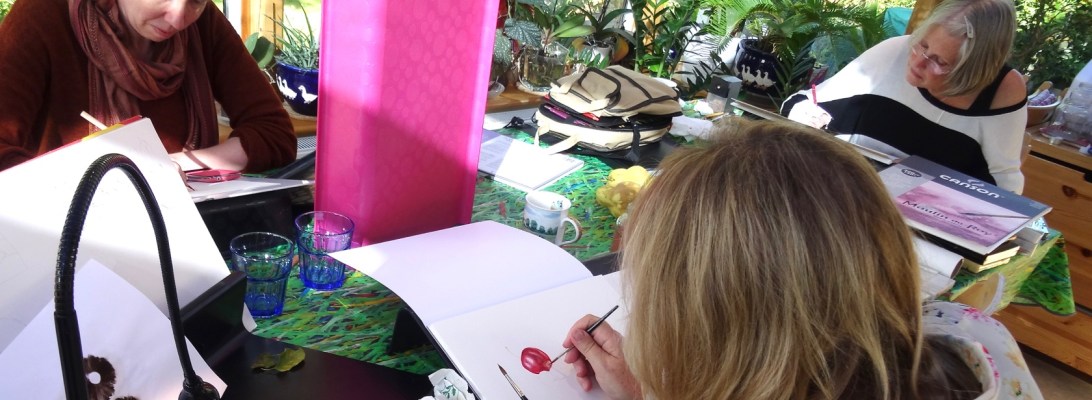
One of the students was working in watercolour and as she was neither very familiar with watercolour, nor botanical art. I think she did an amazing job. The other student first came on one of my workshops a couple of years ago with the wish to learn coloured pencil. She hadn’t done any art either, so she too had a steep learning curve. But she comes to my classes and workshops on a regular basis and is now a very good artist.
It was a lovely balance to have in the workshop as the more experienced student had a very good idea how the other felt and was able to give encouragement.
The two pictures shown here are very good and I think both were very happy with the results so far. Obviously the coloured pencil picture is quite a challenge. Apart from the form of the apples (four different ones) with their respective shrivelling leaves, she had to contend with different textures too. I know that she went home with a determination to complete the picture.
This slideshow requires JavaScript.
Normally, when one has flowers and leaves in a botanical art picture, one does the flowers first as they die first. But in this instance the issue was the shrivelling leaves as they were moving constantly. Therefore these were started first to capture the initial shape and the colour that attracted her to them in the first place. She intends to go back to them after getting the apples finished.
The next workshop in Bosham will be ‘Autumn colours. Wow!’ Friday 28 October to Sunday 30th. I still have some places available so do get in touch soon so that you can secure yours. Please use the contact form at the end to contact me if you would like to come as I will be at the ASBA conference in Pittsburgh. I will be able to pick up emails and confirm if there is still room for you.
Before I update a little more, there are still a few places on the ever popular botanical art workshop ‘Fruit and Veg’ or ‘Strawberries and Cream’. The last part isn’t intended to paint as we will be eating them. However, there is no reason why shouldn’t reserve some strawberries to paint.
Please do get in touch as soon as possible if you would like to attend the workshop, Friday and Saturday 19 & 20 August, between 10:00 and 16:00, including lunch.
The workshop is held in Bosham near Chichester. There are plenty of B&Bs in the vicinity and I have a list should you need it. But these days it is easy to find accommodation on the internet.
We have a kitchen garden, although not too much in it as we were away during a vital period. We took cucumber plants to my daughter in Norway; she has cucumbers, our plants died! But we do have exciting overgrown radishes, apples on the way and blackberries already here. The runner beans are beginning to produce, but the broad beans are few and far between. Our neighbours got plenty of Raspberries whilst we were away – all gone now, but you never know, some may pop up.
I will put a form at the end of this blog so that you can get in touch with me quickly should you decide you would like to join in the fund and games. More information and booking form at Gaynor’s Flora workshops.
In the last update on 1st of August, I mentioned that I had beens struggling with painting tomatoes in coloured pencil as I was trying out different papers. For my fourth attempt I used my trusty old supply of Fabriano and it is now finished. I will show it to you another time as in reality I only did it as a teaching video for my online botanical art course. I still have to edit the video.
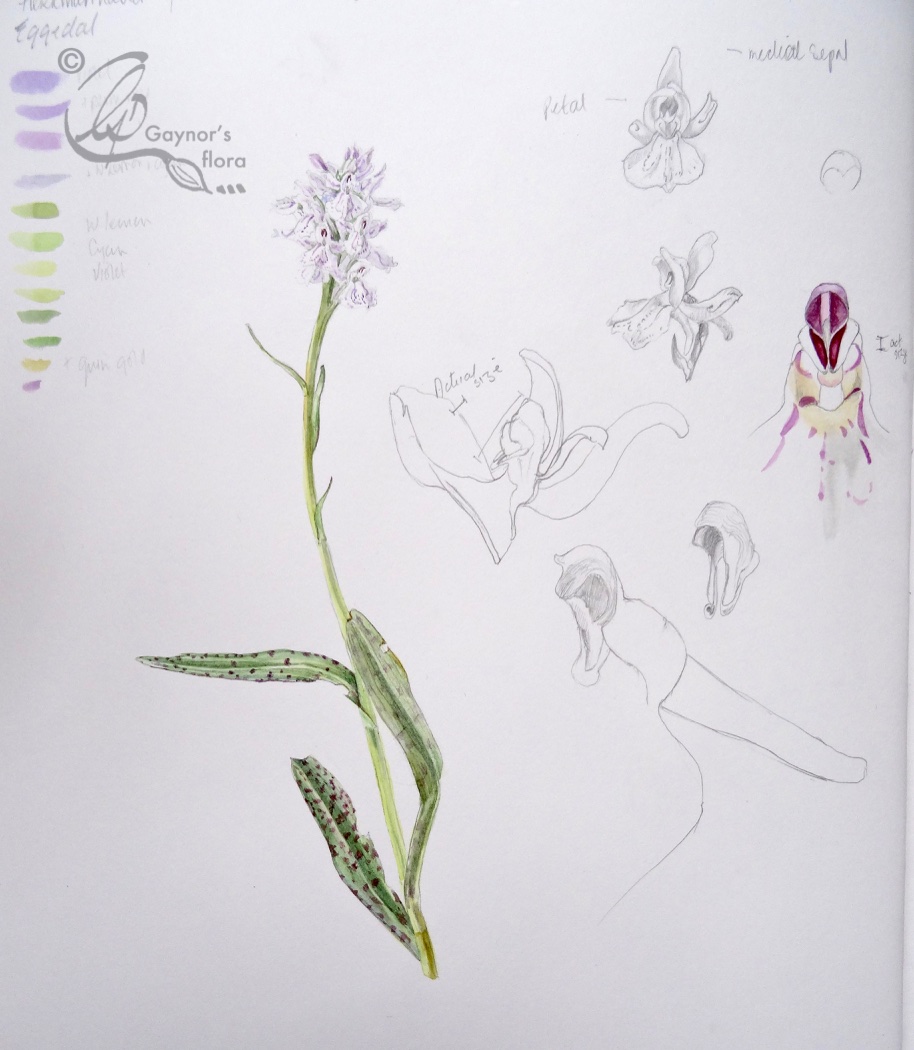
I also mentioned our trip into the mountains in Norway and showed you a list of plants that I might do for my next RHS submission. Here are a few sketches of the Heath spotted Orchid from my sketchbook.
This blog is particularly brief, although I still have plenty of news to catch up on.
I had a commission for a Fritillary earlier in the year. I showed you some of the preparatory drawings in my sketch book in a blog 25 February this year. The customer approved the composition and the final picture was painted in watercolour.
Because the picture was needed for a particular date, delivery waited until today. It has now gone to its new home.
Whilst I was away, I was filling in forms, writing CVs etc for the American Society of Botanical Artists (ASBA) conference in Pittsburgh and the exhibition in New York in November. I didn’t have access to all my paperwork to fill everything in, but thought I could rely on the information in my website. Not so! For some reason or other a couple of pages were empty, such as the one for awards, and several others were not updated. Why, I don’t know. But as my husband says it is because I’m human. That might be a surprise to some!
Have a look at my website, because some of the factual things were updated yesterday.
What has this got to do with botanical art? Find out in the botanical art course.
Whilst doing this vital function, I was reminded that I needed to mention that I have some places on the online botanical art course Online botanical art course . I keep the number low for new people starting each month so that I don’t become overloaded with teaching, leaving no room for my own painting.
The feedback that students get back from me for each assignment is comprehensive – as those who are already doing the course can vouch for. Each assignment I receive often takes several hours to mark, so that as you embrace the tutorials and struggle with practicing for the work you send to me, you know that your efforts will be treated seriously.
The course is suitable for people starting out in botanical art and for those who want to improve. Generally speaking, the ‘wanting’ to improve in our botanical art practices applies to all of us and it sometimes helps to have someone else to guide us further along this path. Do sign up and give it a go.
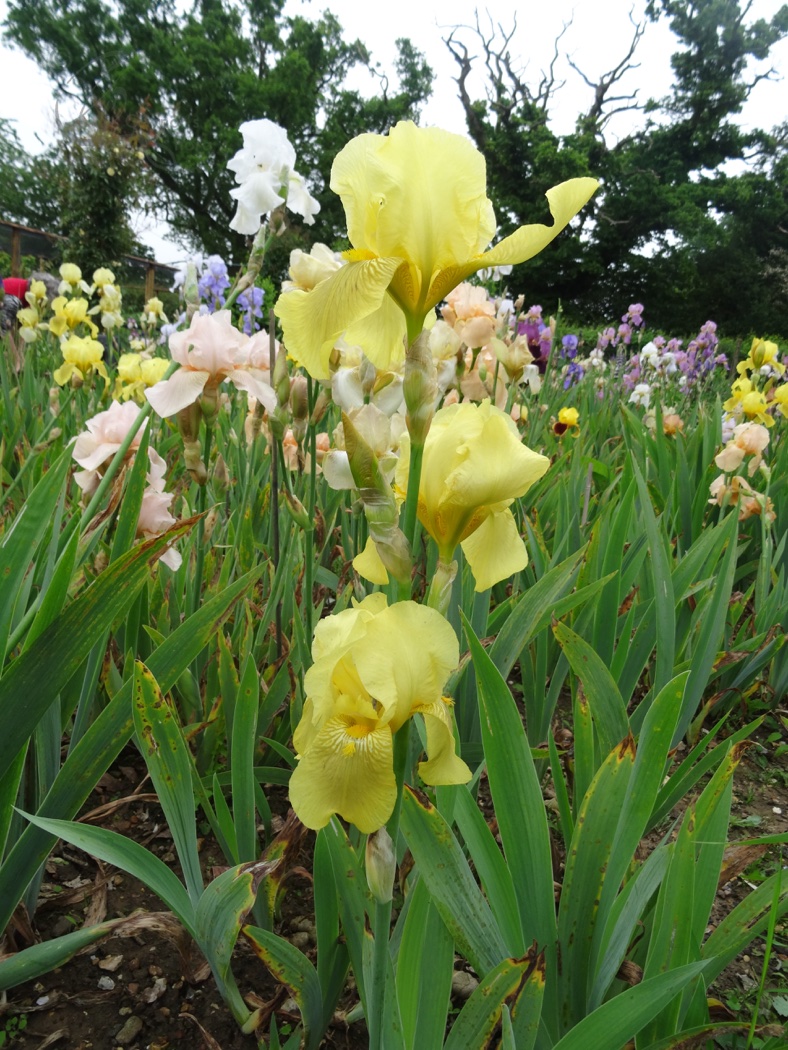
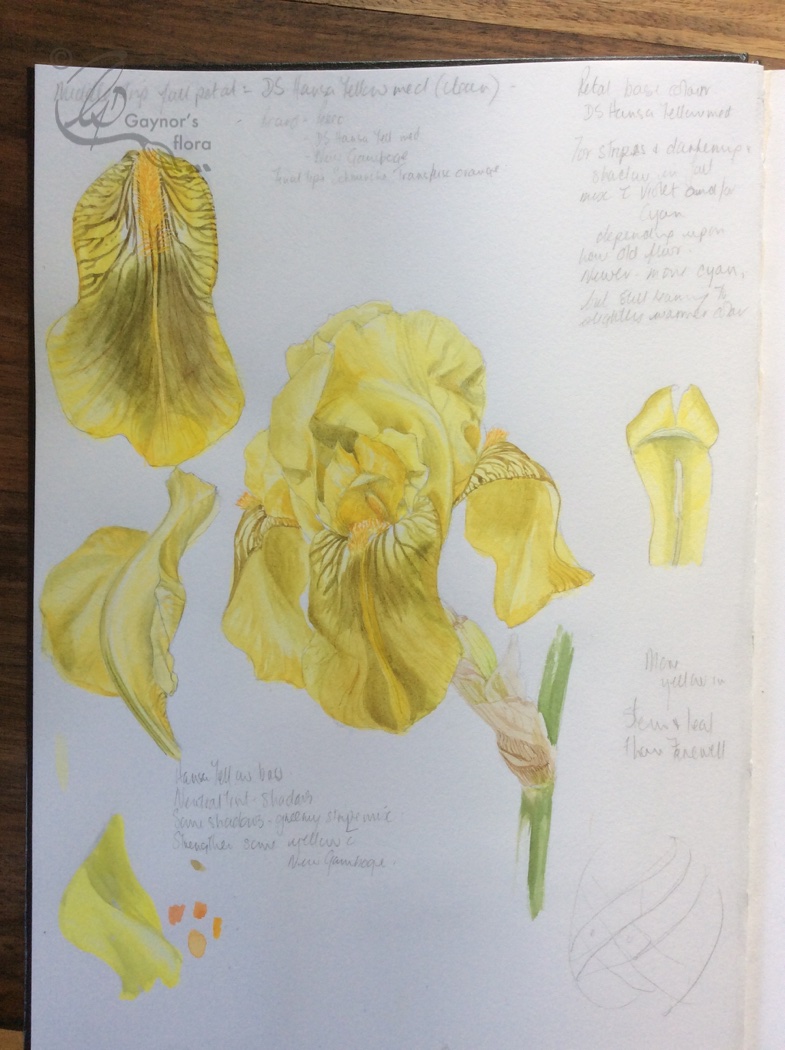
Going back to the beginning of June and the Cedric Morris collection of Irises; these are the pictures of the second Iris. This time it is the Benton Apollo. In the garden in Hadleigh, Suffolk, the Irises were at various stages of flowering. The Benton Farewell that I showed you yesterday had only just started flowering and there was only the one fully opened. However, the Benton Apollo Irises were very much in full bloom.
Iris Benton Apollo
In this picture you can see some of the other Iris colours in background. And I believe that this part of the garden was secondary!! Anyway, again I was smitten. But who in their right mind would choose a yellow flower to paint?
Both white flowers and yellow flowers are considered very difficult to paint, but it all depends on whether you have leaves backing the flowers, and the way you do your shadows. In actual fact the Benton Farewell had a lot of subtle mauve tints in the white and the yellow iris has also some beautiful and interesting shades, particularly in the fall petals.
On Saturday evening I made my way home in the car. It was hot. For the first part of the journey, Julia accompanied me, sitting in the front seat holding her Iris cutting with all the windows wide open. My Iris was safely supported in the boot of the car – or so I thought! Julia’s Iris didn’t even flutter in the wind and mine was safely in the boot being torn to shreds.
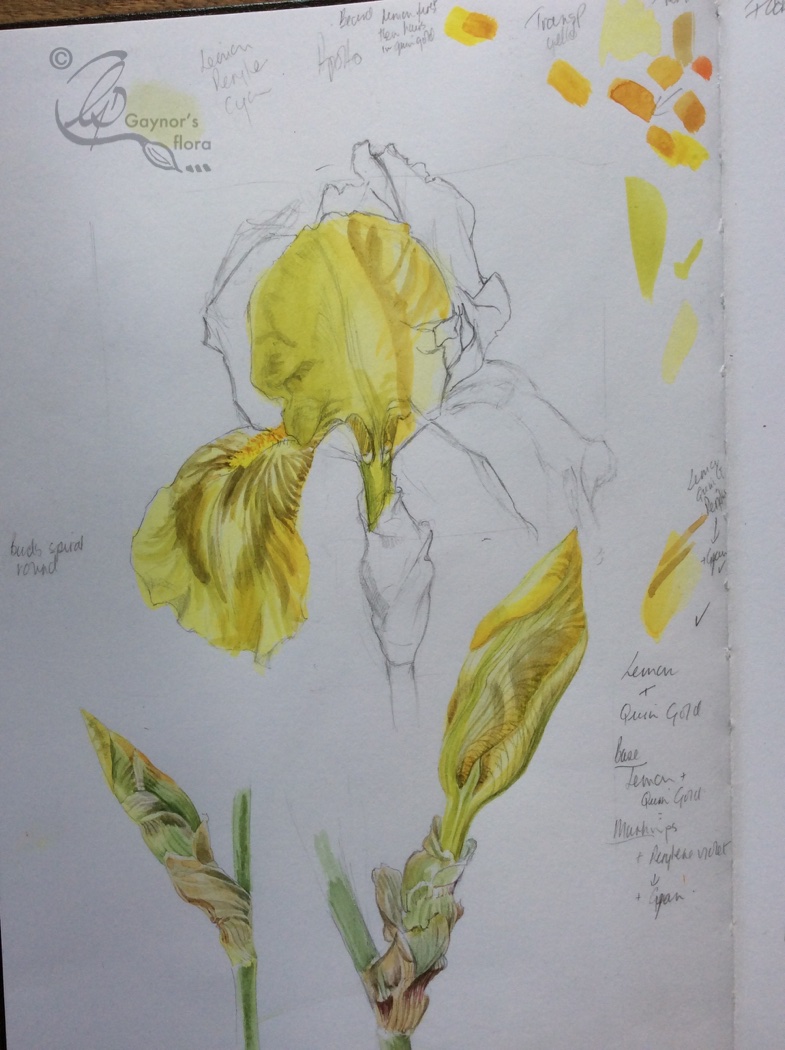
I was lucky enough to have some buds left on the cuttings and during the following week I did demonstrations on four days. What did I use for my subjects? The Irises of course.
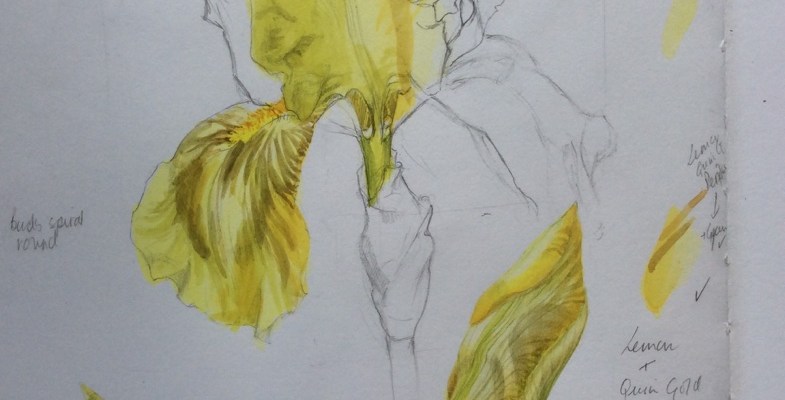
Benton Apollo sketch done in situ.
Benton Apollo sketch from cutting
Both sketches are watercolour in a Stillman & Bern Zeta sketchbook.









 GAYNOR'S FLORA