At last I have published details of the new online botanical art course. You will find information on the page of my website by clicking here: Gaynor’s Flora online botanical art course.
The course is based on six modules and is suitable for both experienced and inexperienced students. You choose your main medium; either watercolour or coloured pencil and I have made YouTube videos to demonstrate techniques.
Unfortunately I will have to limit the number of new students that I take on at any one time, but take on new ones each month.
I look forward to hearing from you.
As it is almost the end of Hellebore time, I will pretty up this blog with ‘Hellebore mix’ in watercolour.
I couldn’t believe it, but between us all we had enough dark Hellebores and Snowdrops to concentrate on the effects of doing something light against a dark background.
The intention of the workshop was to show how little work was really necessary on a white flower when placed against a dark background. Luckily I have some very dark Hellebores and one called ‘Slate’, that were still flowering. Additionally one of the students came with some that were a delicious ruby-red.
I was afraid that we might have to use the Leucojum that are still flowering in the garden, because the snowdrops really didn’t do too well and were almost finished – or finished off by slugs. The Leucojum normally doesn’t start flowering until after the Snowdrops, but this year started in December, before the Snowdrops. Weird!
I won’t rabbit on any more but show the progression during this weekend’s workshop. As usual it was a lovely group and they worked hard.
Painting like mad with coloured pencils.
This slideshow requires JavaScript.
The next botanical art workshop in Bosham will be 18-20 March when we will be doing ‘Spring is on the way: flowers & bulbs’. It would be nice if those coming to the workshop would consider doing the flower attached to the bulb. I think that botanical pictures showing what also lies beneath the surface can be as interesting as that above the ground. There are still some places available, so do get in touch.
In actual fact, I’m cheating a little, as I was going to write this blog this evening having spent a couple of days off from writing my botanical art online course, to sketch some Fritillaries in preparation for a commission in watercolour. But, I also got a query from a lady this evening, about the use of coloured pencils and how I choose whether to use watercolour or coloured pencil for a subject.
My answer to her and anyone else who asks ( as I do get the question fairly regularly), is that I have no idea. I just have a feeling that I want to do one or the other.
But, when I did my last RHS exhibit in 2014, I deliberately chose to do it in coloured pencil to show that solid subjects (crabapples), dainty subjects (blossom) and delicate detail (dissections), could be done in coloured pencil. The judges said they didn’t realise I had used CP and thought it was in watercolour!
Back to the commission; I had bought some Fritillaria meleagris at the local garden centre and Fritillaria Michailovskyi at Chelsea Physic Garden when I was there at the beginning of the month. I think we are innate plant hoarders! So this week I have been doing a series of small sketches in my sketchbooks.
Without thinking too much, I started out in a Stillman & Bern Epsilon sketchbook, realised what I had done (as the Zeta is better for watercolour), but continued in it, deciding to do my colour samples in coloured pencil. Although you can’t compare CP and watercolour by the names, or know how one colour mixes with another, I know the two mediums well enough to be able to convert fairly happily.
I’m afraid the following photo is not brilliant as I took it on my easel this evening, but I think you get a reasonably good idea of the results on the page.
Fritillaria meleagris in coloured pencil.
By the time I had finished these, the one dark flower I had was looking a bit faded as it was being subjected to being in the warmth of the shed during the day and outside during the cold night. I needed to concentrate on the foliage as it was a bluish green, except near the base, but felt I really should do this in watercolour.
I changed to the Stillman & Bern Zeta sketchbook. Shame they aren’t all in the same one – but never mind! I had hacked (dissected) the one flower to pieces and done one or two small sketches, so decided to draw a portrait of the bulbs. In the end, all of the sketches on the 2nd page are watercolour over graphite. The bulb is from the Fritillaria meleagris, but you also see the Fritillaria Michailovskyi. I have taken a photo of that one halfway through so you can see the amount of graphite shading I actually did. Before adding colour, I did a wash of clear water to ‘set’ the graphite so it wouldn’t discolour the colours I was going to use.
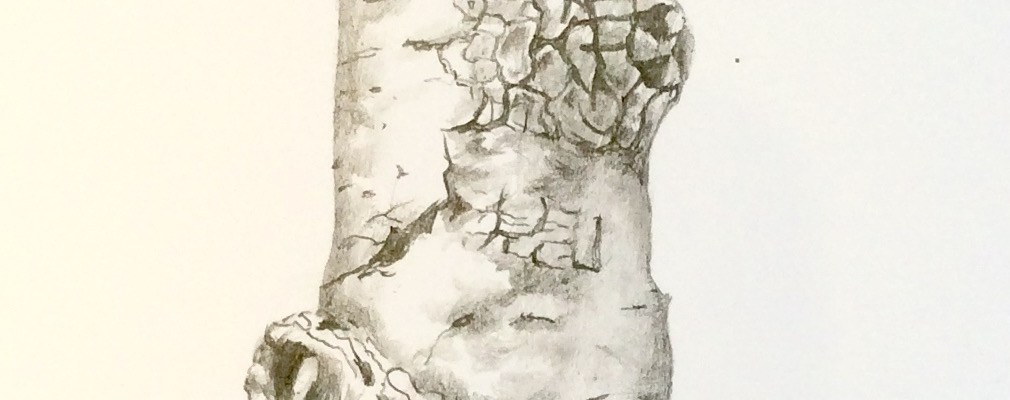
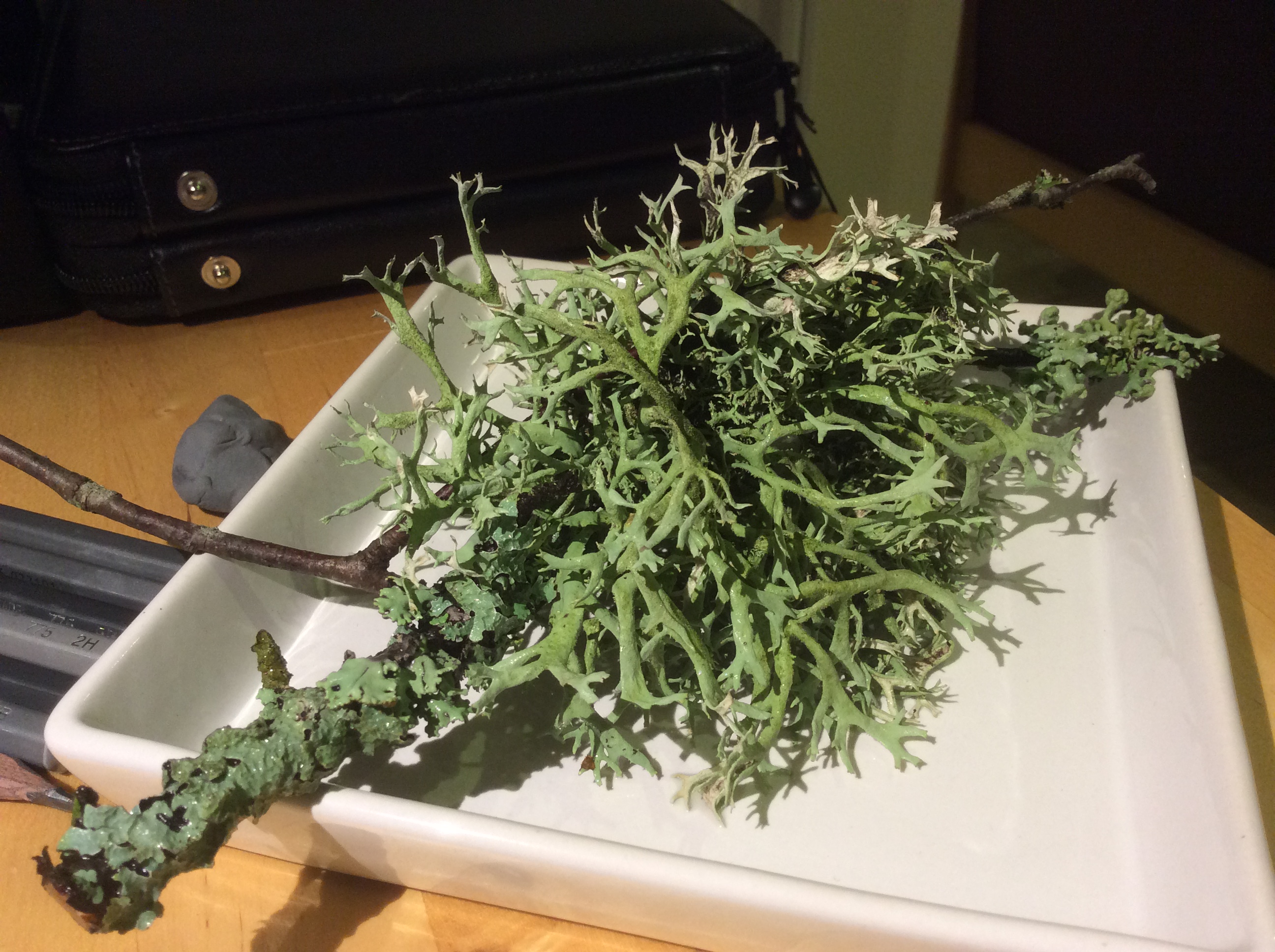
In reality the workshop became textures , bark, lichen and leaves!
In the end, I felt it had been a very unusual workshop because four of the five students were coloured pencil artists and only one was a watercolour artist. Three of the CP students wanted to do graphite only instead of colour, to improve their tonal value skills as well as the use of graphite. The watercolour student wanted to improve ‘green’ skills. They were definitely students who knew what they wanted to do! Their intention was to improve various aspects of their skills in botanical art and it was such a pleasure – and honour to help them.
On the first day we focused a lot on preparation. This time we didn’t actually talk very much about composition, but we went through the first stages of drawing and making a rough tonal value reference drawing.
LichenBroken piece of BirchDrawing wood and lichenDrawing piece of wood found on the beach.
As well as the different drawing techniques, we also looked at light and shade forming a solid object, and mixing greens. Unfortunately not all of the photographs turned out too well, but I think you will appreciate some of the results anyway.
Dried oak leavesThe piece if wood with lichen
Of course the various types of lichen we had collected between us was worthy of more detailed investigation, so out came all the magnifying glasses and lenses that we could muster. The specimens were hugely intriguing and the colours definitely became accentuated when you see them in detail.
I was particularly pleased with the results and I am just sorry that the photograph of the CP picture did not do it justice. I’m afraid the light was failing when I took the picture, but the tiny detail of the lichen was actually very well done – and exhausting to do. It will obviously take time to finish that piece even though it is small. I hope that the artist will not lose patience with it and complete it at some point so that it can be shown again on the blog. I think the other photographs of the work have turned out reasonably well.
Thank you all those who visited our home this weekend during the Bosham Christmas Craft Trail.
In May, Chichester Open Studios art trail involves artists who live in or around our lovely city. But in recent years it seems that there are more and more serious artists living in Bosham, a village just outside the city, who are taking part. Over the years, one of the artists has opened her house each November and invited some of the Bosham artists to exhibit with her. But as there are so many of us, she can no longer accommodate all of us, so last year we decided to have a craft trail in our own homes – it was successful.
Most of the artists who have taken part the last two years are makers (except for me), thus the title ‘craft’. The other artists taking part work with glass, ceramic, driftwood, jewellery, fabrics and also artwork for the garden. When thinking of your Christmas presents for next year, think of taking a relaxing weekend break in Bosham. We have yet to decide on the date, but although a lot of people visited us this year, Black Friday seems to have taken a stranglehold in the UK now, so our craft trail is very likely to be the week before!
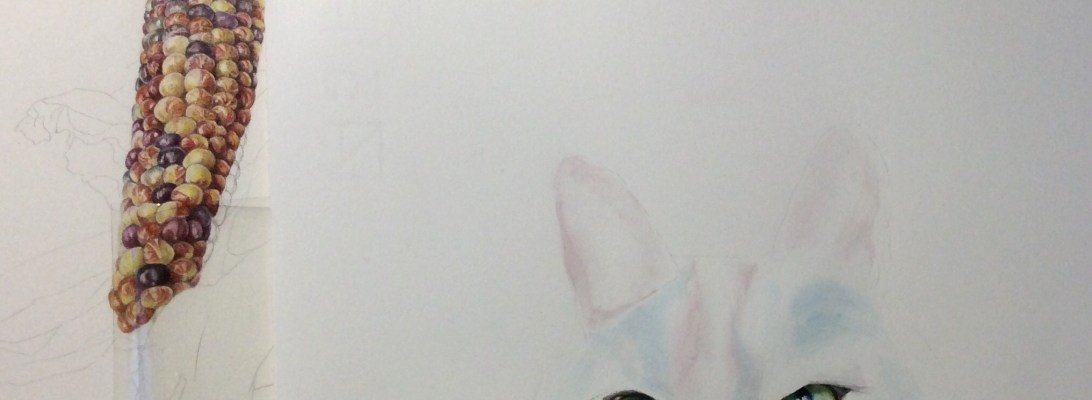
During the craft trail, I moved my easel to the house, as it has now become rather a muddy experience walking down to the shed. Robin also said it was nice to have my company for a change (oops)! As usual I had some work hanging in the conservatory – I’m afraid we forgot to take any photos as it was quite busy. But I was also demonstrating what I do. The original intention had been to work on my Indian Corn picture in coloured pencil, and I did do a little more on that; but getting questions about watercolour too, I needed that available as well.
My daughter’s cat was recently very ill and the vet’s surgery put themselves out to help. As a thank you she wanted me to do a ‘quick’ sketch of the cat for her to give them. The word ‘quick’ doesn’t rhyme too well with what I do – although I did and do try!
‘Tigger” is a Russian Blue. Tigger is a very descriptive name, although he does have a very beautiful face. Someone pointed out to me today, that she wished photos were taken that hid her neck! In this picture, he isn’t too blue yet, but the green eyes are there as well as the start of the extremely upright ears. The sheepskin he is lying on hides one of the reasons for his name! He is a lovely and very affectionate cat – particularly around meal times.
Indian corn in coloured pencil, or Tigger in watercolour?‘Tigger’, a Russian Blue in Pink, with green eyes! Watercolour.A long – haul ‘Indian corn’ in coloured pencil.
Isn’t it amazing what several people can do to make a botanical art workshop happen! I was worried as to whether the workshop would live up to its title as just about everything had fallen off the trees. Winter had come further than I thought it would.
But, everyone kept their eyes peeled and the majority came with subjects to paint themselves, or share with others. Wonderful.
About half of the students had been to one of my workshops before and the other half were new to me. I’m glad to say that the new students had been tempted to try by others recommendations. It was a lovely group of people and we kept the bitter cold out.
Firstly the group:
Hunting for subjects?
You have to agree that although it was cold outside, the inside was full of warmth.
Don’t forget the Bosham Christmas Craft Trail next Friday, Saturday and Sunday. You will be very welcome.
At last all the details are clear for the next Botanical art holiday in Norway. I hope that you will be able to join me. I look forward to hearing from you. Have a look at the page on the website under tuition and you will find all the details there. If you have queries, get in touch.
Phew! I have just managed to post the list of botanical art workshops for 2016. Do have a look at them and make your reservations for next year. The schedule and the booking form can be found under Tuition – Workshops. My UK based workshops are limited to 8 people so that I can concentrate on each person and give them advice to improve their skills.
I’m afraid that I haven’t got quite so far with the Norwegian botanical art workshop holiday. The hotel is booked for Friday 24 June to Friday 1 July 2016 and I have posted this in the relevant section under Tuition. However, all the details and booking form have yet to be completed. Do start saving. Fantastic weather has been booked yet again and the hotel is looking forward to looking after us. This year, everyone was amazed by all the flora that was out. Norway is now very careful about using sprays on roadsides etc, so now everywhere is fantastically beautiful as wild flowers are encouraged.
As well as working on botanical art painting and improvement, we will be taking trips out to collect subjects to paint, and hopefully organise an afternoon trip a little further afield too. I intend to offer a two-day focus on pen & ink in addition to the mediums you normally use (watercolour, coloured pencil or graphite). I will be providing the materials for the pen & ink, so that no-one needs to worry about sourcing that equipment prior to the week’s holiday workshop.
I’m afraid that in looking through the pictures from the Norwegian workshop holiday this year, I got rather involved in them and as well as posting a few on the page about the holiday, I have included some more here. Please do enjoy. If you like the photos, imagine what it is like to see it all in real life!
I look forward to hearing from you soon.
View along the valley at BlåfarveværketLooking at part of the exhibition in the held in the Mine Director’s house at Blåfarveværket.From the same exhibition.
This exhibition was very unusual as it was held in the Mine Directer’s barn. Torvald Moseid had embroidered a long frieze depicting Orfeus & Euridike. He had done it between 1978 and 1985 – apparently working on nothing else. Each section depicted beautifully the feelings throughout this story.
Flora from MølenMore flora from Mølen.
You need to bear in mind that Mølen is Norway’s largest beach of rolling stones, but apart from being an area of scientific interest, it is outstandingly beautiful.
2015 is not over yet; we still have the rest of October, November and December. So much happens in the garden during this time as things switch off to rest and reconstitute themselves ready to spring open in all their glory next year.
Personally, I find that there is still so much out there that I want to paint. I used to think that it would be a time of rest for me too – not true. I still don’t have enough time to paint or draw the living three-dimensional plants onto my two-dimensional paper (or whatever it is I paint on).
I am in the process of putting together a botanical art workshop schedule for next year. I have just heard back from the hotel in Åsgårdstrand (where Edvard Munch had his studio), that they would love to have us again at the end of June 2016, so I can now get the rest of the schedule together and hopefully post it on my website during this coming week.
In the meantime, information about the two remaining Bosham botanical art workshops for 2015. There are only two vacant places for the ‘Stunning Pen & Ink’ workshop, Friday and Saturday 30-31 October. That is not this coming week, but the one after. If you are interested, do get in touch as soon as possible if you don’t want to be disappointed.
For the last 2015 botanical art workshop there is one vacant place; ‘All those stunning Autumn colours’, Friday to Sunday, 20-22 November. Again do get in touch.
Obviously the Pen & Ink workshop will just be pen & ink and I can supply you with the necessary equipment. The Autumn colour workshop can be in either watercolour or coloured pencil. The classes are kept small so that I can give appropriate help where necessary – as well as demonstrate both mediums.
I look forward to hearing from you soon.
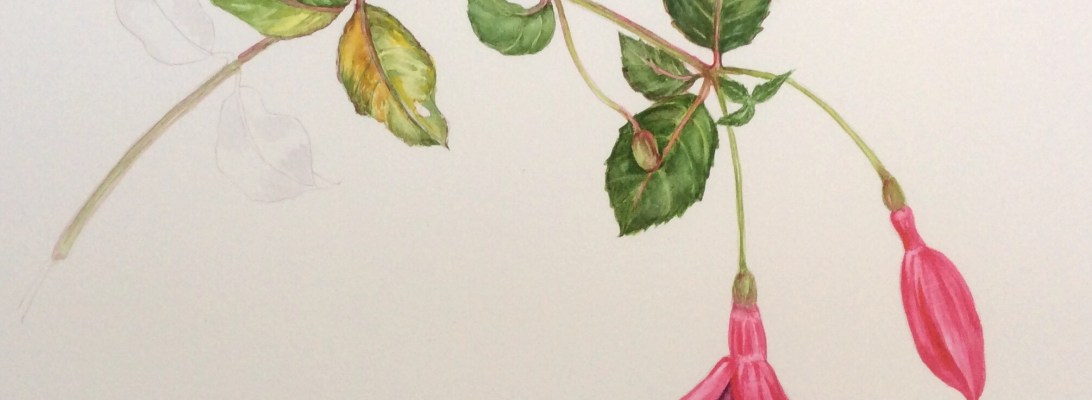
Himalayan Lily in Pen & ink‘Flowers from my Winter Garden’













 GAYNOR'S FLORA