Tracing to art paper without indentation

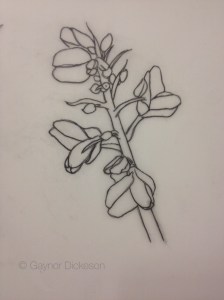
I wrote a blog  called: tracing to Art paper from 25 March 2013. I thought it might be useful to refer to in conjunction with my new video on YouTube : 

http://youtu.be/VdDlTH7m5Os

Both on the blog and in the video I have used an instrument called a Decoupage tool. This was bought from FredAldous  online. It is very useful as it is smooth and small, but just large enough to spread the load placed on it when transferring an image onto art paper, without indenting the paper.

Why is it important not to indent the paper? Often, when transferring an image, no matter how careful you are, you will nearly always get some indentations. If painting in watercolour, the pigment is more likely to collect in the narrow grooves leaving a darker line. If using coloured pencil or graphite, pigment won’t go into the embossed lines so easily and white line are left. You don’t want either of these effects from outlining your image. 

The technique is simple and removes the risk of the embossed image during transfer.

Do give me feedback about the video, positive and negative, so that I can carry on improving ones in the future.

I will be having a graphite workshop on Friday and Saturday, following pressure to put on such a workshop. Watch this space for some pictures at the end.

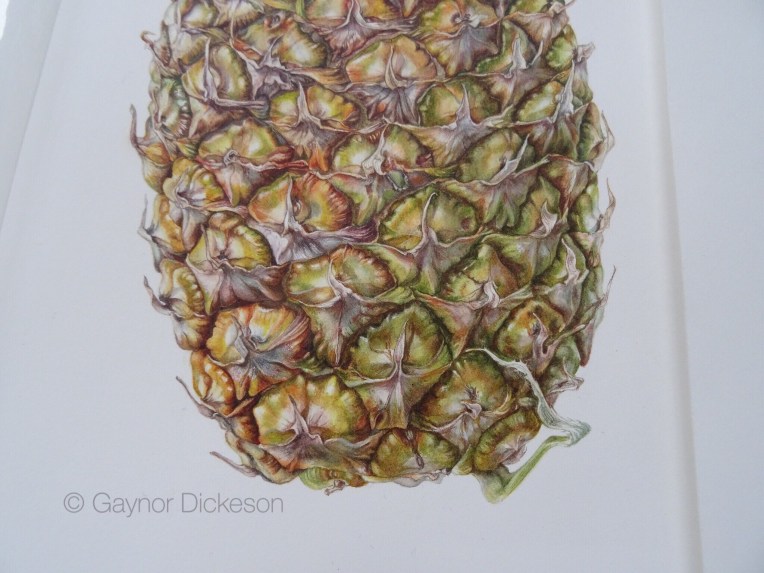
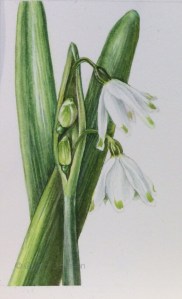
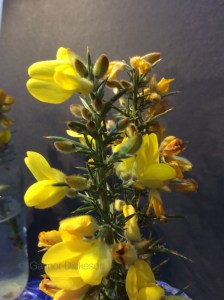
Now The reason for following this blog – botanical pictures completed in the last few days. I haven’t done many of the artists trading cards as with my style of painting, each one takes about two days. The last one is the image used for the tracing and as Gorse is not easy, I am on my fourth attempt! I don’t give up that easily!

The pineapple and arrival of Rory McEwen vellum

This week has been and will continue to be quite eventful. On Sunday, we drove up to London to deliver pictures for the SBA exhibition in April at Westminster. Several assignments have arrived from London Art College to mark and I have started these. This morning I had my usual weekly class and this afternoon a friend arrived from Norway ready to take part in the workshop I am holding this weekend – Friday to Sunday.

Tomorrow we plan to go to Kew and of course the highlight will be to visit the Shirley Sherwood Gallery of botanical art. Hopefully I will be able to write a bit about it in the evening.

But today there was a big knock on the door. I could see the sun flooding in through the glass in the door and the shadow of a person standing outside. I opened the door and there stood our very smiley ( and helpful) postman with a parcel in his hand. I saw straight away that it came from the Hunt Institute, Pittsburgh. It was the vellum! I was so excited and the poor man got dragged inside to be told the story behind it all.

I understand that not everyone is entirely sure what vellum is. It is animal skin – often goat or lamb, which has been collected from abattoirs and prepared by specialists for painting or writing on. It is parchment, the same material that old documents were written on. In fact all acts of Parliament are still written on parchment.

Why use vellum/parchment rather than paper? Well, the archival properties of parchment are far greater than that of paper. For important documents this is an important consideration. For artwork this too is very important, but there are additional benefits ( and difficulties). Watercolour is applied with a dry brush technique as unlike paper, the pigment lies on the surface of the skin. In doing so, the pigment reflects its colour well as it is not absorbed into the skin and dulled in any way. Rory McEwen’s pictures really do show this fact very well.

But as I haven’t yet decided what to paint on the vellum, it is likely to be a few months before I get started with it.

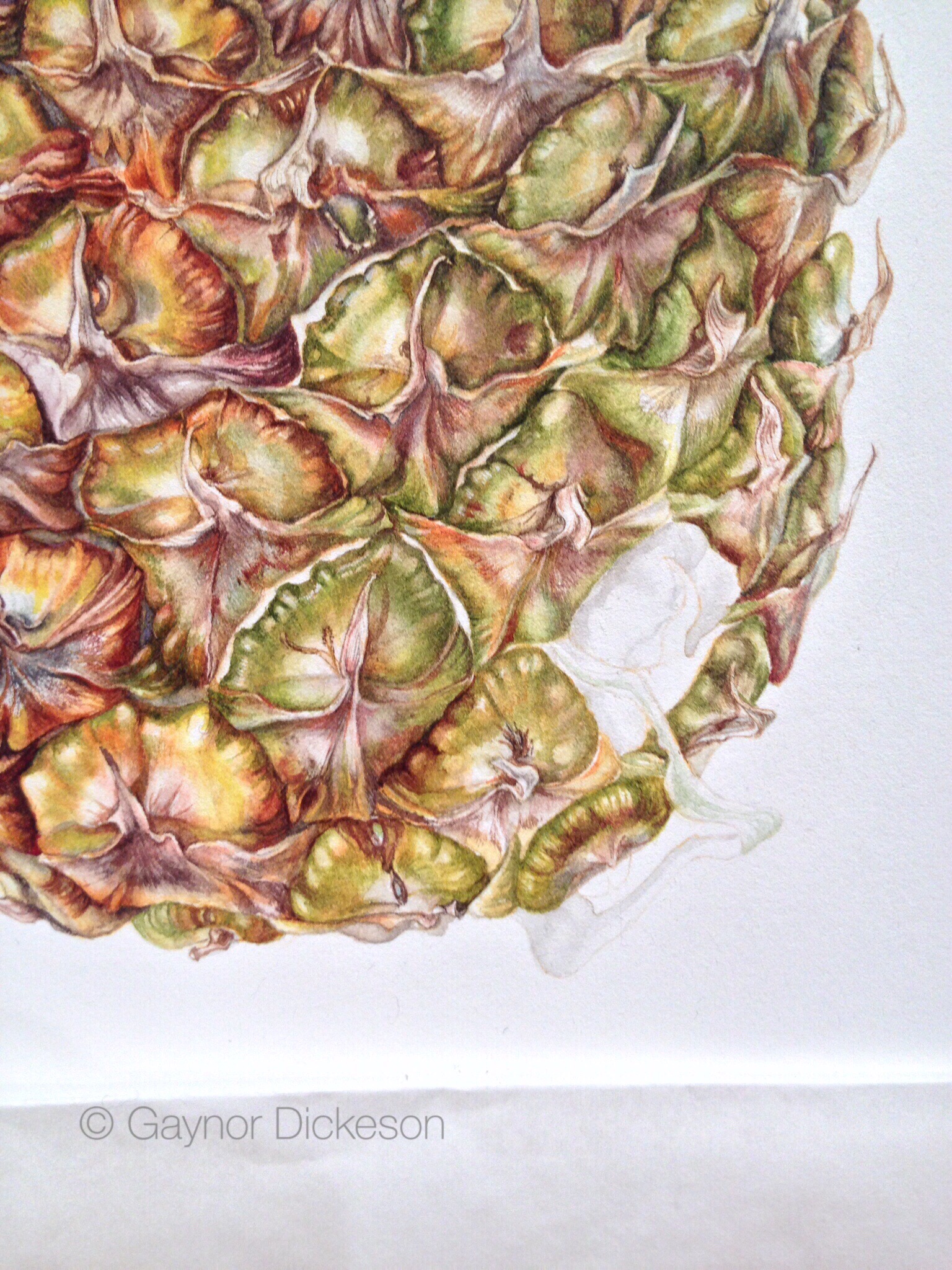
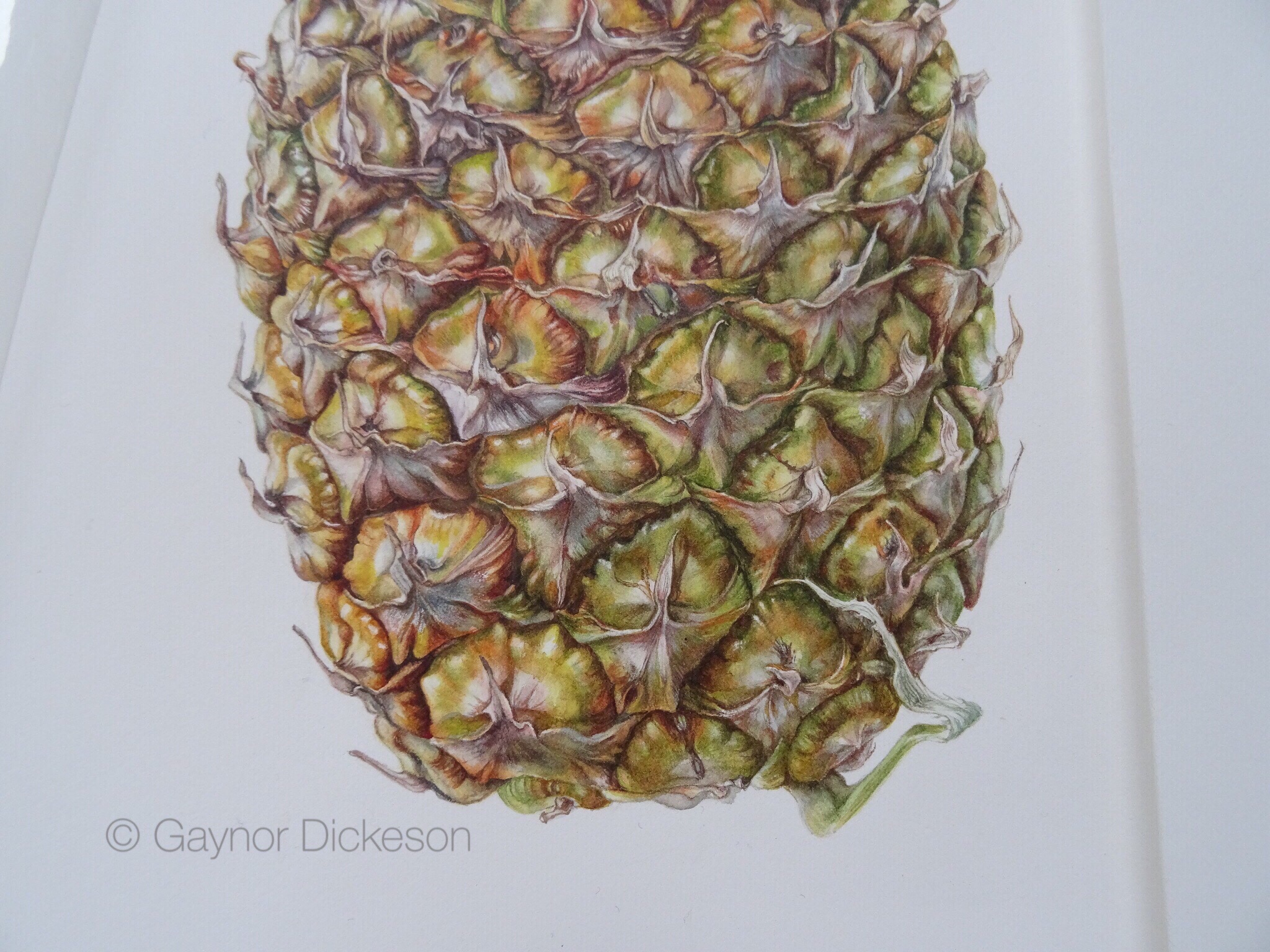
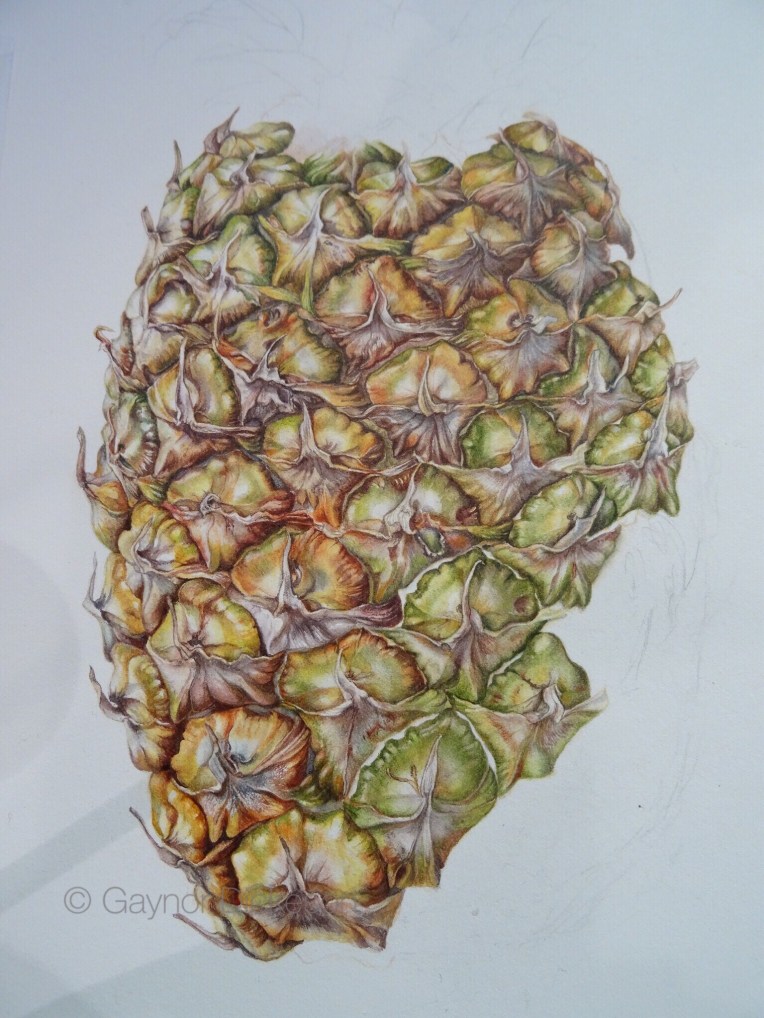
Last of all, how is the pineapple doing? In showing these pictures, I am being careful not to show how I have pulled the painting together as a whole. I think it important that the person who is to receive it, should see it first as a complete picture. Once that happens, I will then post it on my blog.

More pictures!
IMG_0073

IMG_0074

IMG_0075

From the fruit to the leaves. I read somewhere the other day about someone needing to get into the ‘zone’, when painting a picture. That really struck me with this pineapple, because it was so different from the last piece of work I did. It had to feel right before I actually started putting paint on the paper. I had to feel confident that the colours I was going to use were the right ones, and that the sequence of colours and the way I laid them, were right for this picture too.

I now had this feeling all over again. I was going to use exactly the same colours as I used for the fruit, but in different mixes. The textural effect I wanted would be completely different. It felt like starting from the beginning and needing to get in the ‘zone’ – but more importantly I couldn’t afford to make any mistakes at this stage. I had to be confident of what I was doing, before I did it.

I started off with painting the shadows in a neutral mix. This was to establish where the light came from, and therefore how the shadows would have an effect on the shape of the leaves. I couldn’t do this in the same way with the fruit part of the picture, because I knew I would be using a series of pineapples and painting each segment from the ‘fresh pineapple of the moment’. By the way, I used four pineapples for the fruit.

Have you noticed how the pineapple fibre really gets caught between your teeth?

Back to painting the leaves. Once I had established where the shadows would be, I started painting the leaves where I could see the upper surface, which was a darker green and quite shiny. I needed to make sure I had some good tonal contrasts in these areas. Am I succeeding?

IMG_0076

More pineapple segments

I have a feeling that posting the progression of this pineapple might be just a little boring for some. But on the other hand it also portrays the amount of work necessary and how I have to continually adjust the colours and the segments in relation to each other.

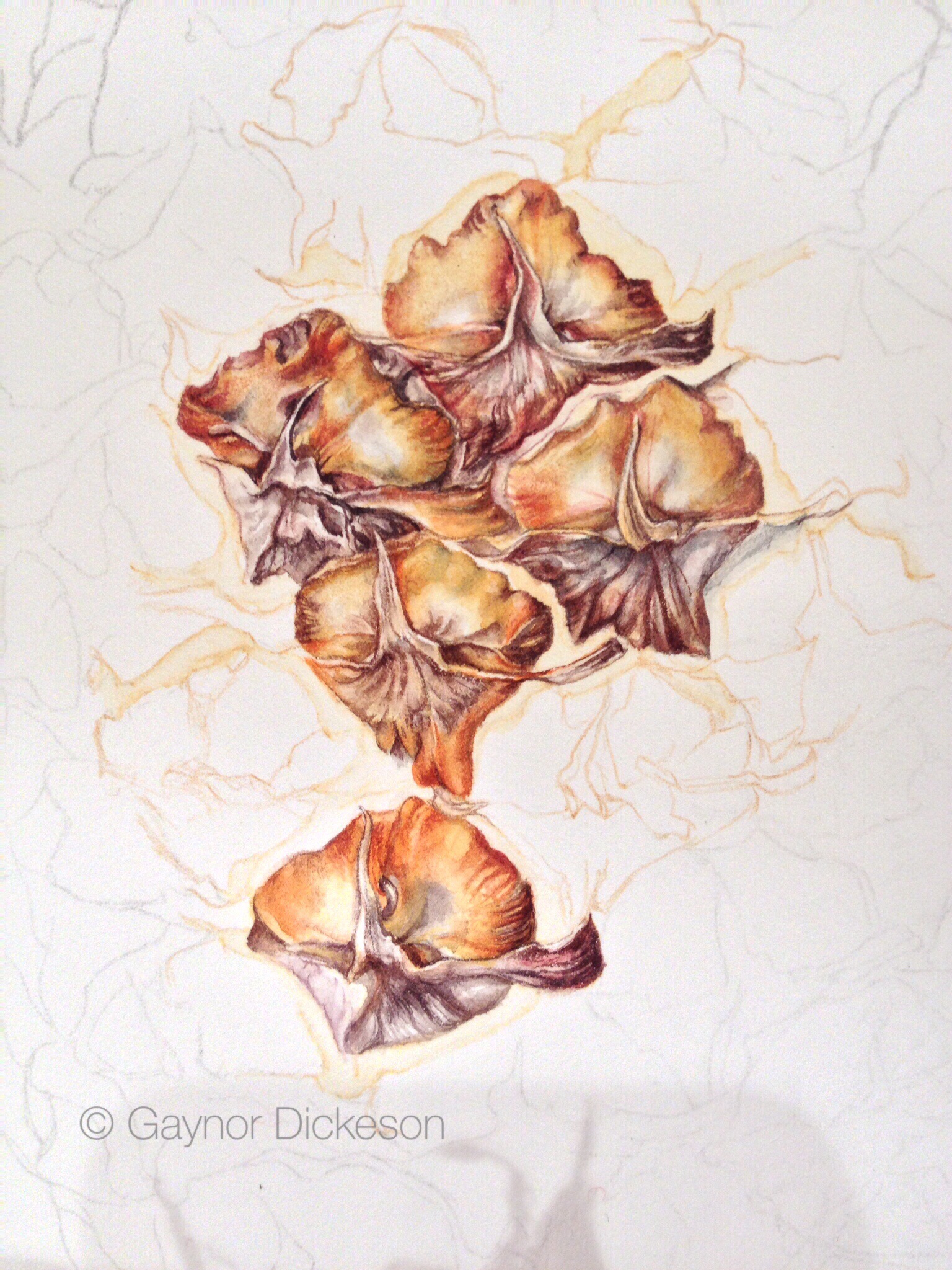
Knowing how I paint each segment in a rapidly changing pineapple is interesting in itself. Obviously I paint what I see, but I have to bear in mind that once all the segments are done, they need to be moulded into a complete shape. I can envisage that being the tricky part.

For this past week I have been painting every spare moment. My pineapple is somewhat further advanced than I am showing you here, but as this is a commission, I don’t feel it is right to show the completed work until the client has received the picture. The picture is far from being complete, although to date we have eaten four pineapples that were rather the worse for wear. They still tasted good though!

I mentioned that I take pains to draw the pineapple and arrange the segments appropriately. Once that is done I transfer this to my watercolour paper. But what happens then, particularly when I have to change pineapples? This is why I draw the segments in so they can easily be adjusted. I paint from life, therefore when I begin a new pineapple, I place it in such a position as to be able to find segments facing the same direction as on my original drawing.

Sometimes it can be quite difficult as every segment is different, and may not fit in too well. But so far it is going OK.

I have just had a thought. The Norwegian Botanical Art holiday workshop is over a longish period where one can work continuously and with guidance. A pineapple (although not of Norwegian origin) would be something one could work on. Do you fancy having a go? Look at http://www.gaynorsflora.com/page10.htm for details.

IMG_0062

IMG_0063

IMG_0064

IMG_0061

Another Pineapple in watercolour

It is now several years since I painted my last pineapple and I have been asked to paint another one. I started the drawing before I went to Norway and today have got back to it having caught up (sort of) with other outstanding tasks that accumulated whilst I was away.

The trouble is, we had to eat the last pineapple before we went away! So what do I do? It was delicious by the way.

When you buy a pineapple, it has been cut and removed from the parent plant. This of course is obvious, but what is less understood is that it will not become riper after it has been cut. As far as I understand the pineapples are cut at their ripest. Some buyers prefer to buy them green and if the golden yellow colour is wanted they are sprayed about a week prior to harvest with a plant growth regulator. If you want to check this up read http://en.wikipedia.org/wiki/Pineapple.

The pineapples that I have bought are mainly from Costa Rica and I think are the cultivar “smooth cayenne”.

I normally take pictures of my subject first so that I have an idea of what it originally looked like, so that when it dies or rots too much, I can replace it with a fresher specimen. In this instance my original drawing and placing of segments will be different to any other pineapple I get. But, I can use segments in the new pineapple, making sure that they are in a similar position and lit in a similar way to the original specimen. Thus I can continue to paint from life – which for a botanical artist is far the best thing to do.

My initial work:

Initial pineapple drawing.

Note the tramlines in a Fibonacci spiral. I observe the lines, draw the crossing tramlines and at each intersection place a segment. Once a tracing has been made, I do a very rough shading on the original sketch to indicate the form of the fruit.

The tracing of the original drawing.

I traced over onto a Fabriano Classico HP 640gsm paper in a manner that I have previously described in one of my blogs. This leaves no indentations from the pencil and is easily removed before painting.

03.IMG_1985


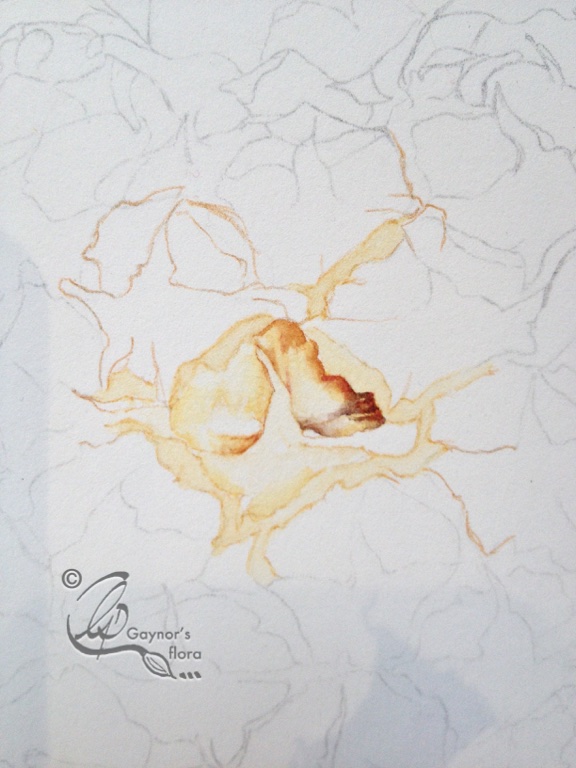
I used a watercolour pencil to lightly outline my segments in an area of the pineapple I can manage initially. When I begin to paint, this colour will be absorbed into the painting avoiding lines. I don’t do too many at once in case I really need to change any of the segments in a later pineapple.


Autumn colour workshop Saturday – and Palmengarten

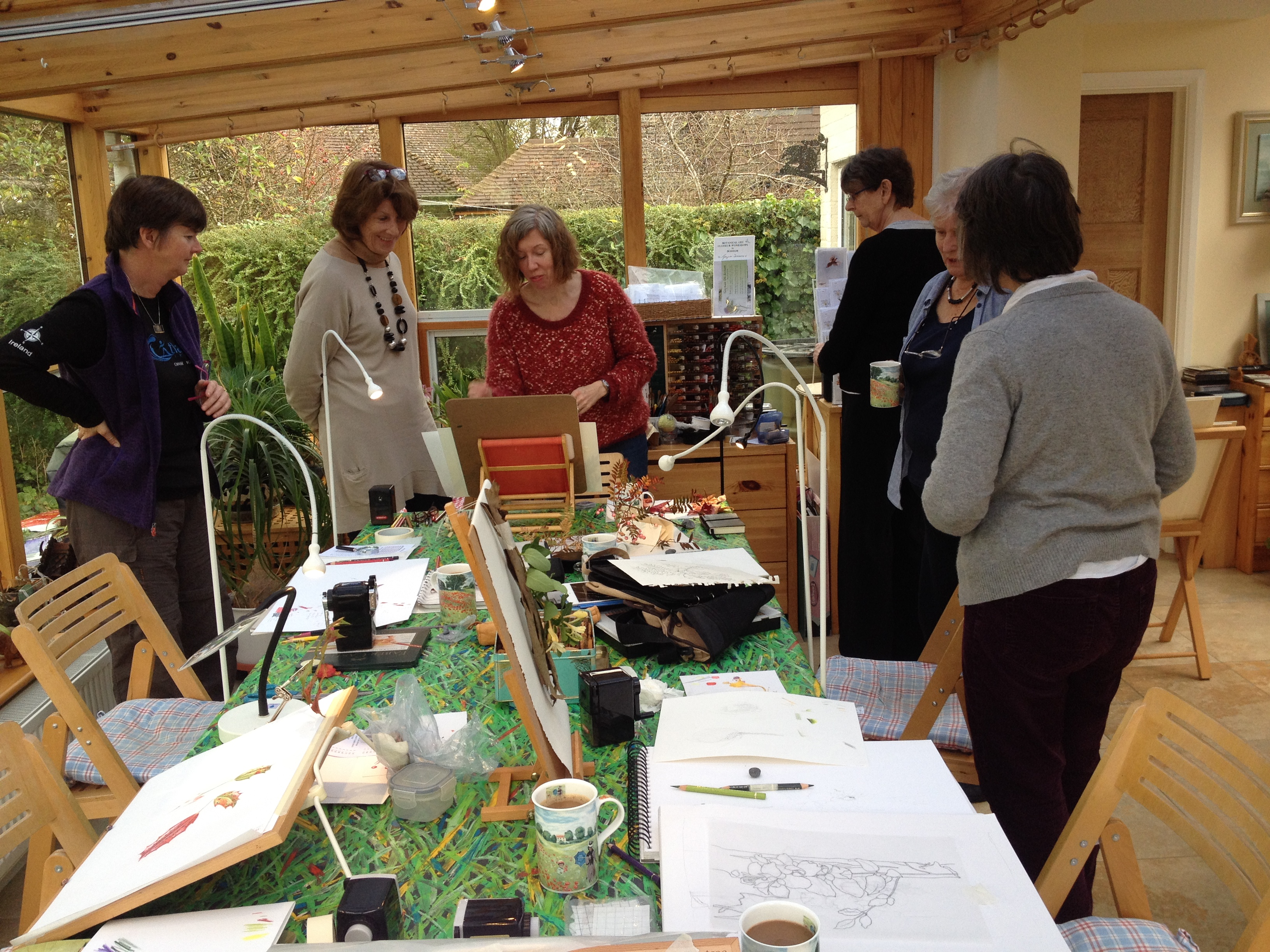
I have had a very good day in teaching this workshop. I mentioned yesterday that I had the feeling that there would be some lovely results from the workshop; that feeling persists.

Even so, their accomplishments continue to amaze me and therefore I also need to be on my toes and give enough advice for continued development. I was glad to see that they took a couple of active breaks whilst drinking their tea or coffee, so that they could go back to the drawing board with fresh eyes. But, even though taking a break they continued to discuss their progress.

IMG_1690 IMG_1692


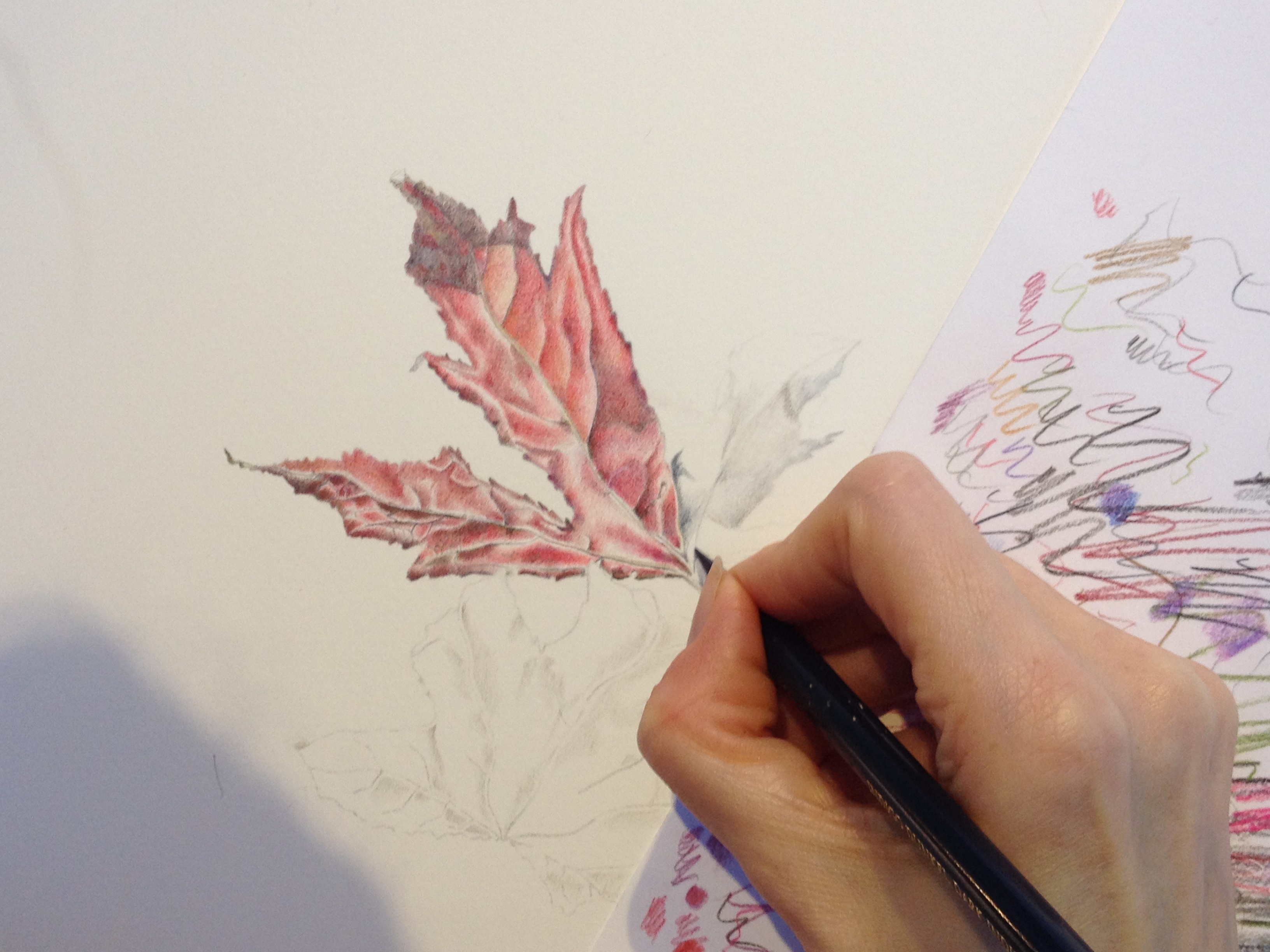
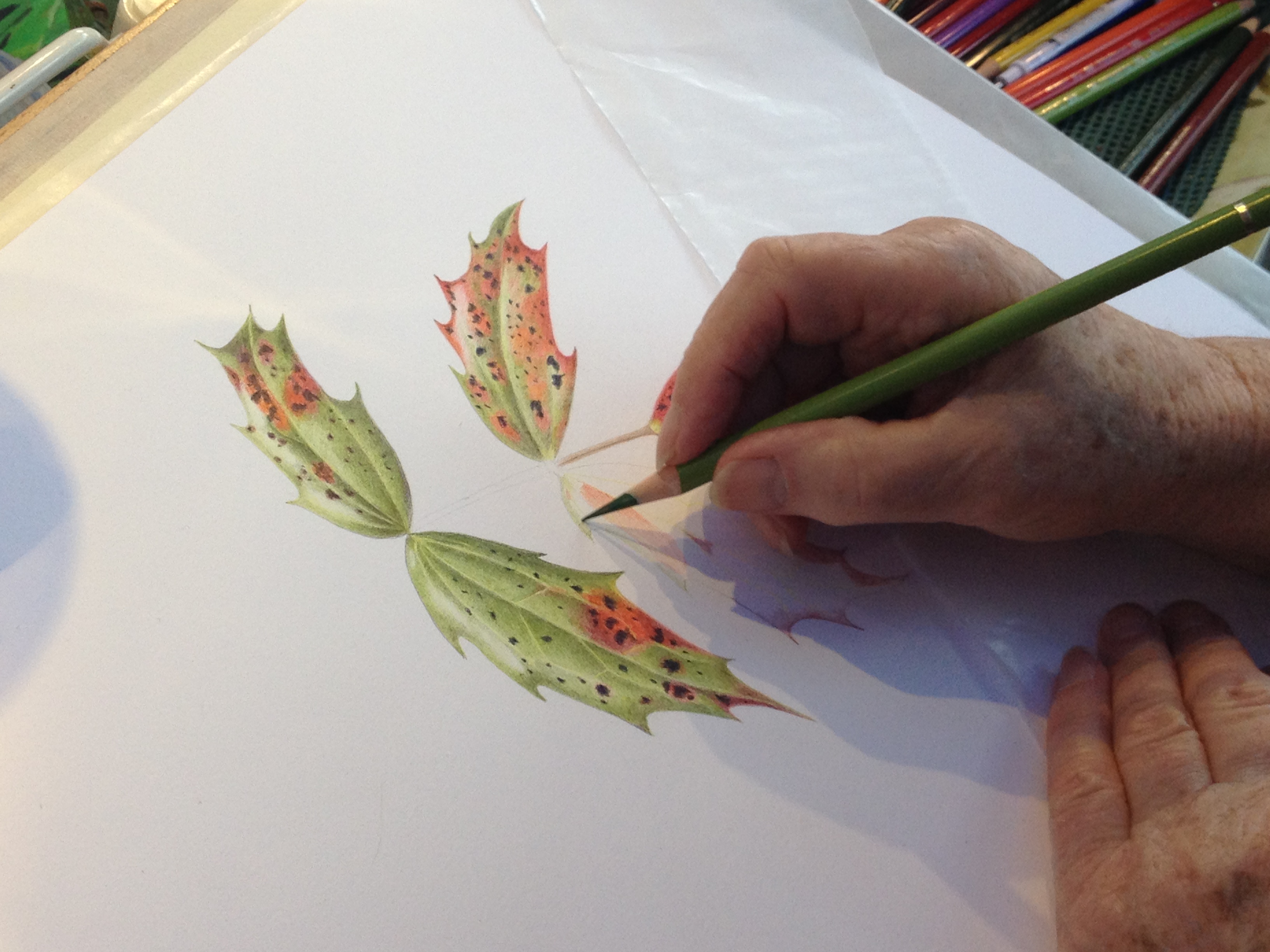
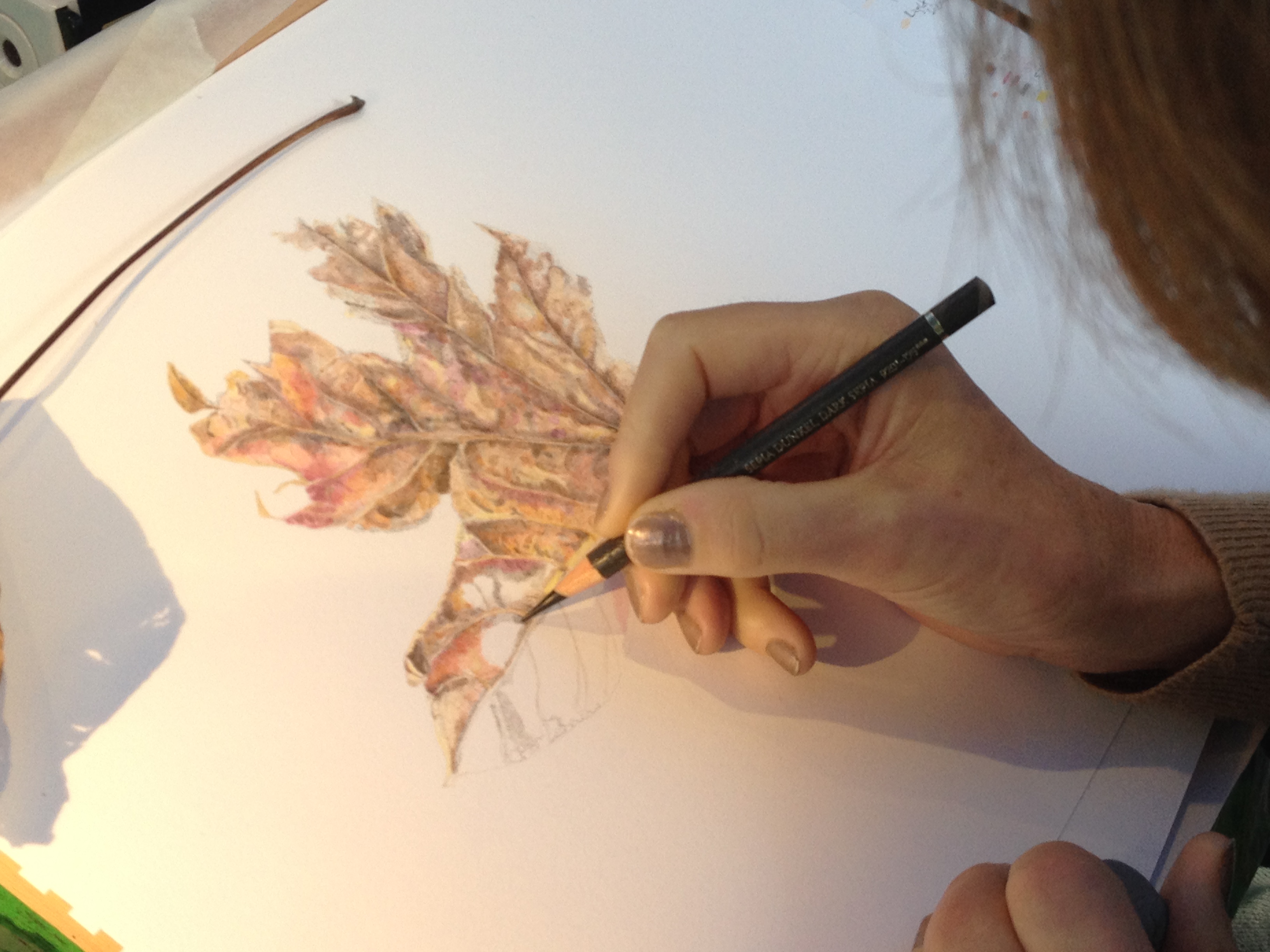
Some of the work as it is developing. There is a huge difference in each of their styles of working and every student has a struggle with a certain aspect of their picture. Two of the pictures were started on Monday at the SFP workshop, but you can see how their pictures are developing. Some have chosen very complicated pieces to draw and in fact only started using coloured pencil this morning. Not all of the pictures are shown here.

Liquid amber
Liquid amber
Liquid amber
Liquid amber
Mahonia
Mahonia
Horse Chestnut leaf
Horse Chestnut leaf

The last one shown below is the Honeysuckle. I think you might be able to understand the quandary the artist has when painting this picture. We are now in mid November, she has found this Honeysuckle still flowering, but knows that its days are numbered. In addition to the limited supply, she also wants to get done that part of the plant that is likely to die first – the flowers. This is typical of all botanical art painted from a live subject – what do you paint first and what is likely to change most?

In addition to this, if choosing to paint the flowers first, how much shading does one put into the flowers? If the dark leaves are done first, then the ‘hole’ left in the picture for the flowers is likely to need much less shading than if done without a dark background.

Painting white or very pale flowers on white is quite daunting. It is possible, but one has to make sure that the shading to create form, is not overdone. The problem is minimised if the pale flowers are against a dark background, or background of leaves. The hole you leave in the painting for the flower is a shape and therefore the problems of creating the appearance of three-dimensional form are reduced.

The form of a subject is created by light hitting the surface of the subject. Some areas will be exposed to light and some areas less exposed to light or very little light. Thus the combination of the flat shape of the object, and the tonal differences created by light exposure, give you form; and a means of identifying the object. Colour is another issue altogether.

In the case of this Honeysuckle, it was decided that a grey underpainting on the leaves would be done first so that the flowers would stand out as white shapes. Before the leaves are completed fully, the flowers will be completed delicately and the leaves finished afterwards. The bark will be finished last of all but I doubt that you will get to see that part of the picture.

Honeysuckle attached to Eucalyptus bark.

So, some more pictures from the Botanical art exhibition held in Palmengarten the botanical gardens, Frankfurt, Germany.


Artwork by Linda Pitt, Roberta Mattioli and Hazel Rush
Artwork by Nicki Tullett, Charlotte Linder, Rosemary Lindsay & Anne Lawton
Artwork by Barbara Munro, Charlotte Linder
Artwork by Sue J. Williams and Janet Pope

Palmengarten – Tuesday week 3 (and botanical form tips)

Back to almost normal for one day. I had my weekly class today instead of tomorrow as we are going up to London for the SBA Christmas meeting.

A lot of the teaching today was based around form and observing tonal values relative to the light source. Sometimes students find this a difficult area, particularly if the surface area of the subject is very uneven and absorbs the available light.

It can sometimes help to use a substitute smooth shape, to work out the underlying tonal values and thus the form. For example, with a spherical shape there might be difficulties in determining where the light falls and what is in shade, depth of shade and areas of reflective light. One can use a ball as a substitute and cover it with cling film to make the surface smooth. This will in turn reflect light well and highlight differences in tonal values creating a clearer three- dimensional form. The complications of texture, patterns and colour are reduced during this phase and can be added once the shape and form have been established.

Palmengarten news. Sue has had a good day at Palmengarten with a lot of interest again both in the gardens and the botanical art exhibition. She was very relieved to experience that this evening the trains were at last running normally and she got home at an acceptable time.

There are three new green dots on pictures indicating that they have been reserved!

IMG_0952.JPG
Artwork by Sue Wickison

IMG_0984.JPG
Artwork by Sarah Caswell & Linda Hampson

IMG_0951.JPG
Artwork by Angeline De Meester & Sandra Armitage

IMG_0983.JPG
Artwork by Elisabeth Sherras Clark & Sue Wickison

IMG_0918.JPG

Botanical art on Vellum

Again I haven’t done too much painting over the last week as we have had family staying and we took the opportunity to have a little bit of a holiday with them.

But now I’m back to painting.

Whilst in Pittsburgh last year there were several botanical artists who tried to persuade me about the benefits of painting on Vellum. I saw some really beautiful work there and was really tempted. My husband bought me a few small sheets for Christmas and it has been lying there. Since then I have seen some more work on vellum and I wasn’t too enamoured. It definitely was not of Rory McEwen quality! You see I aim for the best.

I have been painting a small picture on vellum during the last few days. I had taken a photo of a bee on the runner beans and wanted to do this. Normally I only paint from real life and obviously this was a problem as I didn’t have the bee although did have the runner beans. I did some research on the bee and found out that it is called a Bombus pascuorum worker. It also meant that I had some other bee pictures to make sure that I got the details right. I’m not happy if I haven’t got the subject actually in front of me.

For once I decided to paint it oversize. This is another thing I don’t normally do, so I have several ‘firsts’ here. I know that I had to paint using a dry-brush technique, but still wasn’t sure how. I therefore examined the pictures in the Rory McEwen book ‘The colours of reality’. I had to refer back to this book on several occasions as I built up the layers. I thought that as I had painted on Porcelain many years ago, that I could adopt a similar process. I’m afraid that didn’t work! But I gradually began to get the hang of it and also take advantage of the fact that you can lift out mistakes.

I will put a couple of pictures in this blog, but add a few more as an album on my Facebook page.

If anyone has any tips, please let me know. I haven’t stretched the vellum, but would like to do so on larger pieces.

Runner bean leaves, first washes and details
The bee
The bee
Runner bean flower
Runner bean flower
Finished painting
Finished painting

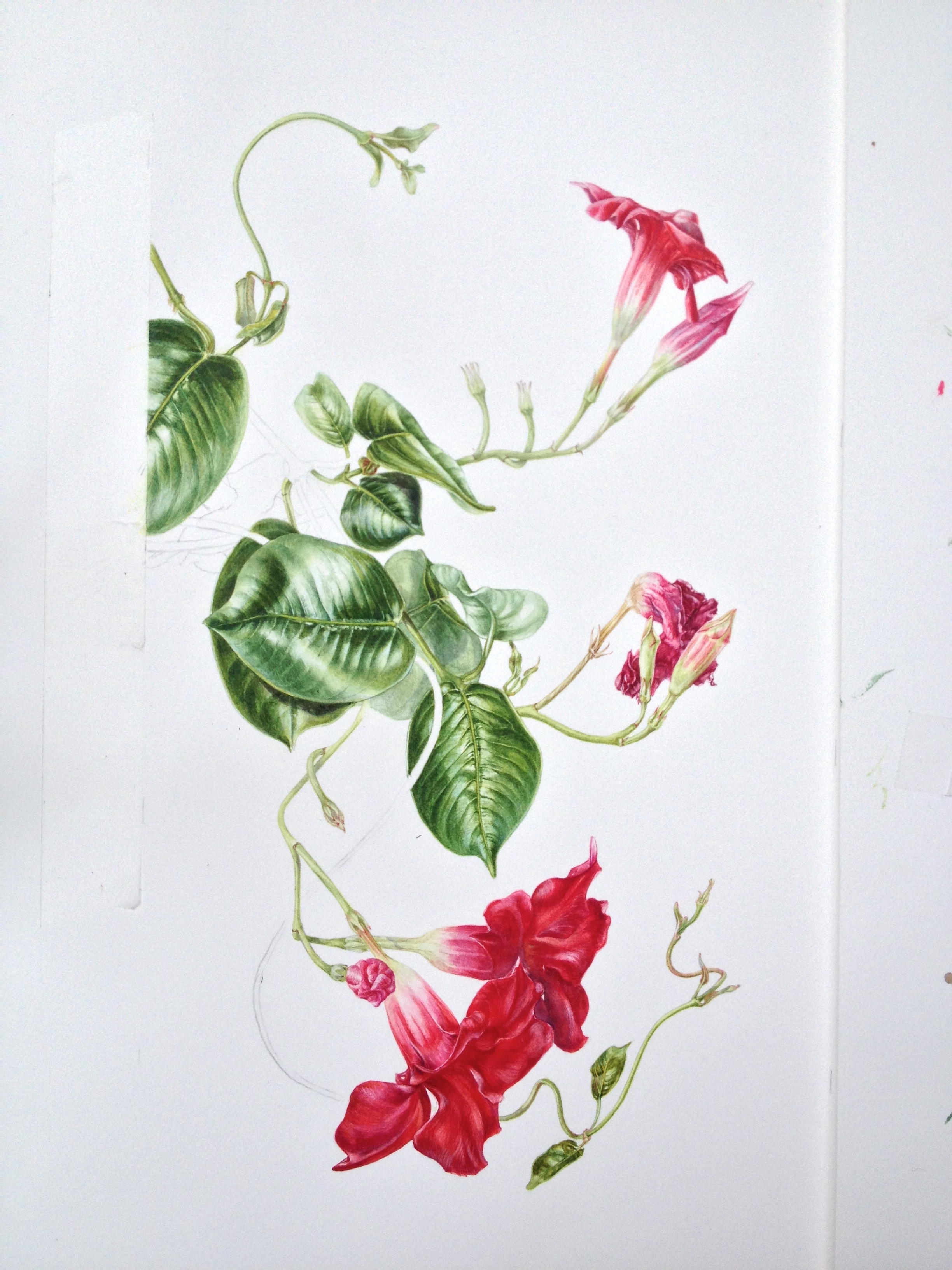
The Dipladenia: Anything missing?
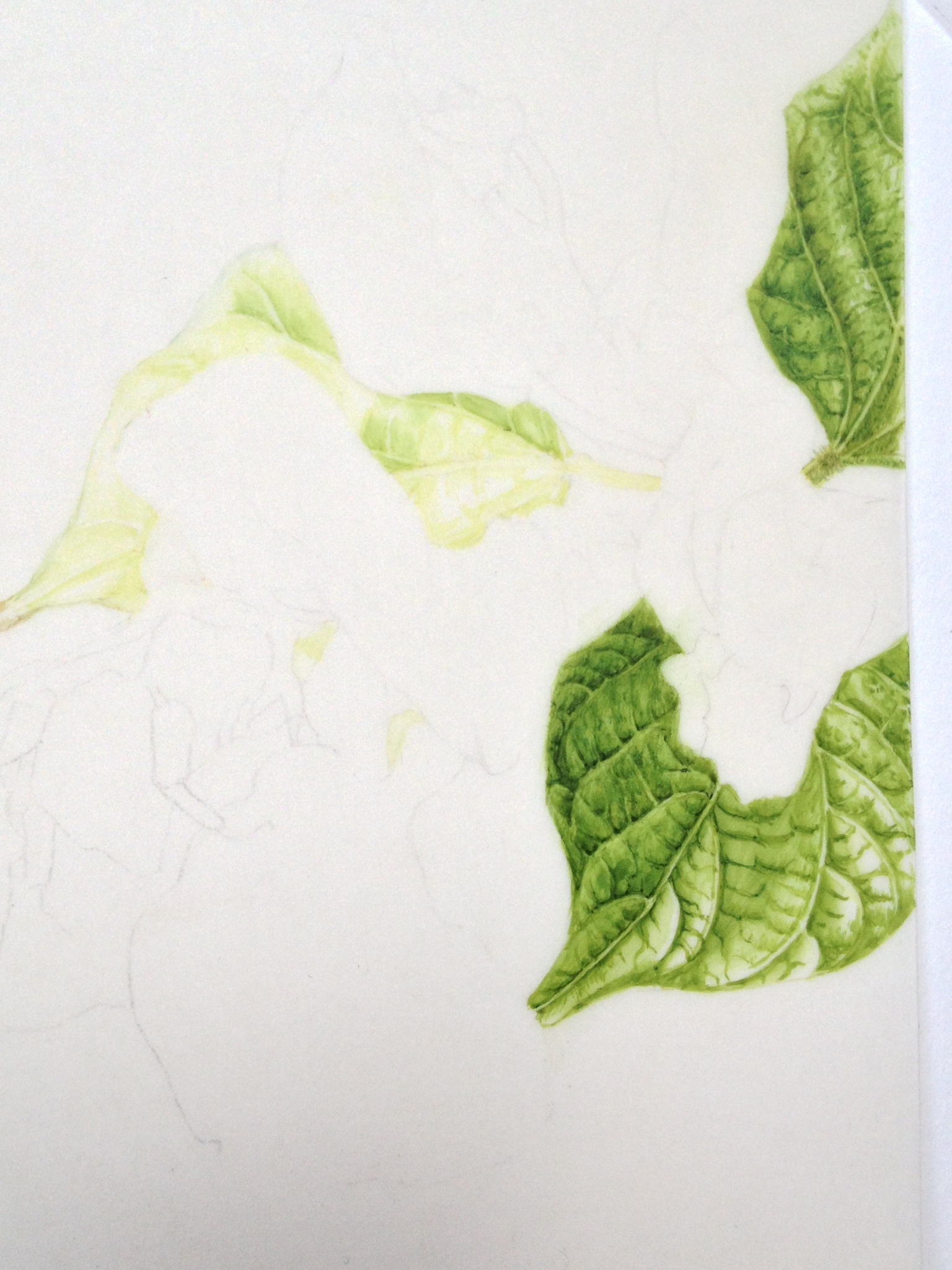
In between marking assignments and receiving pictures for the SBA exhibition at Palmengarten, the botanical gardens in Frankfurt, I have been painting.

Last time I suggested you find the part in the picture where I had made a mistake, but had rectified it.

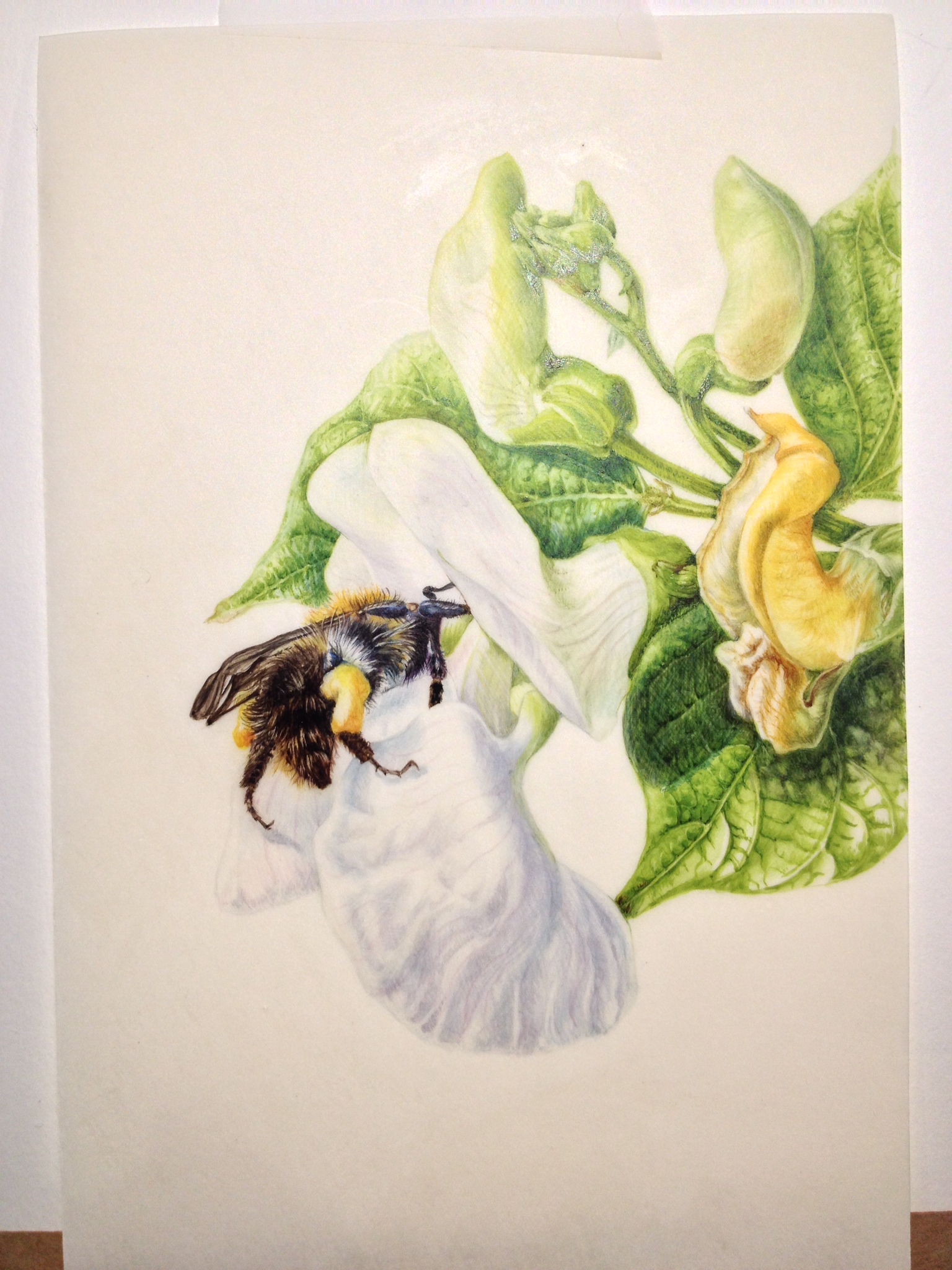
Now I have three photos of the final work on the picture – I think!

Dipladenia picture: What is needed to balance the composition?
Dipladenia picture: Notice the difference? Does it work?
Dipladenia picture: Is it finished?
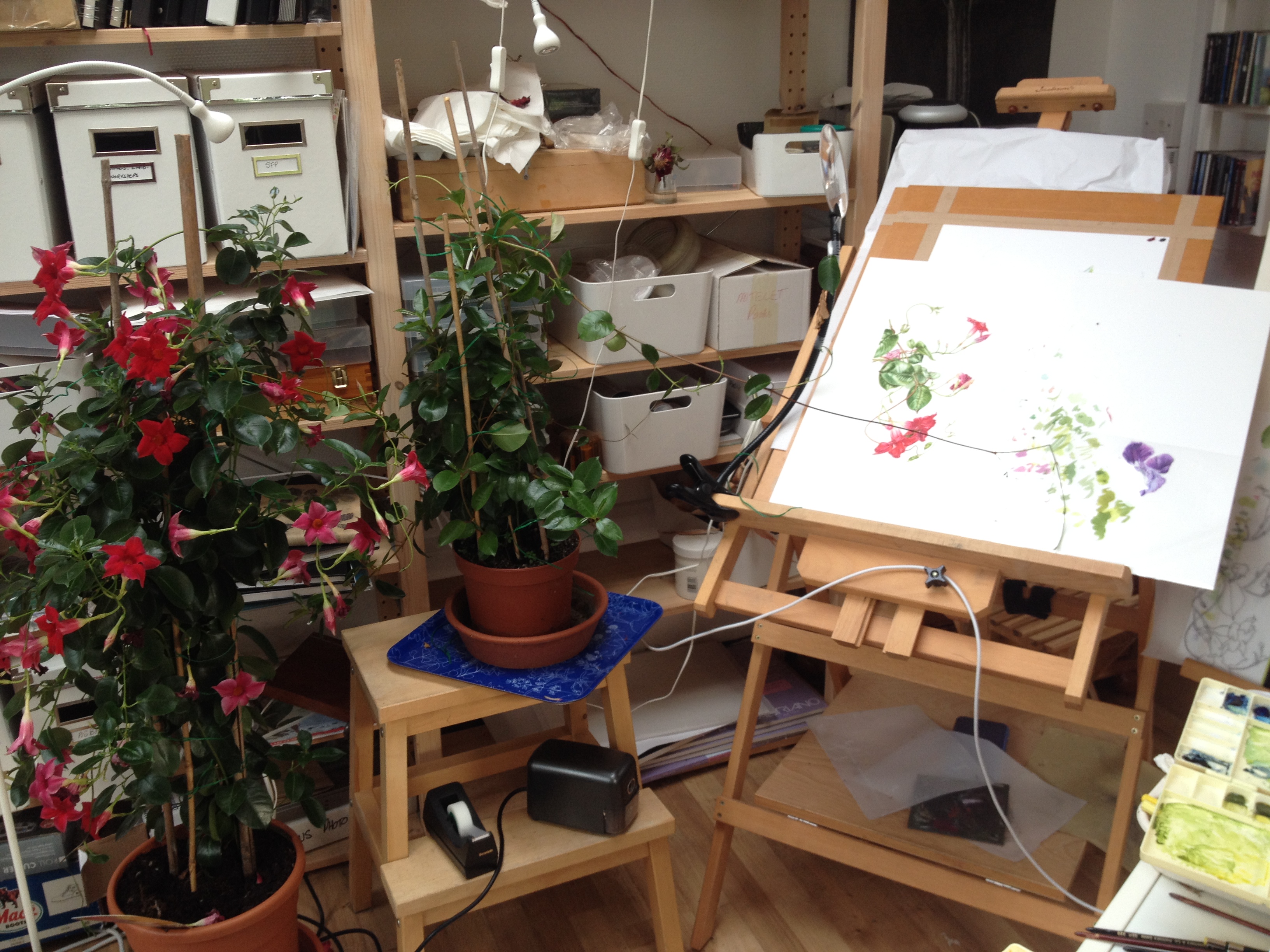
Part of my shed. The table looks as though a bomb has hit it, therefore hidden!

What to do with the plants now as it is poisonous. It nearly took the life of one of our cats and is very much a temptation to play with – as well as being very beautiful and exotic looking for our colder climate.

Botanical art workshop today – demo tomorrow.

The last day of this workshop was today. The sun shone for most of the say and obviously affected positively everyone in the room.

The workshop went well. The students seemed to be satisfied with both some of the things they had learnt, as well as what they achieved. To top it all we had a lot of fun. There seemed to be longish periods of almost silence, interspersed with hilarity.

A good workshop from the point of view of the tutor (me), but in the end everything depends on what the students got out of it.

Have a look at some of the results.

20140601-003420-2060367.jpg

20140601-003421-2061136.jpg

20140601-003419-2059491.jpg

The next workshop is Tuesday 17th until Thursday 19th June and is all about beautiful roses. How difficult can they be? Not so difficult once you are given tips in what to look for in your subject; and how to translate this onto your paper. Do get in touch if you can join me.

But tomorrow I will be demonstrating at the Oxmarket Art Centre, for the Society of Floral Painters (SFP). This time I will be demonstrating watercolour.

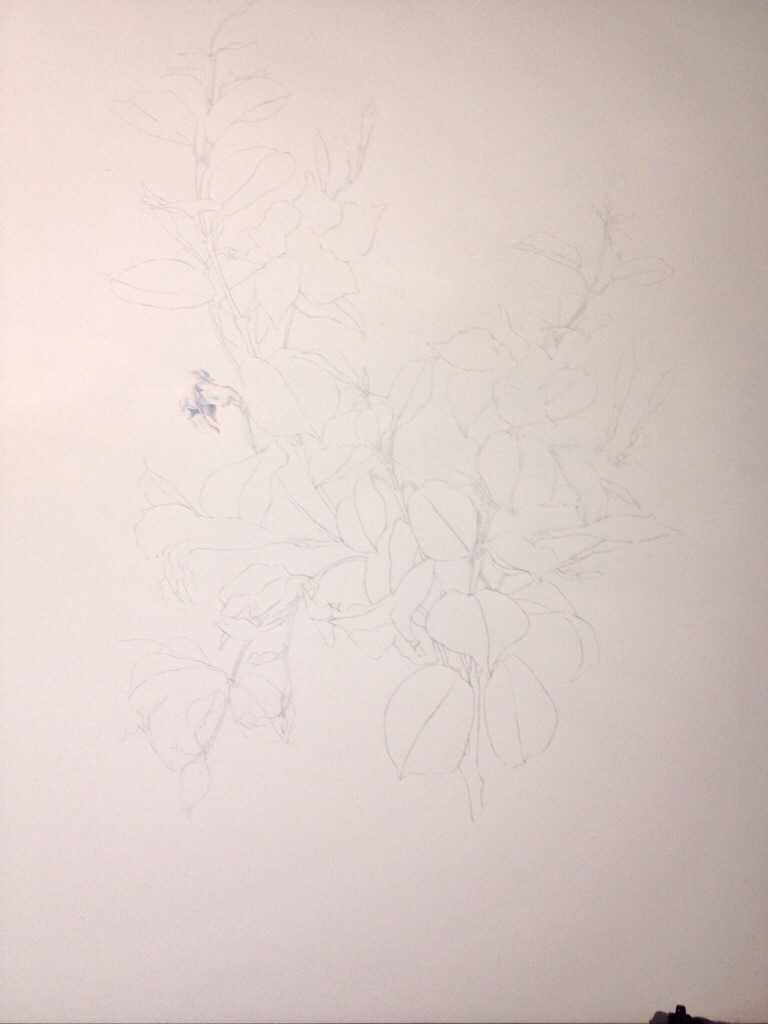
Over the last three days whilst discussing composition and drawing, I started off my composition as an example for the students today and for the demo tomorrow. My next picture has taken three evenings to draw. It is a Mandeville plant. It is quite a complex composition because of the growing habit of the plant – which needs to be shown.

My students from the last few days all wanted to come back to Chichester to see the demo, but unfortunately live too far away to be able to drop in. I promised that I would use the blog to show them how the picture develops.

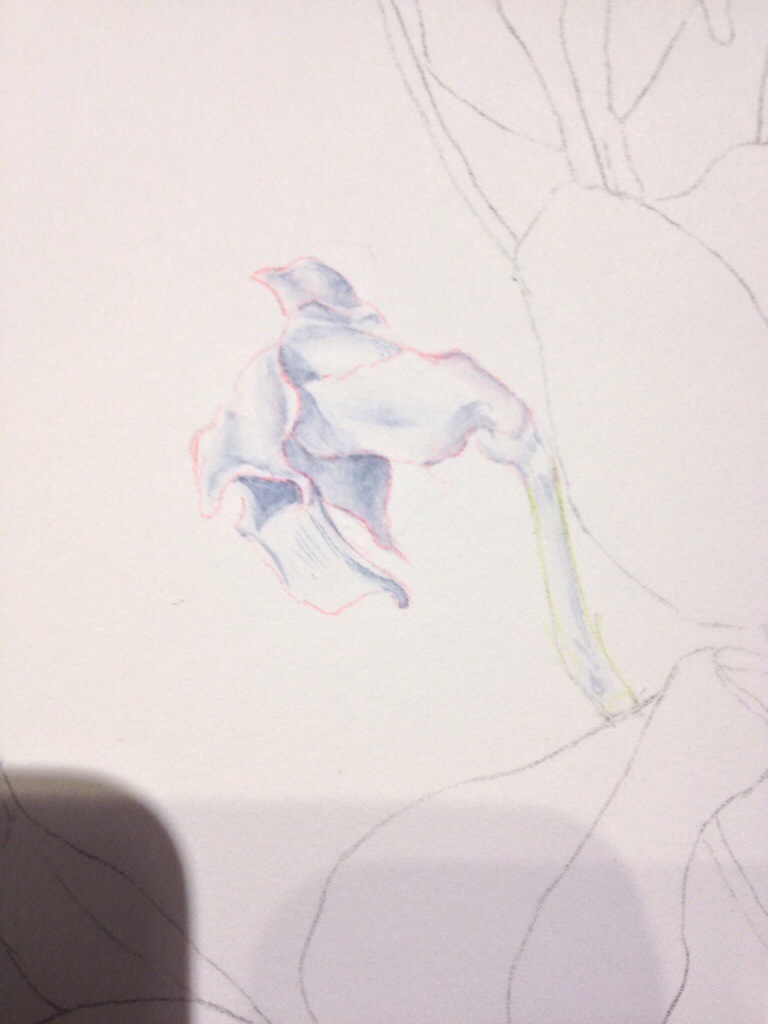
These are the the first two photos, but I am not sure whether you will see clearly enough the drawing in the first one. The second shot is the tonal under painting of a dying flower.

Hopefully one of the many buds will open tomorrow so that I can do one of the spectacular flowers.

Come and see the demo at the Oxmarket, Chichester 11:00 – 16:30.

20140601-010130-3690718.jpg

20140601-010131-3691656.jpg