How did the Pen & Ink workshop go?

‘Thanks so much for a brilliant 2 days. I thoroughly enjoyed it all!’

I got this email as soon as the student had returned home after the Pen & ink workshop. Is it any wonder that I enjoy teaching when I get a response like this?

I had a full workshop and you have already seen the step by step series I had prepared. If you want to know what each of the steps entails, you will need to sign up for one of the workshops next year.

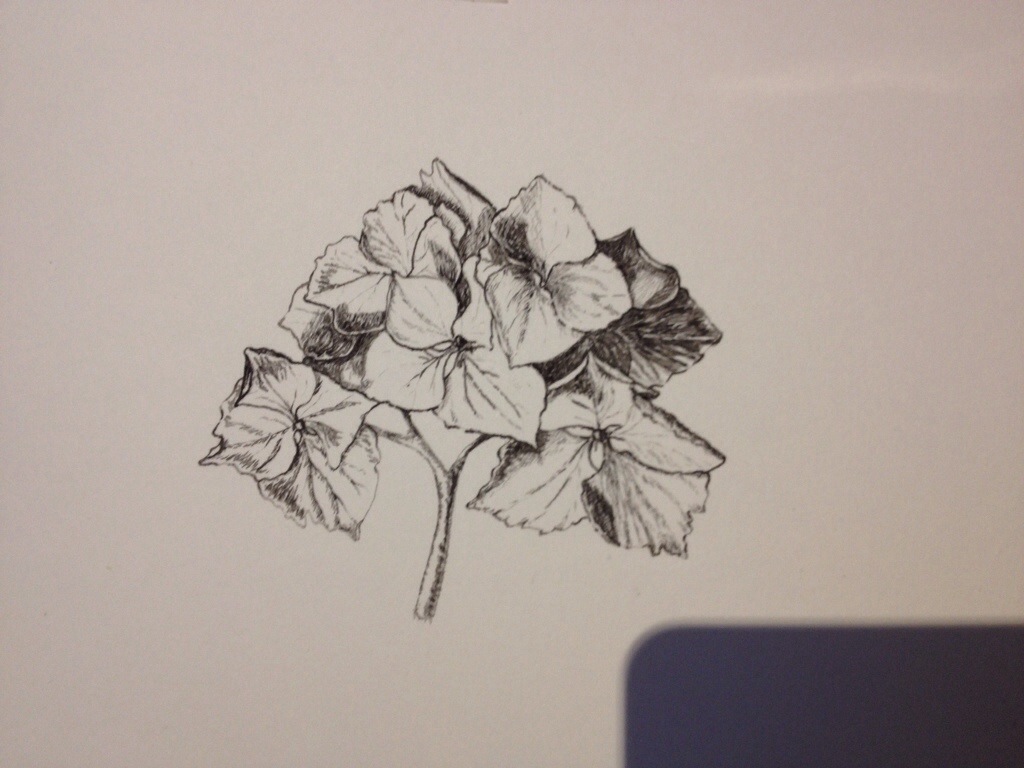
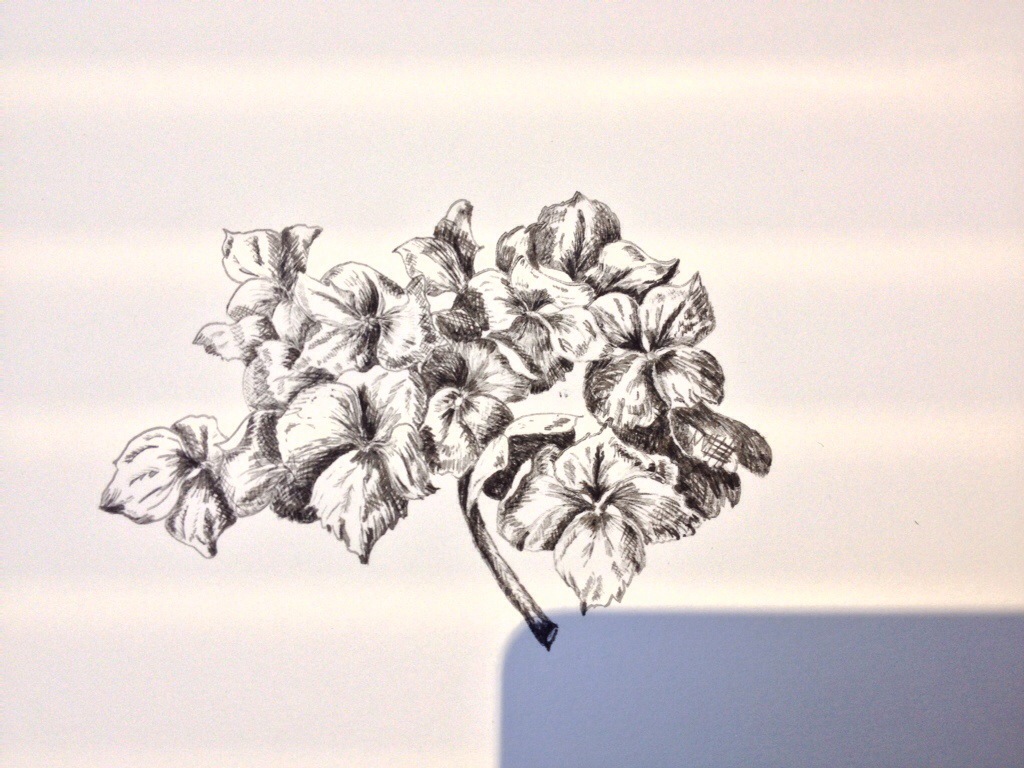
Each of those taking part worked really hard, expressed their pleasure in having done the workshop and several want to practice the technique more. Most of the students hadn’t intended drawing a Hydrangea as they thought it too difficult. But, after showing them the technique all but one attempted it. These are some of the results:

20131201-223000.jpg

20131201-223016.jpg

20131201-223317.jpg

20131201-223728.jpg

20131201-224350.jpg

20131201-224410.jpg

20131201-224425.jpg

They are good aren’t they?

Pen & Ink workshop starting on Thursday

On Thursday this week I will be having a workshop using Pen & ink.

Following the Sarah Simblet workshop in July, my students asked me to show them her technique. Obviously, although I studied Sarah’s technique, I use it in my way.

Going on a workshop doesn’t mean that you have to incorporate the teacher’s technique 100% when you finish the course, but that you use what you have learnt and incorporate some of it into your own way of working. That is why no botanical art teacher is absolutely right or absolutely wrong. We are all different and emphasise different aspects in our work.

I advise students who come to me, to also learn what they can from other teachers too, so that they can develop their own style, using elements from all they learn.

Anyway, on Thursday and Friday I will be having several students who want to learn a pen & ink technique that is not dots.

During the last few weeks I have done a series of step-by-step pictures and these should give a better idea of what is needed at each stage of the picture. I realise that without further instruction these pictures will not make full sense. But, the last picture is the completed one.

20131126-235720.jpg

20131126-235238.jpg

20131126-235318.jpg

A drying Hydrangea.

A botanical art workshop in Norway is coming

Would you like to do a botanical art workshop in Norway? Would you like to do this in Edvard Munch’s home town of Åsgårdstrand near Tønsberg in South Eastern Norway? Now is your chance.

Recently some of my students asked me to organise a summer painting holiday in Norway. I have been making enquires and this is very likely to happen from 29th June next year for one week.

The hotel in which we will stay lies on the coast along the Oslo fjord and the room in which we will be painting looks directly out onto the sea with east facing natural light. This is a fantastic time of year with long hours of daylight for us to enjoy.

Obviously, the intention is have a botanical art workshop, but I also want you to have time to relax and to look around the area. I have yet to arrange all the details, but I plan an afternoon tour of Edvard Munch’s home and studio where ‘The Scream’ was born.

Please let me know if you would like to join us as soon as possible as I keep my classes small so that I can give everyone the individual attention they need.

Hear are a few pictures from the beautiful area around Tønsberg, Nøtterøy and the islands in the area. Are they tempting you? Do the brilliant colours make you want to paint?

20131126-003105.jpg

20131126-003137.jpg

20131126-003225.jpg

Teaching at West Dean

Thus last week has been incredibly unexpected – and busy.

Last week my husband and daughter made quick decisions about moving her goods and chattels from Amsterdam to her new lovely home in Tønsberg, Norway. I was not too happy as this meant I wouldn’t see her new home -yet. But as I had classes, these were my primary responsibility and I couldn’t let my students down.

I remained at home licking my wounds, but consoling myself that I would have plenty of time to paint.

After a few days, I got a call from West Dean. They said it was a mercy call, asking me to step in for one of the teachers; a colleague whose work and techniques I know well. I made a few calls to re-arrange my own plans, and stepped in!

Obviously, before I arrived at West Dean I did worry a little about what I was letting myself into, but trusted that my friend had made notes of what she had planned. When I arrived, I met a really lovely, welcoming group of people and a programme.

Because the morning had been wasted, I worked with the group unto 21:15 to catch up so that they wouldn’t lose out on too much. They weren’t going to get the tutor they signed up for, but it was important not to lose out on more than this. By the way, the topic was about mixing colour in watercolour.

During the remaining days, I got to know the group fairly well and an extremely good time was had by all – at least as far as I could see. I enjoyed myself and as usual learnt a lot from them too. I stuck to the programme already laid out, giving the students the information and showing the technique that my colleague used. As can be expected I was able to make additional suggestions from my own techniques which they found useful.

20131116-204025.jpg

20131116-204042.jpg

20131116-204106.jpg
All very quick demos on the course.

Botanical art workshop – Autumn colours – in Bosham

Well, I mentioned that I was due to have a botanical art workshop from Friday until today. Are interested in how it went?

I have been allowed to take the following pictures and you can judge from these how it went. I and the people who came, would obviously be very interested in your feedback, so please comment.

20131103-225647.jpg

20131103-225707.jpg

20131103-225738.jpg

20131103-225752.jpg

Some of the subjects.
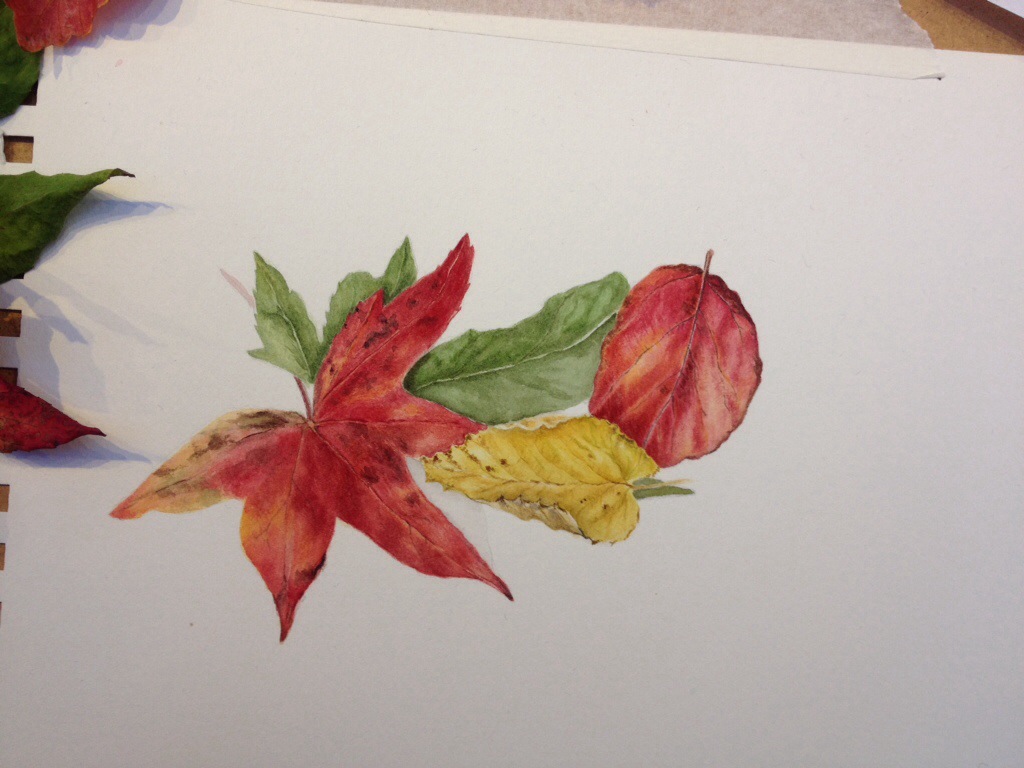
As usual, we took a photo once the position of the subjects had been arrived at. As I have suggested previously, it is worth doing this as we are painting from living things and they change over time. If something wilts, we can replace that element and if we knock something out of position, we can re-arrange. We still paint from living subjects.

20131103-230349.jpg

Enjoying the company and the opportunity to paint.

20131103-232501.jpg
Glory tree – Coloured pencil

20131103-232604.jpg
Malus Gorgeous – coloured pencil

20131103-232705.jpg
Fallen leaves – Watercolour

20131103-232756.jpg
A pear plus Malus Gorgeous and Golden Hornet crab apples – Coloured pencils.

I think that you will agree that these are lovely pictures that are well on their way to completion. But, what is even more amazing is that some of the students had not done much in the way of their chosen medium previously and they accomplished so much in this one workshop. It was exciting to watch them develop. No wonder I enjoy teaching!

Botanical art workshop starting tomorrow

Tomorrow morning several students will be arriving to do a botanical art workshop entitled ‘Autumn Colours’. Obviously with the storm that was, and the pouring rain today and forecast for tomorrow, I am not exactly sure what people will be wanting to paint.

This year the seasons seem to be running a little late and the trees are not really changing too much yet. We have nothing like the number of Maple trees in the near vicinity that have the colour that we saw in the Adirondacks, but we do have one or two. One of our neighbours has a Liquid Amber tree, but only the leaves at the top have begun to change colour.

The things that are striking in our garden are the different colours of the crab apples. In fact, as we now have all six sorts that I am in the process of painting, they do make a spectacular picture dotted around the garden. I can imagine that someone might be tempted to paint one of them or even an apple scattering from each of them!

One thing is sure, that someone will arrive with something that I want to paint!

20131031-231645.jpg

Do you use photographs in botanical art?!!!!

Yes. Sort of.

Some of my paintings take around two years to complete especially if I am doing a series of paintings and they include; A year in the life of………

How do you complete a series of paintings if the series is from the same genus and they bloom and fruit at similar times?

This is how I do some of it. As an example I will use the picture that I have been working on this week. Malus Gorgeous.

In the spring last year I did some sketches, colour detail and size of the blossom. I had to do five other crab apple trees at the same time and, during a ten-day period. This year I did dissections of blooms from the same trees and preparation sketches of the dissections to include in the pictures.

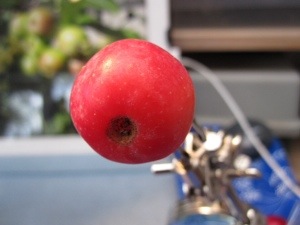
Going back to the Malus Gorgeous specifically, this summer I planned the composition and sketched this out on my final paper. I used elements from various pictures I had taken of the small tree. Bearing in mind that the apples were not full size and far from ripe and the finished painting was to include ripe fruit. The photographs were and are only a rough guide. This is the photograph I used for the main bunch of fruit.

20131018-202924.jpg

I had to enlarge the fruit slightly to the size they were likely to be when ripe, allowing for the fact that even this allowance might be slightly out. I had measured the ripe fruit the previous year so had a good idea of the size. I then started painting the leaves.

I picked the leaves I intended to paint, one at a time. None of them the ones in the photo. Some were more interesting than others, but I had to make sure that the leaves I picked were the ones arising from the fruit spur. These were the type I had included in my picture, and not those born on new shoots, as these are more leathery and differ quite a bit.

20131018-205331.jpg

I positioned each leaf as I had sketched it in my composition and painted it into the picture until most of the leaves were in place.

I have been doing the same with the apples. These are this years ripe apples. They have started falling off the branches, therefore I had to get on and paint them whilst I could – particularly if I wanted the series finished to exhibit at the RHS next year. That is if I get exhibition space.

20131018-210219.jpg

Funnily enough and, luckily, the apples seem to last different lengths of time on the trees. But there isn’t much in it, so I have to plough on until all the apples are finished.

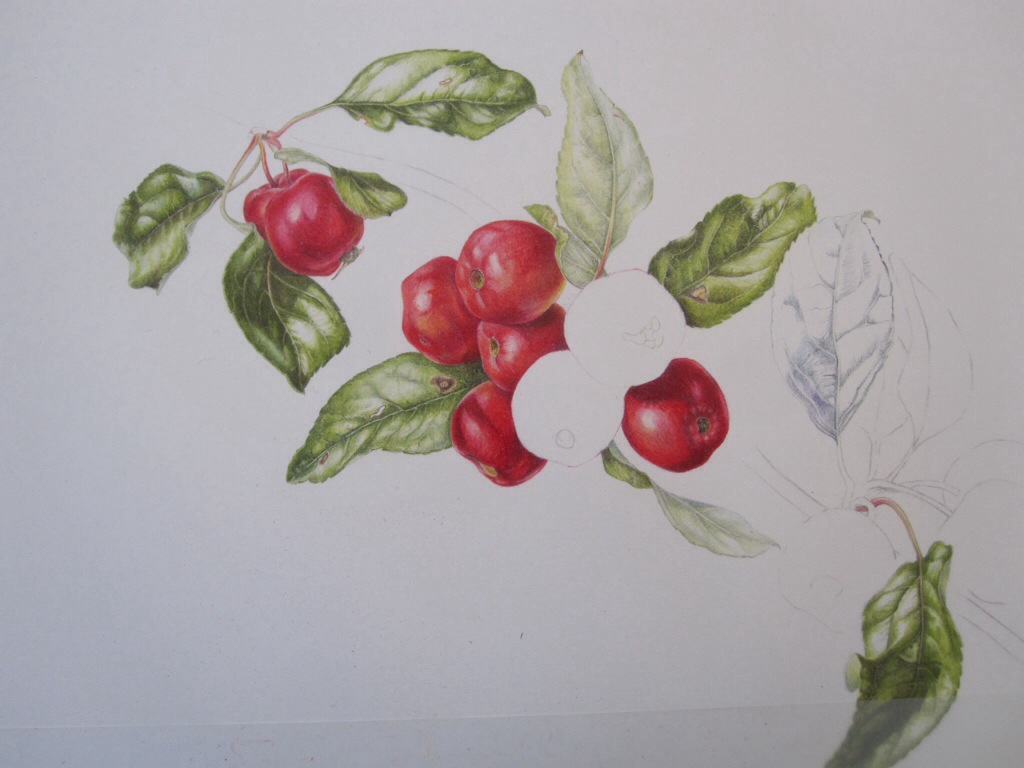
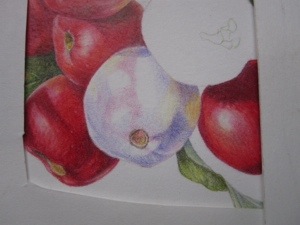
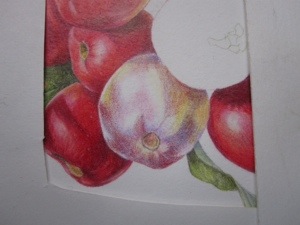
Some of the pictures of the apples being painted – with coloured pencil used dry in case anyone was wondering.

20131018-211337.jpg

20131018-211407.jpg

20131018-211426.jpg

20131018-211727.jpg

Today I managed to do all the apples. I have a couple more leaves to do and then have the dissections and branches to put in the picture. But that won’t happen yet as I have to catch up on all six pictures. The sketches Of the dissections that I have in my sketchbook will give me enough information to do this at a later time. Don’t forget that once everything is in place it has to be tied together with shadows etc in the right places.

As you see I do use photographs in botanical art, but every element in my pictures are painted from life.

By the way, comments or queries are very welcome.

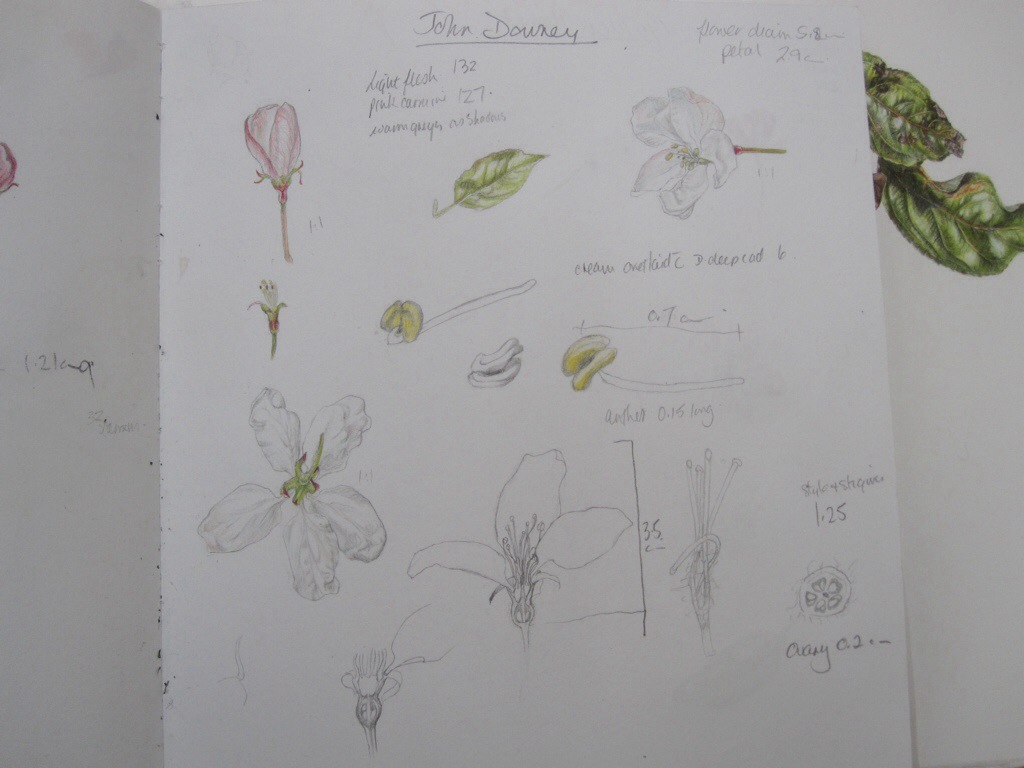
My sketchbook page.

20131018-213801.jpg

Back home to crab apples

So far this week I have been catching up – or trying to, after our time in the US.

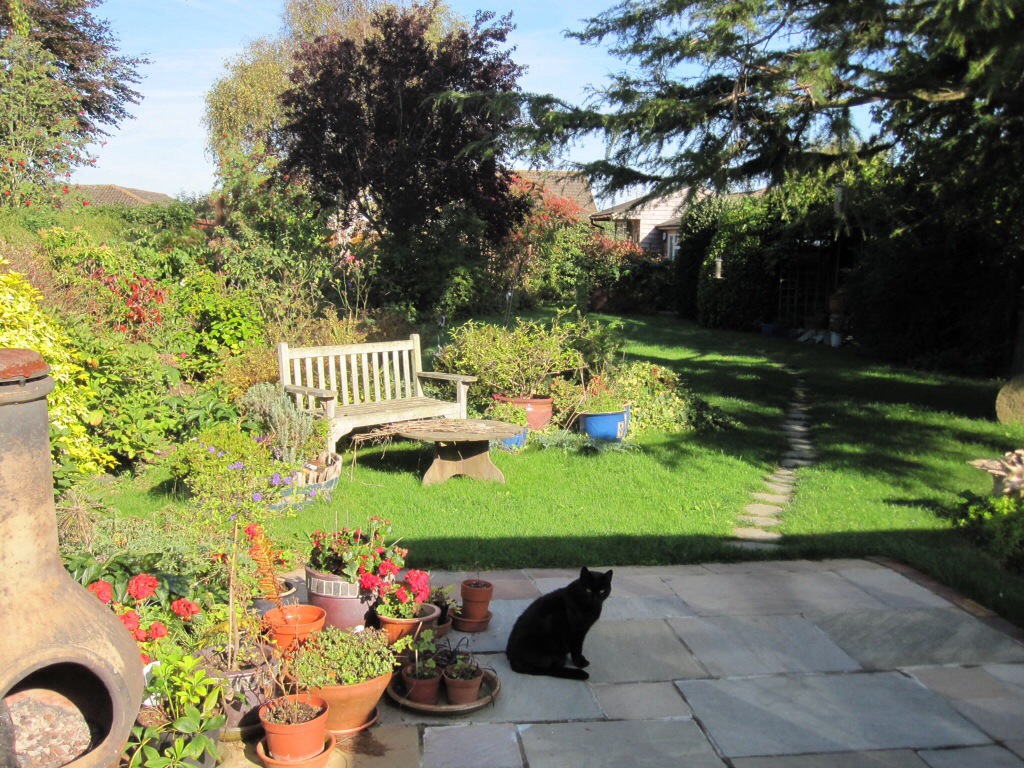
I mentioned that everything was green and therefore a shock after seeing the intense fall colours in America. This was the first sight of our back garden and one of our cats.

20131011-234947.jpg

It was still reasonably warm on our return, but I kept on my full length jeans.

Monday and Tuesday afternoon I did a lot of paperwork to catch up, but Tuesday and Wednesday morning I had my normal weekly botanical art classes. Everyone was very interested in the trip we had taken and most particularly in the catalogue from the Hunt Exhibition. Hopefully the catalogue will be motivational for some of the students.

At last on Wednesday I was able to get back to painting my crab apple series. Whilst we had been away, the Malus Golden Hornet crab apples had swelled up (luckily it has rained a little since we were away) and turned yellow. The apples are not fully ripe yet, but as this was the only painting where I had done no apples at all and very little preparatory sketches, it was the one picture I was most concerned about.

I had in fact actually started the painting before we went away. I had done a composition and finished most of the leaves, placing the apples roughly in accordance with measurements taken two years ago when starting the series. However, this year there has been little rain during the summer months and the fruit were not as big as originally allowed for. That aspect of the painting had to be sketched anew. A photo from the Malus Golden Hornet.

20131012-000945.jpg

On Thursday morning it started getting really cold here (relatively speaking) and a wind was building up. The Malus Gorgeous, a lovely little tree near our front door, has quite big deep red crab apples. They were beginning to fall off the tree. Although I have painted a composition with this apple several times, I had started a different composition. I again have done most of the leaves, but need to paint the apples. The Malus Gorgeous.

20131012-001630.jpg

I felt it was now important to do a list of the pictures, detailing what was missing on each one and the urgency of each element. I don’t want to miss an important phase in the development of each apple because I was concentrating too much on one of the..

My Malus John Downey tree now has only three apples left on it. It didn’t do too well this year. I still had five apples to paint in the picture! I decided this was a priority. I can wax lyrical about the beauty of this tree, but I will save this for another time.

So, now I have been rescuing crab apples to paint their portraits in the relevant picture and yesterday managed nine hours on John Downey. My husband went out in the evening, so I could do what I enjoyed best – paint.

I haven’t got new pictures of this painting, but here you can see the notes from my flower dissections in my sketch book. Peeking out from under the sketchbook you can just see some completed leaves on a branch contain gripe crab apples.

20131012-002840.jpg

Today, Friday, I have only had a couple of hours painting as we had to travel to Bristol for a meeting with other tutors from London Art College (LAC). I am the Botanical Art Tutor for LAC which is a distant learning course. If you are interested in this, have a look at their website. It is a good course.

Last day in Pittsburgh

The last day of the conference with the ASBA. It is sad. I have made a lot of new friends here from all over America, Canada, the UK, Australia and South Africa. There has been such a wealth of experience here that I am tingling.

As I have been so involved with the Hunt Exhibition, I have only been able to dip in and out of the ASBA conference. But today I went to the lectures. Unfortunately, I have been unable to go on any of the workshops, but I am happy having had the opportunity to talk to so many people.

First thing this morning there was a lecture from people from the Phipps Botanic gardens. The talk was about how they are trying to bring knowledge of plants to the people. Three of the scientists gave us a small glimpse of their everyday. It was about bringing knowledge of the environment to young people who are unlikely to even get to see a big park or open space.

For example, growing veg in window boxes as they don’t have gardens. Or, how the bugs they see in between paving stones are affected by chemicals in the environment and by the vegetation growing there, however minute. We also heard about research into the impact of chemicals on fertilisation and then the bugs and bees that carry out the fertilisation process. There are plants that can remove chemicals from the soil and, then in turn the chemicals can be extracted from those plants (phytoremediation). But as everything is in an environment depending upon each other, they have to check that curbing problems in one area doesn’t create problems in another.

The last person we heard from was trying to find a cure for Parkinson’s. This involved talking to people where it is common to find plants are used as treatment and then researching the properties of those plants. Many cures for cancer have been found in this way, such as Yew for breast cancer and the early treatments of cancer with moss growing in the mountains in Norway.

My husband sneaked in on this lecture and then spent the rest of the day at the Botanical gardens.

One of the final statements was that Botany is dying. But we have only ourselves to blame for that. Apparently in ordinary biology books, one will see a picture of an insect on some plant material. The discussion about the picture is most likely to only be about the insect and not the plant or perhaps the dependence each has upon the other. Important topics.

Pictures my husband took:

20130928-235634.jpg

20130928-235739.jpg

Another lecture we had was about How to start a Florilegium. We were lucky to have four people who had been responsible for co-ordinating projects. These included the Brooklyn Botanic Garden Florilegium, the Eloise Butler Wildflower garden Florilegium in Minneapolis, the Filoli and Alcatraz Florilegiums and the Highgrove Florilegium. It is quite a job managing such important bodies of work.

I’m afraid I have no photos showing any of these Florilegia!

The last lecture I went to was with Lugene Bruno, the Curator at the Hunt. The topic was ‘Beyond Accuracy’. She was talking about the art behind the botany. It was a very interesting and encouraging talk. It also inspired some ‘warm’ discussions. What is the difference between Botanical art and Illustration. Also, how much leeway is given before it becomes Flower painting. However, there was agreement that there was room for all disciplines in appropriate circumstances.

Tonight we had the hidden bid. It is a very good way to raise money within the ASBA for projects within the organisation. Some lovely donations were made by the artists and it obviously created a lot of excitement.

20130929-001332.jpg
To complete the days, we had a lovely dinner before going our separate ways for a while.

Before I finish off today, you may remember I me tensioned the Cathedral of Learning in Pittsburgh. This is a picture My husband took from the inside. Remember, it was built for the purpose of housing the University of Pittsburgh and for no other reason.

20130929-001856.jpg