I have listed the plants in the order according to the type of ground in which they grow – from boggy to sandy:
The cloudberry and small cranberry often found intertwined together in the boggy moss of a swampy lake edge.
The bog bilberry is more of a bush and guards the very marshy plants perching on rocks in the marsh.
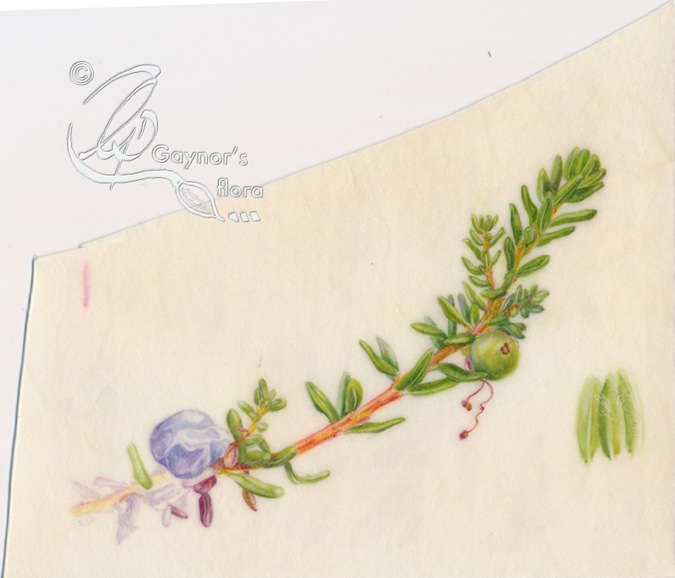
The Mountain crowberry grows in various areas from rocky outcrops at the edge of a swamp, to tiny examples without much soil, clinging to the rock on mountain tops.
The bilberry and cowberry are generally in a similar habitat in damp woods and forests; the cowberry can be the main plant on an old wood ant heap often with bilberry and mountain crowberry.
Bearberry grows in sandy areas on the edge of forests or creeping down over smooth rock.
The next stage of this blog goes into my working practice for this series. After which I will talk a little about each of the species and how I painted the final pictures. I will use the above order of plants as I would love others to learn more about them, where to find them and their uses.
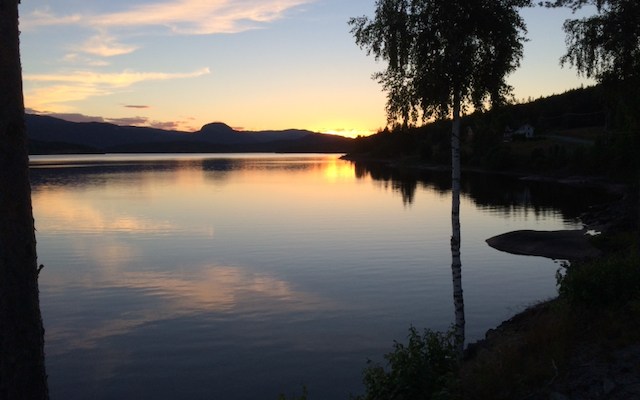
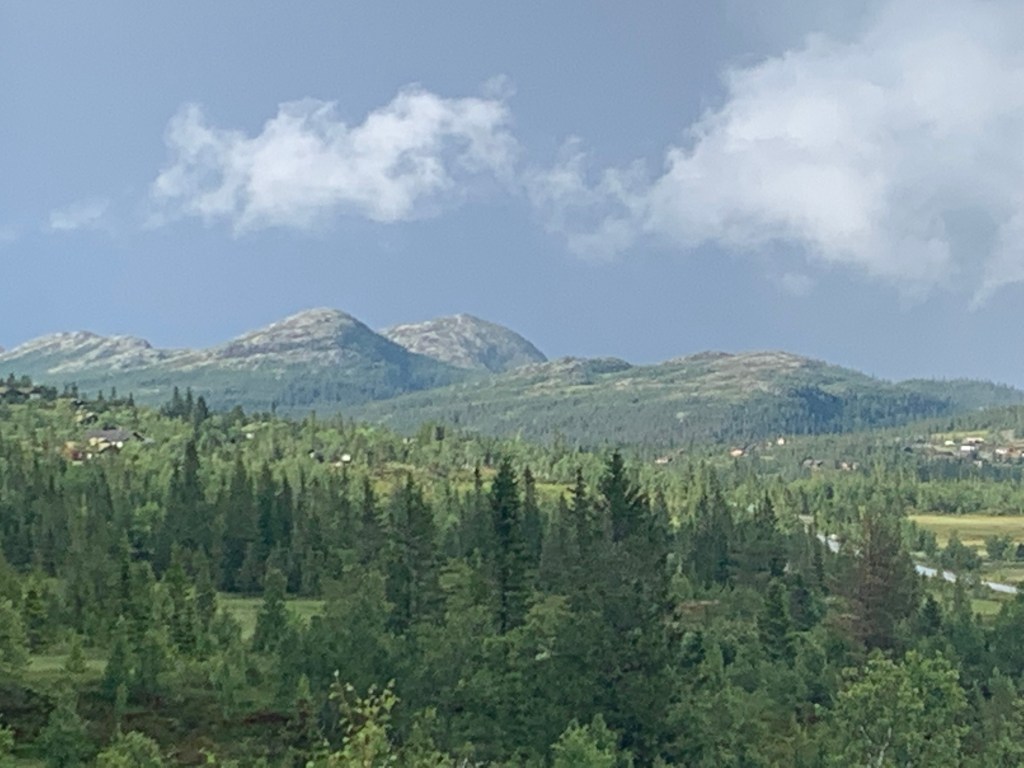
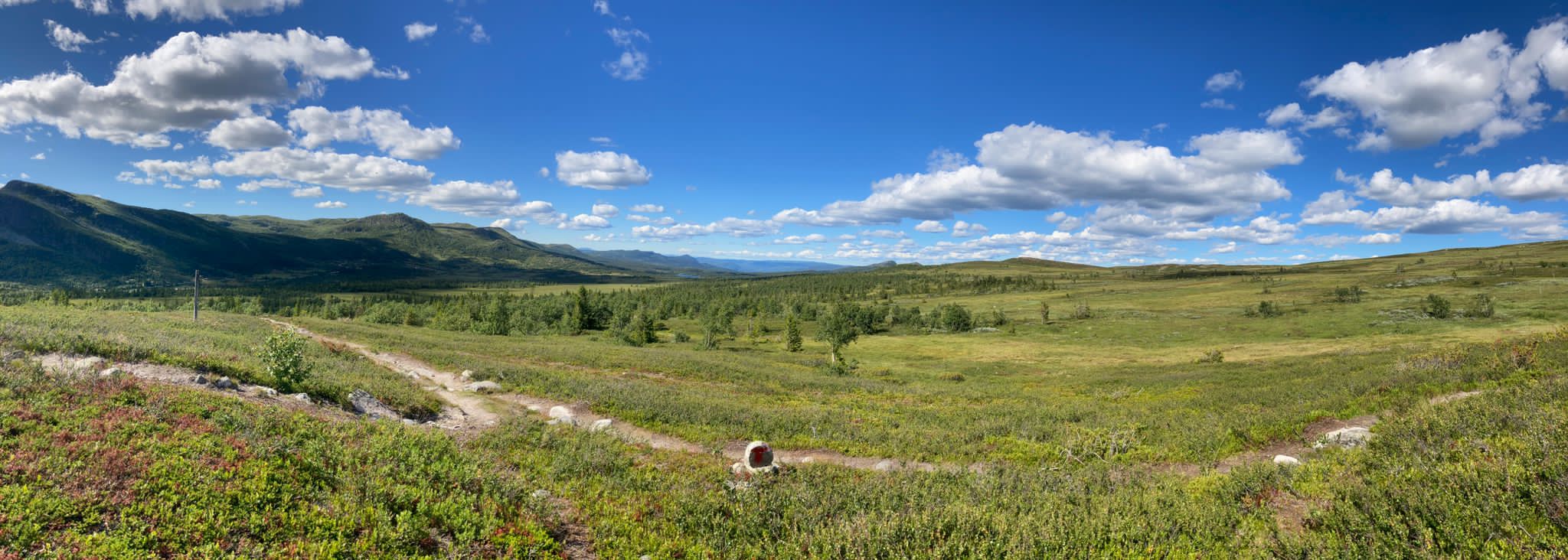
Anyone would think I am trying to sell Norway. I am, it is a fantastically beautiful country. The picture above is in Sigdal, the valley below Haglebu. It is the view we had from the house we built in the late 1970’s. It is from here that I learnt to love Norwegian flora.
In the previous blog I finished off by saying that I still hadn’t seen any sign of one of the two species that got me going with this series of plants. This was the Bearberry (Arcostaphylos uva-ursi). I had already found out that they were not known to grow in the county I now live – along the west side of the Oslo Fjord; In fact locals didn’t seem to know about the plant!
In 2017, that very first summer of sketching, I managed to do some sketches of each of the five species already found. This gave me a feel for the plants but I still needed to do a lot of research into them. I had found that the cloudberry is dioecious – the male and female reproductive organs are separated in two different organisms; each plant is either male or female. My girlfriend from whom we had borrowed the cottage that year, was not aware of this. But, it seems, she was not alone in this as it was a surprise to many Norwegians with a cursory knowledge of the plants around them.
There was plenty of mountain crowberry ( Empetrum nigrum subsp. hermaphroditum) in the area round the cottage. The crowberry is a family of plants that isn’t quite straight forward in that the species at lower altitudes is dioecious like the Cloudberry, but at this altitude in the mountains is more generally a subspecies called ‘hermaphroditum’. This means it carries both male and female reproductive parts.
Finding plants and choices in 2018
The cottage at Flatvollen, near Haglebu. 906 metres over sea level.
As I realised I was going to need quite a few years to complete my series with only two weeks at a time when we could get to Norway, we decided to rent a cottage at a higher level in the mountains. We looked at an area where I had used to go skiing when younger – Haglebu at the top of the Sigdal valley where it goes over the mountain then steeply down into the next valley. This time we found a cottage at 906 metres over sea level and I could see that I would be near the plants I intended to paint. Although I still hadn’t found the one plant I had been looking for.
In front of the cottage there was quite a boggy plain and I knew that I could get plants such as Cloudberry there. Behind the cottage was steep mountain and I knew most of the other plants would be available to me there.
We went for a short hike and explored. The marshy area was quite wet, but there were a lot of Cloudberry plants. Unfortunately, it was too late in the season to see any flowers but getting onto my hands and knees I got a real surprise. Weaving in and out of the boggy moss was the tiniest plant, with the smallest flowers and leaves. The plant was so insubstantial but lying on top of the moss were the remains of some red berries. This was Vaccinium oxycoccus Subsp. microcarpum (small Cranberry). The Cranberry bought in our shops is Vaccinium macrocarpum– large cranberry, and of course cultivated in large amounts in the US.
I had just found my 6th plant, but still not the bearberry.
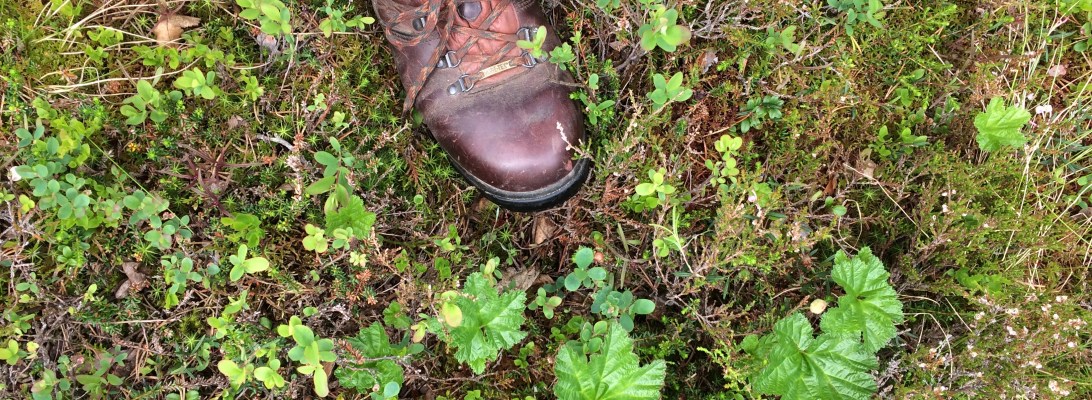
Below you see the small cranberry on top of the moss with sprigs of bog bilberry and mountain crowberry and a little Betula nana (Dwarf birch), often found as the last tree (no more than a low shrub) on the tree line.
The tiny pink flowers of the Small CranberryAn unripe fruit attached to the main plant on top of the moss.
I had to remind myself that the reason for getting interested in this series of plants was because the bearberry often got mixed up with the lingonberry (cowberry), and this often happened at lower elevations. I needed to continue my hunt for the species.
We went hunting and eventually I found quite a few plants in a dry sandy forest area in the next valley. This was Arctostaphylos uva-ursi (bearberry). I now had my seven species, although one of them was not in the immediate area where I was collecting my samples. That is, until I found some very near the cottage, growing down a rock face.
Sketching from an old anthill.Out sketchingat Mølen a World Heritage site on the south east coast of NorwaySketching in the back garden in the UK
Since moving back to Norway there have been two bumper years for Cloudberry fruit and this is why we have so much in the freezer now.
But back to my sketches that were incomplete right up until last summer (2022). This plant in particular is not easy to find if you don’t know exactly where to look, and even then you might miss the right period of time.
We took a couple of long day trips into the mountains to look, and we eventually found what was missing. As well as a lot of driving, I extended the workday when I got back home. The flowers don’t last long and whilst I had them, I needed to dissect and sketch with measurements before going to bed.
Robin birdwatching
The typical demands to a botanical artist. But luckily during the summer months we have a lot of daylight hours in southern Norway – in fact around mid-summer the sky doesn’t really go dark. Birdwatching at midnight is different to say the least! The picture to the left is Robin birdwatching at 5 mins past midnight on the 12 June – still over a week to mid-summer!
The lesson learned? Make sure when sketching that you have the where-with-all to measure various aspects of your plant and to make accurate colour swatches.
Equipment for sketching outside
As you will see from the pictures at the top, sketching on location can have various problems, from ants still defending their old anthill, a very hard bottom rest and a helpful cat.
The anthills in the Norwegian forests can be huge, but so too can the ants. They have a large territory to look after and a lot of old wood to turn into something future generations of trees and ants can live off. But they do have a painful bite! One often finds several of the plant species I was considering, growing on them. One often finds lingonberry, bilberry and mountain crowberry, well established on them. It also suggests what some of the ants transport to their home.
When I am out sketching in nature I minimise the amount of equipment I have with me. I try to keep everything in the same sketchbook and for watercolour use a Stillman & Birn, Zeta series. It has stood up well to the battering it has had and takes the watercolour washes well.
Normally I use a bum-bag when walking not too far and it will contain this kit:
Of course I go nowhere in the mountains without my mobile phone, but these days they are much more than a phone or safety net. The Victsing 3-in-1 mobile phone camera lens was introduced to me many years ago by Sarah Morrish and I use this to get the details not normally seen very well. In particular it enabled me to get a picture and draw the growing tip with flowers of the Empetrum nigrum subsp. hermaphroditum (mountain crowberry) . I keep a small piece of mm paper with it to measure within the photos.
My palette is an old one with the original student colours removed and replaced with artist quality colours. I use transparent single pigment colours and normally have a couple of yellows and Quin Gold, Permanent Rose, Perylene Violet, Purple, A cold and warm blue and this time a single pigment green.
The pencils preferred are a 3B and HB as they are easy to lift if necessary, plus a single black fine liner pen. I only need to sharpen one of the pencils so have a sharpener to fit that. Otherwise travel brushes, ruler and erasers, magnifying glass, small water holder and kitchen towel.
Sketching in the New Forest in the UK. I got a tick bite this time, but it wasn’t infected.
A dire warning; this is what happens when an infected tick bites. This is Robin’s leg last year.
If I take specimens with me, then I have a small plastic bag ready and can add some of my painting water. Sketching back in the cottage or at home means that I have all my equipment available.
I nearly forgot an important addition to the list above; Insect repellant because of the ticks, and sun screen, particularly here in Norway where the air is so clear.
The picture to the left is Robin’s leg last summer after a tick bite! We have a lot of dear and ticks, but doctors are very aware of the dangers and are quick to prescribe treatment.
A serious start on the series in 2017
My friend’s cottage at 800m over sea level.
By 2017 I still hadn’t decided which plants I was going to paint and this first year we borrowed a cottage from one of my oldest friends in Norway. The cottage was at about 850m over sea level.
Around the cottage we found Rubus chamaemorus (cloudberry), bilberry (Vaccinium myrtillus), cowberry (Vaccinium vitis-idaea), bog bilberry (Vaccinium uliginosum)and mountain crowberry (Empetrum nigrum subsp. hermaphroditum). This was a pretty good start.
Notice that three of them were Vacciniums – from the heather family. In fact the Blueberries you buy in the shops are yet another species (Vaccinium corymbosum) but they are farmed and not included in my choice.
Importantly I hadn’t found a bearberry (Arcostaphylos uva-ursi) which was partly the reason for choosing to do this series.
But there were loads of other lovely flowers such as Heath spotted orchids, geraniums and various insectivorous plants such as the Common butterwort. There was also plenty of Andromeda polifolia (bog rosemary) in the moss and amongst the new Cloudberry leaves. When seeing it growing at the Chelsea Physic Garden in London, I realised it was an opportunity to paint the species and the resulting picture resides in the Chelsea Physic Garden Florilegium collection.
This picture was taken4 July, it had snowed and it was bitter cold with a wind behind it!Believe it or not, this was taken the day after on 5 July and it was really lovely and warm.
Weather is very changeable in the Norwegian mountains and although mid-summer, it can snow. This can make it difficult not only in choosing species to paint, but also finding them and making sketches in the open.
I still. hadn’t decided which species I was going to choose to follow up on, although I did have a rough idea. A lot depended on how easy it would be for me to access the plants and whether I could find them in the vicinity of the cottage we rented each year.
Several of the plants I had been thinking about had fairly small fruit and elements of the plants were also very small. How was I going to display this? One plant had large leaves and two had very tiny leaves. Some plants lived in very boggy areas, several had access to water but the roots weren’t lying in water, and one was happiest in dry areas such as sandy pine forests. Some of them intermingled.
How was I going to work this out? I wanted an exhibit that drew together seven different plants into a whole.
I started by just sketching mountain plants with fruit that were edible (not toxic). This started my several-year long period of ‘Constructive Procrastination’!
I started painting the final pieces in 2021 after moving back to Norway.
Sketching
First page in my sketchbook – Cloudberry sketches
Today, my sketch pages are rather a mess. They started out beautifully organised, but as time has progressed, I have added more sketches, more information, and more colour matching. This means that my sketch book is now not a beautiful work of art but a tool to get enough information for completing a final composition.
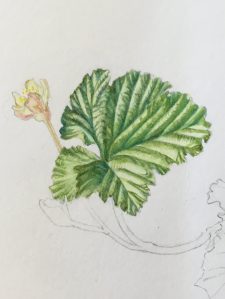
This is the first page in the sketchbook I kept for this series. You can see the very first sketch of the cloudberry leaf that I did in 2014 whilst teaching at Åsgårdstrand. In later years I was able to add both male and female flowers actual size and enlarged dissections. BUT, I was stupid enough to forget to get all the measurements and have spent the last two summers chasing to find the relevant pieces at the right time of year.
I had other pages with Cloudberry sketches including research done on the net, and referencing different photos I had taken, but none gave me all the information I needed!
It took me years to catch up on this plant as every year is so different. One can’t guarantee that flowering will happen at the same time each year, or, as in this case that you find both sexes of flower. One year, we had planned our trip from the UK to coincide with a roughly general fruit picking time for this plant. But when we got up to the cottage, everything was long over as it had been a very hot summer.
I am telling you this here as it shows how important it is to get all the necessary information when you are doing the sketches.
Cloudberry fruit sketches from berries given to us by a kindcouple who had found ripe fruit 200m above where we had looked.
Each year we rented the same cottage in the mountains for a two-week period. I spent the whole time sketching and painting, when we weren’t out hunting for specimens or picking fruit.
By 2018 I had not been lucky enough to find any fruit since starting the project in 2014.
One day we were out picking Bilberries when below me I saw a couple walking along a path with two bulging plastic bags full of something orange. I knew immediately what they were and rushed down to ask the stupid question ‘where did you find these’? I knew full well no-one gives up the location of their ‘mountain gold’ – a name used for Cloudberry fruit. But luckily enough when I explained what I wanted them for, they gave me two berries. The above sketch is those two berries. My husband had never even tasted them at that point, so they became a treat for him!
Deciding which plants to study and paint was only one of many decisions I needed to make. I also had to decide what material to paint on and with what!
I chose calfskin vellum.
I helped to scrape the skins clean of fur.
In November 2016 I met some friends at William Cowley’s and we were shown round the family business in Newport Pagnell. Cowley’s have produced parchment and vellum there since 1870. It is a smelly business, but they were able to assuage some of our concerns about using a material from animals. Apparently, no animal is killed to obtain the skin – it is a by-product from animals used for our food and milk.
The cattle, goat and sheep skins used for parchment are all obtained from farms where livestock has been reared for wool, milk or meat. No animals are bred to make parchment.
Cowley’s staff select the best skins available and transform them into beautiful pieces of parchment and vellum.
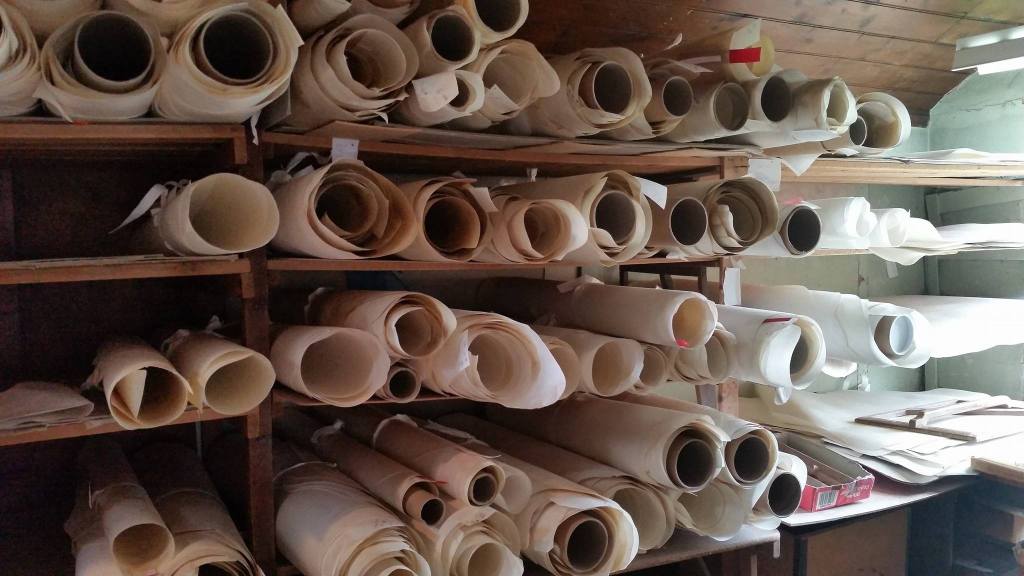
The transforming process of changing the skin into vellum and parchment used for artwork and legal documents, is hand-done and takes a long time. Cowley’s vellum is ‘worth its weight in gold’. I bought some fairly well matched skins so that I could get seven pieces from them each measuring 25 x 31 cm when mounted; Cowley’s also did the mounting for me.
Vellum is a very special substrate and there are examples that go back hundreds of years. The Magna Carta was written on vellum 800 years ago. Today we have DNA testing and as vellum is skin, this can be a fantastic safeguard.
There are not many limitations as to what can be used on vellum with colour pigments in the form of watercolour paint, ink and gold foil well known. But graphite and waxy pencil can be a hindrance and not normally recommended because of their fatty nature and difficulty with adherence to the vellum. Whatever is used, lies on the surface and is not absorbed into the substrate as with paper. That is why the colours can appear more vibrant.
In botanical art it is customary to use watercolour on vellum, but I also wanted to introduce graphite which I knew could cause some difficulties. This was something else I needed to research.
Luckily, when I was teaching at the American Society of Botanical Artists (ASBA) conference in 2019, I watched two well known artists painting on vellum with watercolour and graphite graphite. I absorbed all the tips that they were able to give, and this helped enormously when adding the graphite sections to my pictures.
Composition contents
Golden section overlaid Vaccinium corymbosum leavesartwork. Note compositional use of ‘third’ lines and placement of main focal point.
Composition is a very difficult subject, and it is something many of my students struggle with. There are loads of ‘rules’, but the best design is by those who know the ‘rules’ and know how to break them; look at Rory McEwen’s work as an example. When saying this, it sounds as though I have overcome the issue of composition – far from it. For every picture I paint, the result is my subjective view. For the person looking at the picture, their subjective view is likely to be slightly different.
However, in modern times there is much research into the placement of the main focal point and some equipment can ‘see’ what the brain notices first when accessing a picture or view. As a baseline, the Golden section is not far out. Therefore, defining the placement of the focal point in a picture is important.
I have spoken to quite a few people about what they would like to see in my series of pictures. I had decided on the measurement of the mounted vellum piece, 31 x 25 cm, therefore I had limited space.
I wanted to paint several elements of the plants, repeated across the series, demonstrating details of the plants not normally appreciated. I hoped that people taking their normal flora for granted would learn about these plants from my finished artwork.
As I was looking at edible fruits my main point of interest was the fruit. But, without overloading the composition I wanted to give information about the flower, its habit and habitat. I still hadn’t decided exactly which plants I would include, but I knew that they would normally live several meters over sea level, preferably in the mountains and probably have some sort of association with each other.
Read on in the next blog due to be published 30 March 2023
Preparing for rain – view from the cottage at Flatvollen near Haglebu.
As promised, this is the second part to the blog about my series of pictures – Foraging plants in the Norwegian Mountains. It will continue twice weekly until the RHS exhibition mid June 2023.
But what did make me choose this topic to study? It started at the workshop I had in Åsgårdstrand in 2014.
Cloudberry leaf and remnants of a male flower – sketch 2014
There were students from Norway, the USA and the UK, and I wanted them to get a feel for and learn about some of the plants that mean a lot to Norwegians. Funnily enough, like me, Norwegians take a lot of their fruit for granted and don’t know too much about them. I asked a botanist friend to get some plants when she was at her cottage in the mountains; she arrived with several, including cloudberry (Rubus chamaemorus). This particular year she only found male flowers, but more about this later. At that point I didn’t know they were male flowers; I was just disappointed that none seemed to be fertilised and developing fruit.
As the students were mostly new to botanical art, it was unsurprising that no-one had any real interest in painting the cloudberry plant without the flowers in full bloom.
But all were thrilled by the range of wildflowers available and painted many they found whilst on walks in the neighbourhood. For my part, the cloudberry plant material was enough to kickstart my interest in studying it. Painting the sample available was the start of my obsession for Norwegian edible fruit; it continued until I finished the series of seven pictures in January 2023
Royal Horticultural Society (RHS) botanical exhibition planning
Magnolia x soulangeana flowers – 2011
Over the years the requirements for exhibiting with the RHS have changed. I had previously done two exhibits for the RHS botanical art shows and had medals from 2011 and 2014. In 2011, 8 pictures were required for each exhibit and in 2014 this was reduced to six although one could have more. When planning for my next exhibit I decided to do seven pictures as odd numbers are aesthetically more pleasing than even numbers.
I will be describing my progress with all seven pictures in my blog, although the exhibit requirements is now only six pictures. I felt Norwegian edible plants would be an ideal topic and had hoped to complete the series over the following three years, but ‘life’ got in the way.
I was responsible for the UK representation during the Botanical Art Worldwide Exhibition in 2018. Scotland had their own exhibit.
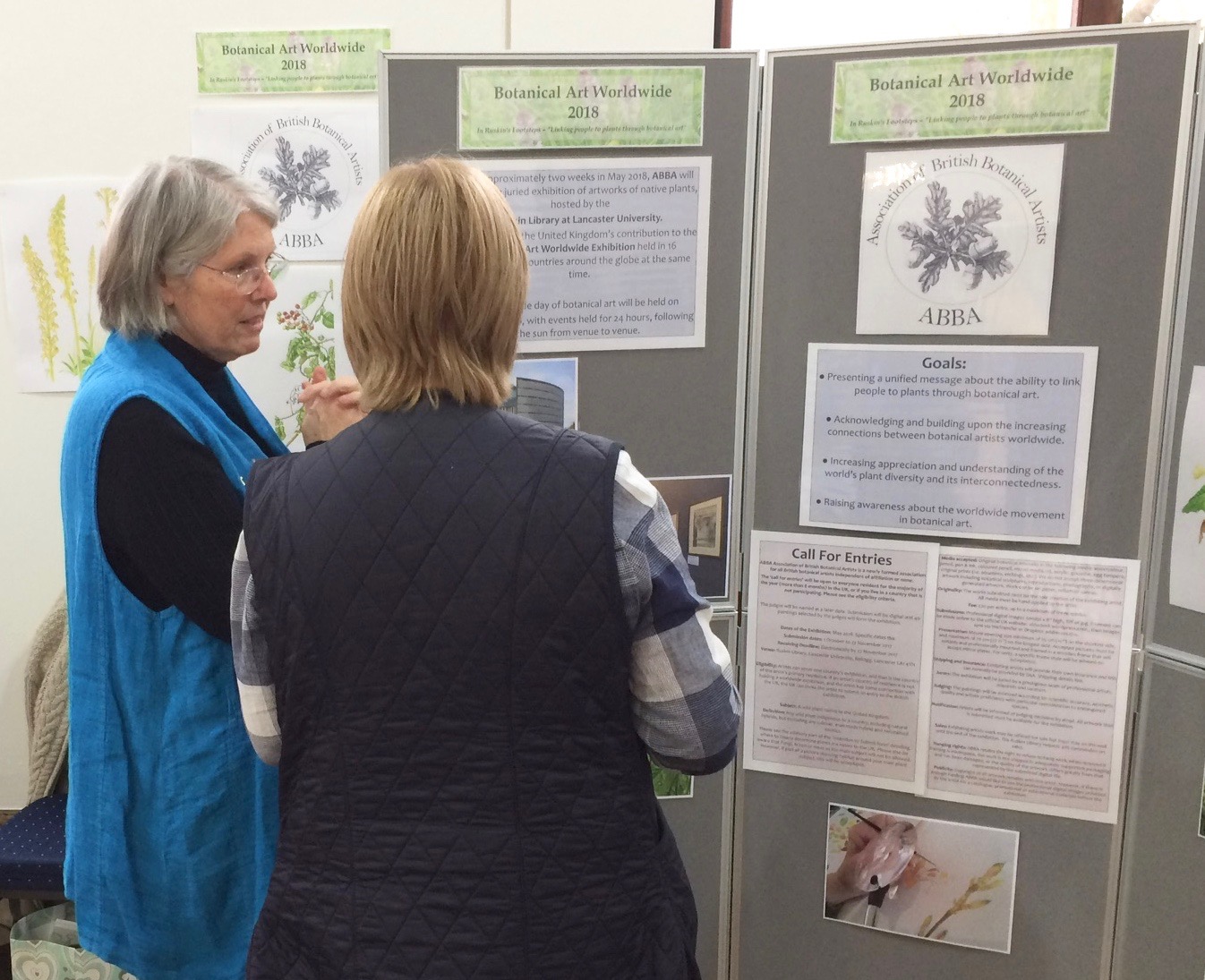
My involvement in the worldwide exhibition happened quite suddenly when I realised that the UK would not be represented. I felt this was wrong as we had so many brilliant botanical artists. So I was determined to make it happen; Robin, my husband, suggested that if we got enough people interested, we should call ourselves the Association of British Botanical Artists (ABBA). Luckily, I was able to convince others and ABBA organised several successful events across the country representing UK botanical artists.
During the build -up to the Botanical Art Worldwide exhibition, it became clear that there was a need for an organisation to welcome ‘Anyone, anywhere’ interested in botanical art. Up until then it could be quite expensive to learn about botanical art and membership of existing organisations was based on an individual’s level of expertise. Dr Shirley Sherwood OBE was also of a similar opinion and supported the idea – something that really meant a lot to me and my motivation for continuing my work to establish an organisation.
The Association of Botanical Artists (ABA), now an international organisation, is still going strong.
Malus ‘Gorgeous’ – 2014
Eventually, as I got back to planning my next RHS exhibit I recognised that there were some logistic problems. I lived in the UK and hadn’t planned to move back to Norway. Although some of the plants grew in high mountain areas in the UK, there were still some difficulties obtaining what I needed. For example, there were very few female cloudberry plants and therefore only a slim chance of getting material for either the female flowers or fruit. I therefore needed to get to Norway on a regular basis and knew that I could only do this once a year.
I already had another workshop planned in Norway for 2015, so 2016 became the target for starting seriously with preparation sketches
Botanical art workshop at Åsgårdstrand
I realised that I wouldn’t be able to decide which part of the plants to focus on until I had done as many sketches as possible at different stages of development.
I would need to make careful notes about colour and size of specimens to aid my decision making.
I will continue this story with a new blog on 26 March 2023.
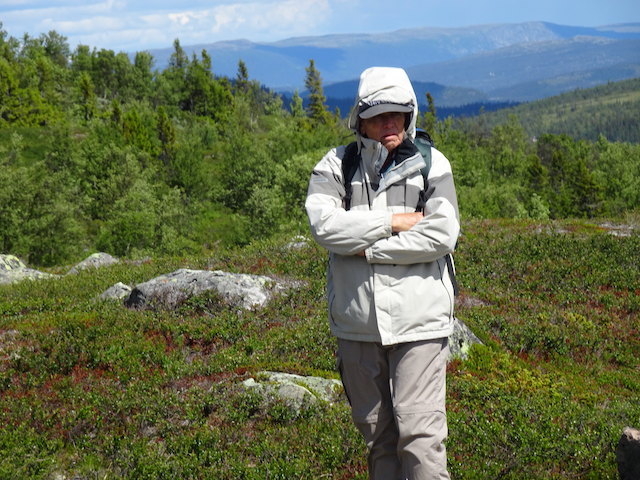
These photos were taken over the years whilst in the throes of this project – Foraging plants in the Norwegian Mountains. Haglebu, the area where the photos were taken, is about 850 metres over sea level in south east Norway and the area where all my plants came from.
I am originally English but have lived many years in Norway with a 24-year gap in the UK from 1996 to 2020. I lived in the valley of Sigdal for several years, just below Haglebu so returning to the area for this project was a joy for me.
Following my application to exhibit at the Royal Horticultural Society (RHS) Botanical Art and Photography Show this year (2023), I received confirmation that I will be one of the exhibitors and allowed to show six pictures in a series of my own choice.
Picking Lingonberries
The topic I chose is the one mentioned above, Foraging plants in the Norwegian Mountains. This series of blogs is about my whole process from choice of plants to painting the final pictures. I intend to post the blogs twice a week right up to the 2023 exhibition in June.
Typically, many Norwegians forage for fruit during the summer and autumn periods of the year. This is understandable when you think that in many parts of Norway the upper metre or more of the ground is frozen solid and covered with snow for up to 6 months of the year. From late May until late September the Norwegian flora has a very fast and compact growth and development. If you come to Norway during the late spring or summer, everything seems very lush with lots of spring flowers everywhere.
If you travel up into the mountains, the flora is different but still very lush – as you see in the pictures above.
Spring seems to start off with the birch (Betula ) and we love to see the ‘mouse ears’ showing in May. The Norwegian national day is 17th May and being able to decorate everywhere with ‘mouse ears’ really gives the feeling that warmth and growth is at last on the way.
One of the reasons I chose foraging in the mountains as a topic was because I always knew that there were differences in the fruit we found, but it wasn’t until I started painting botanically that I understood how to note these differences and the importance of doing so accurately.
When I first arrived in Norway in the early seventies, I quickly learnt which fruit was good and very roughly the type of area in which I would find it. I then learnt how to use the various fruits for jam, juices and puddings, giving the family a taste of summer over the winter months.
Now I have the freezer full of bilberries, cloudberries, cowberries (or lingonberries), wild cherries as well as the usual fruit from the garden such as red, white and black currents and plums.
A red Bearberry
Red lingonberries
When foraging, there were two fruits that were easy to confuse, but I learnt to distinguish between them, although not via botanical knowledge. I have since discovered that both are safe to eat, but not equally pleasant. They have completely different uses which, I will come back to in a future blog when describing them.
Both fruit are red and there is a similarity to the leaves, making it a little complicated when picking them – unless you know what to look for. The one to the right has many uses in jam and juice, whereas the one to the left is a stone fruit of which mostly the leaves are used.
What made me choose these plants to study?
In 2014 whilst still living in the UK, I came to Norway to run and teach at a botanical art workshop in Åsgårdstrand, a popular sailing village near where I now live. Edvard Munch lived in Åsgårdstrand when he painted The Scream.
I have been really bad at keeping on top of my own website because of all the work in relation to ABBA (Association of British Botanical Artists). Therefore this information about my participation in the RHS exhibition next week is not on the right page! Sorry about that, but I am telling you a little more about it now and hope that you will be able to make it.
Following on from the exhibition ‘In Ruskin’s Footsteps’ at Lancaster University, we (ABBA) have a stand this coming week at the RHS Plant and Art Fair, which for Botanical artists is a very important event. It is on 11th & 12th July at the RHS Halls in London. ABBA have a stand with the majority of Botanical artists, in the Lindley Hall. As I said in my last blog, Follow the Banner!
We are exhibiting five of the original pictures from the juried exhibition in Lancaster, giving everyone a further opportunity to study them. One of them is mine – Sea Thrift, painted on vellum. I mentioned that I would be demonstrating at the exhibition and now it is clear which medium I will be using, also which plant I will be painting.
I had intended getting my own exhibit finished for the RHS exhibition next year, but because of the amount of work that has gone into ABBA, I have decided to put this off until 2020. My topic is ‘Foraging plants of the Norwegian Mountains’.
It became very clear whilst going through the various phases of the Worldwide exhibition preparation, that although the UK is a distinct island it is still part of the European Continent. At one point in our history we were connected without needing to use a tunnel, boat or plane. Our plants bear witness to this in that many of the plants that are native in Northern Europe, are also native in the UK. However, some may not be so common these days.
Image being drawn on vellum
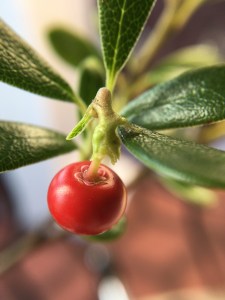
One of my series of plants is the Arctostaphylosuva—ursi, Common bearberry in English and Melbær in Norwegian. It looks similar to a Crowberry, but is white inside (floury), giving its Norwegian name. When picking Crowberries it is not popular to mix Bearberries in by mistake as they don’t taste quite as nice, although edible. Also it is a stone-fruit and not a berry!
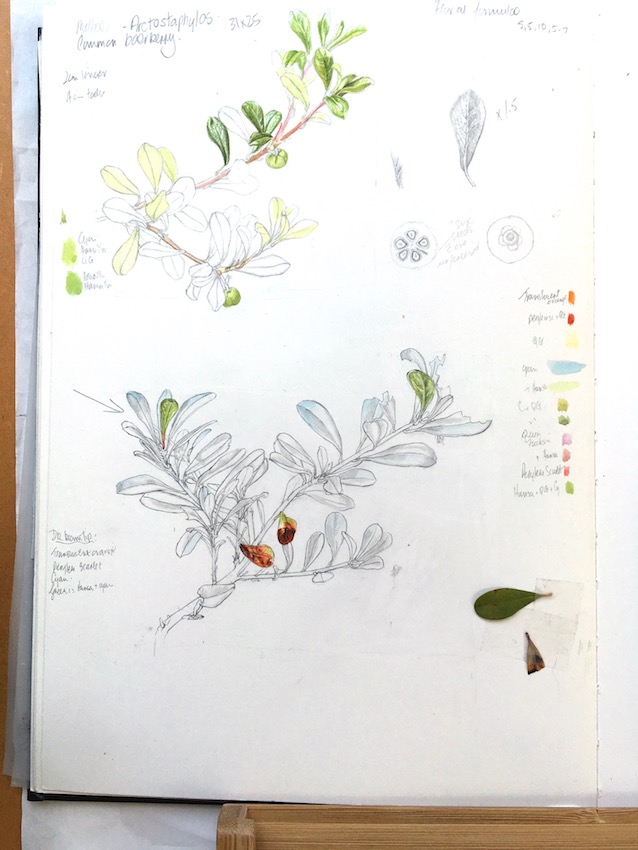
ABBA wants to encourage botanical art in relation to our native flora. As I intend to paint the series on vellum, I will be using this medium on the ABBA stand at the RHS. I have a nice little plant of the Bearberry with the beginnings of small flowers. The image is already transferred to a small piece of vellum which will be ideal to practice on and make decisions about which colours to use.
From my sketchbook.
You might be just able to see that in my sketchbook I have quickly done a rough tonal drawing, indicating where the light is coming from. I have also put in a little blue to indicate where the light of the sky has reflected on the leaves and started indicating the difference between the colour on the front and back of the leaves: but that is in my sketchbook. Which colours I will actually choose to use on the vellum, remembering that colours appear far more intense on vellum as it reflects the colour of the pigment better than on paper, will be the result of this trial piece.
In addition to my demonstrations we will be talking with people to find out what they want from ABBA in the future and whether they – you, want to be part of it. Our focus will be to help anyone, anywhere, interested in botanical art to learn more.
But there is a little icing on the cake: The RHS have agreed to show the Botanical Art Worldwide exhibition slideshow from 25 countries. This will happen in the talks area of the Lindley Hall, between and after the talks. But just in case you want to see it otherwise, we will be showing it on the ABBA stand.
This is the last opportunity to see the Worldwide Slideshow!
General Data Protection (GDPR)
If you want to follow my blog then please do sign up for it on this page. However, if you would like to get the occasional email from me about workshop availability or general information about my botanical art news, then you will need to sign up for this separately.
Below is a link to subscribe to either or both email lists. You can easily unsubscribe at any time.
The last time I wrote a blog was at the beginning of April. That is a long time ago for a blog, but the time has been filled to the limit.
I won’t go into the intricate details, just enough to let you know what I have been doing.
The RHS Launch February 2017
I don’t think I have mentioned in any great detail the formation of the Association of British Botanical Artists (ABBA), initially just to allow the UK (England and Wales) to participate in the Botanical Art Worldwide Exhibition. At the American SBA conference in Pittsburgh in 2016 we were faced with the possibility that the UK would not participate because we were all too busy! I couldn’t let that happen. In the end 25 countries took part.
Our esteemed judges: Martyn Rix, Christabel King, Helen Allen, Ann Swan & Brent Elliott
At a meeting back home in November, three of us met and agreed to form a steering group with me as main co-ordinator; we launched ABBA at the Royal Horticultural Society’s (RHS) Botanical art show in February 2017 and the process for participating in the Worldwide Botanical Art Exhibition began to take shape. A few more botanical artists joined the steering group and we were away.
We decided we wanted to hold the exhibition ‘up north’ as everything happens ‘down south’, doesn’t it? We found an exhibition space in Lancaster and ‘In Ruskin’s Footsteps’ (the name of the UK exhibition) started to develop. An RHS Dawn Jolliffe bursary was applied for and granted, so now we had something with which to pay for some of the things we had to pay for!
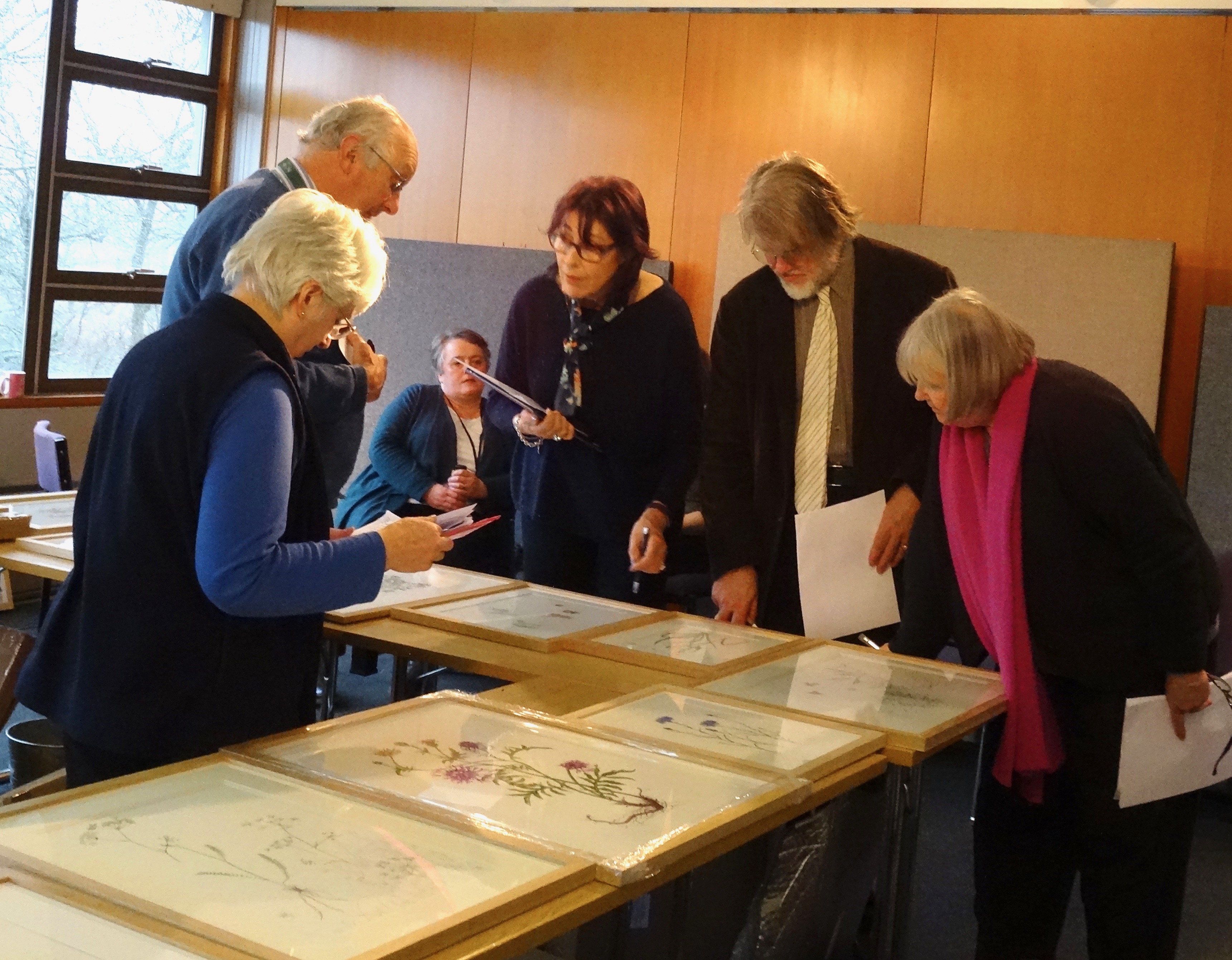
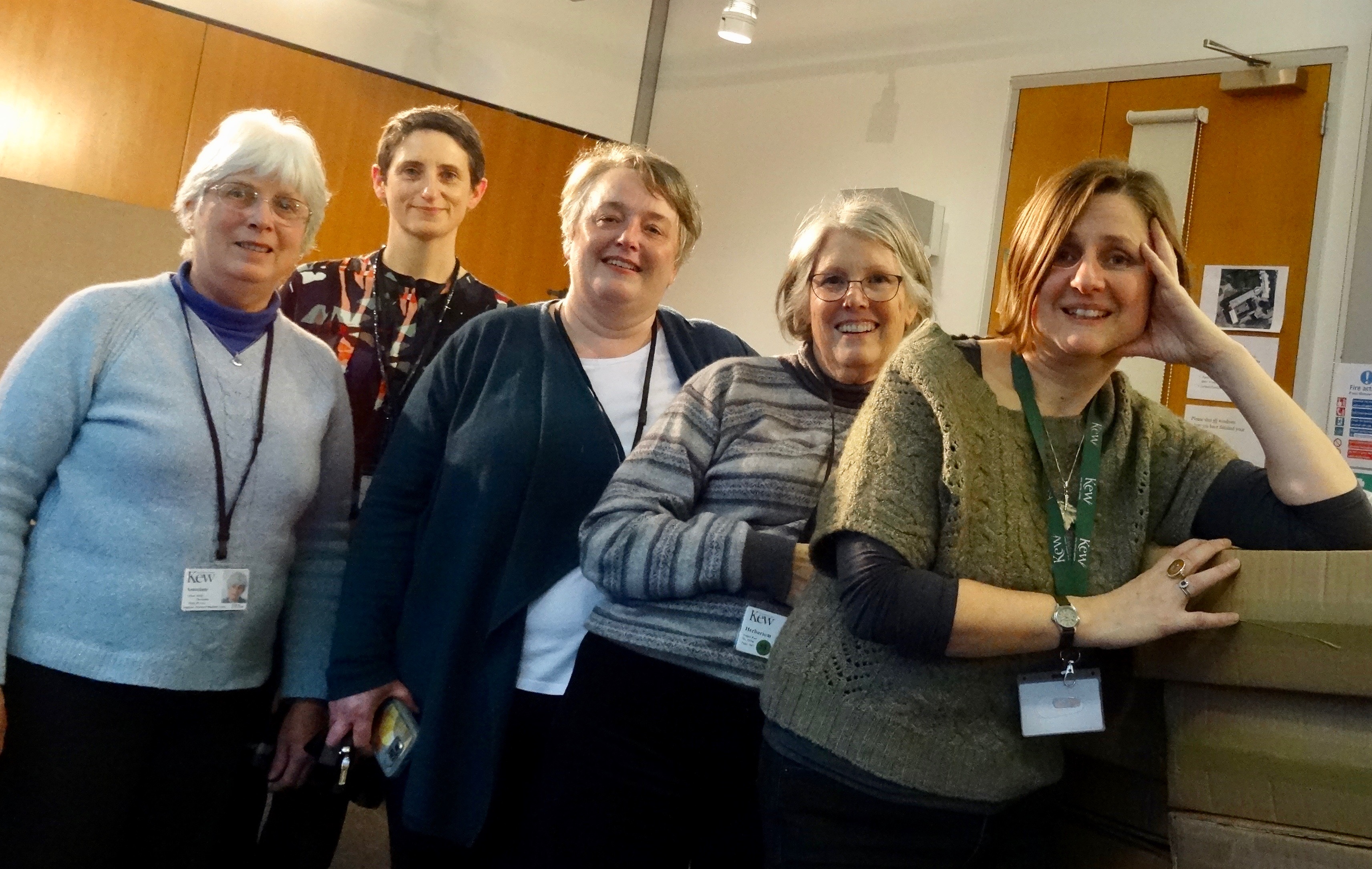
Packing after the judging: Christabel King, Deborah Lambkin, Sarah Morrish, me, Lucy Smith.
In November submissions of botanical art pictures arrived from all over the country and our amazing judges took care of that- initially digitally (with signatures removed) and the last phase ready framed at Kew in January. 40 beautiful pictures were chosen for the exhibition to be held 18th May to 9th June.
Several other institutions in London decided they wanted to work with us for the Worldwide Day of Botanical Art 2018, which was on 18 May. Therefore, together there was a lot going on behind the scenes on these events too.
After some wobbles and lots of hard work, the time to set up the exhibition arrived, now to be held at the Peter Scott Gallery, Lancaster University. It is a fantastic exhibition space and people working there plus the previous curator at the Ruskin Library, were very helpful and supportive.
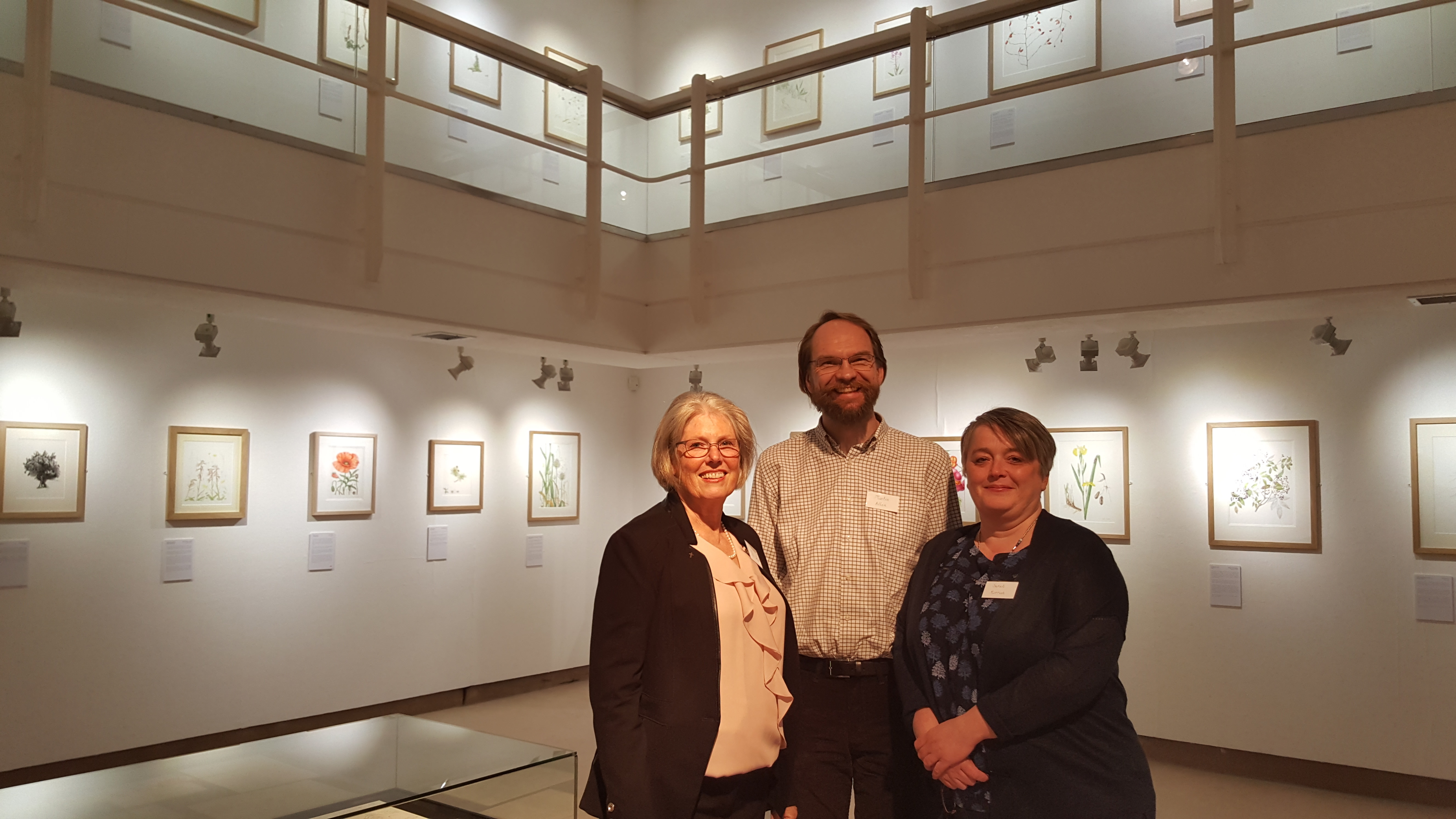
Martin Allen, Sarah Morrish & me just before the preview 17th May 2018
Worldwide Botanical Art Day in the Peter Scott Gallery at Lancaster University.
We had the pre-view on the evening of the 17th May, with speeches by the curator Richard Smith, myself and the opening of the exhibition by Professor Stephen Wildman. That in itself was a lovely event (I think!) and many of the exhibiting artists came along.
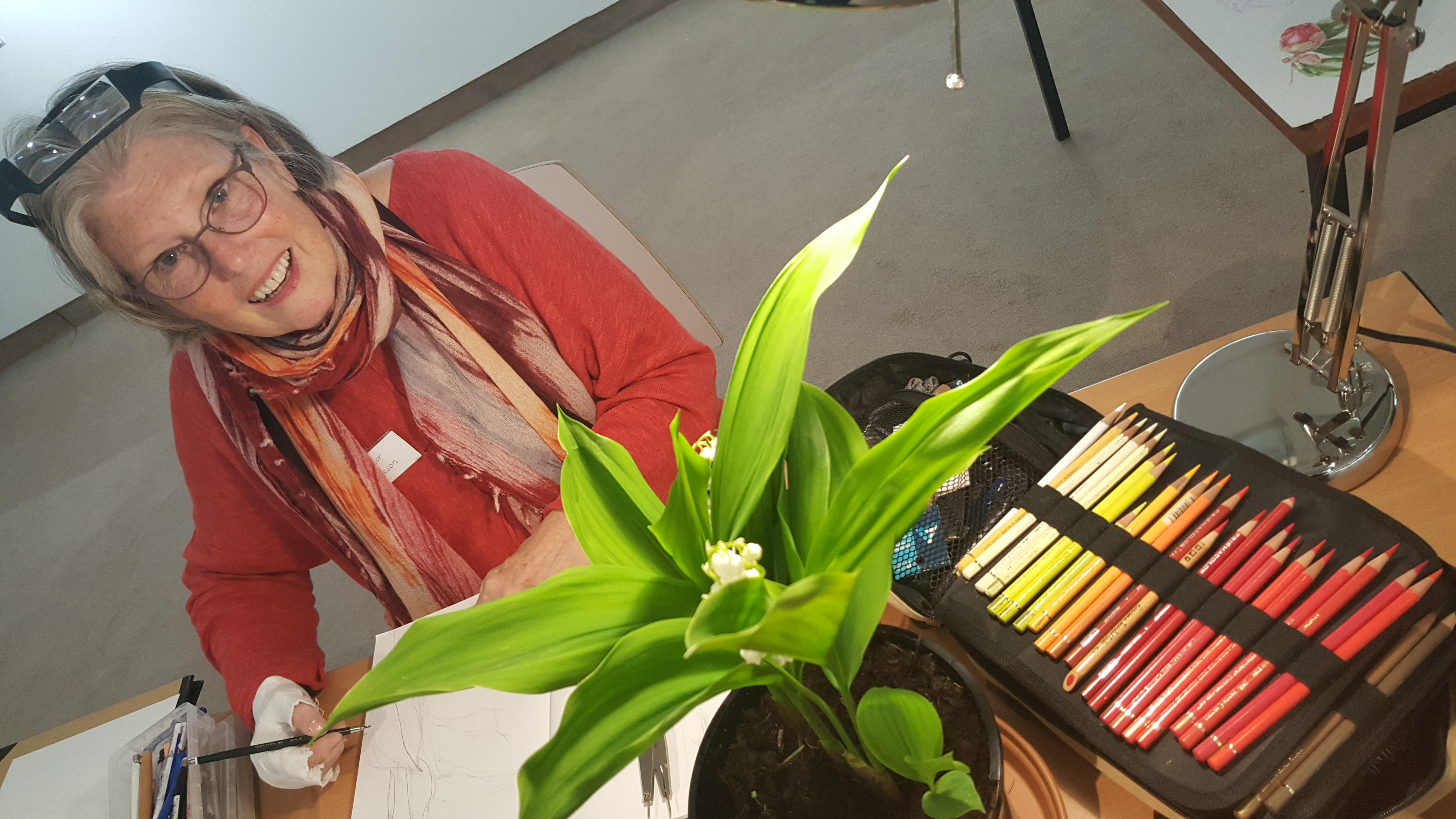
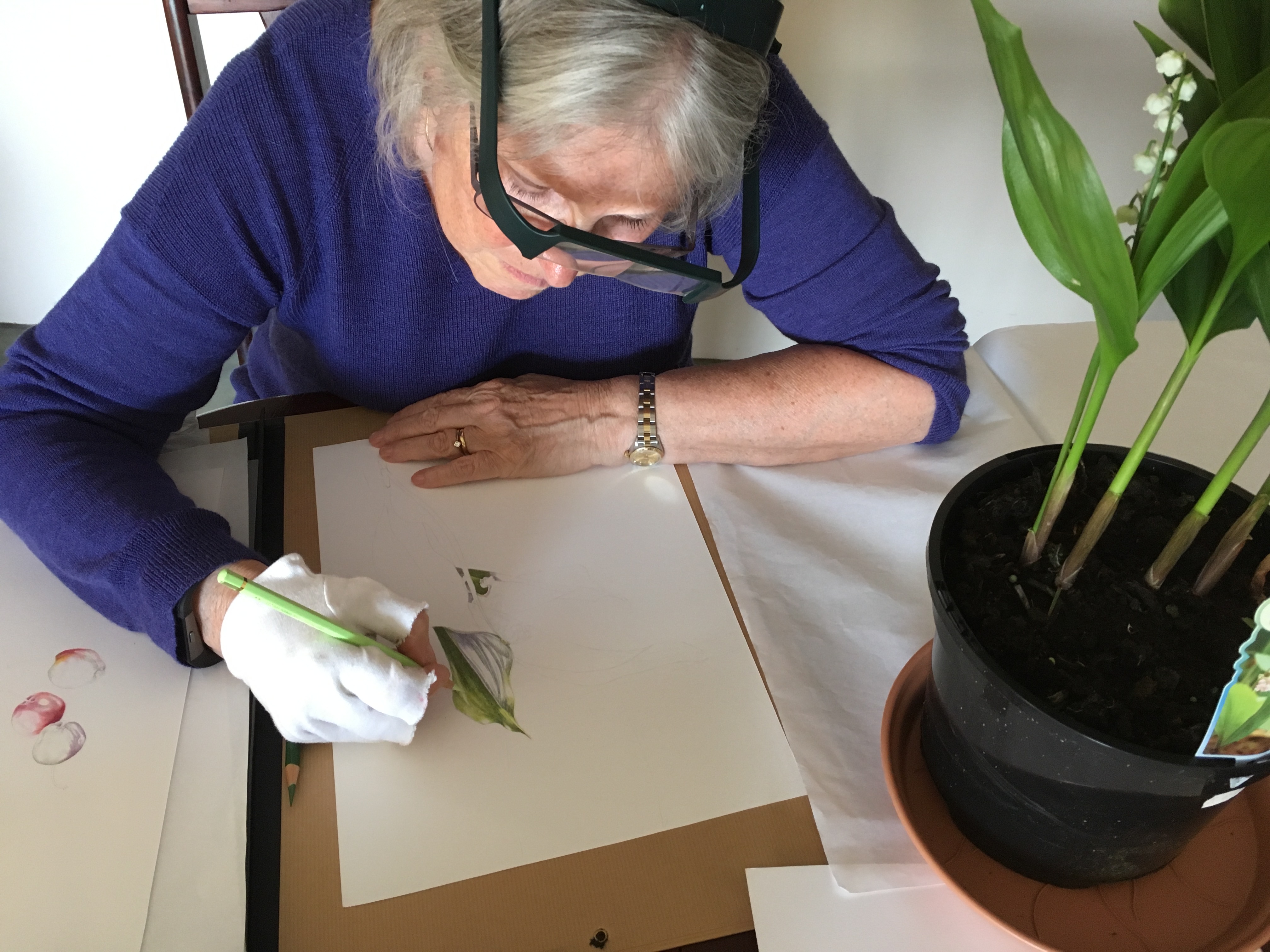
Starting a Colour pencil demonstration of Lily of the Valley. Worldwide Day of Botanical Art 18 May 2018
A little further along with the demo on Monday 21 May
For more information about the Botanical Art Worldwide Exhibition; In Ruskin’s Footsteps, go to
www.britishbotanicalartists.com.The exhibition is on until 9th June 2018. Generally botanical artists are there demonstrating and on the last day there will be a tour of the pictures and a talk.
In between all of this I have managed to squeeze in the Chichester Open Studios weekends and I had quite a few interested visitors. Each evening though it was back to working until the early hours of the morning, on ‘In Ruskin’s Footsteps’.
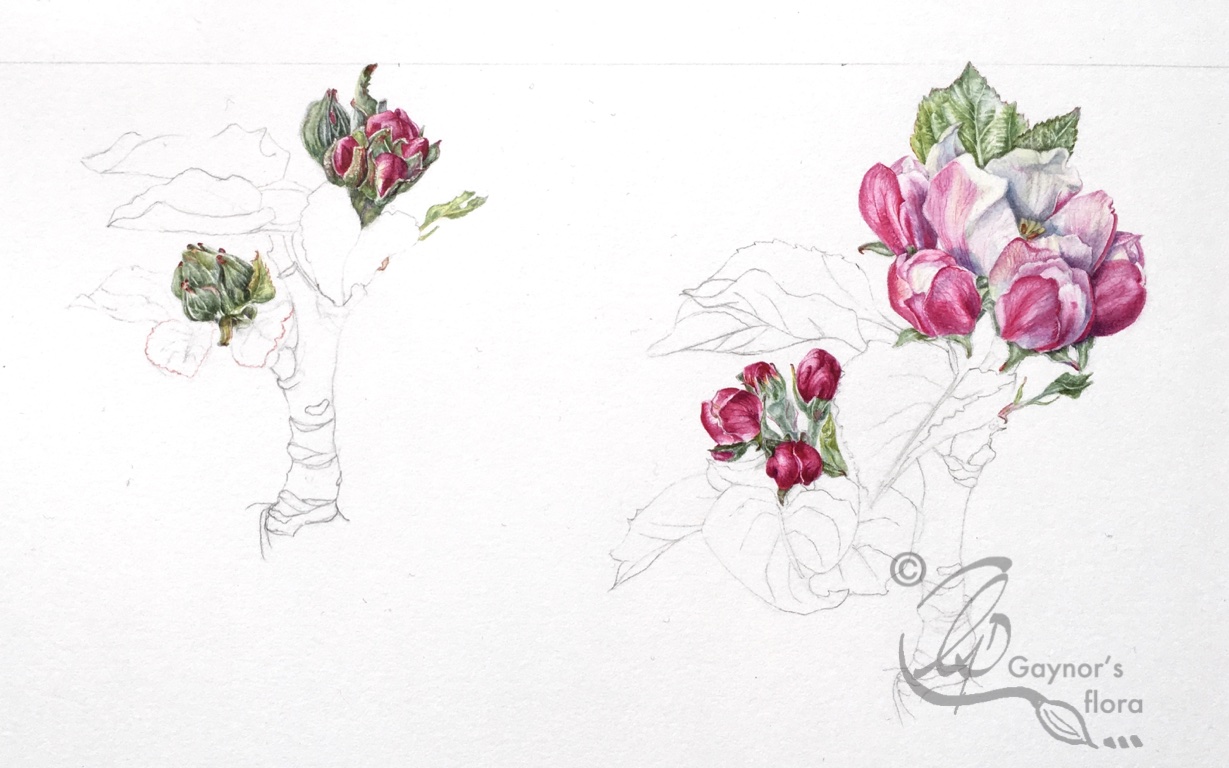
At Chichester Open Studios art trail, starting off the final work for a commission. A Bramley Apple in watercolour.
To show you a little of my own demos whilst in Lancaster I am including the unfinished picture I worked on in coloured pencil. I chose a Lily of Valley as so many people worry about white flowers. I wanted to show how best to do it. I used a lamp to highlight from the left and some of the leaves became backlit creating a beautiful architectural plant. The picture will remain unfinished as the flowers are now long gone, but it will be useful to demo on.
General Data Protection Regulation (GDPR)
Sorry to have to bore you with this! WordPress already has a system in place that protects you if you have signed up to follow my blog. But if you would like emails directly from me about workshops and tuition, or information about my botanical art news in advance of exhibitions etc. then to hold your name on my mailing list I need your permission.
My mailing lists are stored on my computer address system and on a MailChimp list. They are used solely by me and I do not give them to anyone else.
If you would like to have my botanical art news, please click on this link and follow it right through: http://eepurl.com/dqv4ML
If you want to hear from me about workshops and tuition, please click on the link and follow it right through: http://eepurl.com/dqwEtb
Each link enrols you onto a different list, so if you want to hear directly from me about both my news and tuition opportunities , follow through with both of them.
You can easily unsubscribe at any time. Thank you for reading this.




















 GAYNOR'S FLORA