I am writing this on Sunday as by the time we got home last night I was thoroughly exhausted. We spent 13 hours travelling between Frankfurt and our home in Bosham. We were in an empty van – except for suitcases and some bubble wrap. I didn’t feel 100% when we started, but I could not understand why I was getting worse during the journey – until we put two and two together.
Robin and I were obviously very tired as a result of the hard physical work last week, but as the van was empty it was rolling around a lot. It is not like me to not to want to eat, and Robin wasn’t much better either although he was doing the driving and holding onto the wheel all the time. For any of you who picked up the tweet yesterday, I took one picture of the foggy driving conditions. It was not a nice journey.
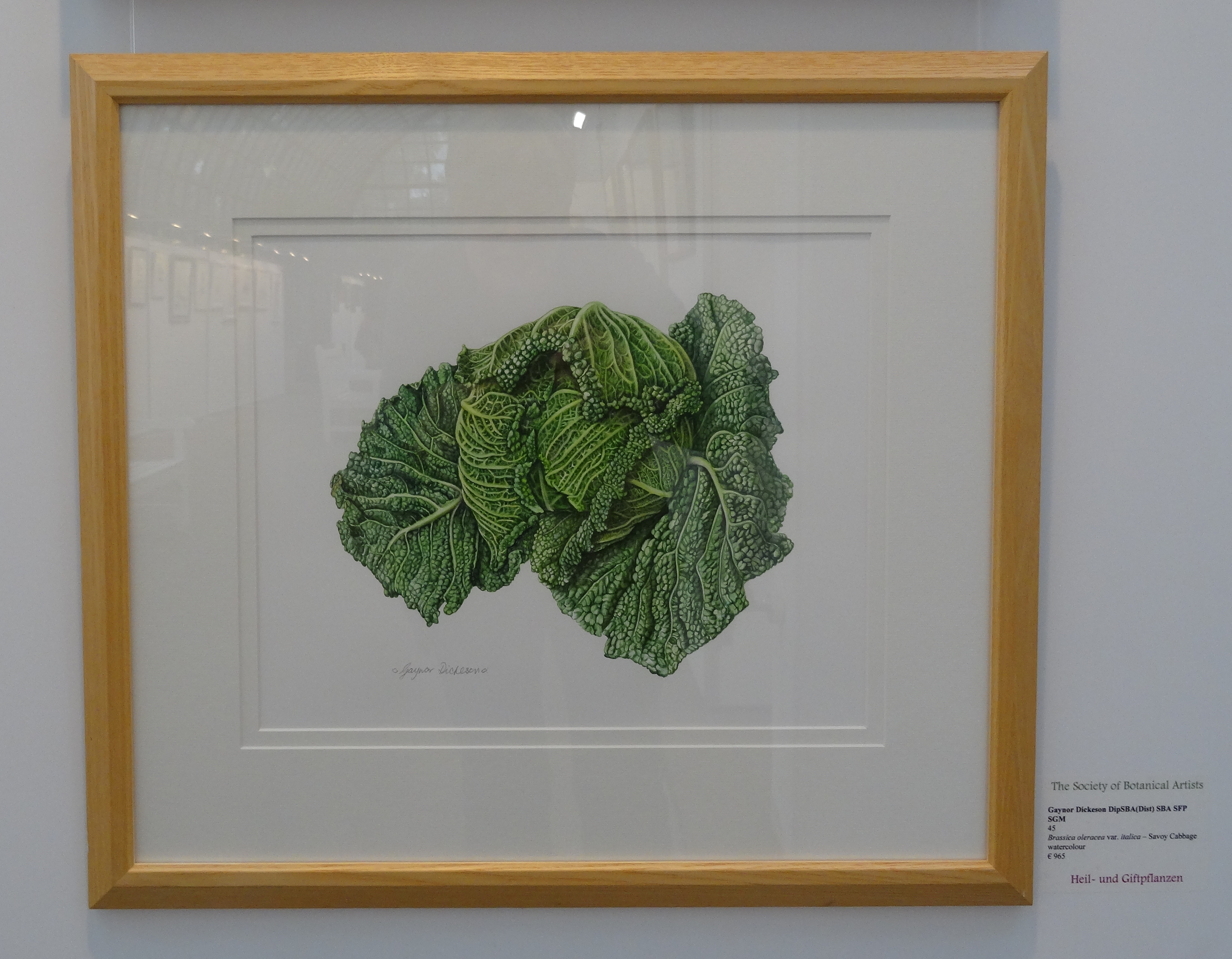
However, whilst on the road I did get a message that we had three further deposits for pictures yesterday. That I felt was brilliant news. Today I picked up a message on the SBA Facebook page that someone there had seen a German newspaper with information about the exhibition from the 76 SBA artists and mentioning in particular two of the pictures.
I am going to attach five pictures here. Three about the journey home and both pictures mentioned in the German newspaper yesterday.
See – All gone!
Parked outside the hotel in Frankfurt & ready to leave.
Is this good driving weather?Gloriosa sp. (Glory Lily) in Coloured pencil by Sue HenonBrassica oleracea var. itlaica (Savoy Cabbage) in watercolour by Gaynor Dickeson
On Monday and Tuesday this week I lead a workshop at Goodnestone Park Gardens in Kent. I have a couple of workshops there per year for Fieldbreaks.
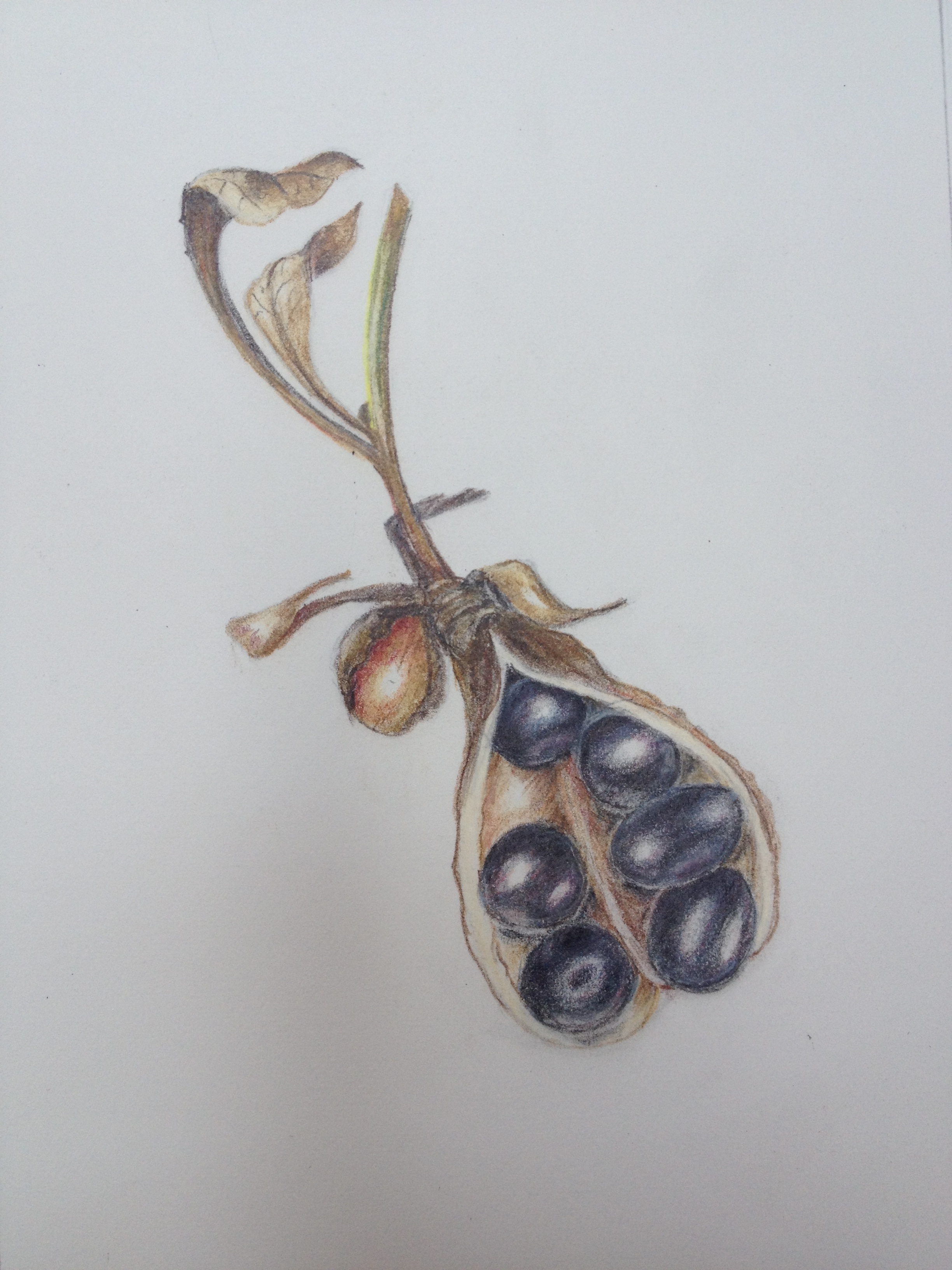
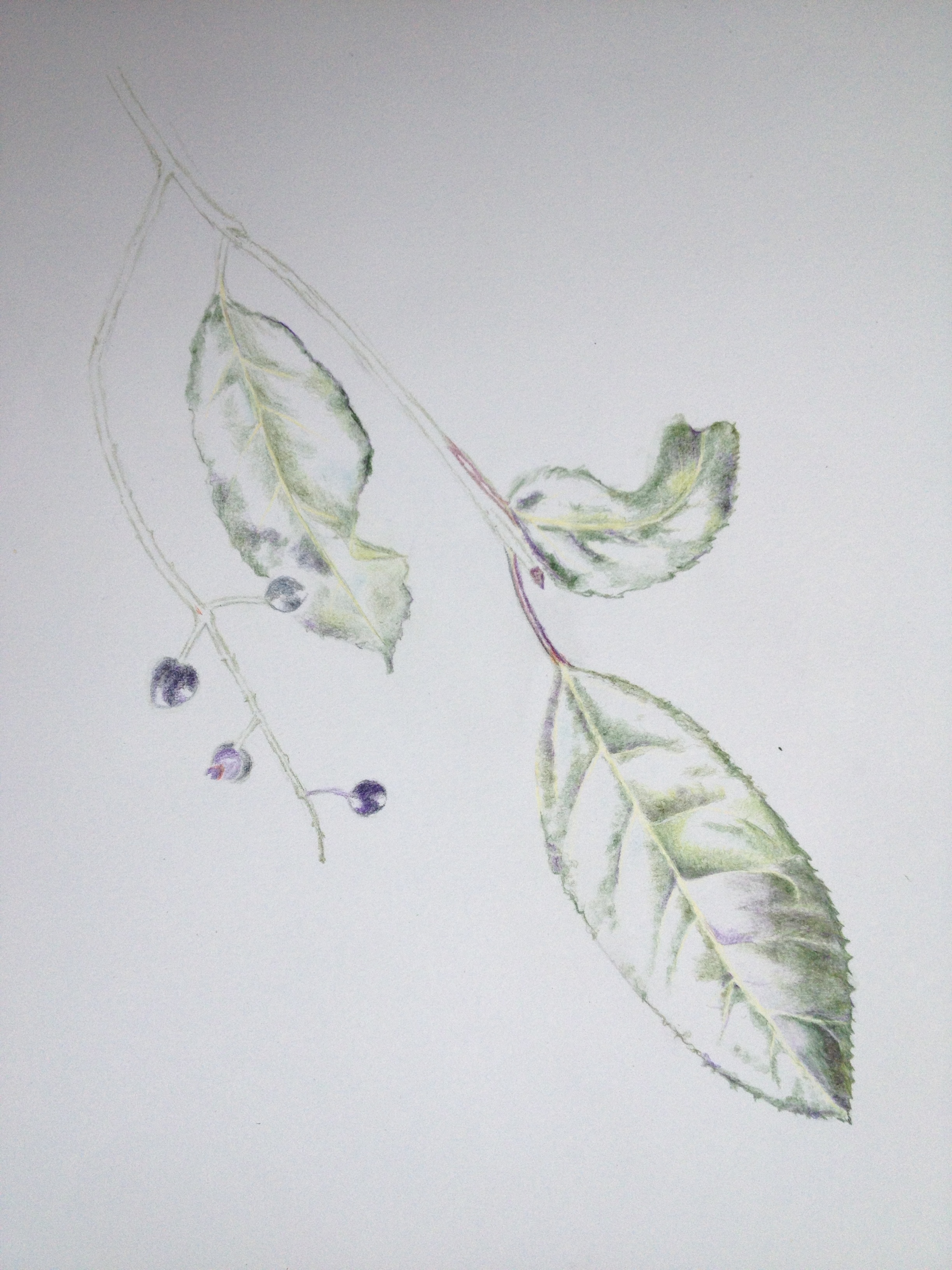
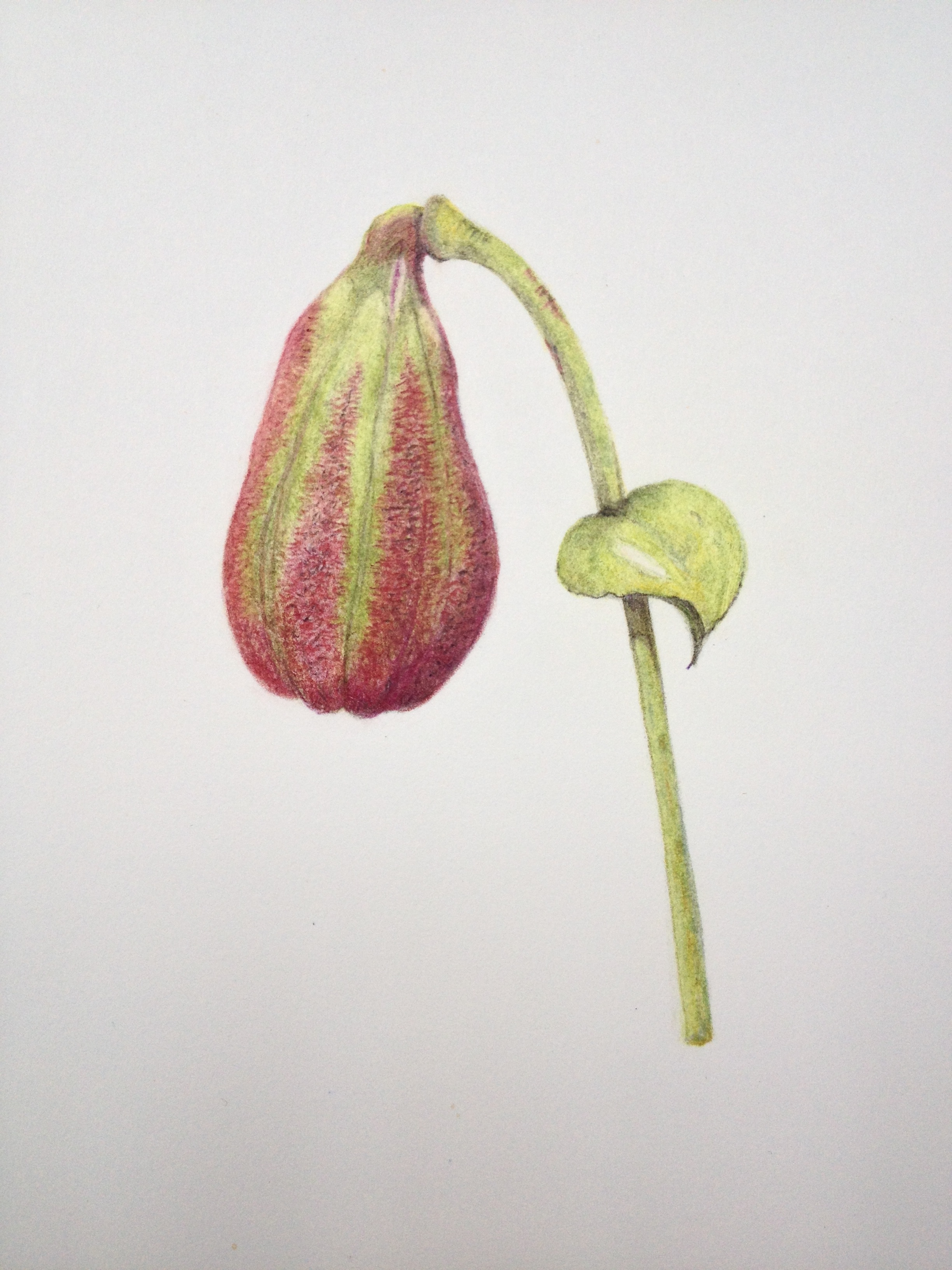
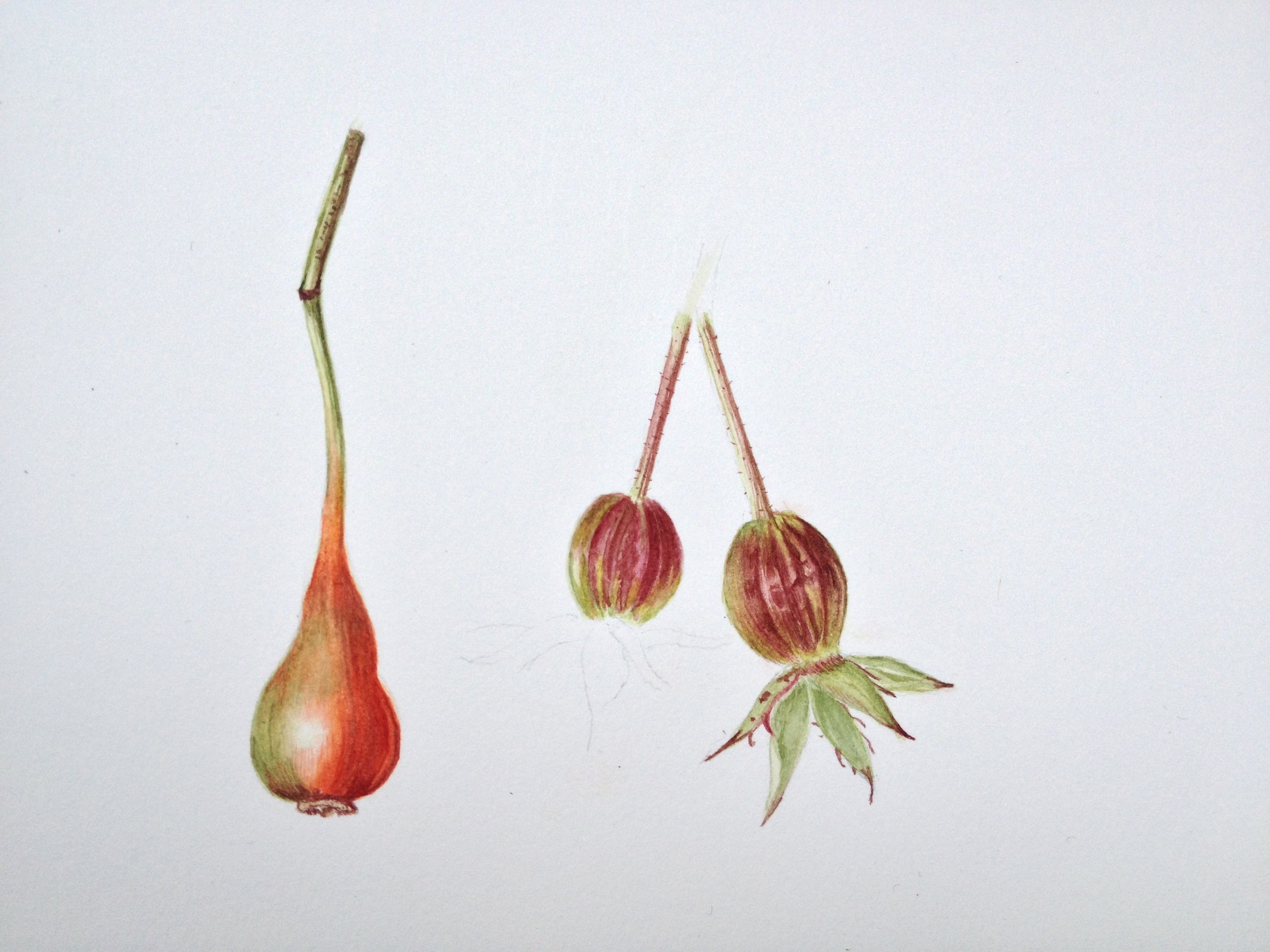
The subject was Hedgerow produce and most of the students were using coloured pencil. One of them had neither used coloured pencil nor watercolour previously, so this was an experience. She did very well, although it felt a bit scary for her.
They are very good at Goodnestone and allow us to pick what we want from the gardens to use as botanical subjects. Some of the subjects we can find there can be quite exciting. But funnily enough, at a workshop I often find that other than new students who have not yet grasped that the ‘prettiest’ is not always the easiest to do, people generally choose very simple subjects. I think that this is because they are more intent on improving technique or learning something new to add to their repertoire of techniques.
Here are the results. I am very pleased with them and I am sure you will think them very good too.
This morning I had an ordinary weekly class and since then I have been working on the pen & ink Bears Britches.
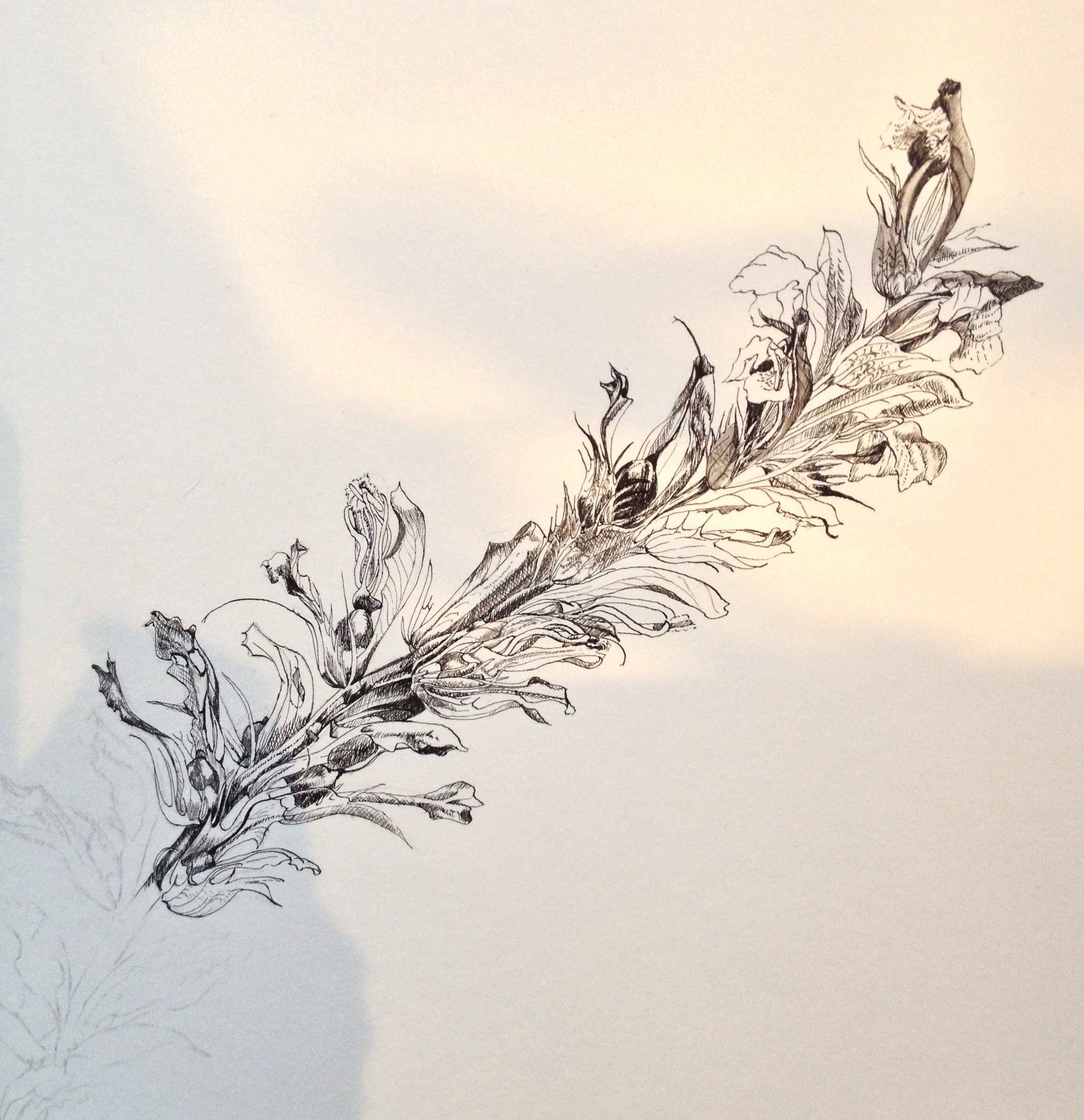
Bear britches in pen& ink
I have only done a small portion of it so far and this is only establishing the flowers and fruits. Once I have established all the elements in the picture I will create tone and then…….. But you will have to wait for that.
On Saturday I will be travelling up to Leicester for the day to go to an Institute for Analytical Plant Illustration (IAPI) meeting, Grasses masterclass, at the University botanical gardens. I am looking forward to this as I have only just joined the group and this is my first meeting with them.
Monday will again be a very early start to arrive at Goodnestone Park Gardens in Kent for 09:30 in the morning. I am teaching at one of the Botanical art workshops arranged by Field Breaks and hugely looking forward to it. Goodnestone Park is a lovely place to do botanical art and the gardens contain a lot of subjects! Already I know some of the students and some use watercolour and others coloured pencil. I enjoy this mix.
But I have started another picture. I am still doing the initial sketch! But the final picture will be in pen & ink. I have another two-day workshop 1-2 October which will be pen & ink. How far I will get with this picture by the start of that workshop, I don’t know – but it will be useful having something on the go.
So far I have only started sketching it. Guess what it is!
Again I haven’t done too much painting over the last week as we have had family staying and we took the opportunity to have a little bit of a holiday with them.
But now I’m back to painting.
Whilst in Pittsburgh last year there were several botanical artists who tried to persuade me about the benefits of painting on Vellum. I saw some really beautiful work there and was really tempted. My husband bought me a few small sheets for Christmas and it has been lying there. Since then I have seen some more work on vellum and I wasn’t too enamoured. It definitely was not of Rory McEwen quality! You see I aim for the best.
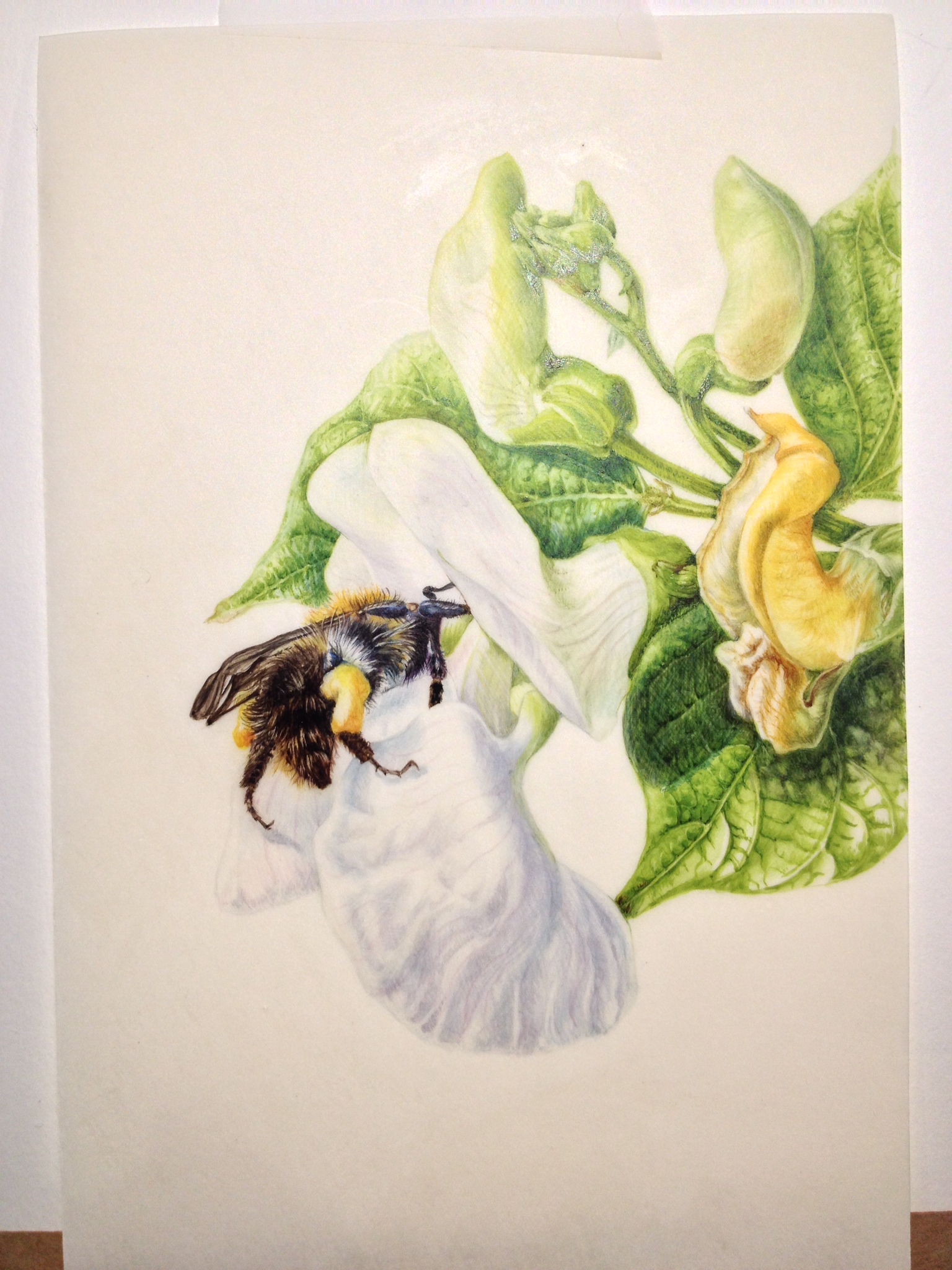
I have been painting a small picture on vellum during the last few days. I had taken a photo of a bee on the runner beans and wanted to do this. Normally I only paint from real life and obviously this was a problem as I didn’t have the bee although did have the runner beans. I did some research on the bee and found out that it is called a Bombus pascuorum worker. It also meant that I had some other bee pictures to make sure that I got the details right. I’m not happy if I haven’t got the subject actually in front of me.
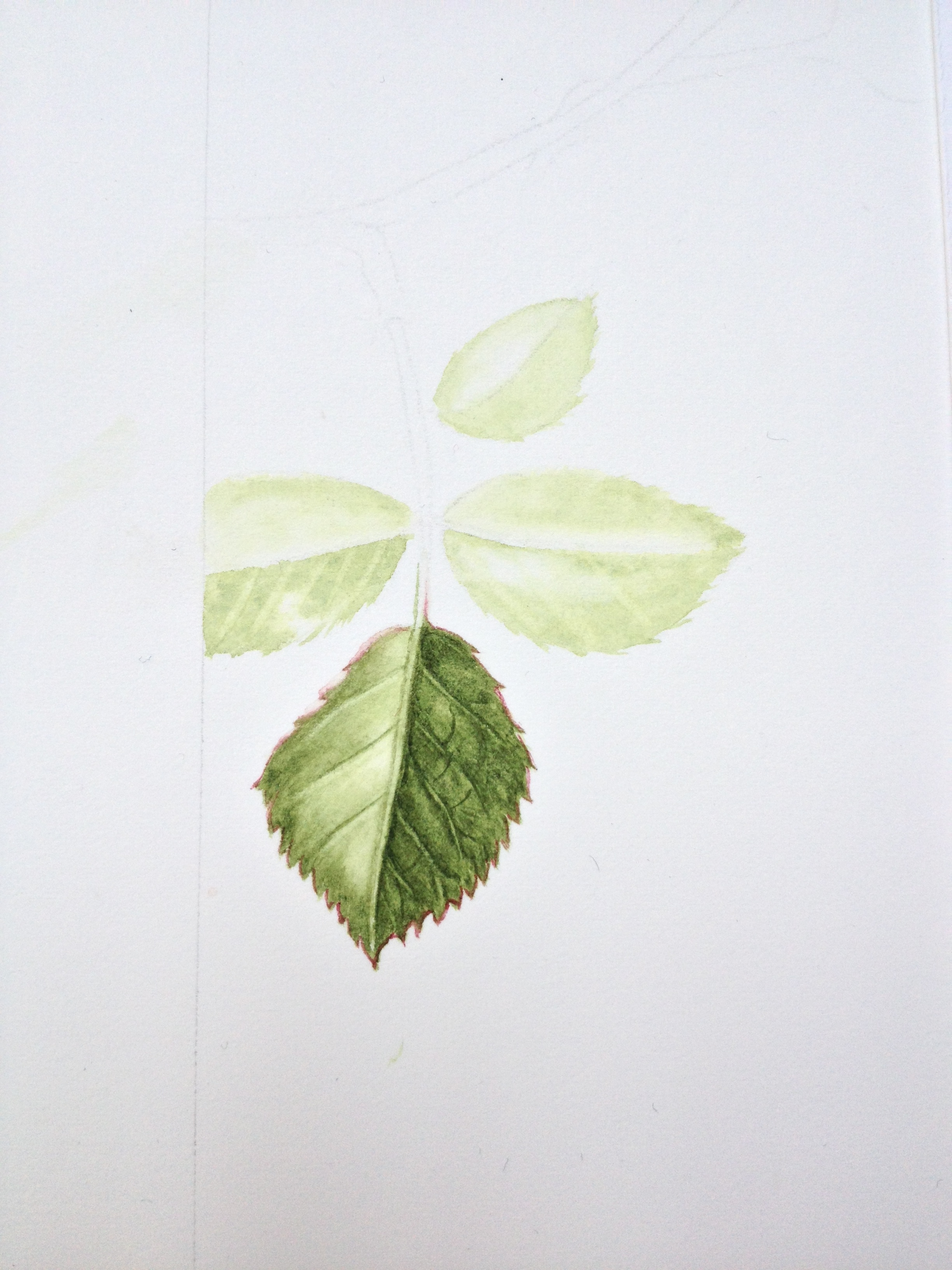
For once I decided to paint it oversize. This is another thing I don’t normally do, so I have several ‘firsts’ here. I know that I had to paint using a dry-brush technique, but still wasn’t sure how. I therefore examined the pictures in the Rory McEwen book ‘The colours of reality’. I had to refer back to this book on several occasions as I built up the layers. I thought that as I had painted on Porcelain many years ago, that I could adopt a similar process. I’m afraid that didn’t work! But I gradually began to get the hang of it and also take advantage of the fact that you can lift out mistakes.
I will put a couple of pictures in this blog, but add a few more as an album on my Facebook page.
If anyone has any tips, please let me know. I haven’t stretched the vellum, but would like to do so on larger pieces.
Runner bean leaves, first washes and detailsThe beeRunner bean flowerFinished painting
In between marking assignments and receiving pictures for the SBA exhibition at Palmengarten, the botanical gardens in Frankfurt, I have been painting.
Last time I suggested you find the part in the picture where I had made a mistake, but had rectified it.
Now I have three photos of the final work on the picture – I think!
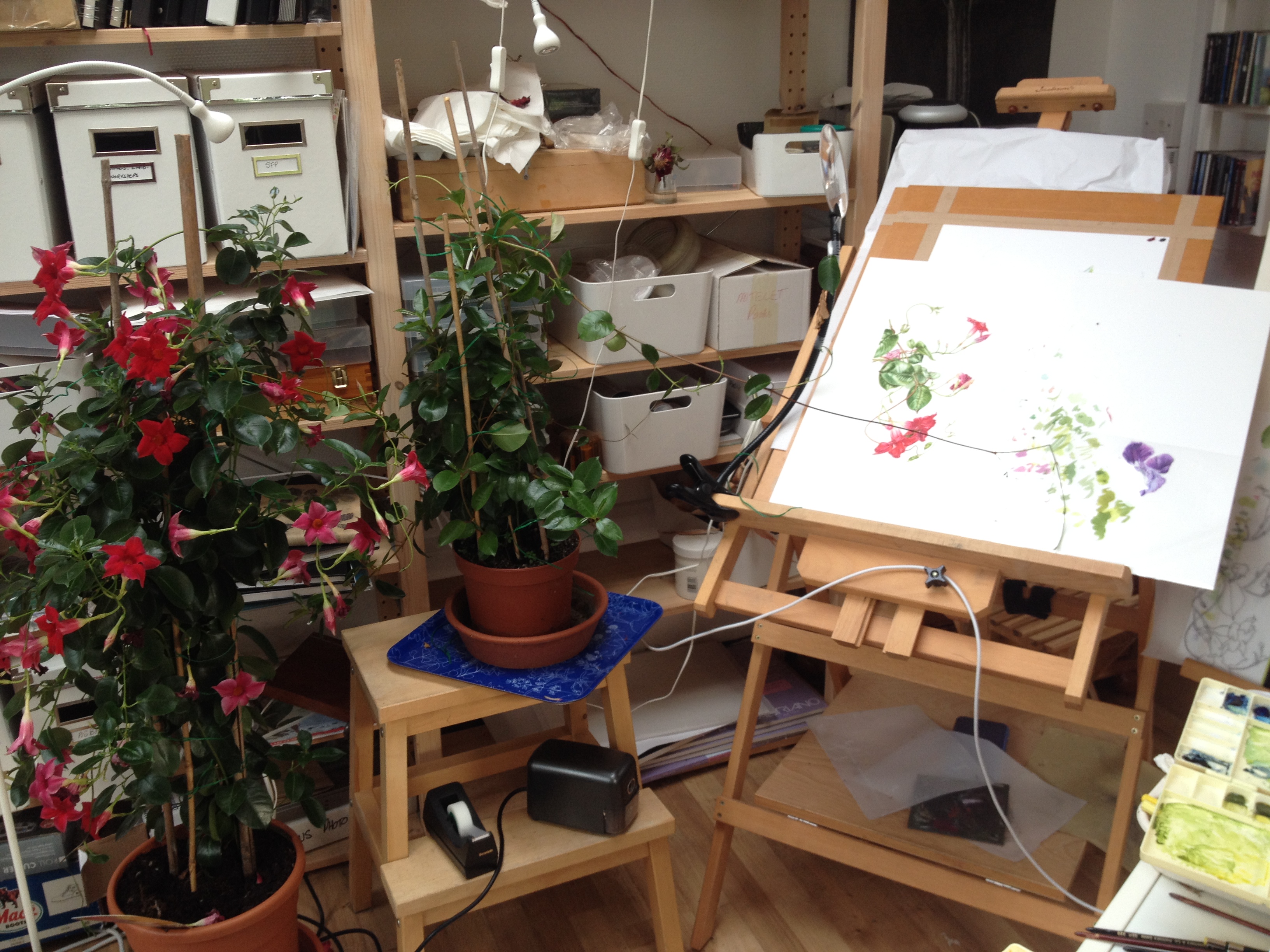
Dipladenia picture: What is needed to balance the composition?Dipladenia picture: Notice the difference? Does it work?Dipladenia picture: Is it finished?Part of my shed. The table looks as though a bomb has hit it, therefore hidden!
What to do with the plants now as it is poisonous. It nearly took the life of one of our cats and is very much a temptation to play with – as well as being very beautiful and exotic looking for our colder climate.
The sun has just come round and is shining in the shed door. It is the only period during the day that I risk the sun coming directly into the shed and shining onto my work. I had just done loads of detail on a leaf and was doing a gentle wash on top. The sun suddenly appeared and I made a mistake. Hopefully it is recoverable.
I therefore took a couple of deep breaths, went out into the vegetable garden directly outside – picked a runner bean and chewed on it to gather my wits. Whilst the work is drying I have decided to do this blog.
Did you see the detail that I showed you yesterday, which was a near miss? In actual fact I did make the mistake and it wasn’t until I was checking over the days work that I saw it.
In the top left hand corner of the second picture I showed you yesterday, there is a leaf going off the page. To the right of it is a tendril of new growth. It was meant to appear from under the leaf. Guess what I did. Without thinking I had painted the petiole of the leaf (rather than curling it round behind and out of sight) and I connected the tendril and the leaf petiole!!!! How stupid can you get? My picture therefore had the a leaf with a petiole and the tendril as a continuation of the petiole! i.e a tendril with the tip completing one end and a leaf completing the other!
I don’t know how many times I say to students, paint what you see and not what you think you see. That also applies if composing a picture from various parts of a plant to make a cohesive whole. The details in the picture have to be completely botanically correct even though taking elements from different parts of the plant.
To correct the whole, I had to lift the edge of the leaf, petiole and end of the tendril – luckily it doesn’t show. I re-painted the tendril to disappear a little lower down the leaf, and then added a stem coming in from above the leaf. That meant I also had to slightly change the direction of the stem coming out from below the leaf. All very complicated and of course that mistake has knock-on effects with the composition in other areas. Hopefully I have managed it reasonably well.
I know that some people will find the above explanation and detail unnecessary in a blog such as this. But I am already being very honest about this picture, so why not go into the detail. It might even help someone else avoid similar stupid mistakes.
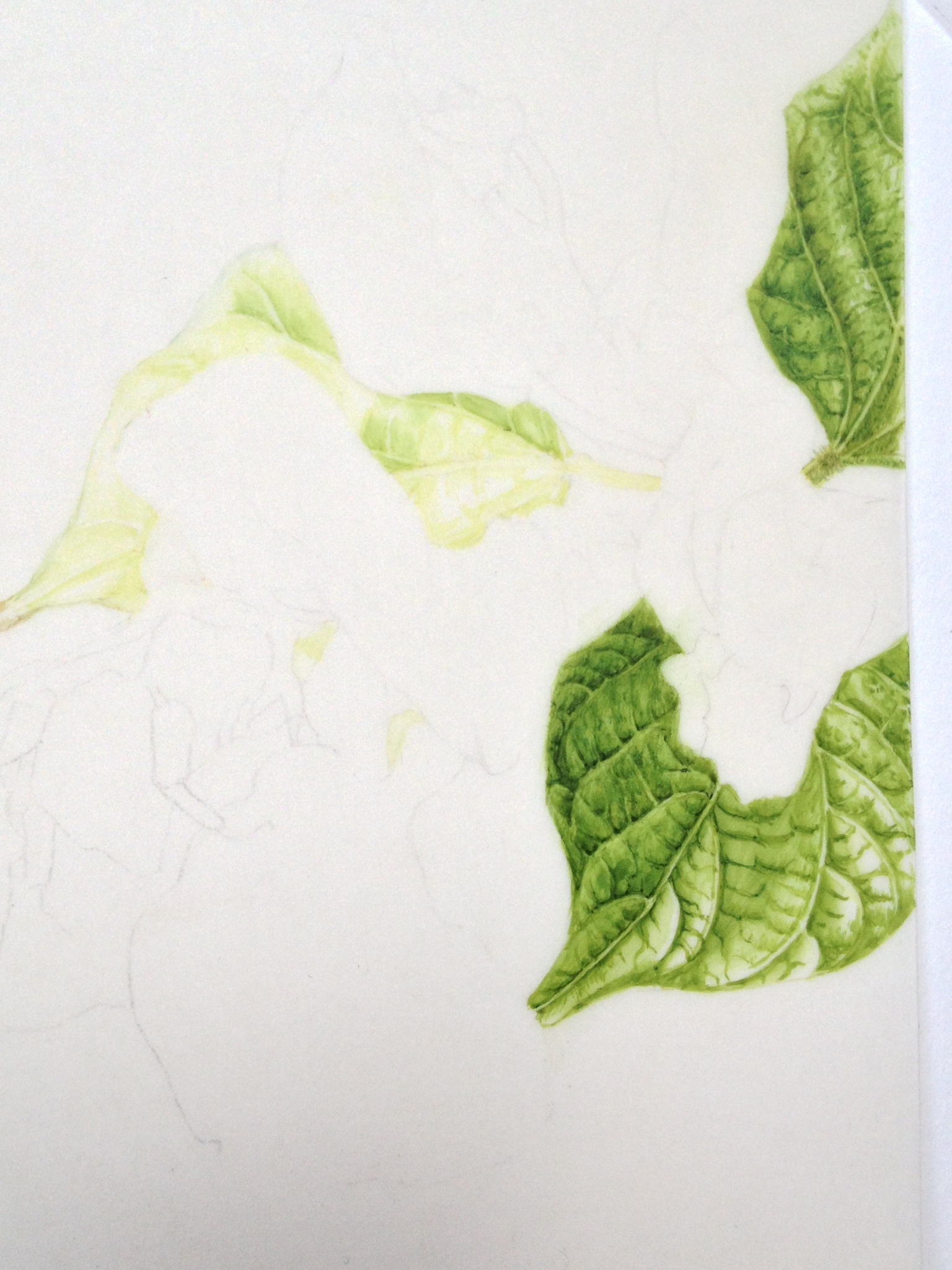
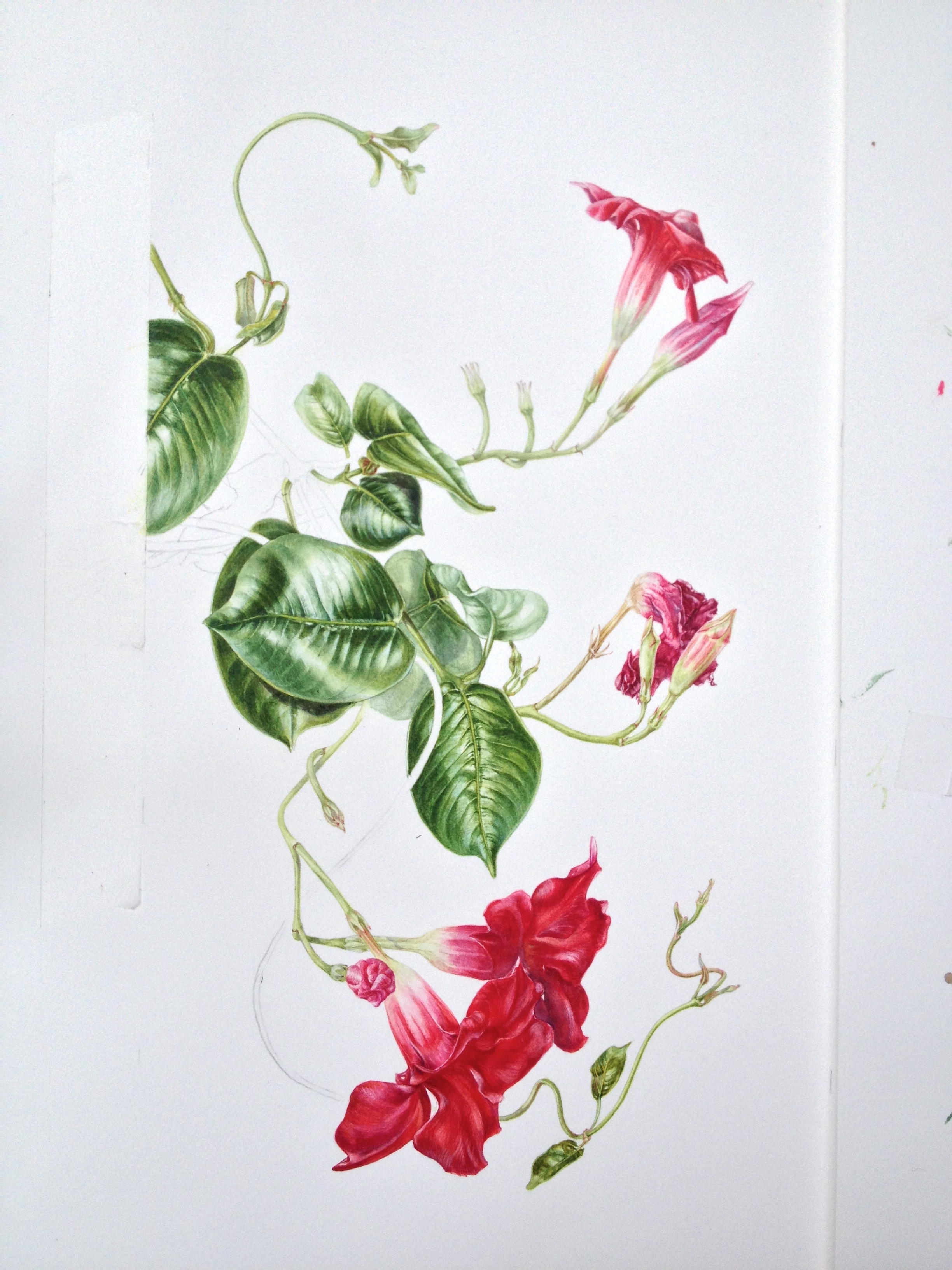
Anyway, the first of today’s pictures is the corrected view. The second picture is more leaves that I have done. These include views of the underside of Dipladenia leaves, foreshortened views and a full frontal view(!). The last is not finished yet.
By the way, I have found that for these leaves I have needed to use smaller brushes than I normally use and a dryer mixture.
Finished leaf and tendril.More leavesLast adult Dipladenia leaf
I have to be honest that the photos I am sending out in my blog are ones taken during work done over the last couple of weeks. I suppose that rather than show you them as I am doing them, I am still hesitant as to where the painting will go and if I will get over my fear of doing it badly yet again!
I am still spending quite a bit of time on the Palmengarten exhibition organisation which means that some days I have virtually no time to paint. Additionally I mark the assignments for the two botanical art courses at the London Art College. It all takes time off the actual painting. But, I am enjoying seeing the assignments that come in and the development of the students.
Do have a look at the London Art College website if you are interested in doing botanical painting either in watercolour or coloured pencil. Obviously getting hands-on tuition is the best, but sometimes distances preclude this and the distance learning is a good option.
Now a couple more photos from the Dipladenia picture.
Dipladenia flower pair with bud and a flower having lost its fused, tubular petals.Dipladenia flower shrivelling & two buds.
I am now on my 6th attempt – I think. I’m losing count.
It is a while since I last wrote a blog and since then I have been trying to get my head around my temporary(!) lack of skills. I had decided to paint a Dipladenia plant for the Botanical art exhibition at Palmengarten, Frankfurt in October. The title of the exhibition is Poisonous and Medicinal plants.
Prior to going to Norway I had sketched out and gently started the picture. For those who may not know, the Dipladenia is as poisonous as Poinsettia. But it grows long tendrils and these are a temptation to a playful cat. Unfortunately I didn’t know how poisonous the plant was and I now know that when the cat suddenly became seriously ill before we went away, that in fact he had been poisoned by the plant.The trouble is it also seems to have had a negative affect on my painting skills.
The plant is now in the shed – well away from playful cats, and will be given away once the picture is finished. I will not give up.
This time I have reduced the design and have painted most of the flowers first. I suppose that is asking for trouble as I seem to get a blockage when I get to the leaves. I know what I want to do, but somehow there is a disconnect between my head and the messages sent to my hand and skills with the brush, pigment and water!
I am taking some photos as I go along.
Dipladenia flower 1
First layer of the dipladenia flower. Note what looks like a heavy dark tracing. It is in fact not heavy and is traced in the method I have demonstrated in an earlier blog. Because no sharp tool, even a pencil is used to do the tracing, the graphite is easily lifted off completely with a putty rubber, leaving NO indent.
We painted the vegetables and ate the strawberries and cream!
I was very disappointed for two students who at the last minute were unable to come to the workshop because of personal difficulties. We did think of them often during these two days.
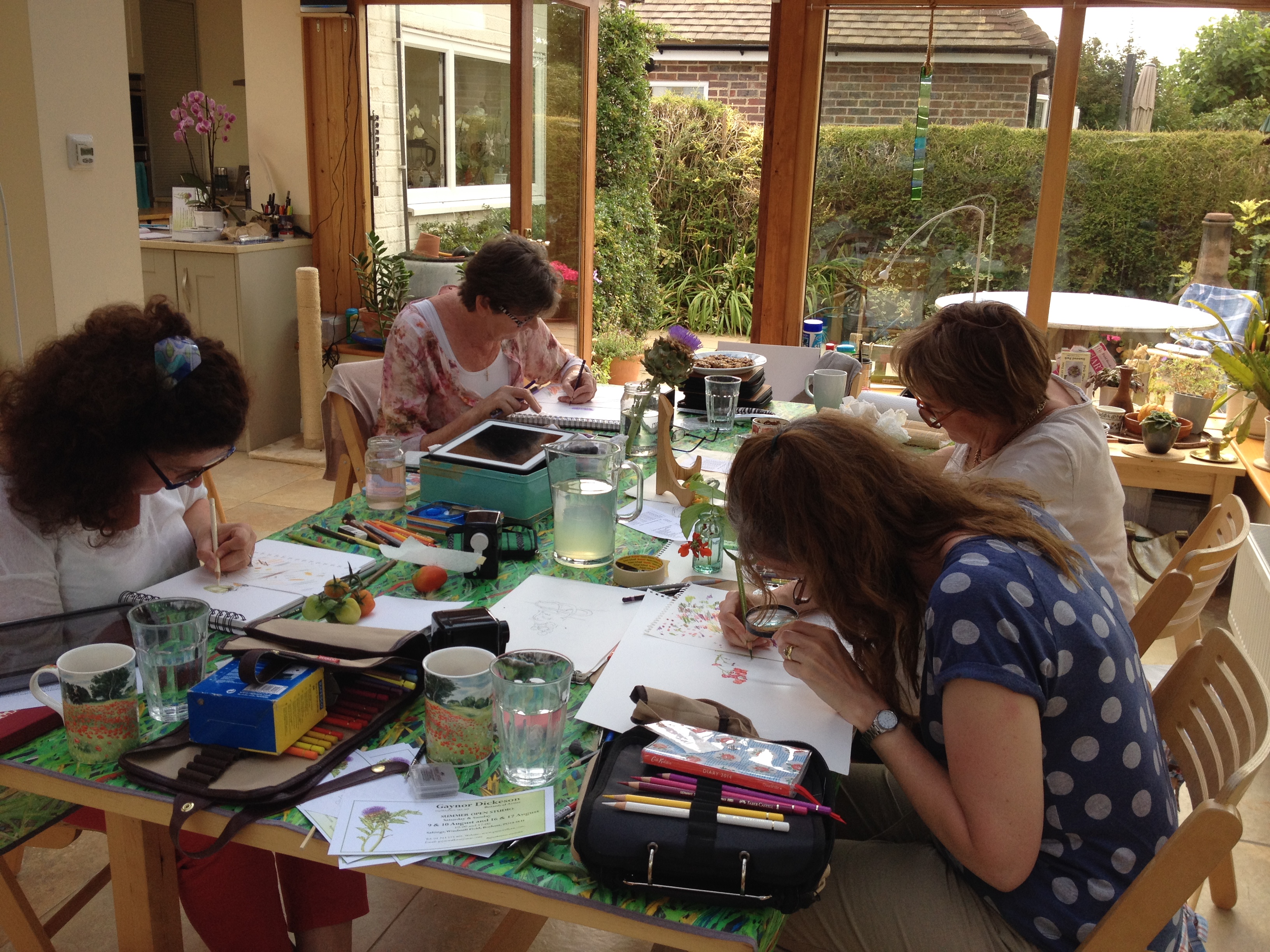
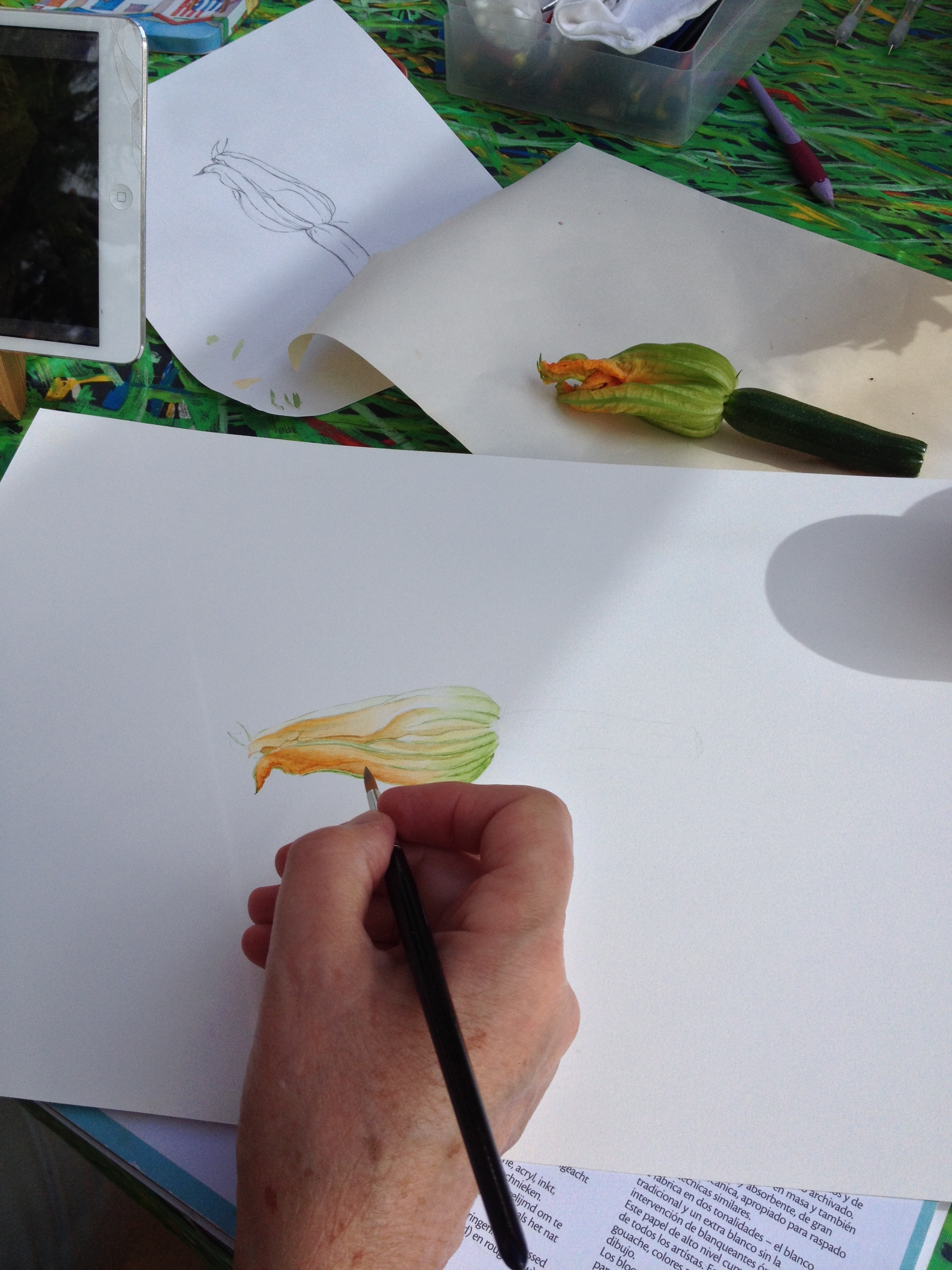
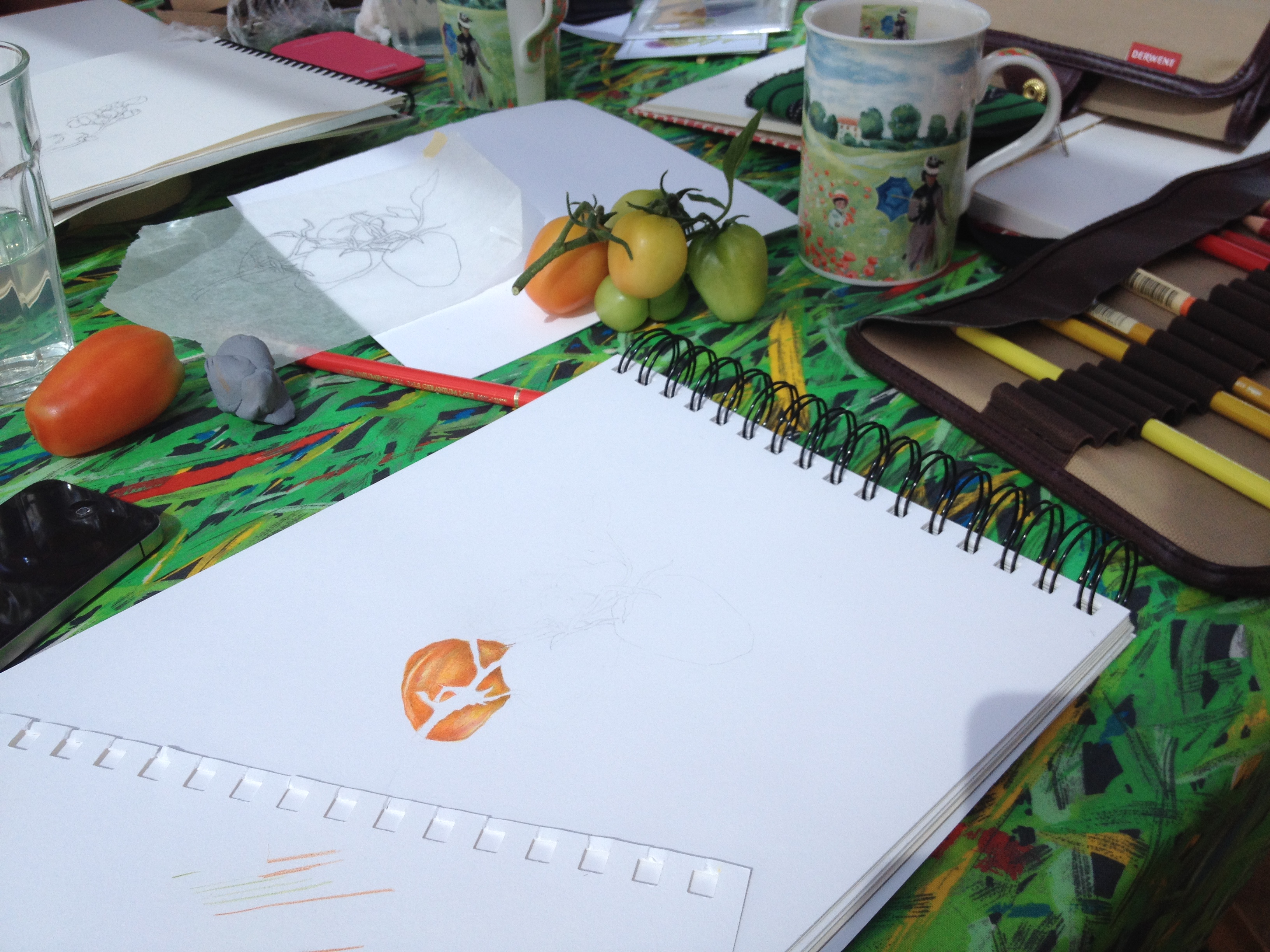
Quite early on during the workshop I felt that the students would have some results that they would be proud of. Having picked suitable subjects from the garden, as usual we spent time on the preparatory work; the composition and drawing. Having said that, one of the subjects we knew would fade very quickly and therefore it was important to get down the first layers of colour fast. This time most people used coloured pencil and only one person used watercolour. It is exciting using different media in the same workshop as each student sees how each affects the final work; although less than one would imagine.
You want pictures, so here they are.
What concentration on a lovely summer day!What flowers are these?A fading flower waits for no-manNow guess what this is.
Today – at the end of the workshop. They promised to finish the pictures that still had work to do on them.
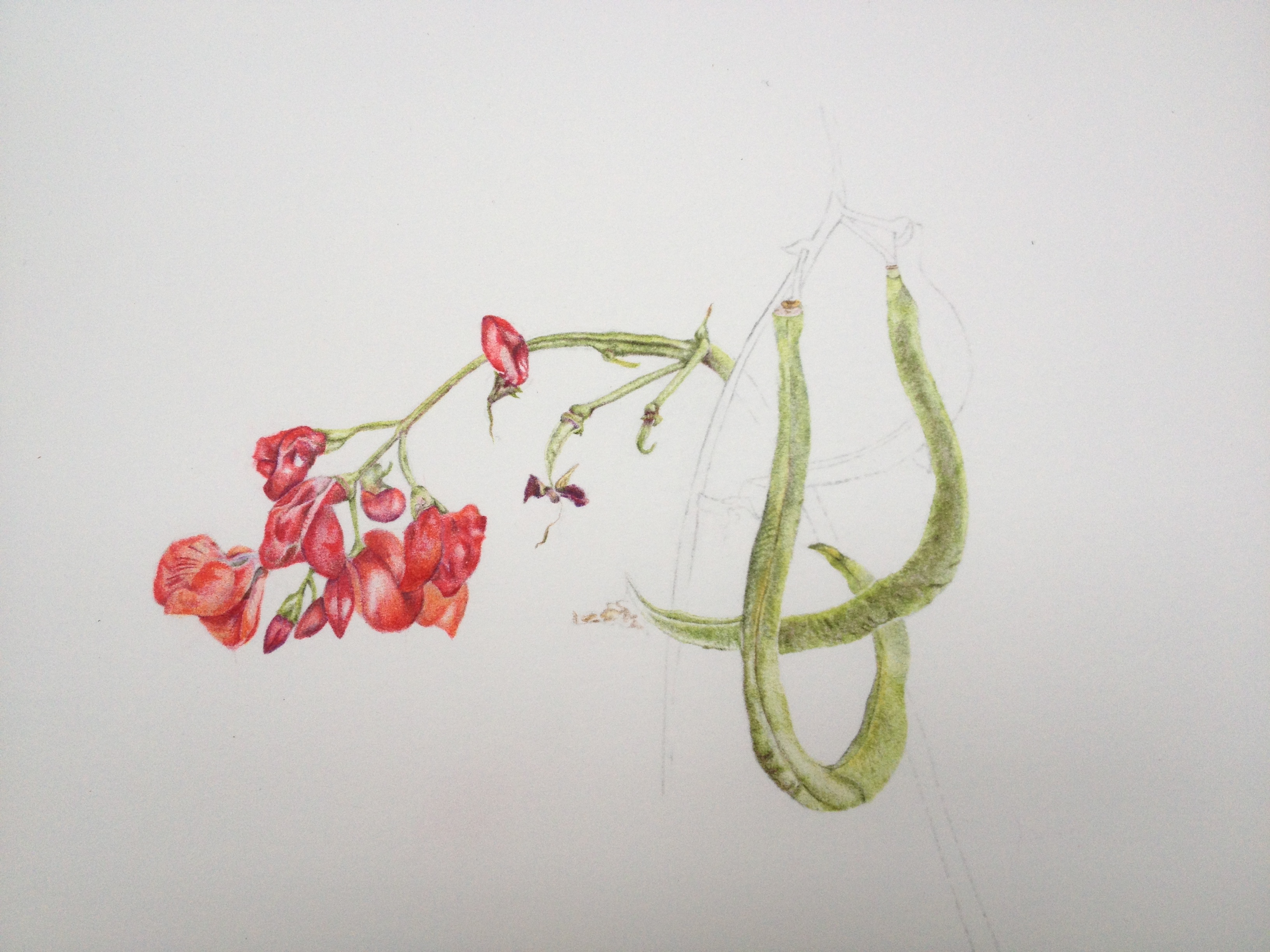
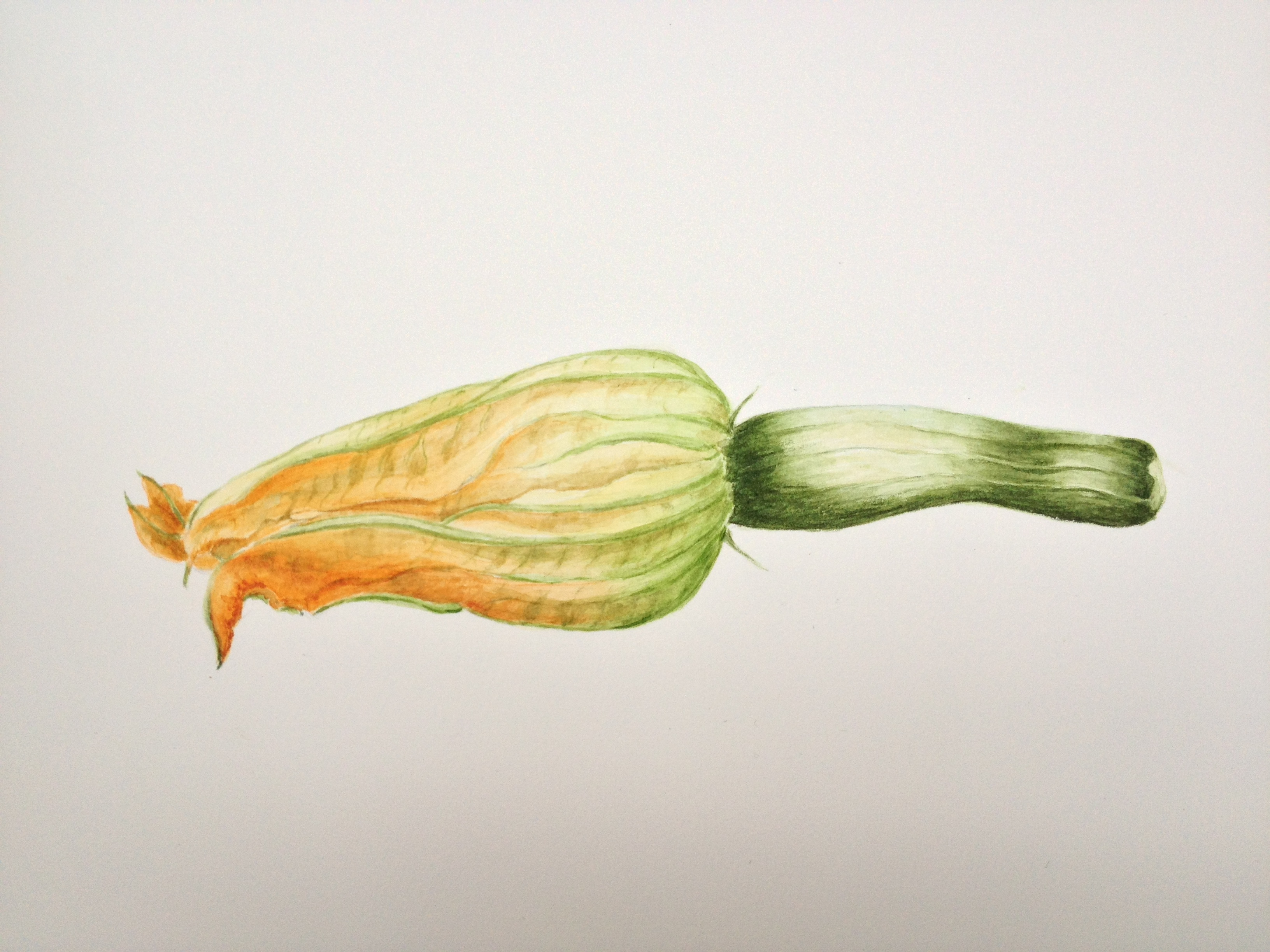
Runner Beans in coloured pencilWhat a beautiful little Courgette. WatercolourHome grown tomatoes – but not from my garden. Coloured pencil.Globe artichoke before its haircut. Coloured pencil and no embossing tool.
After just two days work, aren’t these amazing?
The next workshop is entitled ‘ Hedgerow produce – those colours!’ Tuesday 2 September until Thursday 4 September. As usual it is between 10:00 – 16:00 each day with lunch included. I do have spaces on the workshop, so get in touch as soon as possible.














 GAYNOR'S FLORA