On a walk exactly four years after moving into our Norwegian home.
The above walk was with my children and husband. We went a little further south along the coast from where we live. It was on the edge of a beech wood, very cold and plenty of snow. However, the temperatures were not as low as the day we moved into our new home. On that day, it was minus 15 degrees Celsius!
I have had botanical art students from just as cold climates. They have asked what they should paint when there isn’t too much growing. For my course, I always suggested they might buy indoor plants to complete the course. Once they had finished the course, they could choose their favourite subjects.
A fair amount is still available in the countryside. This can be seen in the picture above, showing the edge of a Beech forest. My garden also contains rose-hips, beech, oak, Rowan, pine, hazel, all of which is accessible above the snow. It also has a lot of wild-life.
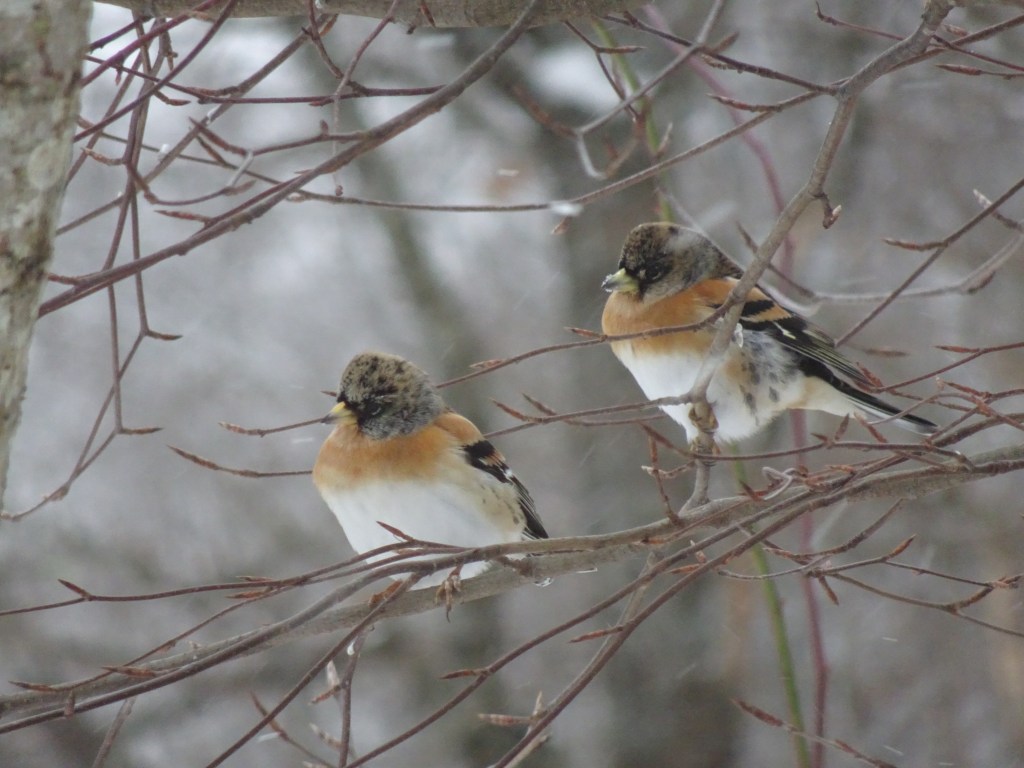
Bramling – Fringilla montifringilla – Bjørkefink in a Beech tree.
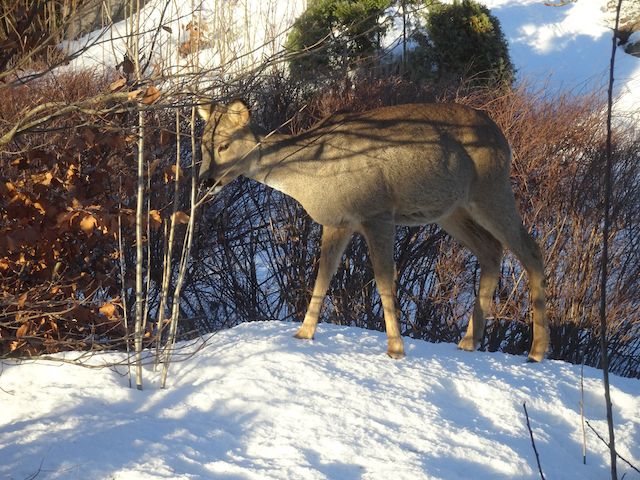
Single female Roe deer – probably first winter alone.
Many years ago, during my first 25 years in Norway, I focused on painting birds. At that time, I relied on photos taken with my SLR attached to my telescope. For additional detail I used skins from the museum. Since then, the equipment available to me has changed. It is more affordable now. I can get much better photographs from my trusty little camera than I did from my film reliant SLR.
Gradually we have moved the bird feeders nearer to the house. This allows me to get quite good photos. Feeding the birds in the garden also provides a plentiful supply of nuts and seeds generally. This attracts other animals during the winter when the supply of food is short. Deer are also welcome visitors and mop up after the birds. But we do have to try and protect our fruit trees a little!!
So what do I paint? I decided to combine my love of painting birds, with my love of botanical art?
Many of the bird species move from the mountains to lower lands searching for food during the winter. This includes the Bramling, Yellowhammer, Siskin, Bullfinch and Hawfinch. At the beginning of the winter, their colours can be a little drabber. As spring approaches, they get new plumage. and become very colourful.
Now I spend quite a bit of time photographing these beautiful birds from the comfort of my own lounge. The two pictures above are good examples.
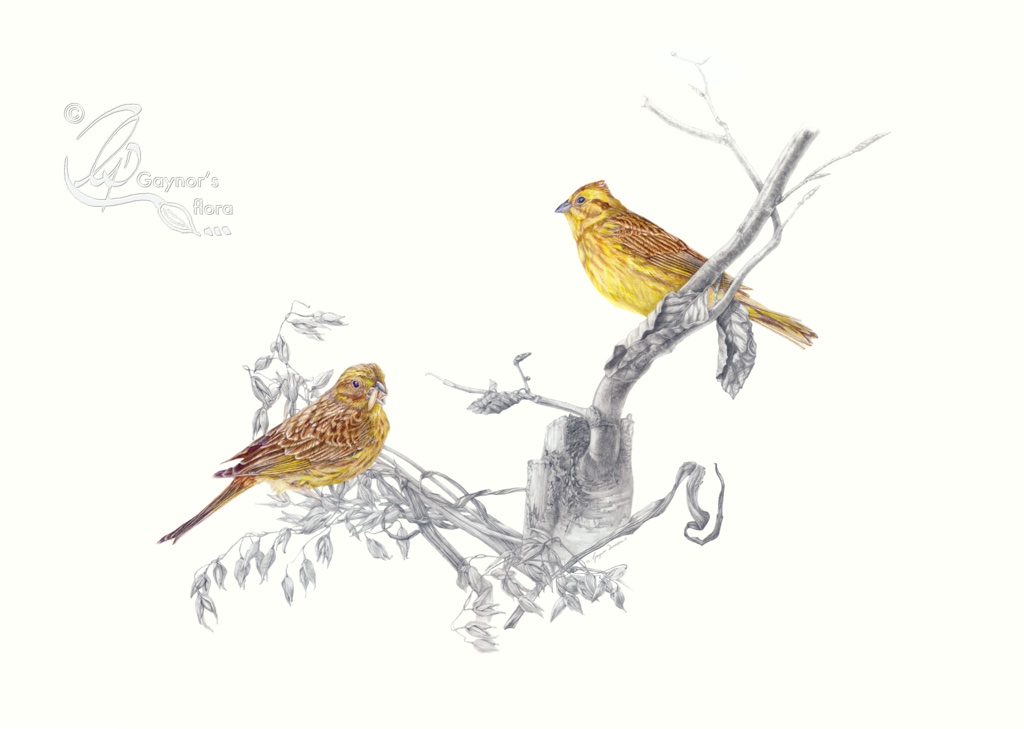
So where has this led me? It is traditional in Norway to put out sheafs of corn for the birds for Christmas. The Yellowhammers seems to be very interested in this food source and flock to the sheafs. This year, we have the corn hanging in a Beech tree, so I had both botanical subjects with the birds. Additionally, I always loved the use of graphite and didn’t start using colour in my artwork until my mid-twenties. So this picture is a combination of glowing colour for the birds and graphite for the botanical detail.
To confirm which is which in this Yellowhammer pair, the female is the more motley colour on the left. I do enjoy painting her more. The Male in striking yellow is on the right. He is very gentlemanly and making sure she is feeding un-molested. All is painted actual size. The finished painting is 52 x 37 cm. Enjoy!
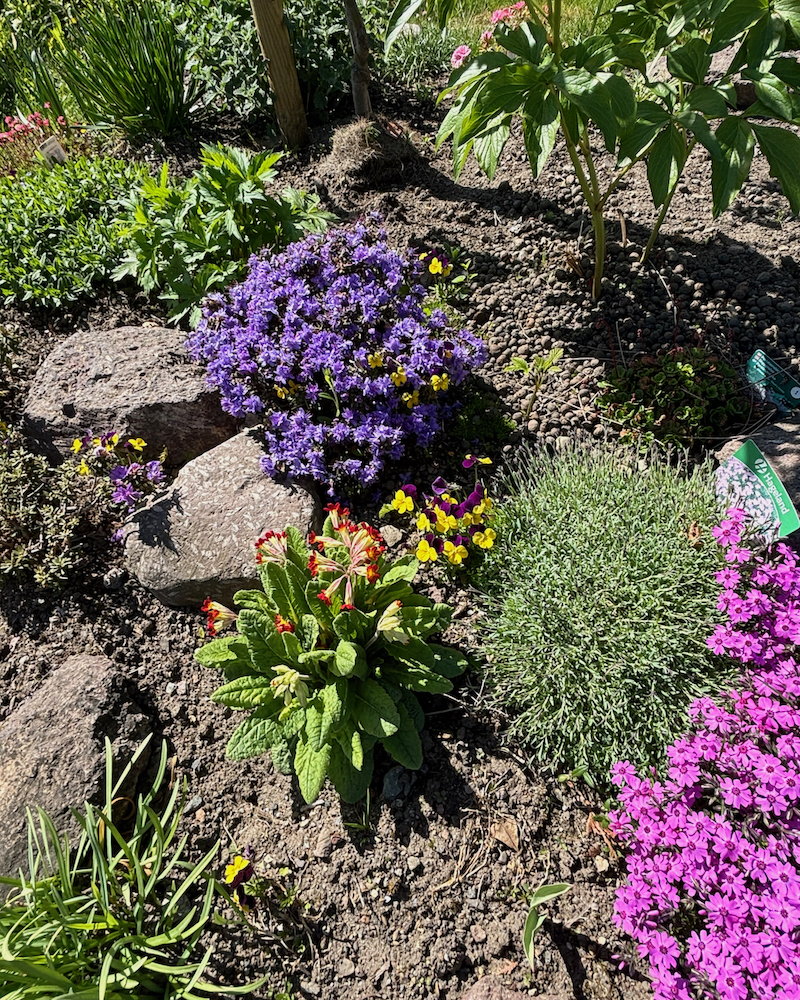
Last snow 5 weeks ago in April and rockery todayin May
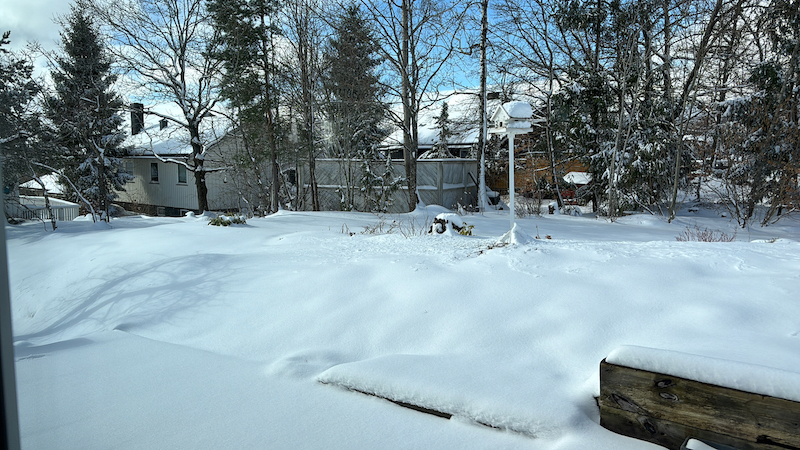
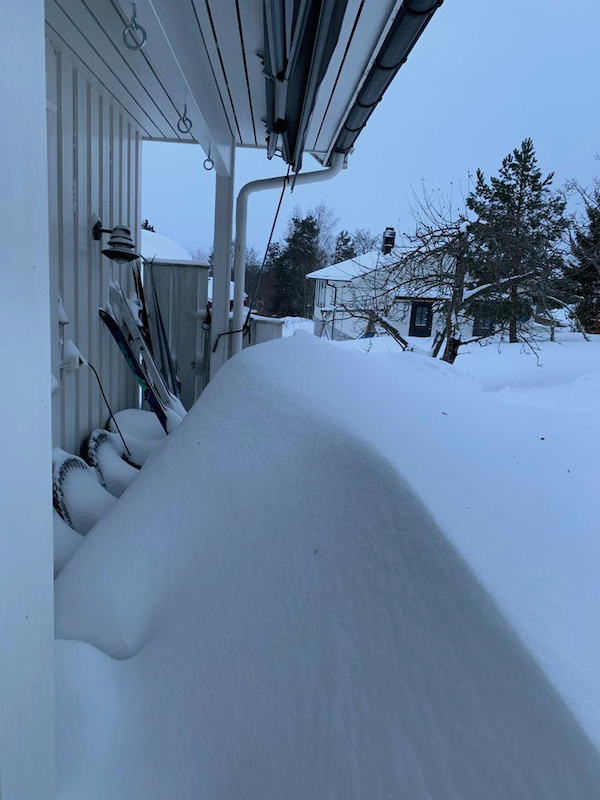
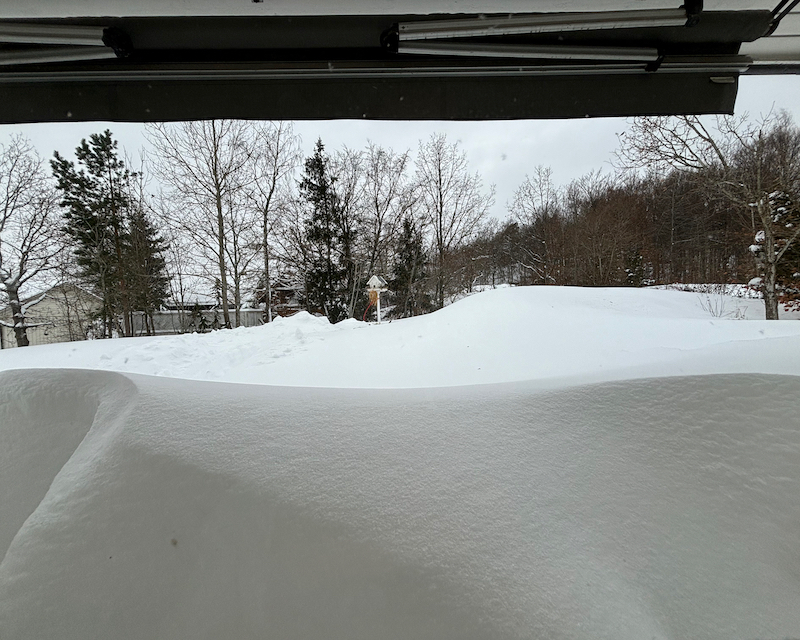
We had a very long cold and snowy winter from 31 October 2023 until the last lot fell on 5th April 2024. In fact, the locals don’t remember so much so near to the Oslo fjord. At one point we had about 2 metres of it and one day we were unable to open any of our doors to get outside. In the end I pushed the kitchen door open a few cm and then used the shovel from a fireside-set to gradually dig my way out.
Of course we had no idea that we would have so much snow and had put wire fences round the apple trees and plants to prevent the deer chewing in the winter. Little did we know that the snow would come well above the fences and there were periods when the deer were really hungry and were able to reach up to the juicy bits on top of the trees!!
I don’t want to bore you with pictures of snow, but have put this little group together:
Can’t get to my skis!Me digging a path on the terrace.Poor red squirrel grovelling for seeds at the base of the bird feeder.Red sky at night. Amazing colours!Snow angel on New Year’s EveLooking out of the terrace door. The snow has packed agains the glass!!
We thought the winter would never end; I couldn’t even access plants to paint. Then suddenly summer arrived. The snow and ice melted over a couple of weeks, the snowdrops started flowering on the edge of the melting snow. This was quite funny to see because as the snow receded, the white flowers emerged. We thought that the ones first flowering would be over by the time the snow actually went, but each patch lasted quite a while.
The next was looking for some green to appear. Every year the grass is brown in the spring and it looks very dead, but after only a few days it starts turning green. Our house looks out over a valley so we can watch as a haze of green tips appear on the trees – until Pang, the world looks as though it has always looked luscious.
This is how the world looks for us now, just a few weeks later:
Apple treesOf course too many dandelionsMini Rhododendron floweringOur loyal red squirrelLooking at tulips in the front garden AND the Oslo Fjord in the distanceLooking out over OSLO when celebrating our national day on 17th May
What an amazing world this is!
We sat on the kitchen terrace early today and ate out breakfast in the hot sun. The same terrace where I had to use my fireside set to shovel the snow away. Looking across the valley we commented on how the trees have attained the green of leaves having been there quite a while. Even the oak leaves were fully open.
As a botanical artist, this shows how important it is to think about the availability of subjects at different times of the year. I will show a little of what I did during this last winter.
During last autumn we had some family visits and showed them parts of our beautiful Norway including an old fort that was used to protect us from the Swedes!! We took the ferry across the Oslo fjord and visited Old Fredrikstad. It is a lovely place to visit and the star shaped ramparts have lots of Oak trees. This meant that in the Autumn there were lots of conkers which I duly collected.
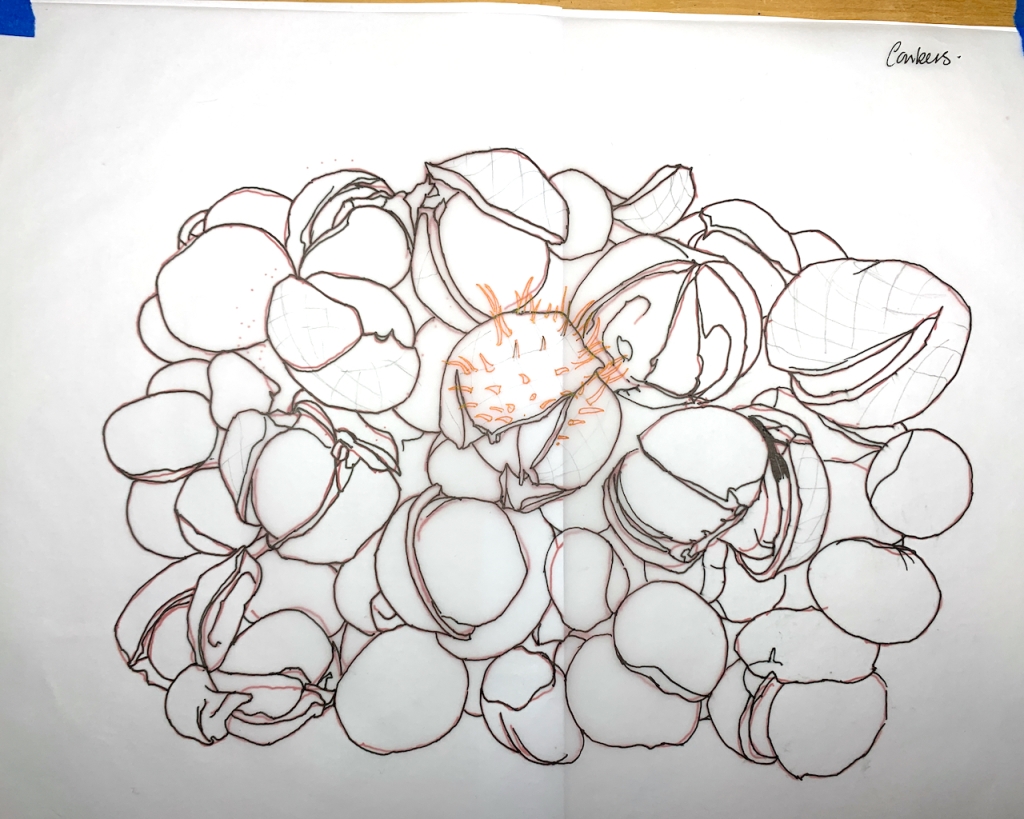
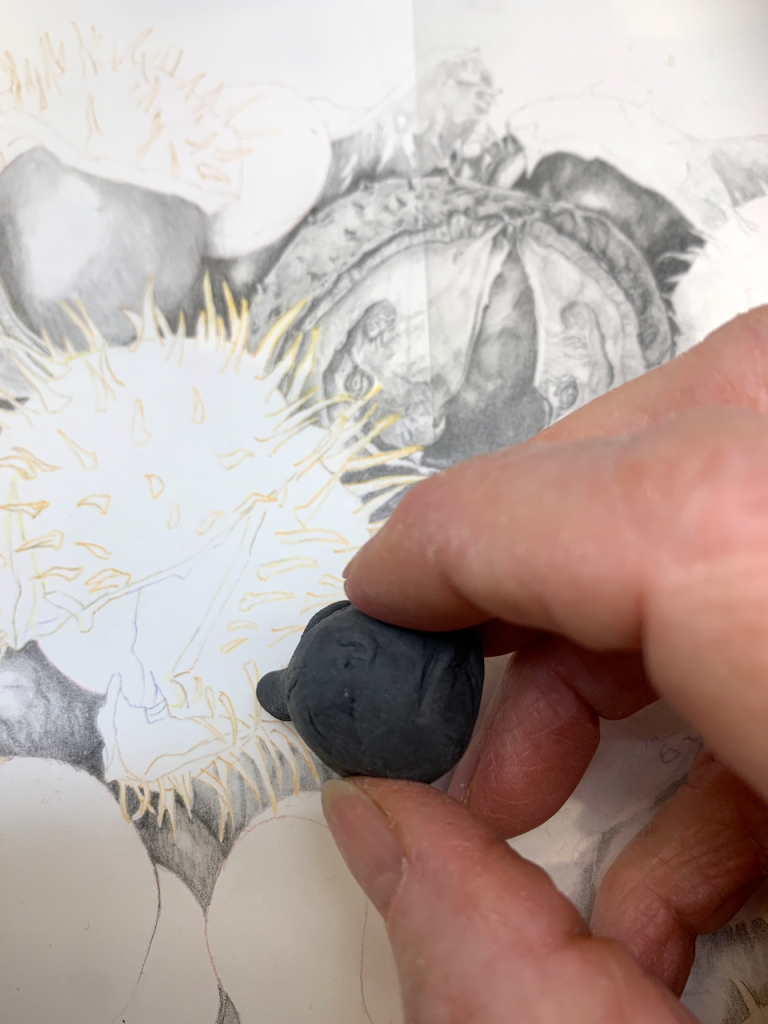
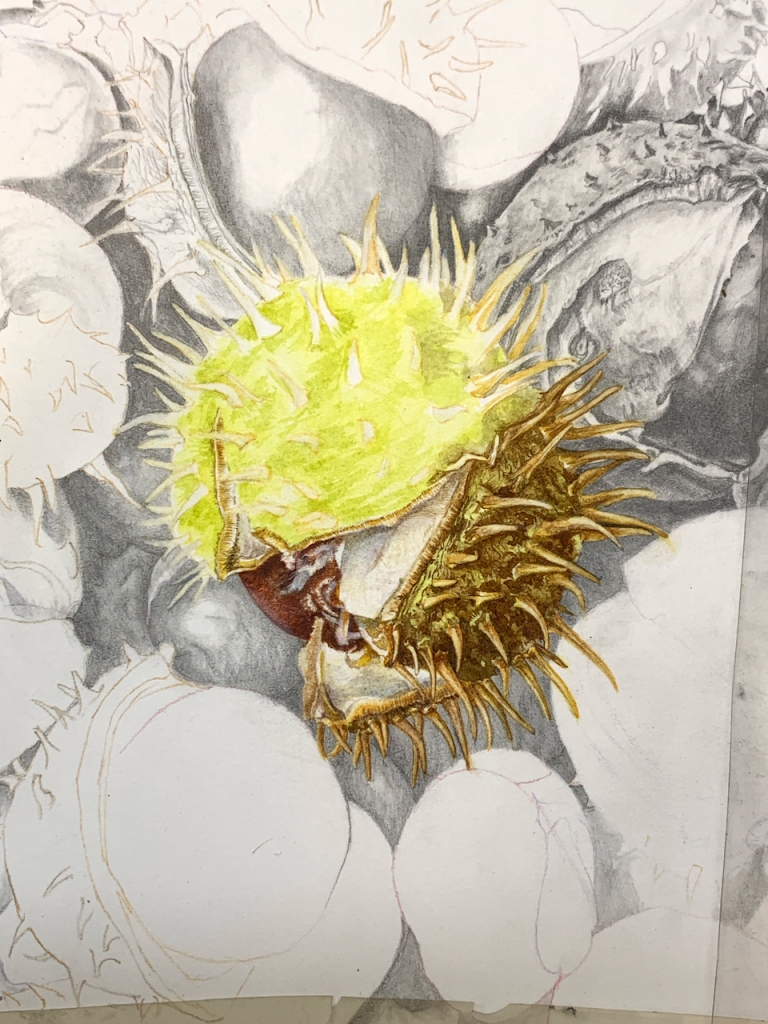
I had some thoughts about wanting to use both graphite and watercolour. In the end, I used everything that came to hand including water soluble graphite, colour pencil and watercolour. I had taken loads of photos of my conker collection, and from this did a line drawing. Of course as the weeks passed the conkers dried, but with the aid of my photos I was able to paint from the conkers in their changing state.
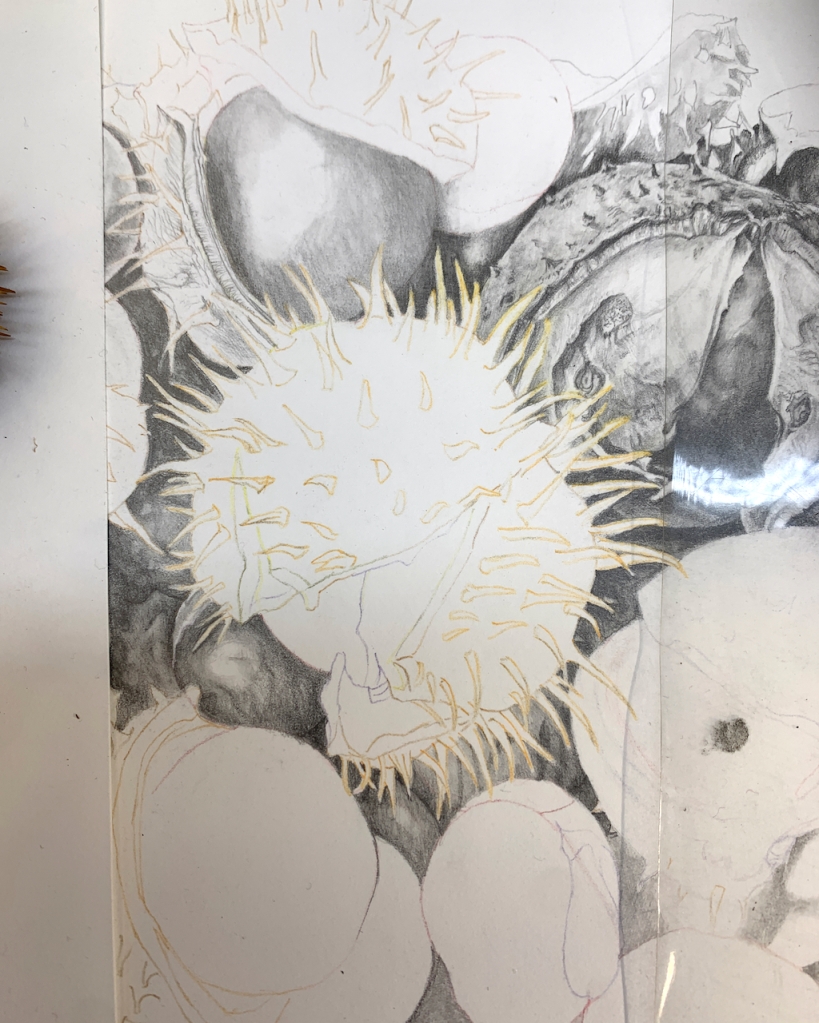
Also as a botanical artist I continue to learn and try to improve. With the picture of Conkers, I was reasonably happy but still wanted to explore new ways of working with graphite. I have always loved using graphite and sections are often found in my pictures.
Whilst in the Netherlands in April I was able to get more graphite. My favourite pencils are Caran d’Ache Grafwood, but with the final picture above, I was trying to reduce the risk of shiny graphite in the areas I wanted to get really dark. How to do that?! I often use water on top of the graphite to set it, but it didn’t quite work here, although I added water soluble graphite on. top.
Faber Castell have introduced som Pitt Graphite Matt, which gets rid of most of the shine. I used a combination of the Grafwood and Pitt Graphite Matt in my next picture, but also used graphite powder. If I want it really black and matt, I have also bought powdered carbon, but so far that is just a little too dark.
A plant that has always fascinated me in Norway is the Tussilago farfara – Coltsfoot. I mentioned the Snowdrop appearing from the edge of the snow as it melts, well another plant is the Coltsfoot. It is considered to be the first flower that appears after the snow goes. Along the roadside, the mucky snow melts away leaving dots of yellow here and there. An incredible little flower, but as it seeds like dandelion I don’t think it is appreciated everywhere.
I wanted to show it emerging from the dark winter:
The title of my exhibit at the “RHS Botanical Art & Photography Show” is as above:
Foraging Plants in the Norwegian Mountains – From Bog to Sand.
Six of my watercolour and graphite paintings are exhibited by order of habitat starting with those growing in the wettest environment to those in the dryest. Seven paintings were completed not just the six, therefore it was a difficult choice to remove one of them. The second one shown below, the small cranberry, is not in the exhibition.
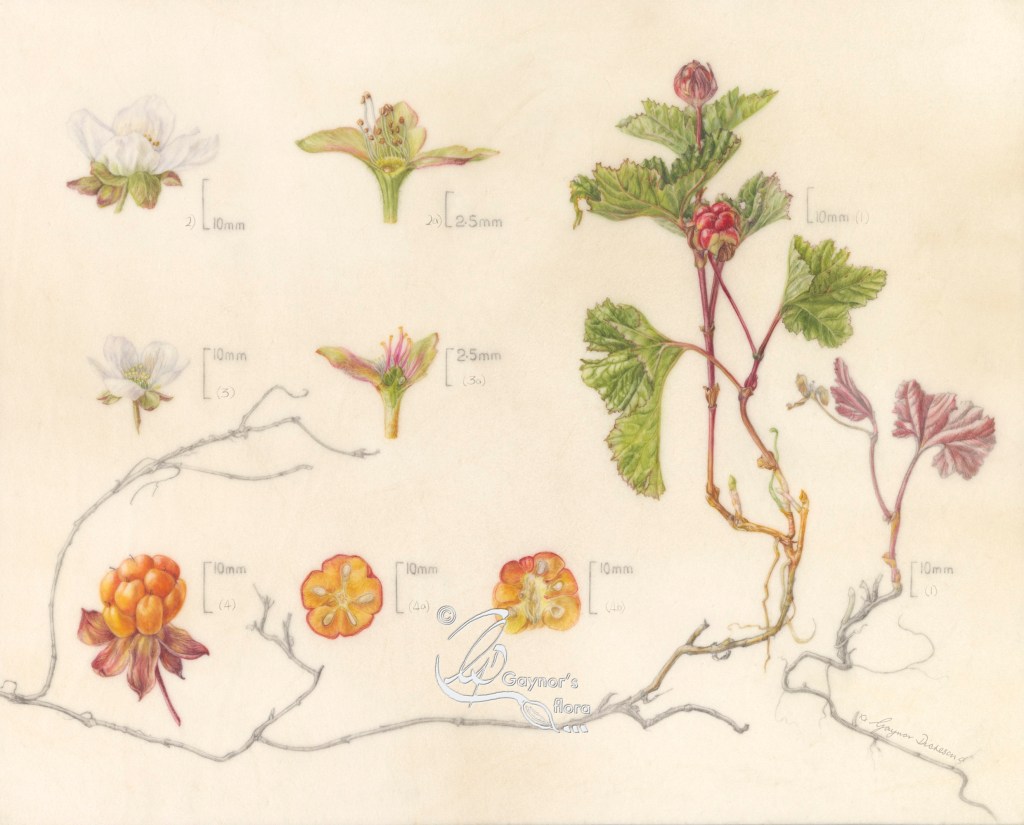
1. Rubus chamaemorus – Cloudberry – Multe Watercolour & graphite on vellum. August 2022
1) Habit 2) Male flower – 2a) LS Male flower 3) Female flower – 3a) LS Female flower 4) Fruit 4a) TS fruit 4b) LS fruit
2. Vaccinium oxycoccus subsp. microcarpum – Small cranberry – Små tranebær Watercolour & graphite on vellum. January 2022
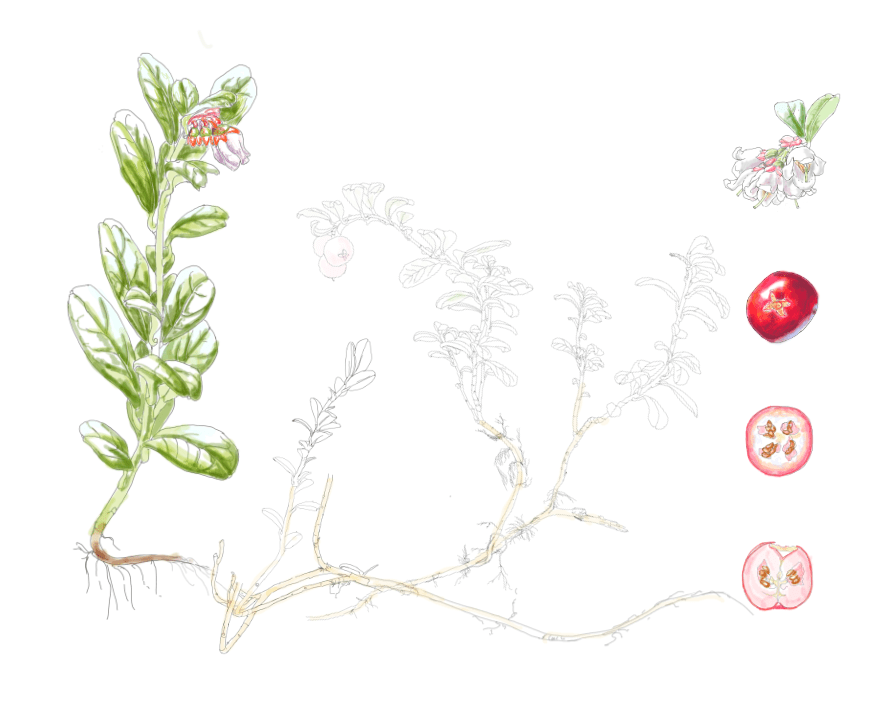
1). Habit 2). Flower 3). TS fruit 3a) LS Fruit 3b) Fruit
3. Vaccinium uliginosum – Bog bilberry – Skinntryte Watercolour & graphite on vellum. December 2021
1) Habit 2) Flower pair 3) Fruit 3a) TS fruit 3b) LS fruit
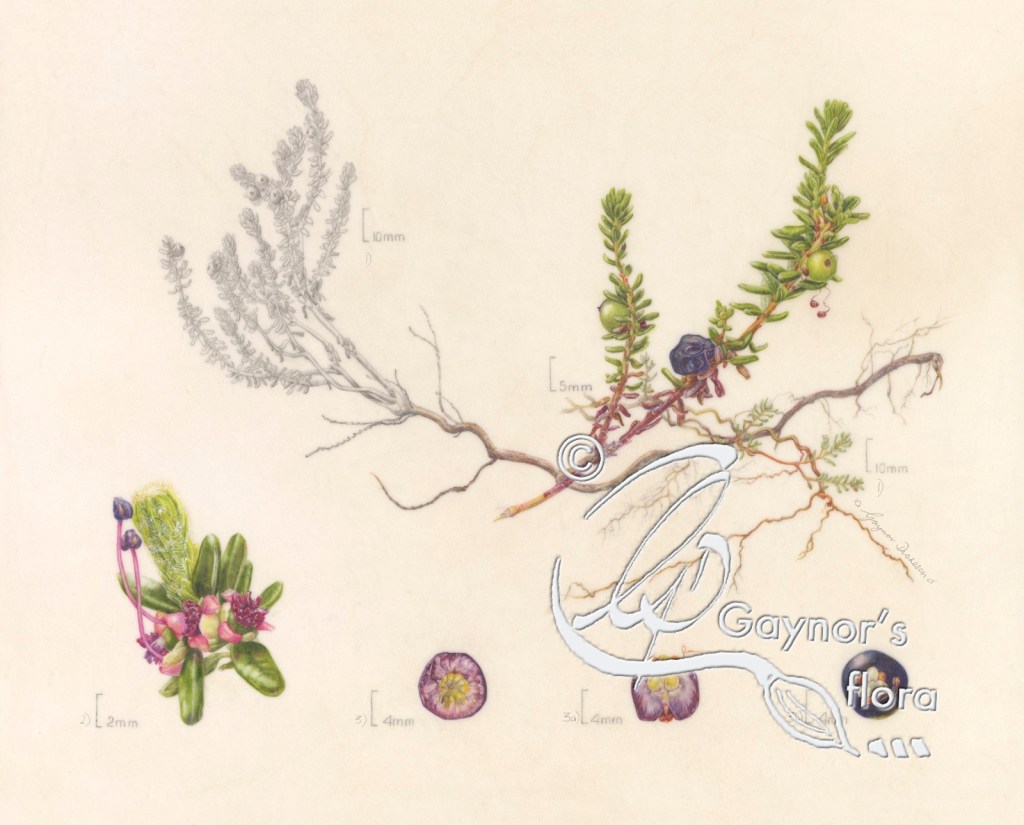
4. Empetrum nigrum subsp. hermaphroditum Mountain Crowberry – Krekling Watercolour & graphite on vellum. January 2022
1). Habit 2). Flower 3). TS fruit 3a) LS Fruit 3b) Fruit
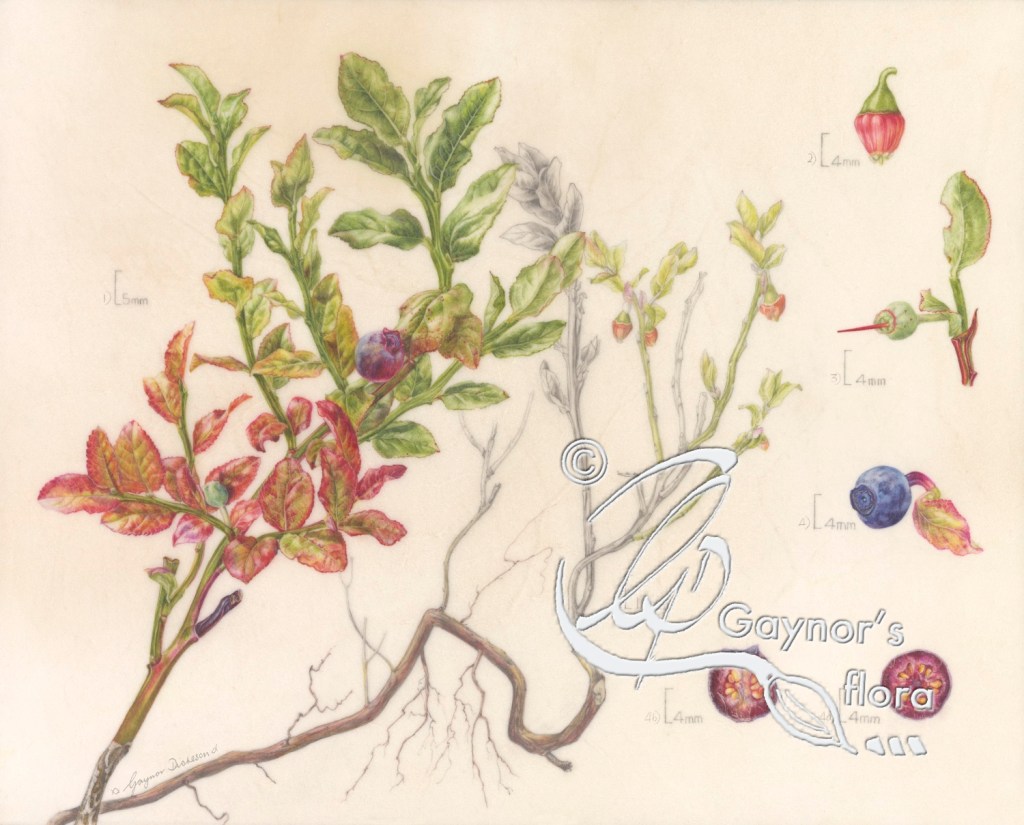
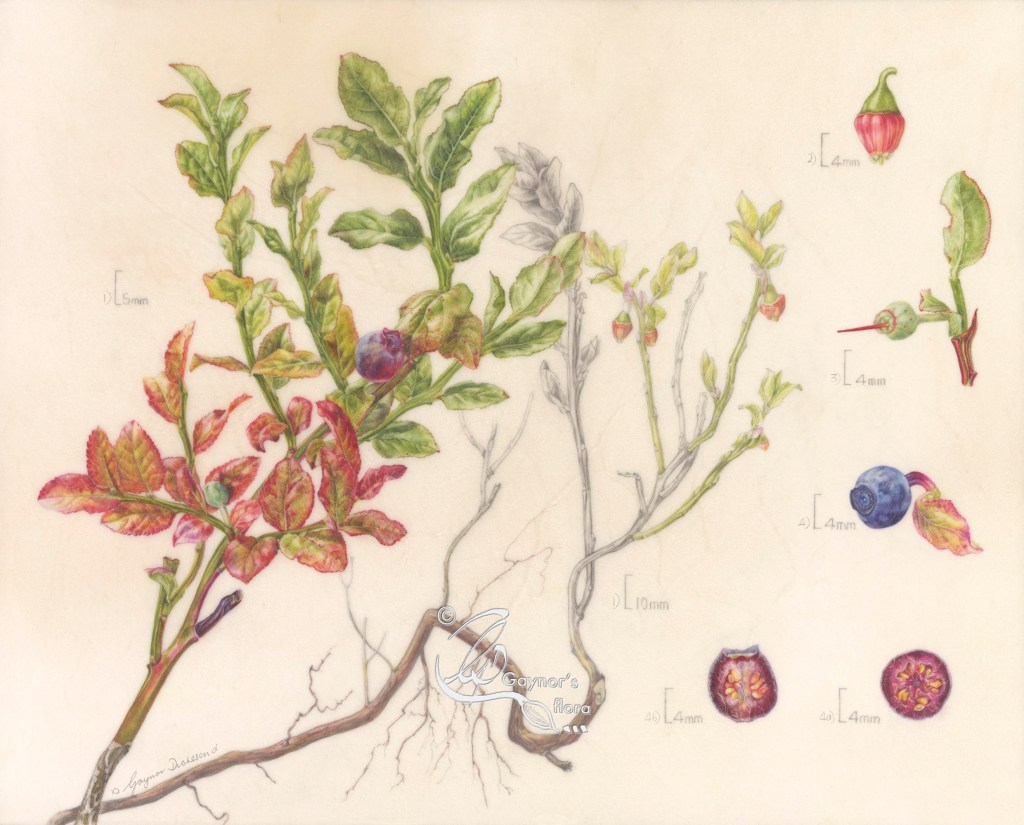
5. Vaccinium myrtillus – Bilberry – Blåbær Watercolour & graphite on vellum. March 2022
1) Habit 2) Flower 3) Immature fruit 4) Fruit 4a) TS fruit 4b) LS fruit
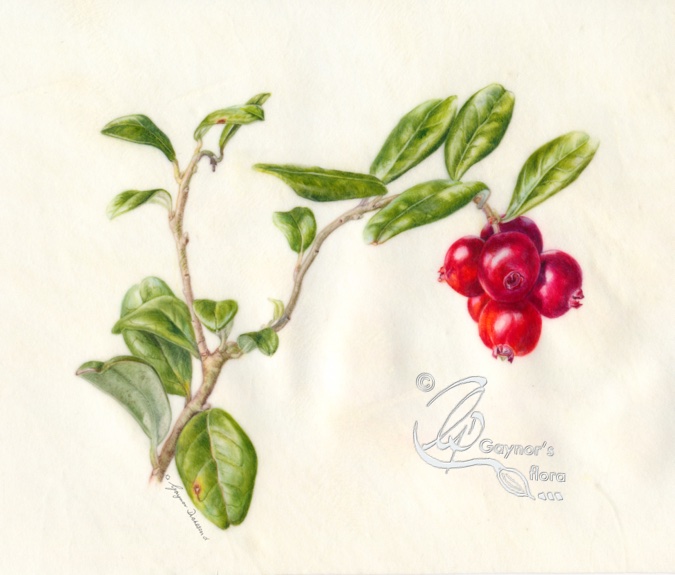
6. Vaccinium vitis-idaea – Cowberry/Lingonberry -Tyttebær Watercolour & graphite on vellum. November 2022
1) Habit 2) Flower cluster 3) Fruit 3a) TS fruit 3b) LS fruit
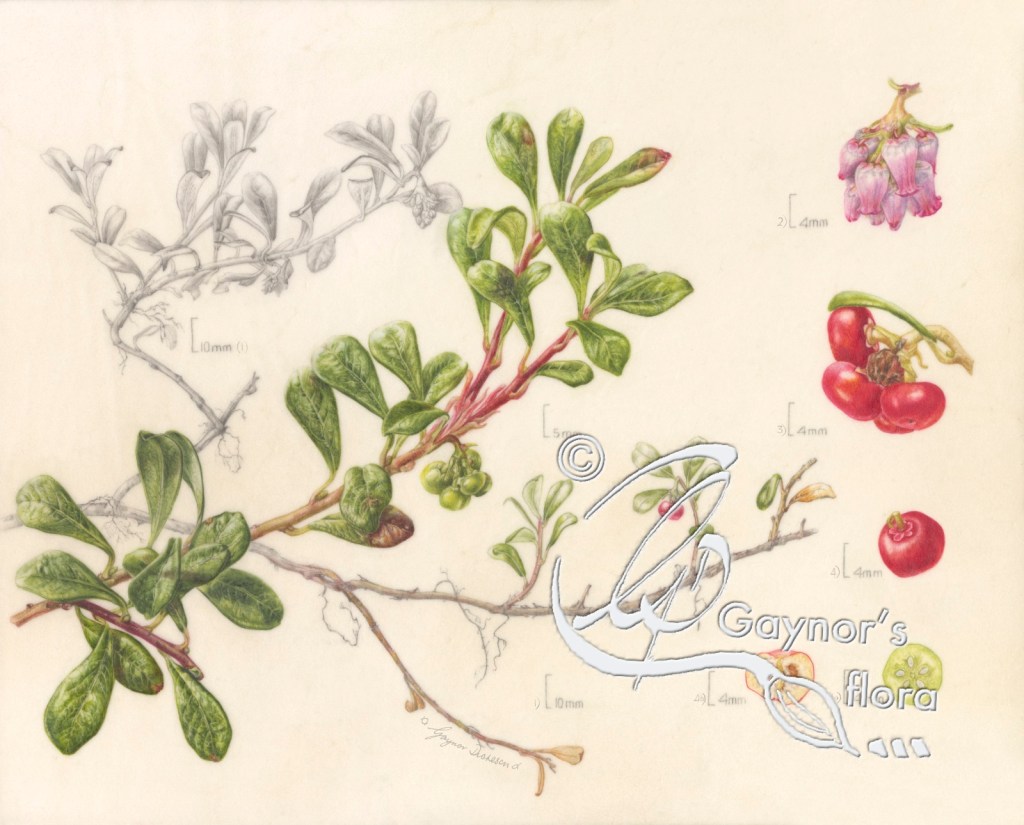
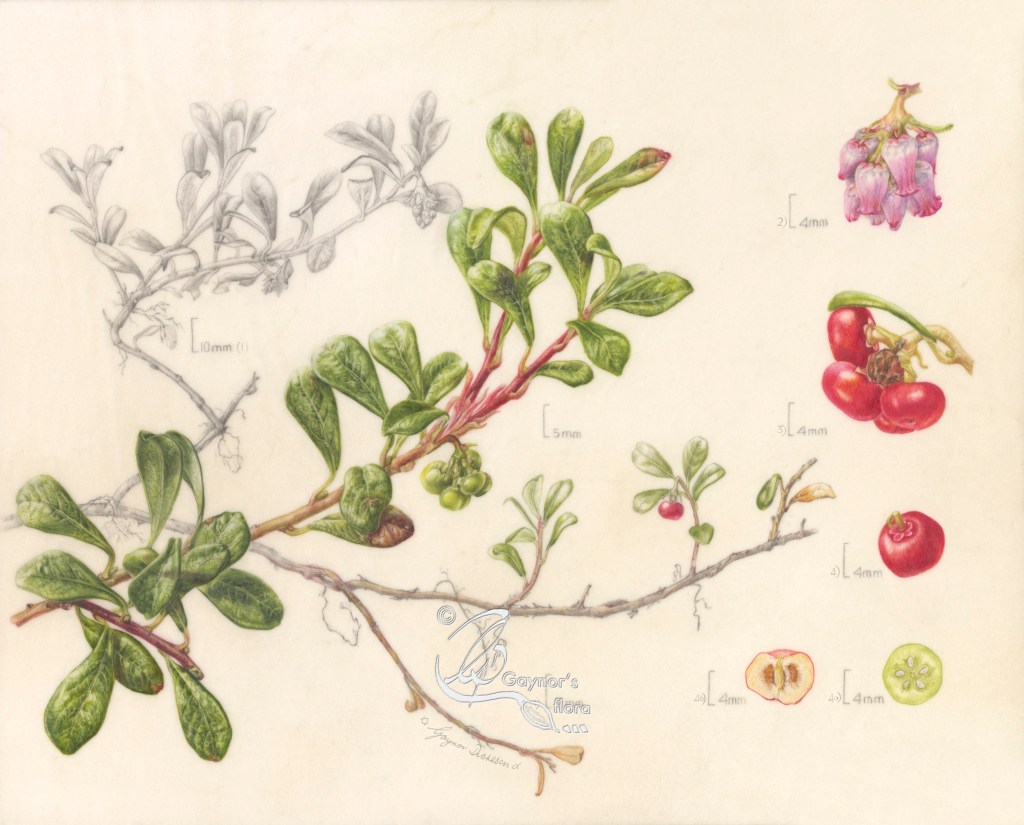
7. Arctostaphylos uva-ursi – Bearberry – Melbær Watercolour & graphite on vellum. October 2022
1) Habit 2) Flower cluster 3) Fruit cluster 4) Single fruit 4a) TS immature fruit 4b) LS ripe fruit
If you have read the blog series you will understand that the Cloudberry and Small cranberry enjoy the wettest environment – bogs and marshes, whilst the Bearberry is often found on a sandy forest floor. The other species are found in various types of environment from damp woods to harsh mountain tops. Some, like the Bog bilberry will grow very well just about anywhere as long as it has water and plenty of sun.
All of the plants in this series live in the Subarctic part of the world and have always provided a lot of nourishment for those living in the far north, the rest of us a little further south and of course animals that roam the area.
Some of the plants typically don’t grow in certain areas as witnessed by the difficulty I had finding the Bearberry. In very hot and dry years some plants produce next to nothing; Cloudberry and Small Cranberry are good examples. Can you imagine the risk that Global warming brings to these plants as well as to us. The warmer the planet gets, the more further north these plants are likely to move making it even harder for us and the animals they support, to find them. As it is, plants that can normally be found further south in Europe, are now beginning to appear in Norway; their pollinators moving with them and having a negative effect on the species that belong.
When choosing to study and paint these plants I didn’t realise how much I would learn about them. I loved the plants (and their fruit) before this, but now have so much respect for them and the environment in which they grow. I hope that I have been able to pass on at least a smidgen of this.
Thank you for following this series.
Latest news: I am really pleased to say that following the judging process yesterday, 14 June 2023, the judges decided to honour me with a Silver Gilt medal. The award ceremony will be held this evening at the Saatchi Gallery during the preview to the exhibition opening tomorrow.
I look forward to getting detailed feedback about my exhibit from the judges this afternoon.
Depending upon where one lives and picks fruit in Norway, some people are not aware of the bearberry and its identification problems. In fact, initially I had real problems finding an example of the bearberry to draw from.
The first find of the Bearberry plant in 2017
Many years ago I had experienced the misfortune of mixing up the two berries and knew that they could grow in similar locations. But to begin with I didn’t find any near the cottage we had rented. We therefore went on a field trip in the car and drove to an area where I knew they had grown 50 years before. Unfortunately, things had changed, and we found houses instead!
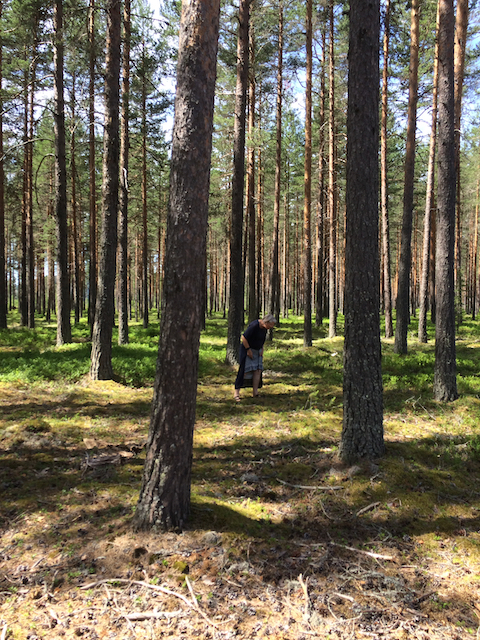
Eventually, in the next valley, we found both bearberry and lingonberry growing together on a sandy forest floor.
The following year in 2018 my poor husband enjoyed a solo 200km return journey to get a sample for me! Fortunately I was using GPS to record the position of every specimen found and he used this to find the forest area.
It was with relief that in 2019 we eventually found some growing very well, close to the main road below our rented cottage up in the mountains. Now I could truly say that all of the plants were from the same area!
Bearberry sketch from my ‘perpetual diary’
I did quite a few different sketches of this plant and like so many of the plants in this series, found that it often starts setting its buds in the autumn in preparation for the following season.
I therefore decided to wait until the following year to try and get an immature fruit. As it happens, I had to wait four years until I could get a sample at the right level of maturity. But at least I managed it and got some good detail.
Bearberry sketchbook page. As usual a lot of research found space along the bottom of the page.
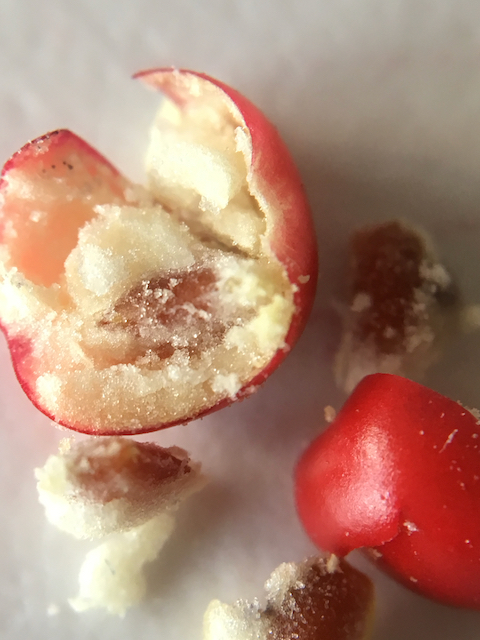
But I think one of the biggest headaches when collecting information was doing a transverse section (TS) of the fruit. The fruit contains relatively large hard seeds, as it is a stone fruit. Carrying out a LS on a ripe fruit was simple as I had no need to cut through any seeds.
But the TS was another kettle of fish! Each seed was about 2.3 mm long and very hard. There was no way I could cut through this without crushing the whole fruit and destroying the chance to draw this section as I had for every other picture.
My trial piece on vellum helped me with my colour decisions for the final artwork. I started the sketches in 2017 and in June 2022 I started the final piece, finishing it in October 2022.
A squashed TS!
Bearberry trial piece on vellum
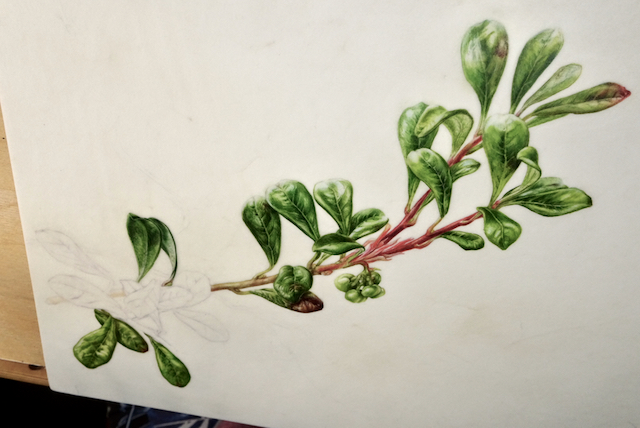
Main branch outlined from sample branch
Main branch almost complete. x 2 natural size.
Graphite tracing for natural size branch
Graphite shading
Graphite and wash
Graphite and wash section complete.
The native range of this species is Subarctic to N., W. & Central U.S.A. including the UK and Norway. It is a subshrub and grows primarily in the temperate biome.
Source: Kew – Plants of the World Online
The photos above are a quick reminder of my process for this series. The various elements are traced to the vellum block and sometimes I go over these with a non-permanent watercolour outline. The main branch has generally been completed at twice the natural size and the sections in graphite or graphite and watercolour wash are normally natural size to show habit. Graphite is used to allow these sections to fall into the background making the overall picture less heavy.
Bearberry leaf tea infusion
Pour 150ml of boiling water over 2.5g of finely chopped or coarsely powdered, fresh or dried bearberry leaves and strain after 10 to 15 minutes. If you want to keep the content of tannins as low as possible, prepare a cold-water maceration. To do this leave the leaves in the cold water for 6 to 12 hours, then strain and heat the tea.
Uses
Inflammatory diseases of the urinary tract – NOT KIDNEY problems – “if treatment with antibiotics is not necessary.” Bearberry leaf infusion is classified as traditional herbal medicinal. Based on many years of experience, bearberry leaves can be used to treat symptoms of recurrent cystitis (e.g. burning sensation during urination and/or frequent urination in women), if there are more serious causes or symptoms remain, seek medical attention.
Tea infusion: drink a warm cup of bearberry leaf tea up to 4 times a day;
Put the berries in a pot and cook over medium heat until soft; about 5-10 minutes. Crush the berries, then run them through a sieve or cheesecloth to remove the seeds. Retain as much of the pulp as possible.
Return the juice and pulp to the pot, adding one cup of sugar for every cup of juice and pulp. Add the lemon juice, mix thoroughly, and heat to a boil.
Boil for a minute or two, then stir in the pectin. Allow the preserves to cool and set.
My last blog about this series of pictures is scheduled for 15 June 2023. It is the day we get the results of the RHS judging, so I hope to include my result. I will show the final pictures which I have been keen to conceal until the judging process is complete.
Arctostaphylos uva-ursi or the common English name of bearberry and norwegian name of melbær.
The Norwegian name, when translated, literally and aptly describes the melbær, flour-berry. The berries are edible, dry, tasteless, and floury. But they are considered an important ‘survival food’ and eaten in sauces by some northern indigenous people with fish, venison, elk and bear.
When describing another plant in this series, Vaccinium vitis-idaea (cowberry/lingonberry), I mentioned that these two plants were the main reason that I wanted to do research and illustrate this series of plants. I wanted to show how they can be distinguished so that both can be used and enjoyed. Getting things wrong – mistaking one fruit for the other – is not dangerous, but it can spoil the effect of a recipe intended for Lingonberries.
Both plants have leathery leaves as well as similar fruit and flowers and although they can grow in the same habitat, the bearberry does better in drier surroundings. In the last blog I showed the back of the Lingonberry leaf which is more oval-shaped, but now I will show you the back of the bearberry leaf which is paddle-shaped.
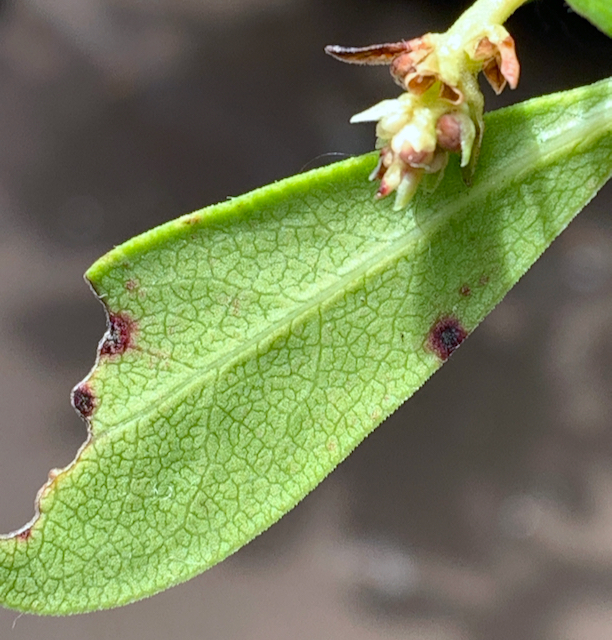
The photo of the Bearberry leaf was taken in September when the tiny flower buds start to appear – establishing themselves before the snow appears so they can make an early start as soon as it is gone.
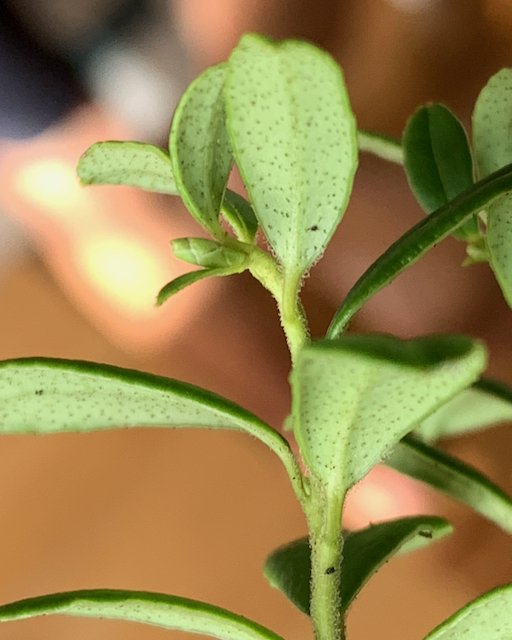
To the left is the ‘veiny’ Bearberry leaf and to the right the ‘dotty’ Lingonberry leaf
As you see, the Vaccinium vitis-ideae – lingonberry leaf has small dots on the underside, whereas the bearberry Arctostaphylos uva-ursi leaf has a fine network of veins.
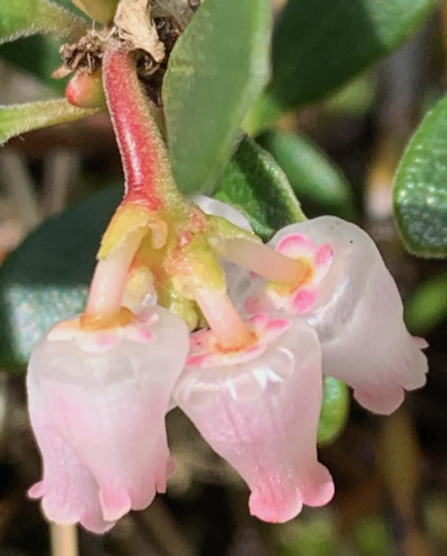
The bearberry is not a member of the Vaccinium Genus, but is part of the Arctostaphylos Genus. However they are both part of the Ericaceae (heather) family. This means that in both species the flowers are typically heather-like, although the bearberry flowers are more urn-shaped and the lingonberry flower is bell-like .
Bearberry urn-shaped flowers to the left and Lingonberry bell-shaped flowers to the right
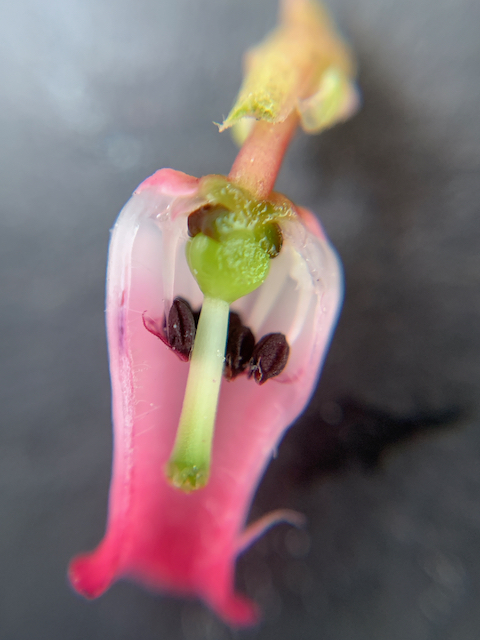
Longitudinal section of Bearberry flower
The rhizomes of the bearberry lie prostrate down rock walls or across the sandy forest floor, whereas those of the lingonberry sit deeper in the humus.
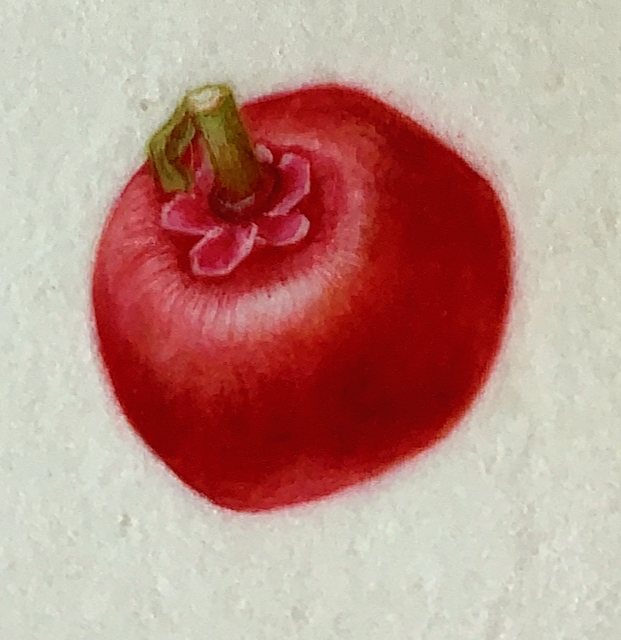
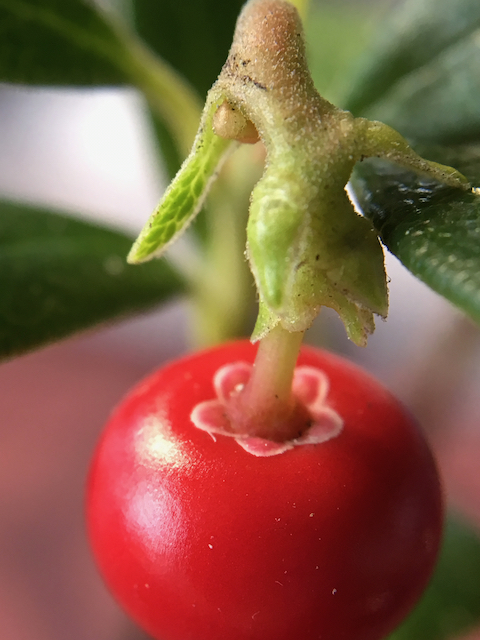
Both plants have clusters of red fruit, but the Bearberry fruit has a slightly flatter spherical form than that of the Lingonberry. Most importantly the Bearberry has a superior ovary (the gynoecium – [female reproductive part] is above the attachment point of the floral whorls [petals etc]), meaning that the remaining sepals are at the top of the hanging fruit, nearest the pedicel (stalk). The opposite is true of the Lingonberry where the remains of the sepals are at the bottom of the hanging fruit, distal to the pedicel.
This is a photo of the longitudinal section (LS) of one flower. It clearly shows that it has a superior ovary.
To the left, Bearberry fruit with sepal remnants near pedicel. To the right, Lingonberry fruit with Sepal remnants distal to pedicel.
The second blog about the Bearberry species is scheduled for 11 June 2023. That will be the last blog about the series, although I will show the completed pictures on 15th June.
Vaccinium vitis idea – Lingonberry plantsin dry moss.
The reason for even thinking of doing a series of plants like this was because of this plant – Vaccinium vitis idaea (Lingonberry/Cowberry) and the next plant in this blog series Arctostaphylos uva-ursi (Bearberry). They are fairly similar and their habitats cross over into each other’s. So unless you know what you are looking for you can easily make a mistake.
Lingonberry leaf back.
It isn’t a ‘dangerous’ mistake to make, but it can spoil a recipe!
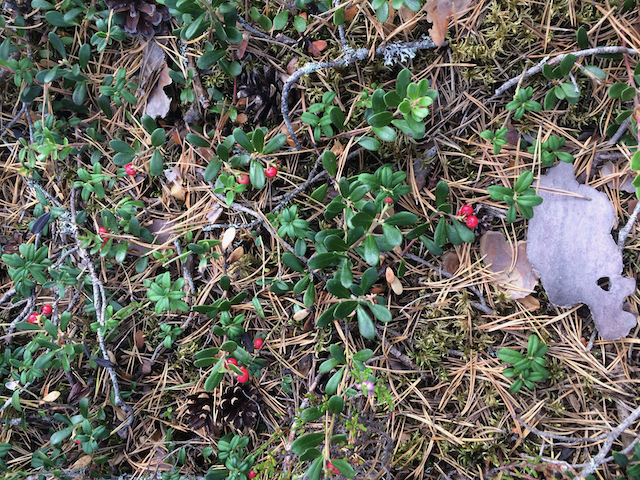
Above is a photo of the Lingonberry in its typical habitat. Both species have leathery leaves as well as similar flowers and fruit. But the Bearberry prefers even drier surroundings than the Lingonberry.
The Lingonberry leaves are oval as you see above, whereas the Bearberry leaves are paddle-shaped; The Lingonberry leaves have small dots on the underside, whereas the Bearberry leaves are finely veined; Both sets of flowers are typically Heather-like, but the Lingonberry flower is bell-shaped and the Bearberry flowers are more urn-shaped. The rhizomes of the Lingonberry sit deeper in the humus than the Bearberry, which are prostrate and limply creep across a surface.
The fruit for both plants are in clusters, but the Bearberry fruit has a slightly flatter spherical shape than that of the Lingonberry. Most importantly the Lingonberry has an inferior ovary (the flower parts arise above the ovary), meaning that the remains of the sepals are at the bottom of the hanging fruit, distal to the pedicel (stalk). The opposite is true of the Bearberry where the calyx (sepals) remain on the fruit around the pedicel.
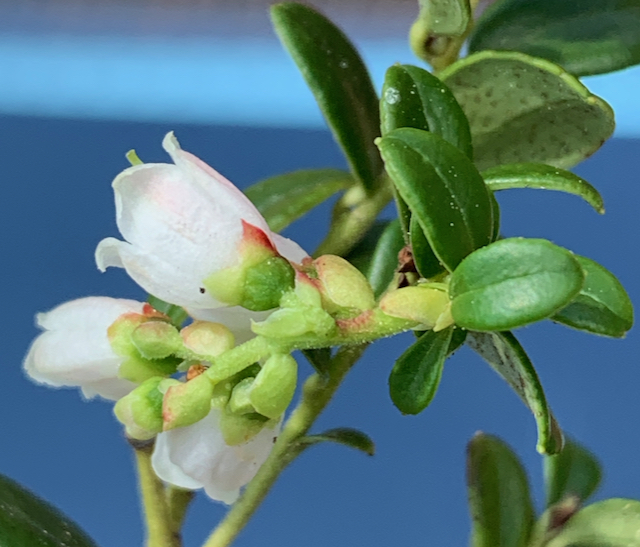
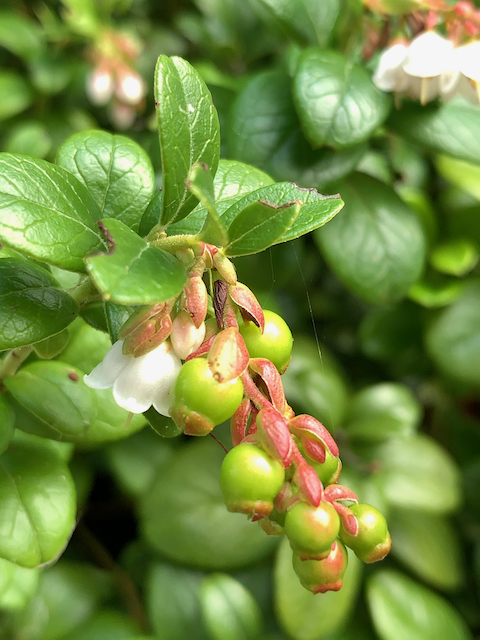
Fruit developing. Petals fallen off to reveal shape of distal end of fruit formed with sepals.
If you look at the painted berry at the beginning of the last blog when I started discussing the species, you can see the remnants of the sepals. Compare it with these three pictures showing the development of the flower and swelling of the ovary in its inferior position.
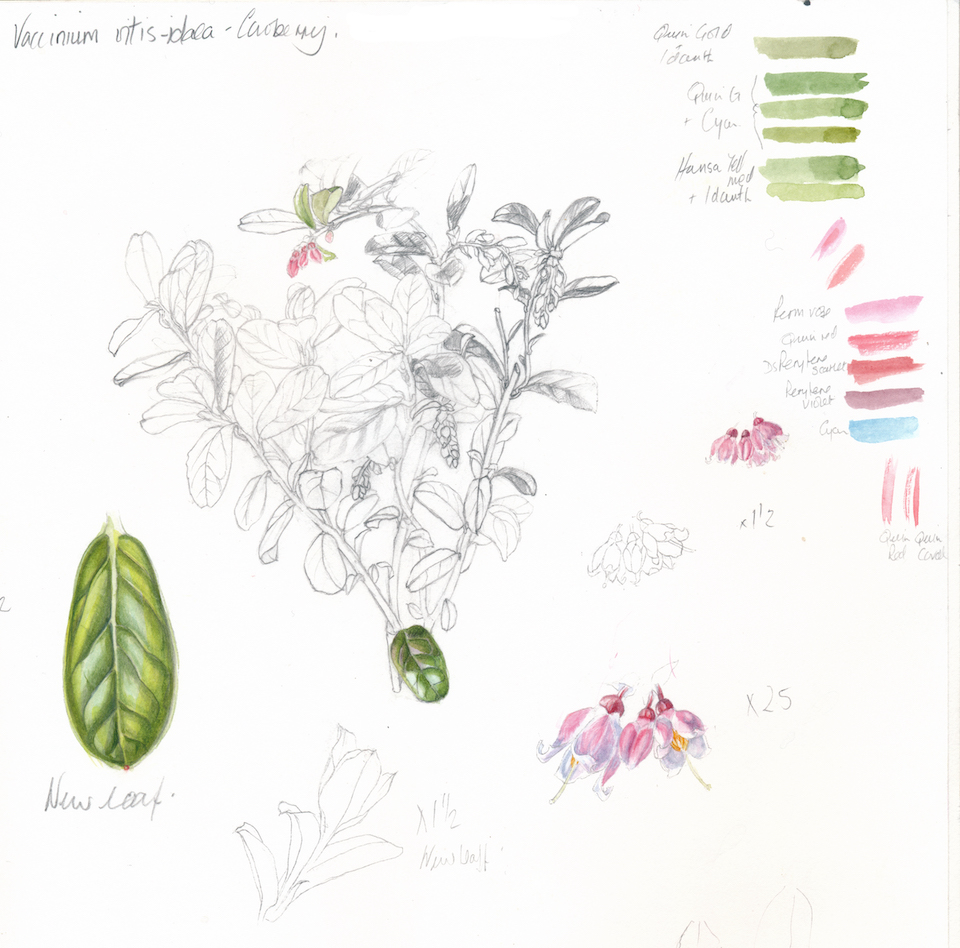
At the end of the previous blog I showed you some of the sketches I did from various Lingonberry plants. Here you see additional ones and you may notice that they were part of the basis for my final artwork.
Below you see my first compositional plan for the Lingonberry picture, but I didn’t really like it. I suppose in this plan I wanted to avoid painting so many small, but detailed leaves. As you now know they have several diagnostic elements to them, but at the same time are quite shiny. The composition just didn’t give me the right ‘feeling’ of the plant.
One weekend I had been out picking fruit with my daughter and we were discussing the way the plants grew and the impression they gave. We again looked at my planned composition and she suggested I replace the flower on the stem with a fruit cluster.
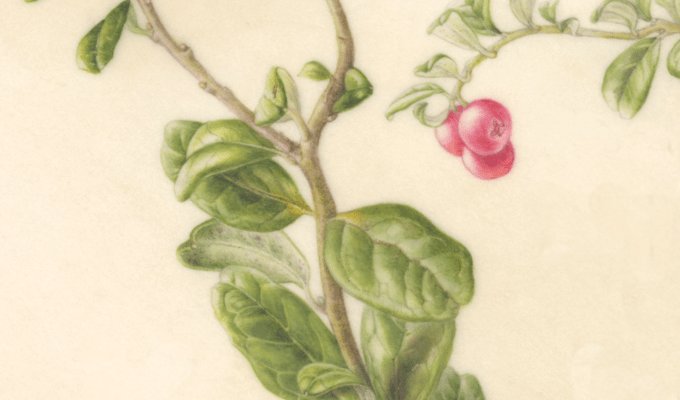
That was the answer – the series emphasis was about the fruit. I decided to do a trial on vellum of the new piece of stem with the berries and this became the basis for the final composition.
My first sketches of this plant were done in March 2017, but I didn’t start painting the final picture until October 2022 (after harvesting), finishing December 2022. Because this plant is not deciduous, it allowed me to work on the leaves right up until the first fall of snow.
The native range of this species is Subarctic & Temp. Northern Hemisphere including the UK and Norway. It is a subshrub and grows primarily in the temperate biome.
Source: Kew – Plants if the World Online
The species in my next blog scheduled for 8 June 2023 is the Bearberry, favoured by bears when they wake up from their hibernation – or so I am told.
Eva’s Raw LingonberryJam
300g Lignonberries
100gm sugar
Blend together the berries and the sugar until berries well macerated. If possible let it stand for few hours in the fridge before being used.
Eva Biringvad gave me this recipe and sent me on a ‘no-return’ journey. Her father made the most delicious bread, so we ate chunks of his bread with sour cream and the raw lingonberry on top. Delicious!
This is also used with meals instead of Cranberry sauce – and it is much nicer.
Ripe Lingonberry ready for picking with Bilberry plants already done and dusted.
Distal view of ripe fruit – inferior ovary
Vaccinium vitis-idaea, or cowberry, the common english name and tyttebær the Norwegian name is more commonly known as lingonberry if you visit Ikea. It forms the sharpish berry sauce you get with your meatballs!
In fact, there are several ways you can eat the fruit and one of the recipes I will be sharing with you is one where the raw fruit is whipped with sugar – it is absolutely delicious – especially on lovely bread with sour cream!! A friend introduced me to this bad/delicious habit, but I have learnt to restrict myself!
I am glad that we picked quite a bit of fruit this last year and it is safely kept cleaned and ready for use in the freezer. Like the Bilberry, I use it in all sorts of recipes, sometimes even together.
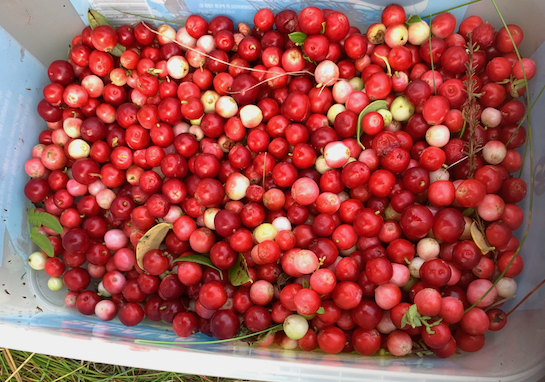
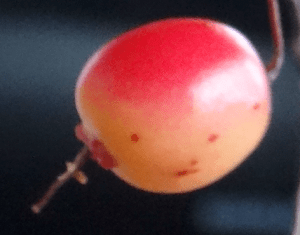
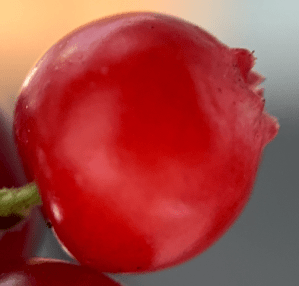
Many will think that the Lingonberry is similar to the small cranberry and in many respects it is. They are both Vacciniums, similar in size; 5- 8mm, but the lingonberry is almost completely spherical whilst the cranberry has a very slightly elongated spherical shape.
CranberryLingonberry
Because the Lingonberry and Cranberry prefer completely different habitats, there is little risk of picking from the two species at the same time. But, both can be used in the same way and for similar recipes.
The Lingonberry is generally found on heathland and shrubby areas, but as discussed in my blog released 7 May, the Small cranberry grows in very boggy areas covered with sphagnum moss.
The next two picture were taken late September at 1100 metres over sea level. The red berries are
Veggli, Numedal, at 1100metres over the seaMix of several species in this series at 1100 m.
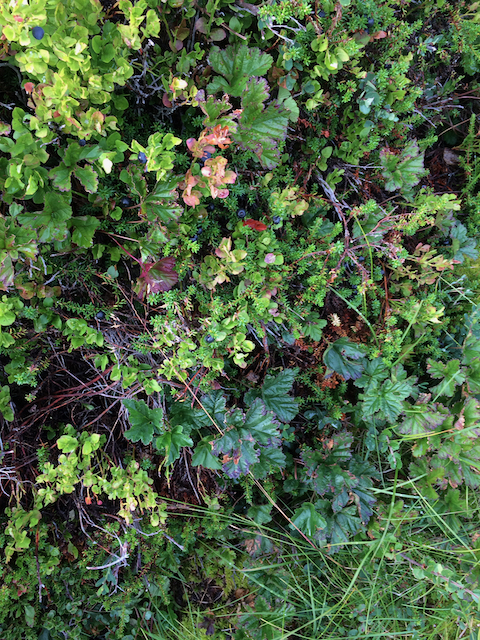
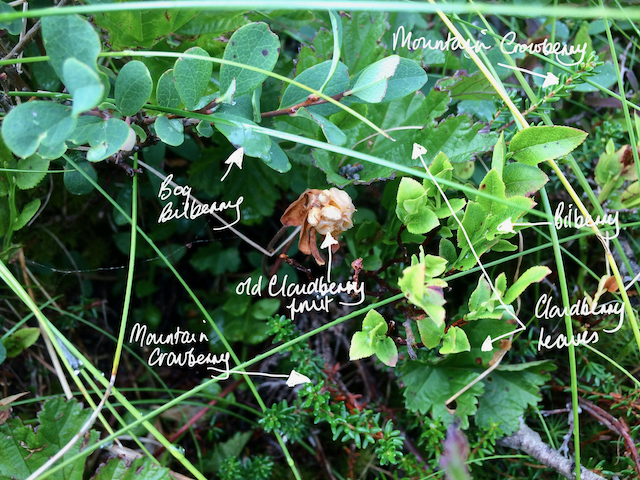
the Lingonberry and you can see that as they hang in bunches they are easy enough to pick. Unlike the bilberry (the red/yellow leaves), the fruit is pretty solid and bullet-like making them even easier to pick that that species. In the same picture is the Mountain Crowberry with their black berries, heather and some very short birch.
We are lucky enough to have some Lingonberry also growing in our garden, but in the two years we have been here I haven’t seen any fruit. Possibly this is because the plants are in shade and it has been very dry since we have been here, and our house is on rock. Therefore, with climate change even the native plants suffer. There is more fruit as one walks from our house into the protection of the woods. Often it grows on the top of extinct anthills, indicating how the seeds were transported.
The Vaccinium vitis-idaea (Cowberry) and the Arctostaphylos uva-ursi ( Bearberry) are, in fact, the main reason that I thought to do this series of plants. I have already written about the similarity between the Vaccinium myrtillus (Bilberry ) and the Vaccinium uliginosum (Bog bilberry), and in that case mixing the one with the other won’t spoil a recipe. But because the Cowberry and Bearberry are so similar, mistakes can be made and although both edible, Bearberry is dry and tasteless and has large stones rather than small seeds.
I will talk about the Bearberry as the last plant in this series. But the second section about the Lingonberry is scheduled for 6 June 2023.
My sketchbooks can be messy in comparison to many!
This is the main double page for my sketches done on the Bilberry plant. I try to keep as much information as possible together so that when I do my final work I don’t have to search too much in the sketchbook. I try to find a hole on the relevant page to add things, either more sketches or research I might have done. I often find that when I am researching on the internet, the gaps are usually left along the bottom edge of the page, so I frequently use this area to write any notes.
As I have already mentioned in the previous blog, there is a similarity in the fruit of the Bilberry and the Bog bilberry, but the stems are very different for starters. The Bilberry stems are very angular and last year’s branches remain green over winter and into the next season. The deer seem to like them and paw away the snow eating the shoots. The Bog bilberry stems are brown and woody; I talked more about this plant in the blogs published 14th and 18th May.
Serious times – the pandemic!
And additional serious times – moving!
By the middle of 2020 I felt that I had enough sketches for most of my final pictures and had already decided to stop the extended period of ‘productive procrastination’. We were in the middle of the pandemic and for most people, the world had turned upside down. My daughter, living in Norway, felt we were too old to live on our own any longer and she was too far away should anything happen to us.
The decision to move back to Norway was thought about and made quite quickly. I think we started talking about it mid June and sold our home with the large beautiful garden and the ‘shed’ – my studio, quite quickly.
The actual move came in August 2020. I had planned all my compositions before leaving the UK and when we arrived in Norway I was all set to start painting the final artwork.
I won’t talk about all the problems moving during a pandemic caused – we were lucky to be completely healthy. But some of the benefits from moving back to the country I loved included being much nearer to the plants in my series. There were lots of others, but I leave that to your imagination.
Goodbye shed at the bottom of the garden.
In between looking for a new home and sorting out all the official stuff and additional problems caused by Brexit, I started working towards doing the first picture. Of course, it had to be the Bilberry. This plant also grows at sea level and was easy to access now.
I only had to walk up into the woods behind my daughters house where we stayed until we finally moved. There were lots of native plants along the tracks, including loads of Bilberry. In our new home, to which we moved in January 2021 when the area was ensconced in snow, we eventually found it contained a lot of Bilberry plants. Heaven or what!?
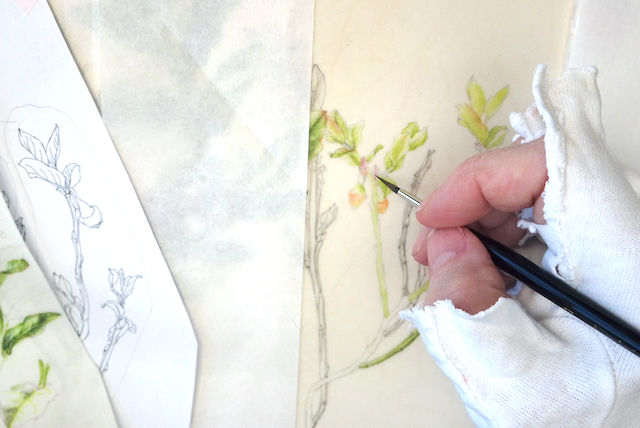
I started with a trial piece of Bilberry parts on vellum and began the final artwork in June 2021, finishing March 2022.
You can see my work station in our new home below. As is perhaps obvious, I continued to procrastinate a little longer as I just had to do more sketches. Working on the vellum off-cut was extremely useful as I also tried out various methods of introducing graphite. Getting the colours right for the bloom of the nearly black fruit whilst I had them was also important. Painting this on paper had been a completely different kettle of fish!
Hello new ‘shed’. This is one of the bedrooms on the top floor, but now my working area consists of two bedrooms turned into one large room – with a view!
Bilberry trial piece on vellum off-cut.
Making sure that I had samples from all the plants in the series at the right time of year was like putting together a puzzle. The flower sections had to be done in the spring and the fruit at various times over the autumn. Leaves also changed through the seasons.
But basically, I knew that I had roughly six months of the year to paint the deciduous plants (Bilberry, Bog Bilberry, Cloudberry) and those I didn’t have access to under the snow such as the Cranberry. For the remaining plants I would be able to get leaves throughout the year as long as they weren’t hidden too deeply under the snow. It became a matter of planning and making sure I knew where relevant plants were over the winter.
The native range of this Vaccinium myrtillus is Greenland, Temp. Eurasia, W. Canada to NW. & W. Central U.S.A. It is a subshrub and grows primarily in the temperate biome. Including both Norway and the UK.
Source: Kew Plants of the World Online
Working on the final artwork – graphite and wash section
Mor Astrid’s (my lovely grandmother-in-law) Raw Bilberry squash
3 l Bilberries
2.5 l water
75 gm Cream of Tartar
4.5 kg sugar
Rinse through the berries to clean of soil. They don’t need to be thoroughly cleaned of leaves and small stalks.
Bruise/crush berries in a plastic bucket and leave for 24 hrs.
Mix the Cream of Tartar into the water and add to the berries. Stir thoroughly.
Let the mixture stand for 24 hrs.
Strain through a muslin.
Add the sugar to the strained fluid.
Stir thoroughly until the sugar has melted in.
Pour into bottles.
The resulting squash can be mixed with water. It is DELICIOUS.
Keep out of easy reach of children or it will be finished off in no time!!
A suggestion from Polly o’Leary after the Bilberry part 1 blog. Thank you Polly.
In this part of Wales theyre called Whinberries. We used to make them into whinberry and apple pie, or whinberry jam. Or both. Depending on how many we found. No recipes, except the usual – plain shortcrust pastry, not too much sugar, because they’re lovely and tart. Same with the jam. Never really thought about a recipe, just made it the usual way as they were such a treat.
This came from Jane Hogan following the Bilberry part 1 blog. Thank you Jane
We used to pick bilberries on the North Yorkshire moors when visiting my grandmother. She used to line a pie dish with pastry, pile in the bilberries with sugar and top with another layer of pastry. Served with custard or cream and eaten hot. There wasn’t usually any left to have cold! It used to take ages to pick the bilberries. (A quick look online suggests a pound of bilberries and four ounces of sugar)
On 4 June 2023 I will publish the first part of the Lingonberry blog.
It is considered to be one of the healthiest berries and has one of the richest natural sources of anthocyanin giving the bilberry its blue/black colour. The bilberry, with a high antioxidant content, is believed to be responsible for the many health benefits, more so than many other berry fruits. In traditional European medicine, bilberry has been used for over a 1000 years.
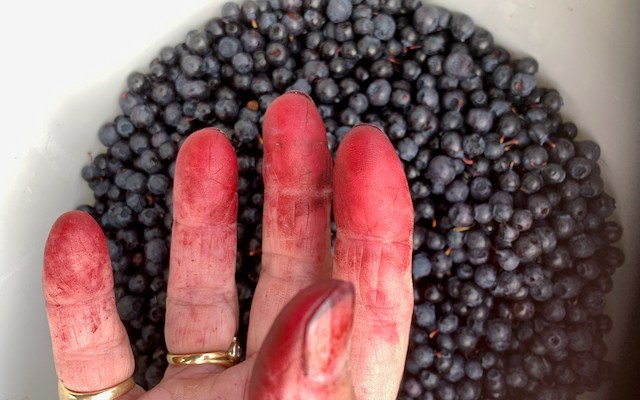
Stained hands from picking
I remember seeing the effect of picking and eating bilberries in western Norway in June 1967. I was being shown how beautiful Norway is and we were on a hill overlooking the Stavanger fjord. A future nephew was picking and eating the berries as he walked along and he turned to me laughing. His face and hands were covered with the juice and his tongue was completely black. It didn’t take me long to realise my face was in a similar state! The blue colour is the anthocyanin that make these berries so good for you. No wonder Bilberry has also been used for dying clothes and food.
I have a lovely picture of my daughter’s grinning face and tongue almost black – but I don’t think she would forgive me if I posted it here!
English bilberry flowers.
Whilst living and hiking in the UK, we often found Bilberry plants in areas on the edge of heathland as it doesn’t seem to do too well in very open areas. The New Forest was a good source an hour away from where we lived at the time.
Bilberries and Lingonberries packed and ready to go in the freezer in Norway
In Norway the plants are everywhere in the woods and also grows well in acidic soils on heaths and marshes.
It is easy to forage and stock up each year!
Picking bilberry and lignonberry
Our Norwegian garden is rocky and on the edge of woods. We have Bilberries growing in the garden and unlike my neighbours wouldn’t dream of getting rid of them to replace with other plants. I love being able to pick them for a delicious dessert whenever I feel like it during the season. But even more exciting for this project, was being able to pick them and paint from them in the comfort of my own home.
Roe deer baby nibbling the tips of the Beech in our garden.
As well as nourishment for us, the plants help to provide nourishment for the Roe Deer that visit us regularly during the winter months. I am happy to let them graze and nibble the tips of the branches as they were here long before people lived in this area. Luckily, they don’t seem to do it all the year round. This is a baby from a family of mother and three small ones that we have had the pleasure of seeing develop.
The Bilberry is not to be confused with Blueberries bought in the fruit department of your local shop. Those are Vaccinium corymbosum and a ‘high bush’’ variant. One can clearly see the difference as the High bush type have pale flesh showing they do not contain the same amount of anthocyanin – the good for you factor.
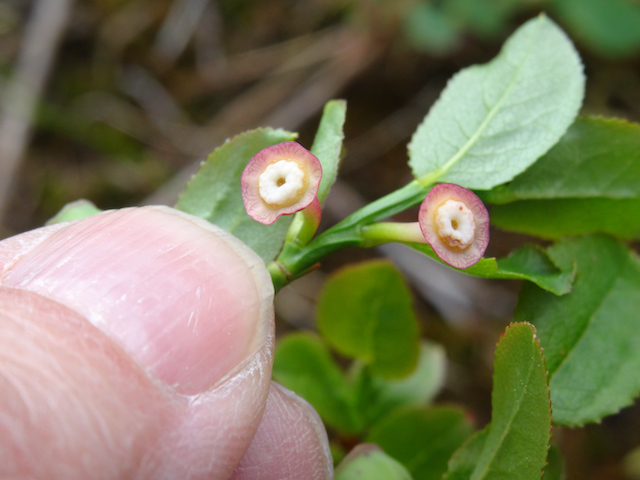
Researching Vaccinium myrtillus was just as exciting as researching all the plants in the series, even though I thought I knew it the best. I am really glad I did so before beginning to sketch as I could easily have been less observant in relation to the number of flowers and resultant fruit on a branch. Unless equally familiar with the Bilberry and Bog bilberry, these two can easily be confused. But in reality there are considerable differences. For starters, the Bilberry only has one flower in a leaf axil, whereas the Bog bilberry has two!
The next blog showing more of how I painted the Bilberry picture, is scheduled for 1 June 2023. We are rapidly approaching the RHS exhibition at the Saatchi Gallery opening to the public16 June.
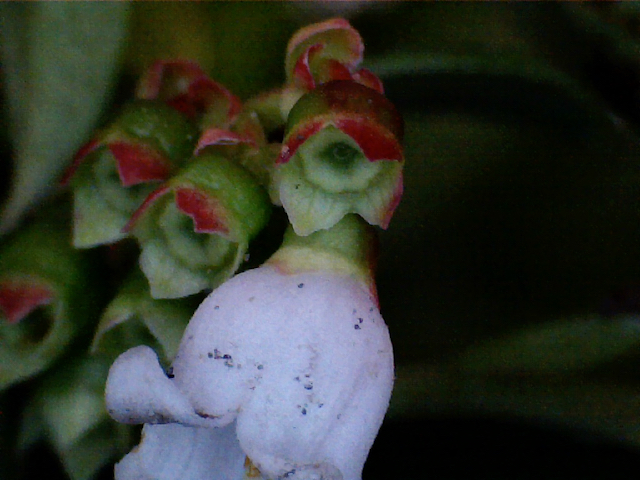
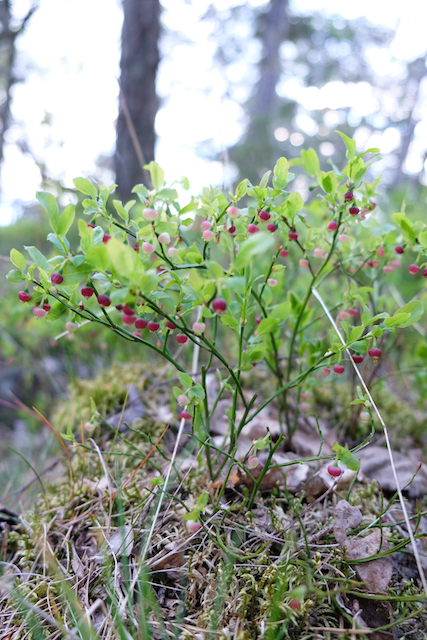
Fertilised flowers.NB the form at the apex.Mixed vegetation at high altitudesNorwegian bilberry flowersBilberry fruit witha Lingonberry sprig poking out at the front.












































 GAYNOR'S FLORA