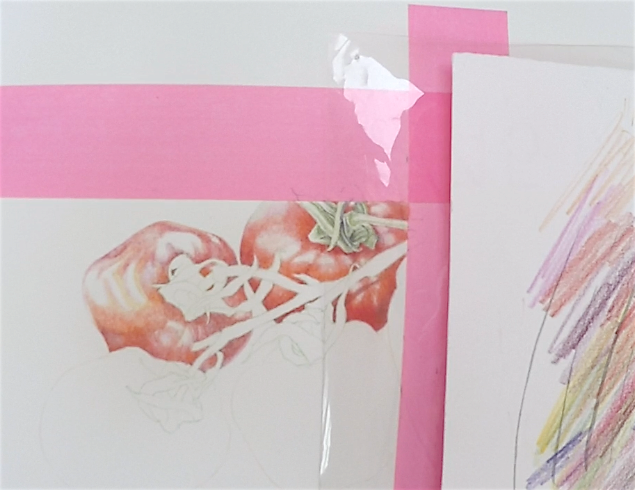
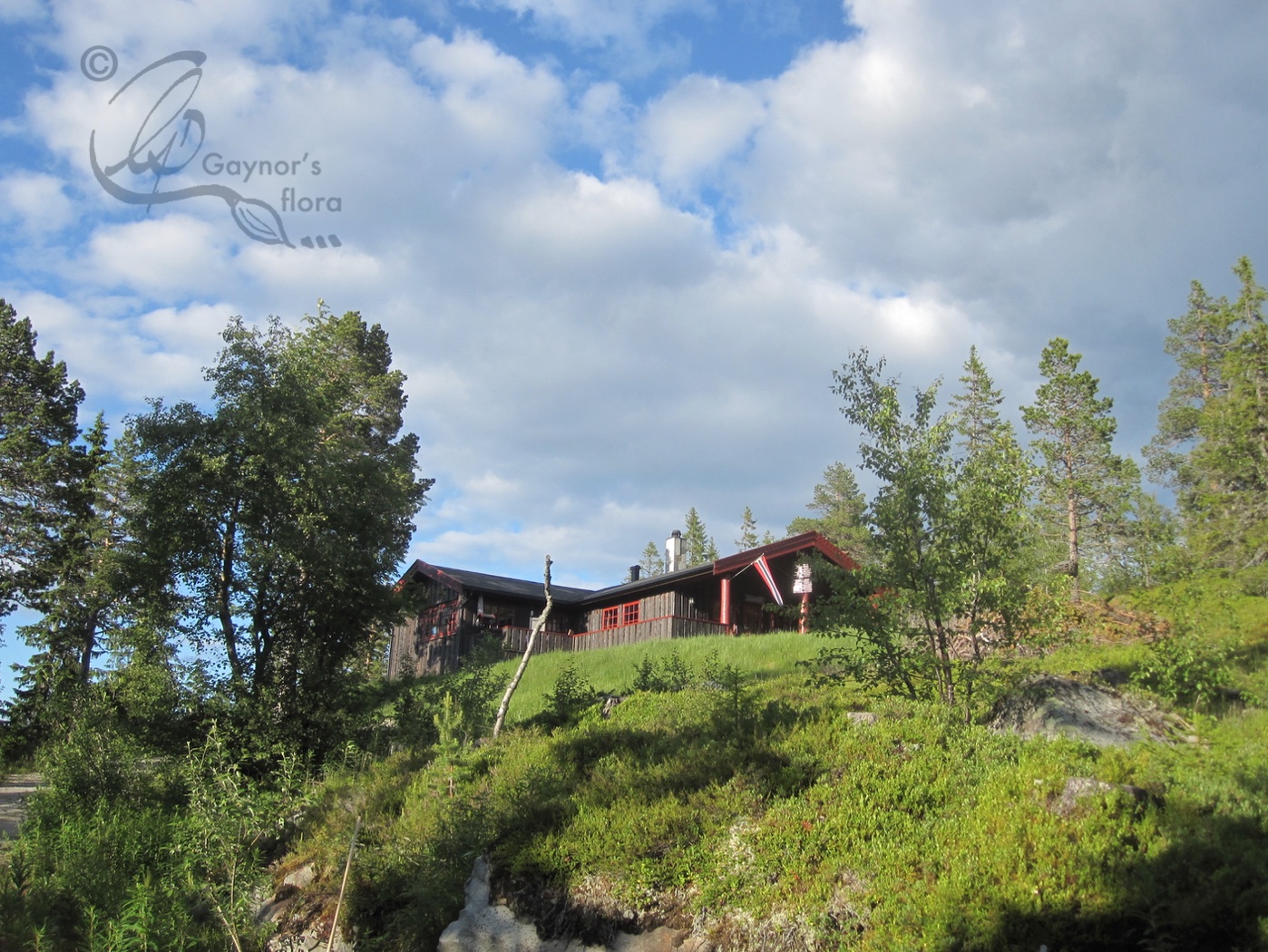
Foraging plants in the norwegian mountains – 24. Lingonberry Pt. 2

Vaccinium vitis idea – Lingonberry plants in dry moss.

The reason for even thinking of doing a series of plants like this was because of this plant – Vaccinium vitis idaea (Lingonberry/Cowberry) and the next plant in this blog series Arctostaphylos uva-ursi (Bearberry). They are fairly similar and their habitats cross over into each other’s. So unless you know what you are looking for you can easily make a mistake.
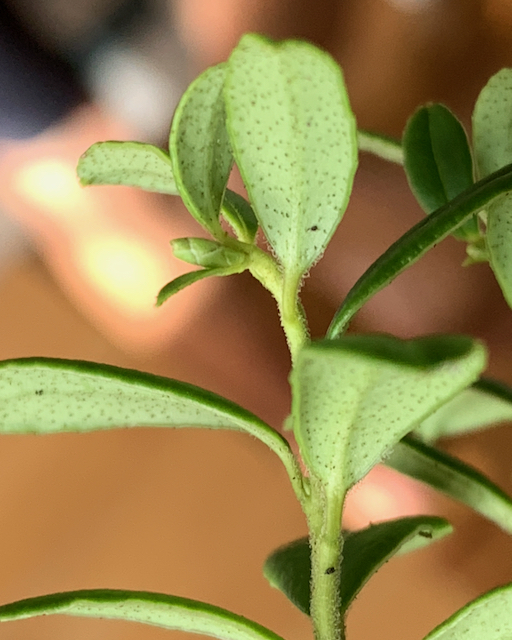
Lingonberry leaf back.

It isn’t a ‘dangerous’ mistake to make, but it can spoil a recipe!

Above is a photo of the Lingonberry in its typical habitat. Both species have leathery leaves as well as similar flowers and fruit. But the Bearberry prefers even drier surroundings than the Lingonberry.

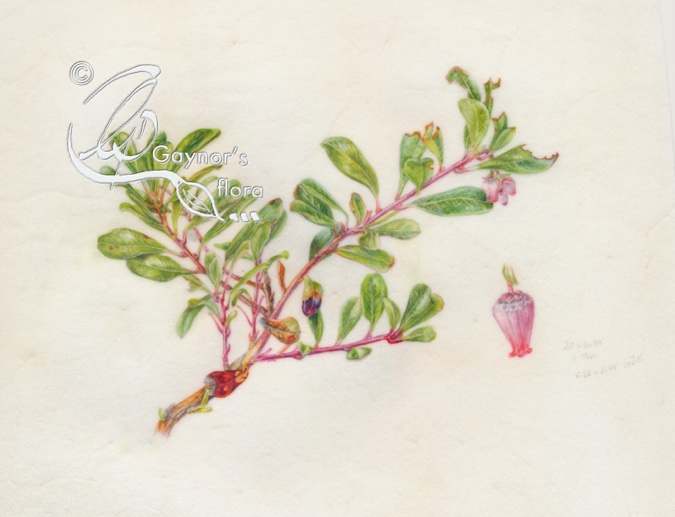
The Lingonberry leaves are oval as you see above, whereas the Bearberry leaves are paddle-shaped; The Lingonberry leaves have small dots on the underside, whereas the Bearberry leaves are finely veined; Both sets of flowers are typically Heather-like, but the Lingonberry flower is bell-shaped and the Bearberry flowers are more urn-shaped. The rhizomes of the Lingonberry sit deeper in the humus than the Bearberry, which are prostrate and limply creep across a surface.

The fruit for both plants are in clusters, but the Bearberry fruit has a slightly flatter spherical shape than that of the Lingonberry. Most importantly the Lingonberry has an inferior ovary (the flower parts arise above the ovary), meaning that the remains of the sepals are at the bottom of the hanging fruit, distal to the pedicel (stalk). The opposite is true of the Bearberry where the calyx (sepals) remain on the fruit around the pedicel. 
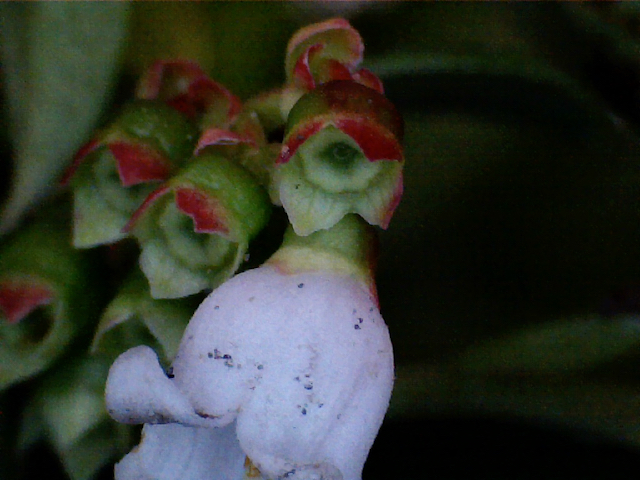
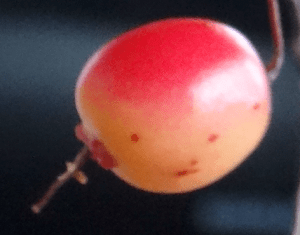
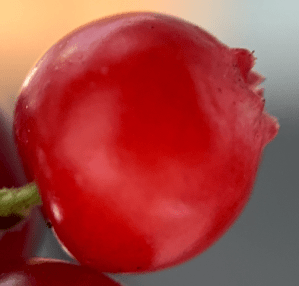
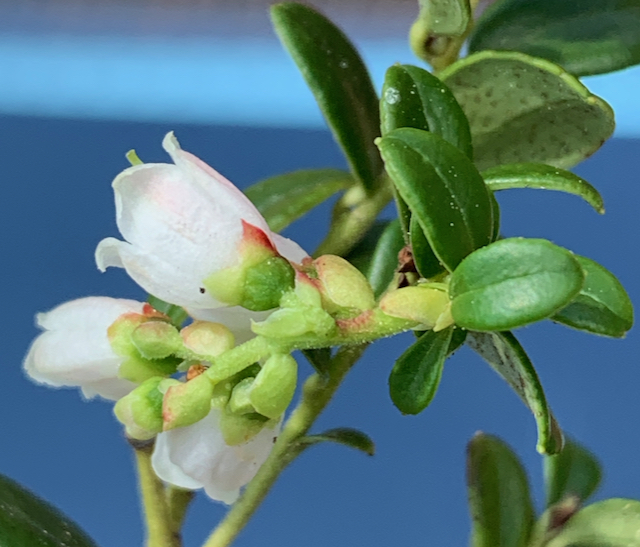
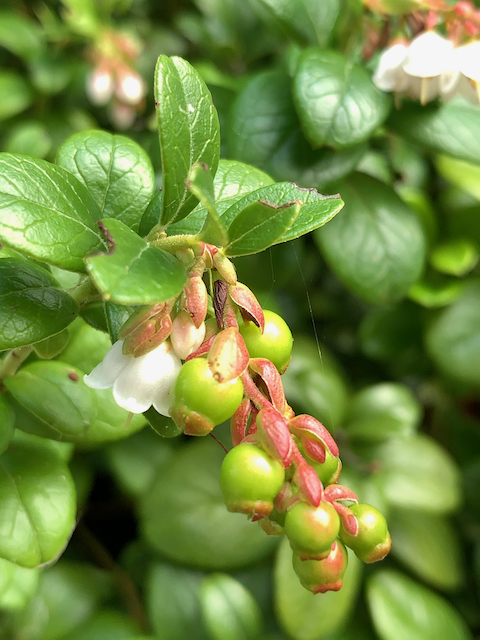
Fruit developing. Petals fallen off to reveal shape of distal end of fruit formed with sepals.

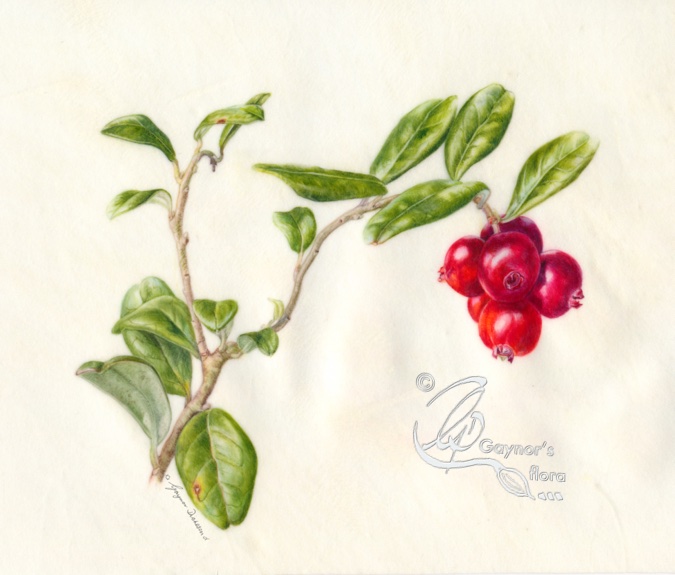
If you look at the painted berry at the beginning of the last blog when I started discussing the species, you can see the remnants of the sepals. Compare it with these three pictures showing the development of the flower and swelling of the ovary in its inferior position.
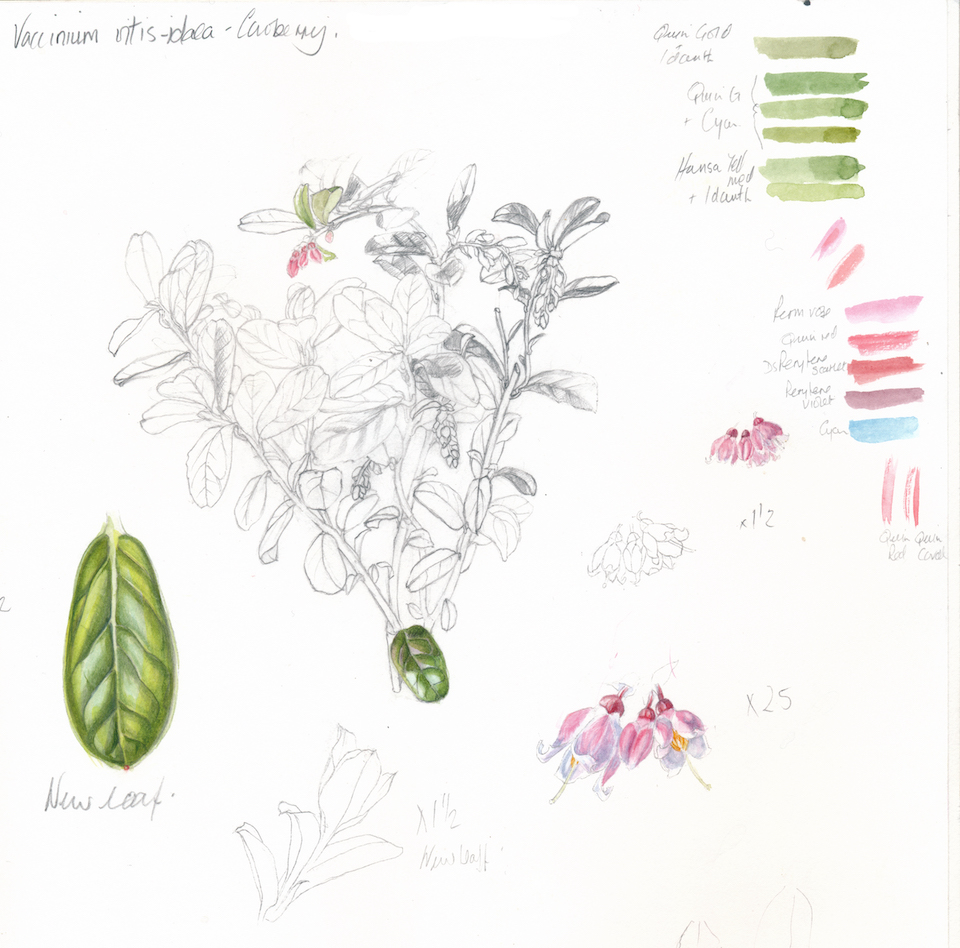
At the end of the previous blog I showed you some of the sketches I did from various Lingonberry plants. Here you see additional ones and you may notice that they were part of the basis for my final artwork.

Below you see my first compositional plan for the Lingonberry picture, but I didn’t really like it. I suppose in this plan I wanted to avoid painting so many small, but detailed leaves. As you now know they have several diagnostic elements to them, but at the same time are quite shiny. The composition just didn’t give me the right ‘feeling’ of the plant.
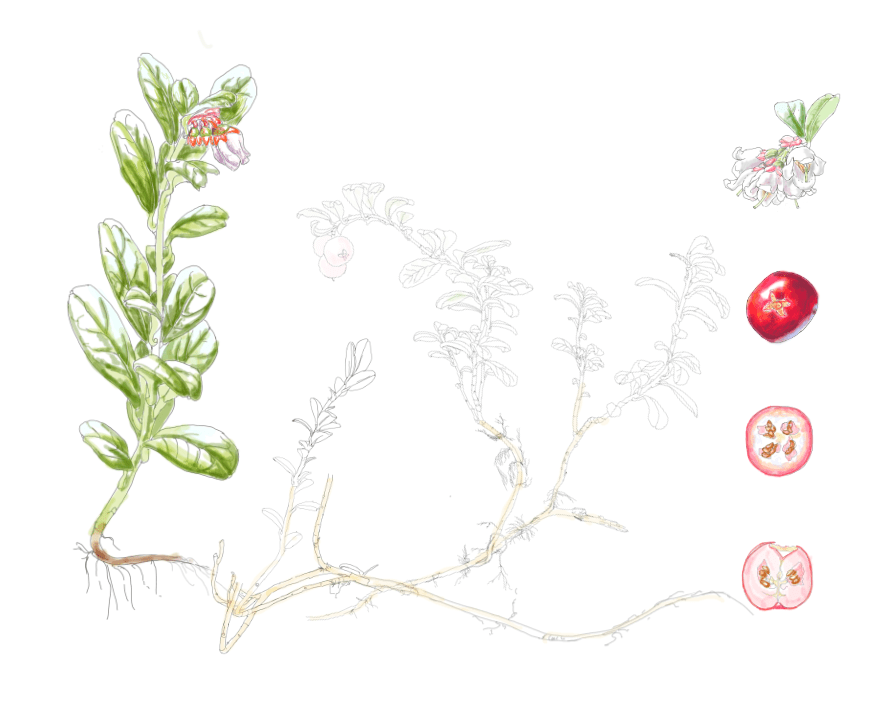
One weekend I had been out picking fruit with my daughter and we were discussing the way the plants grew and the impression they gave. We again looked at my planned composition and she suggested I replace the flower on the stem with a fruit cluster.
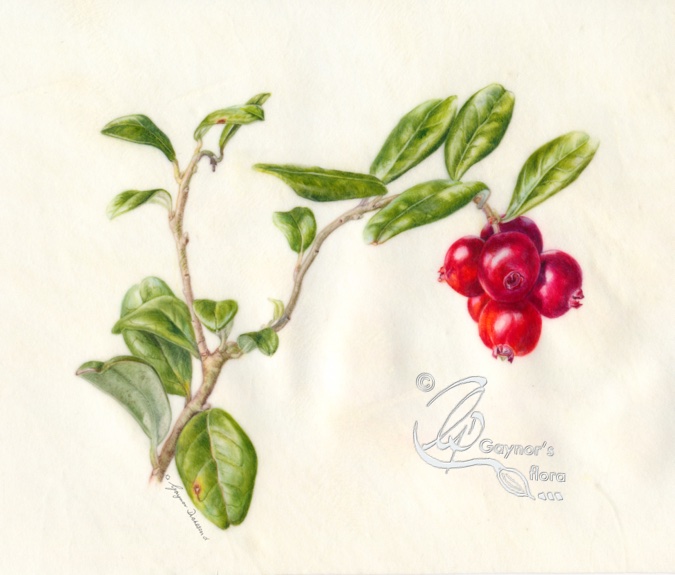
That was the answer – the series emphasis was about the fruit. I decided to do a trial on vellum of the new piece of stem with the berries and this became the basis for the final composition.

My first sketches of this plant were done in March 2017, but I didn’t start painting the final picture until October 2022 (after harvesting), finishing December 2022. Because this plant is not deciduous, it allowed me to work on the leaves right up until the first fall of snow.


The native range of this species is Subarctic & Temp. Northern Hemisphere including the UK and Norway. It is a subshrub and grows primarily in the temperate biome.

Source: Kew – Plants if the World Online

The species in my next blog scheduled for 8 June 2023 is the Bearberry, favoured by bears when they wake up from their hibernation – or so I am told.

Eva’s Raw Lingonberry Jam

300g Lignonberries

100gm sugar

Blend together the berries and the sugar until berries well macerated. If possible let it stand for few hours in the fridge before being used.

Eva Biringvad gave me this recipe and sent me on a ‘no-return’ journey. Her father made the most delicious bread, so we ate chunks of his bread with sour cream and the raw lingonberry on top. Delicious!

This is also used with meals instead of Cranberry sauce – and it is much nicer.

Foraging plants in the norwegian mountains – 23. Lingonberry Pt. 1


Ripe Lingonberry ready for picking with Bilberry plants already done and dusted.
Distal view of ripe fruit – inferior ovary

Vaccinium vitis-idaea, or cowberry, the common english name and tyttebær the Norwegian name is more commonly known as lingonberry if you visit Ikea. It forms the sharpish berry sauce you get with your meatballs!

In fact, there are several ways you can eat the fruit and one of the recipes I will be sharing with you is one where the raw fruit is whipped with sugar – it is absolutely delicious – especially on lovely bread with sour cream!! A friend introduced me to this bad/delicious habit, but I have learnt to restrict myself!

I am glad that we picked quite a bit of fruit this last year and it is safely kept cleaned and ready for use in the freezer. Like the Bilberry, I use it in all sorts of recipes, sometimes even together.

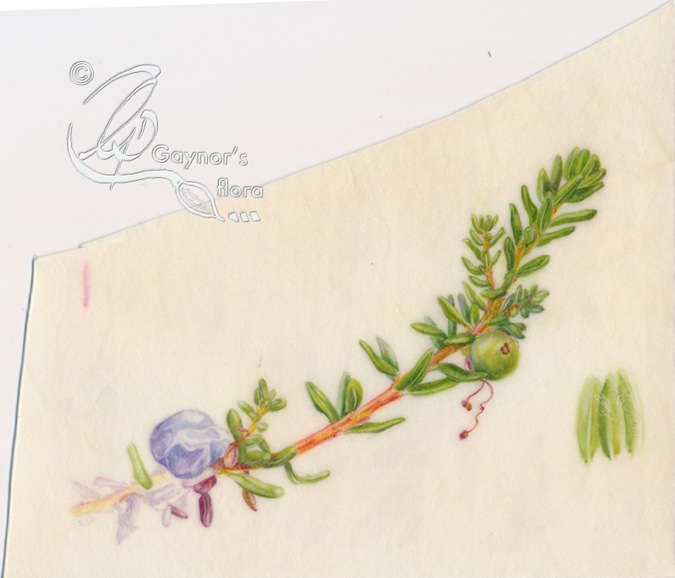
Many will think that the Lingonberry is similar to the small cranberry and in many respects it is. They are both Vacciniums, similar in size; 5- 8mm, but the lingonberry is almost completely spherical whilst the cranberry has a very slightly elongated spherical shape.

Because the Lingonberry and Cranberry prefer completely different habitats, there is little risk of picking from the two species at the same time. But, both can be used in the same way and for similar recipes.

The Lingonberry is generally found on heathland and shrubby areas, but as discussed in my blog released 7 May, the Small cranberry grows in very boggy areas covered with sphagnum moss.

The next two picture were taken late September at 1100 metres over sea level. The red berries are

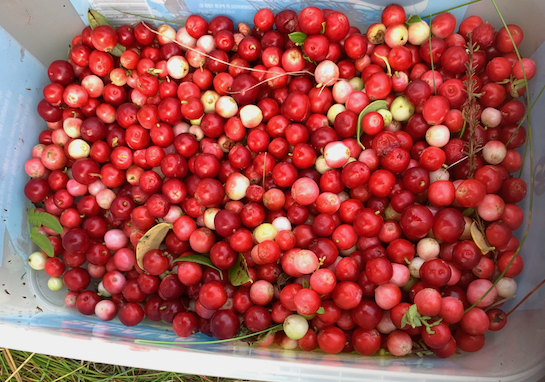
the Lingonberry and you can see that as they hang in bunches they are easy enough to pick. Unlike the bilberry (the red/yellow leaves), the fruit is pretty solid and bullet-like making them even easier to pick that that species. In the same picture is the Mountain Crowberry with their black berries, heather and some very short birch.

We are lucky enough to have some Lingonberry also growing in our garden, but in the two years we have been here I haven’t seen any fruit. Possibly this is because the plants are in shade and it has been very dry since we have been here, and our house is on rock. Therefore, with climate change even the native plants suffer. There is more fruit as one walks from our house into the protection of the woods. Often it grows on the top of extinct anthills, indicating how the seeds were transported.

The Vaccinium vitis-idaea (Cowberry) and the Arctostaphylos uva-ursi ( Bearberry) are, in fact, the main reason that I thought to do this series of plants. I have already written about the similarity between the Vaccinium myrtillus (Bilberry ) and the Vaccinium uliginosum (Bog bilberry), and in that case mixing the one with the other won’t spoil a recipe. But because the Cowberry and Bearberry are so similar, mistakes can be made and although both edible, Bearberry is dry and tasteless and has large stones rather than small seeds.

I will talk about the Bearberry as the last plant in this series. But the second section about the Lingonberry is scheduled for 6 June 2023.

Foraging plants in the norwegian mountains – 10. My working practice

Composition

Do these three pictures have good compositions? It is not easy for you to judge from these as composition is the area within the mount edge – the image and background.

  • Benton Iris ‘Farewell’ is Watercolour and graphite. The painting is part of the Cedric Morris Florilegium.
  • Dying Rosa rugosa is in Watercolour. It was one of the first paintings I did after returning to Norway. The sprig was sticking up above the snow, so it shrivelled quite fast.
  • Rhododendron impeditum is also watercolour and graphite. This picture is part of the Chelsea Physic Garden Florilegium.

Composition in botanical art is not necessarily very straightforward. As botanical art is ‘art’ it should have a main focal point that draws you into the picture. Once your eye is drawn into the picture, something needs to lead it around within that picture and prevent it from being lead off elsewhere.

On top of this, botanical art must be botanically correct. 

The first digital arrangement of my cloudberry sketches

Combining the art and botany for each picture is hugely difficult particularly when you have different sections telling a story about a plant. Having a series of plants in separate pictures that elaborate the story compounds the problem. 

To try and reduce the problem a little I started to arrange the pictures digitally. I scanned some of my sketches and moved them around within a 31 x 25cm area. It gave me something to think about when deciding what to include in each picture and how many more sketches I would need to get all the information I needed.

Scanning and arranging digitally gave me the opportunity to do something similar with my other species and the ability to compare them against each other. This composition looks nothing like the final one, but I kept rearranging until I was satisfied.

I worked hard to compose my set of pictures so that they looked a series. This can be quite difficult when some are from different families 

  1. Rubus chamaemorus – Rosaceae
  2. Vaccinium oxycoccus Subsp. microcarpum – Ericaceae
  3. Vaccinium uliginosum – Ericaceae
  4. Empetrum nigrum subsp. hermaphroditum- Ericaceae
  5. Vaccinium myrtillus – Ericaceae
  6. Vaccinium vitis-idaea – Ericaceae
  7. Arctostaphylos uva-ursi – Ericaceae

The first word in each species is the Genus name from which the plant is derived. Four are Vacciniums from the same Genus.  Six of the plants are from the Ericaceae (heather) Family and you can see this by the similarity of the flowers. One is from the Rosaceae(rose) family, and the stipules on the leaves (tags at the base of the leaves) is a clear indication of this.

Deciding the enlargement was relatively easy with the plants from the Ericaceae Family where the fruit is comparable. But as everything was larger on the Cloudberry picture, only the scale bars can give the size.

My aim with all the pictures was to let people see and understand the incredible flora and edible fruit available in the mountains. Many look at plants and think them pretty, or know where to pick certain fruits, but not so many study the plant and understand how intriguing it really is. This is an opportunity.

What to include in each composition.

I went through my sketchbook and made sure that I had enough information about each plant to fit on my vellum, mounted on blocks by William Cowley’s. I didn’t want to overcrowd each picture. 

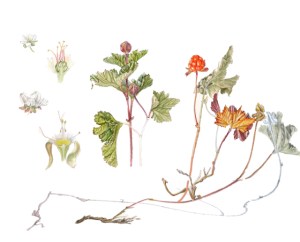
The focus was the plant and its fruit, but one can’t do this without highlighting its flowers. I decided to introduce a picture of the flowers and fruit but restrict dissections to the fruit only. That is until I got to the cloudberry which was going to be the most difficult to integrate into the series. But it isn’t called ‘Mountain Gold’ for nothing.

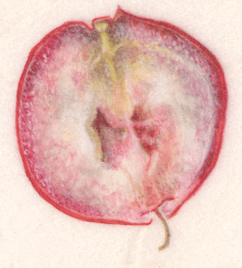
In the end, all but the cloudberry picture included a branch enlarged and branches actual size to indicate habit. Each had an enlarged flower, plus fruit with both longitudinal (LS) and transverse sections (TS). These are the finished longitudinal sections from each fruit; the largest being the Cloudberry.

In the next blog I will be talking about my transfer process. This comes 23 April 2023.

Only Eight weeks until the RHS Exhibition at the Saatchi Gallery in London;

https://www.saatchigallery.com/exhibition/rhs_botanical_art___photography_show_2023

Foraging plants in the norwegian mountains – 7. History of the project

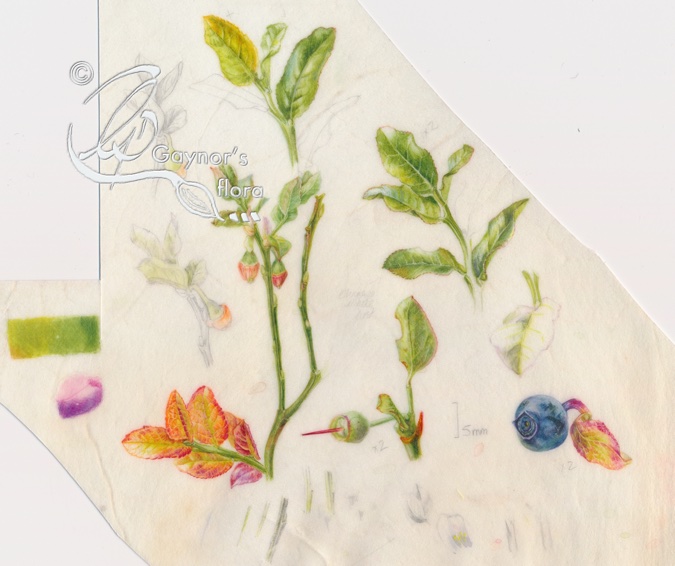
Above are the seven plants I chose with trial pieces on vellum offcuts.

The species I chose, with common names also in English and Norwegian

  1. Rubus chamaemorus – cloudberry -multe
  2. Vaccinium oxycoccus subsp. microcarpum – small cranberry – tranebær
  3. Vaccinium uliginosum – bog bilberry – skinntryte
  4. Empetrum nigrum subsp. hermaphroditum– Mountain crowberry – krekling
  5. Vaccinium myrtillus – bilberry – blåbær
  6. Vaccinium vitis-idaea – cowberry/lingonberry – tyttebær
  7. Arctostaphylos uva-ursi – bearberry – melbær

I have listed the plants in the order according to the type of ground in which they grow – from boggy to sandy:

  • The cloudberry and small cranberry often found intertwined together in the boggy moss of a swampy lake edge. 
  • The bog bilberry is more of a bush and guards the very marshy plants perching on rocks in the marsh. 
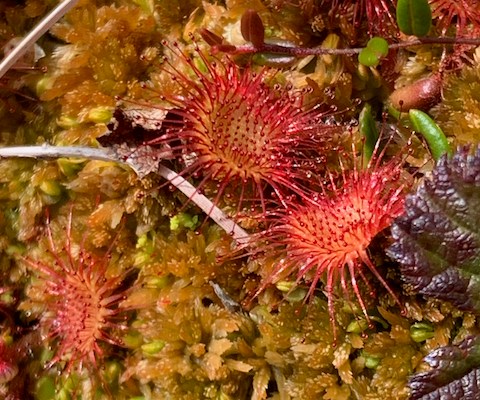
  • The Mountain crowberry grows in various areas from rocky outcrops at the edge of a swamp, to tiny examples without much soil, clinging to the rock on mountain tops.
  • The bilberry and cowberry are generally in a similar habitat in damp woods and forests; the cowberry can be the main plant on an old wood ant heap often with bilberry and mountain crowberry.
  • Bearberry grows in sandy areas on the edge of forests or creeping down over smooth rock.

The next stage of this blog goes into my working practice for this series. After which I will talk a little about each of the species and how I painted the final pictures. I will use the above order of plants as I would love others to learn more about them, where to find them and their uses. 

The next blog will be on 13 April 2023.

Foraging plants in the norwegian mountains – 5. History of the project

Since moving back to Norway there have been two bumper years for Cloudberry fruit and this is why we have so much in the freezer now.

But back to my sketches that were incomplete right up until last summer (2022). This plant in particular is not easy to find if you don’t know exactly where to look, and even then you might miss the right period of time.

We took a couple of long day trips into the mountains to look, and we eventually found what was missing. As well as a lot of driving, I extended the workday when I got back home. The flowers don’t last long and whilst I had them, I needed to dissect and sketch with measurements before going to bed. 

Robin birdwatching

The typical demands to a botanical artist. But luckily during the summer months we have a lot of daylight hours in southern Norway – in fact around mid-summer the sky doesn’t really go dark. Birdwatching at midnight is different to say the least! The picture to the left is Robin birdwatching at 5 mins past midnight on the 12 June – still over a week to mid-summer!

The lesson learned? Make sure when sketching that you have the where-with-all to measure various aspects of your plant and to make accurate colour swatches.

Equipment for sketching outside

As you will see from the pictures at the top, sketching on location can have various problems, from ants still defending their old anthill, a very hard bottom rest and a helpful cat.

The anthills in the Norwegian forests can be huge, but so too can the ants. They have a large territory to look after and a lot of old wood to turn into something future generations of trees and ants can live off. But they do have a painful bite! One often finds several of the plant species I was considering, growing on them. One often finds lingonberry, bilberry and mountain crowberry, well established on them. It also suggests what some of the ants transport to their home.

When I am out sketching in nature I minimise the amount of equipment I have with me. I try to keep everything in the same sketchbook and for watercolour use a Stillman & Birn, Zeta series. It has stood up well to the battering it has had and takes the watercolour washes well. 

Normally I use a bum-bag when walking not too far and it will contain this kit:

Of course I go nowhere in the mountains without my mobile phone, but these days they are much more than a phone or safety net. The Victsing 3-in-1 mobile phone camera lens was introduced to me many years ago by Sarah Morrish and I use this to get the details not normally seen very well. In particular it enabled me to get a picture and draw the growing tip with flowers of the Empetrum nigrum subsp. hermaphroditum (mountain crowberry) . I keep a small piece of mm paper with it to measure within the photos.

My palette is an old one with the original student colours removed and replaced with artist quality colours. I use transparent single pigment colours and normally have a couple of yellows and Quin Gold, Permanent Rose, Perylene Violet, Purple, A cold and warm blue and this time a single pigment green.

The pencils preferred are a 3B and HB as they are easy to lift if necessary, plus a single black fine liner pen. I only need to sharpen one of the pencils so have a sharpener to fit that. Otherwise travel brushes, ruler and erasers, magnifying glass, small water holder and kitchen towel. 

Sketching in the New Forest in the UK. I got a tick bite this time, but it wasn’t infected.
A dire warning; this is what happens when an infected tick bites. This is Robin’s leg last year.

If I take specimens with me, then I have a small plastic bag ready and can add some of my painting water. Sketching back in the cottage or at home means that I have all my equipment available.

I nearly forgot an important addition to the list above; Insect repellant because of the ticks, and sun screen, particularly here in Norway where the air is so clear.

The picture to the left is Robin’s leg last summer after a tick bite! We have a lot of dear and ticks, but doctors are very aware of the dangers and are quick to prescribe treatment.

A serious start on the series in 2017

My friend’s cottage at 800m over sea level.

By 2017 I still hadn’t decided which plants I was going to paint and this first year we borrowed a cottage from one of my oldest friends in Norway. The cottage was at about 850m over sea level. 

Around the cottage we found Rubus chamaemorus (cloudberry), bilberry (Vaccinium myrtillus), cowberry (Vaccinium vitis-idaea), bog bilberry (Vaccinium uliginosum)and mountain crowberry (Empetrum nigrum subsp. hermaphroditum). This was a pretty good start. 

Notice that three of them were Vacciniums – from the heather family. In fact the Blueberries you buy in the shops are yet another species (Vaccinium corymbosum) but they are farmed and not included in my choice.

Importantly I hadn’t found a bearberry (Arcostaphylos uva-ursi) which was partly the reason for choosing to do this series.

But there were loads of other lovely flowers such as Heath spotted orchids, geraniums and various insectivorous plants such as the Common butterwort. There was also plenty of Andromeda polifolia (bog rosemary) in the moss and amongst the new Cloudberry leaves. When seeing it growing at the Chelsea Physic Garden in London, I realised it was an opportunity to paint the species and the resulting picture resides in the Chelsea Physic Garden Florilegium collection.

Andromeda polifolia – Bog Rosemary

This continues on 6 April 2023

Fourth Gaynor’s Flora update

I am so glad that I have these blogs to look forward to each day. They are helping to remind me about the lovely things I have done over the last few weeks. Particularly as I am still catching up with all the undone things, including doing a coloured pencil video.

I am really struggling with the video. I expect that those who are just starting out in botanical art will be relieved to hear that someone who has been doing it for a while, continues to struggle in periods. But the reason that I am struggling is because I am trying out different papers to use with coloured pencils, so that I can advise my students. The subject is tomatoes.

I think that I am now on my third attempt. Its not that I don’t get good enough results, it’s just that I feel I have to adjust my technique for each of the different papers I use. But I suppose that is something new learnt.

First Tomato picture attempt on Strathmore 500 Bristol Plate.
Incomplete first tomato picture attempt on Strathmore 500 Bristol Plate.

Going back to catching up.

A lot had been going on over the last few months with a great deal of time spent on writing the online botanical art course, exhibitions, demonstrations and teaching. I felt I needed a break, but my head was still working ‘twenty to the dozen’. My workshop in Norway was unfortunately cancelled, therefore this time we would be taking a holiday there. I still had work to do on the botanical art course and informed family that this was the case.

I have a strong and determined family! After one day spent working, I was told that enough was enough. I was unhappy at the time as of course I still had to do the work. But since then I have every reason to be grateful to my daughter in particular. I had a holiday and had a proper rest. Maybe I was a pain to everyone else!

Whilst in Norway I didn’t get much painting done either. But we stayed with some friends at their cottage in the mountains and I think I now have a group of subjects to paint for an exhibition at the RHS. It won’t be next year, but if I get my act together, possibly the year after.

As here in the UK one is not allowed to pick certain plants. But I made a note of the plants around my friend’s cottage and I think they will make a very good subject series.

© Skinntryte page

I know that this page in my small Moleskin drawing book looks very boring. But this is how botanical art paintings start, particularly when planning a series of paintings. I’m afraid that I have written the Norwegian names, but you will also see the scientific names if you want to look them up.

Three of the plants are important for fruit picking in Norway –

  • The Vaccinum vitas-idaea is called Tyttebær in Norwegian and Lingon in Swedish (goes with your Ikea meatballs), but Cowberry in English. They are the same genus as the Cranberries we buy in the shops, but a smaller species.
  • Blåbær is Blueberry in English, but again a different and smaller species from the ones we buy in the shops.
  • Multe is Cloudberry in English. They are the most sought after and difficult to find – but generally one knows of a ‘spot’, and doesn’t tell anyone else! There are very special rules governing Cloudberries. One is not allowed to pick the flower and definitely not allowed to pick the fruit until it is fully ripe. If you are caught with red fruit you are fined.

In 1974 and long before I knew the importance of Cloudberries,  my parents visited me in Norway  and we took them into the mountains. My mother loved these delicate white flowers and picked a whole bunch of them!!

Skinntryte is also a form of blueberry. I have found several English names for it including Whortleberry and Bilberry. They grow with Blueberries and for those who don’t know the difference, they might also pick these.

Krekling is apparently becoming more interesting to harvest. It is Crowberry in English.

Of course Tettegras is the Common Butterwort, which is a carnivorous plant. When picking fruit in the mountains, I think one is very glad that there is something that digests all the buzzy, biting things!

Last of all, the Flekkmarihånd is the Marsh Orchid and just beautiful.

This is my friend’s cottage in the mountains. They have invited me back next year to continue painting the series. Thank you Eva and John.

© 1.Eva & John's hytte