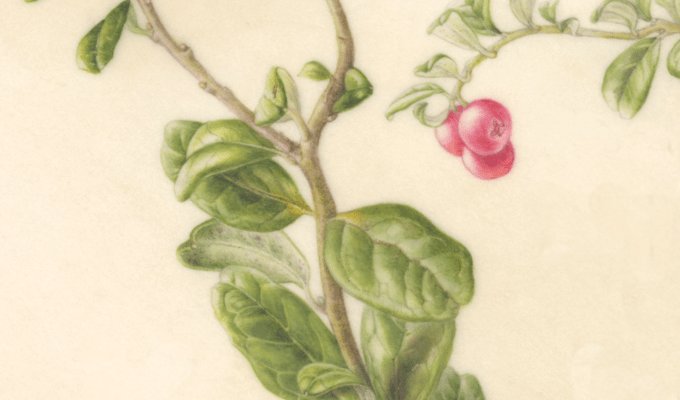
FORAGING PLANTS IN THE NORWEGIAN MOUNTAINS: FROM BOG TO SAND.

The title of my exhibit at the “RHS Botanical Art & Photography Show” is as above:

Foraging Plants in the Norwegian Mountains – From Bog to Sand.

Six of my watercolour and graphite paintings are exhibited by order of habitat starting with those growing in the wettest environment to those in the dryest. Seven paintings were completed not just the six, therefore it was a difficult choice to remove one of them. The second one shown below, the small cranberry, is not in the exhibition.

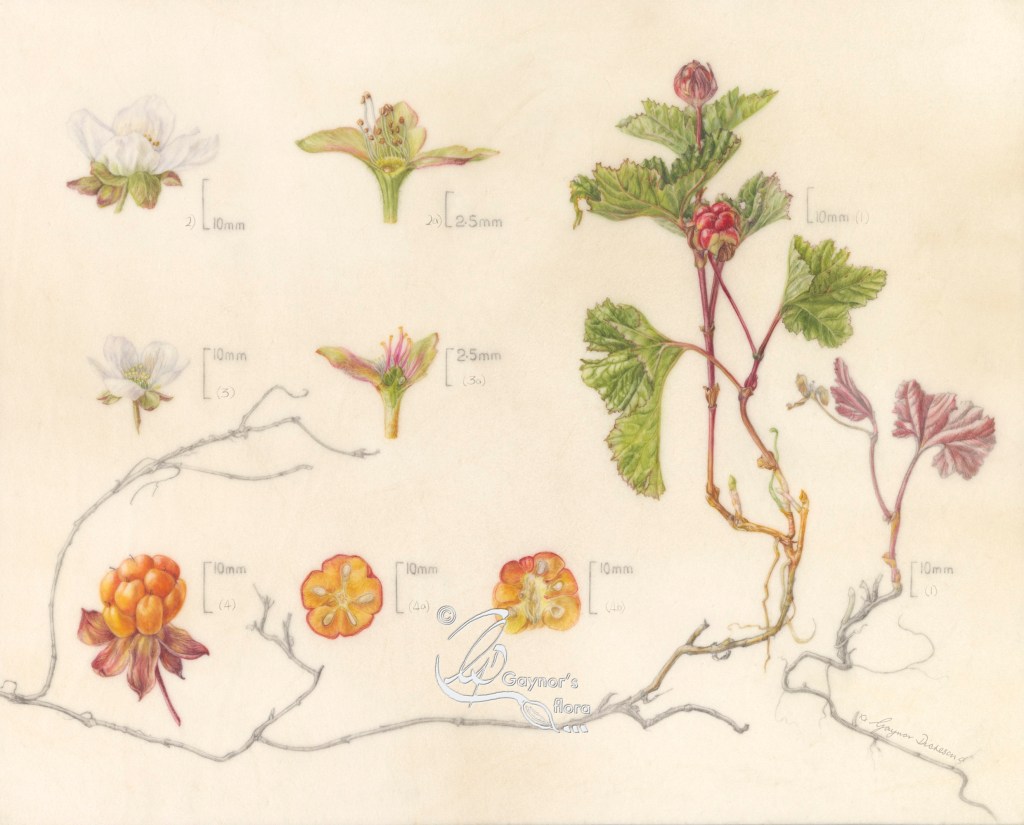
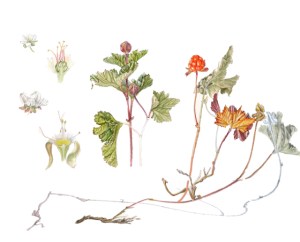
1. Rubus chamaemorus – Cloudberry – Multe
Watercolour & graphite on vellum.
August 2022

1) Habit
2) Male flower – 2a) LS Male flower
3) Female flower – 3a) LS Female flower
4) Fruit
4a) TS fruit
4b) LS fruit

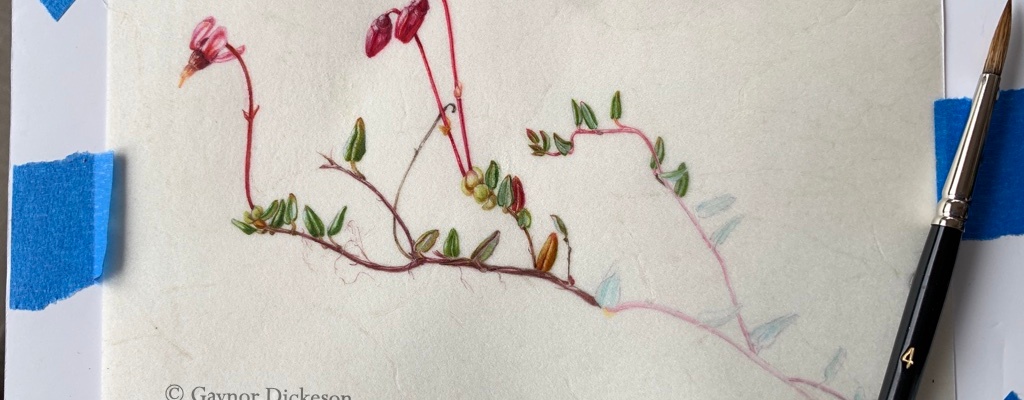
2. Vaccinium oxycoccus subsp. microcarpum – Small cranberry – Små tranebær
Watercolour & graphite on vellum.
January 2022

1). Habit
2). Flower
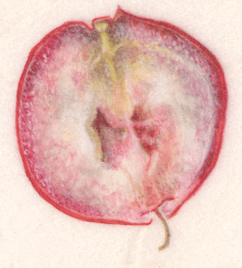
3). TS fruit
3a) LS Fruit
3b) Fruit

3. Vaccinium uliginosum – Bog bilberry – Skinntryte
Watercolour & graphite on vellum.
December 2021

1) Habit
2) Flower pair
3) Fruit
3a) TS fruit
3b) LS fruit

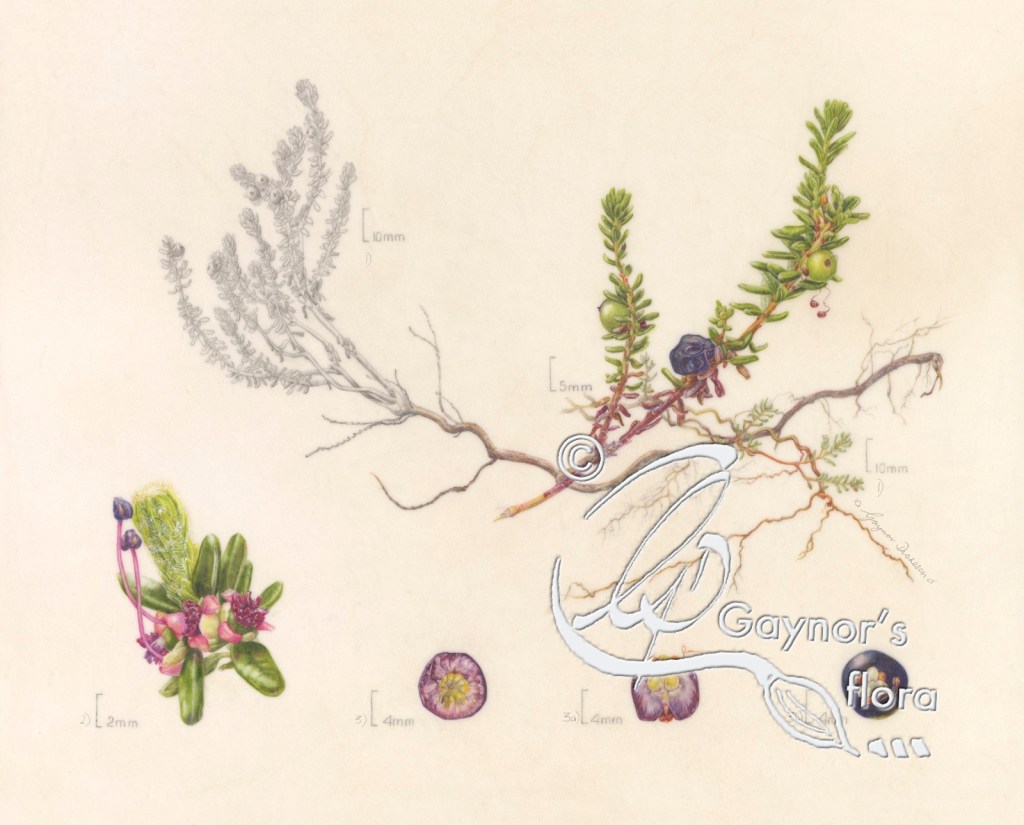
4. Empetrum nigrum subsp. hermaphroditum Mountain Crowberry – Krekling
Watercolour & graphite on vellum.
January 2022

1). Habit
2). Flower
3). TS fruit
3a) LS Fruit
3b) Fruit

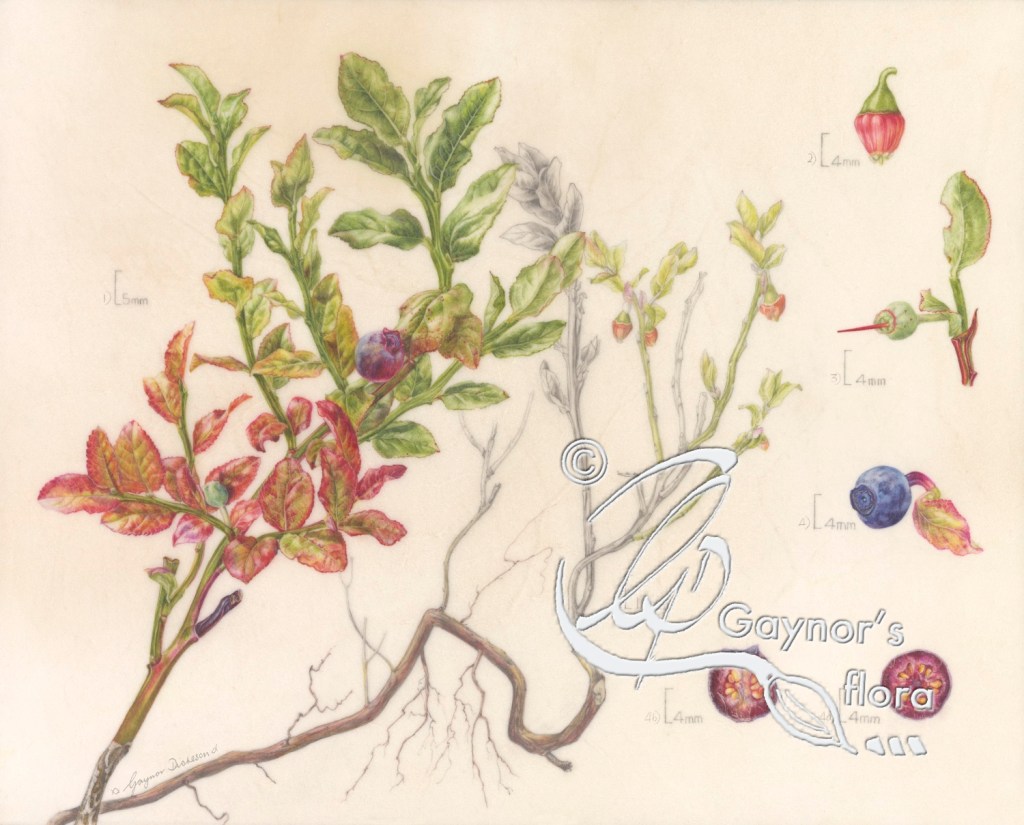
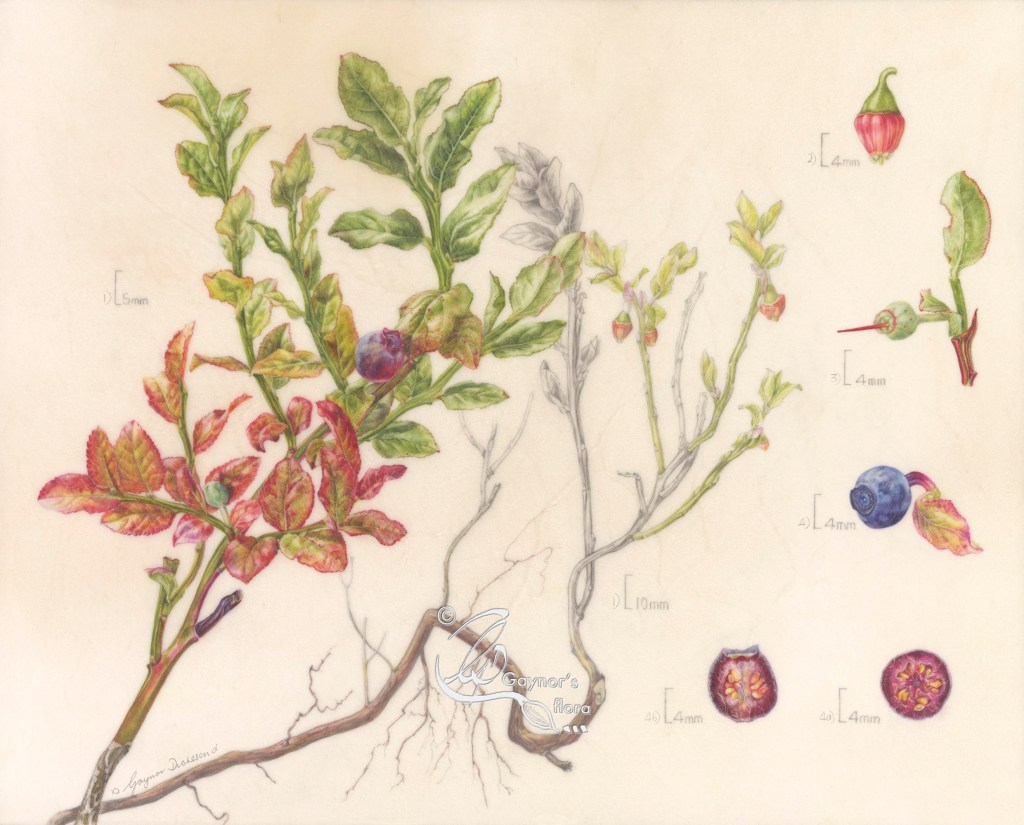
5. Vaccinium myrtillus – Bilberry – Blåbær Watercolour & graphite on vellum.
March 2022

1) Habit
2) Flower
3) Immature fruit
4) Fruit
4a) TS fruit
4b) LS fruit

6. Vaccinium vitis-idaea  – Cowberry/Lingonberry -Tyttebær
Watercolour & graphite on vellum.
November 2022

1) Habit
2) Flower cluster
3) Fruit
3a) TS fruit
3b) LS fruit

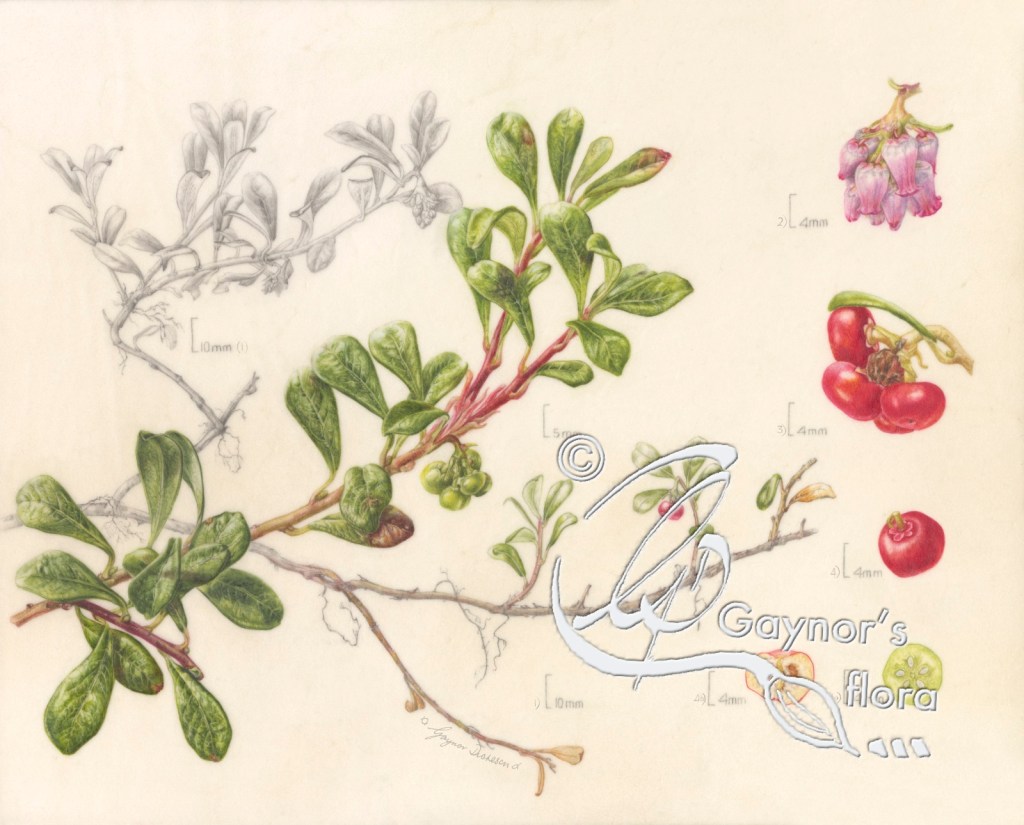
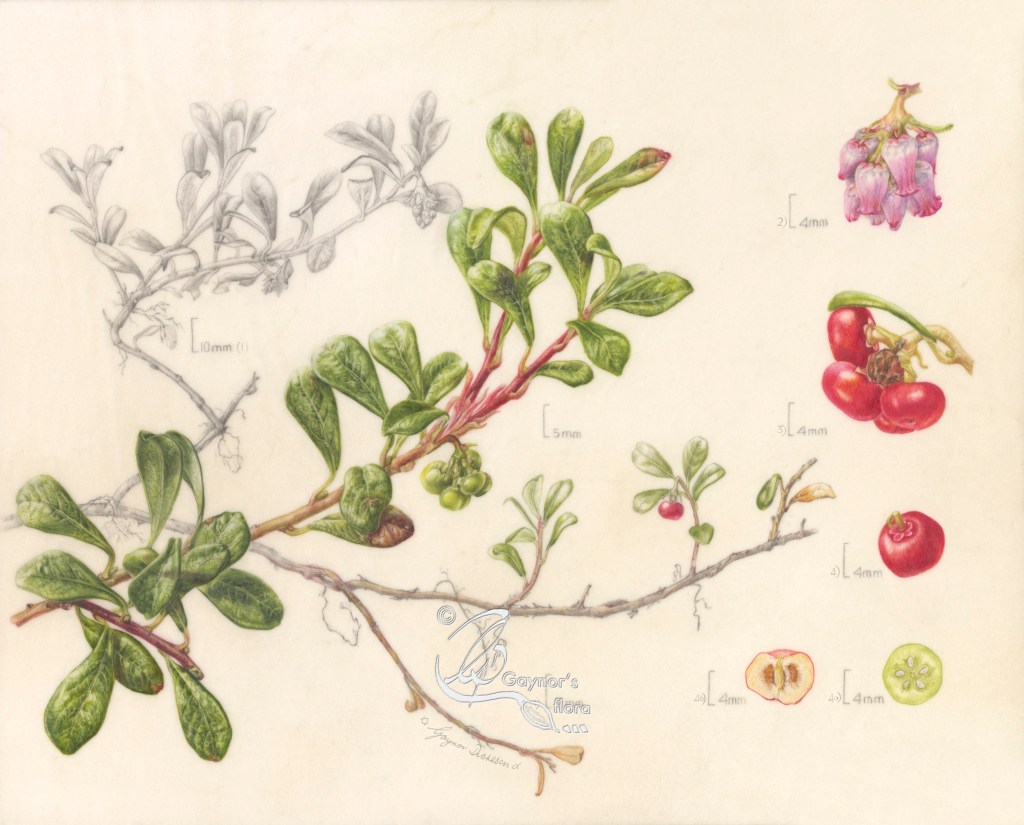
7. Arctostaphylos uva-ursi  – Bearberry – Melbær
Watercolour & graphite on vellum.
October 2022

1) Habit
2) Flower cluster
3) Fruit cluster
4) Single fruit
4a) TS immature fruit
4b) LS ripe fruit

If you have read the blog series you will understand that the Cloudberry and Small cranberry enjoy the wettest environment – bogs and marshes, whilst the Bearberry is often found on a sandy forest floor. The other species are found in various types of environment from damp woods to harsh mountain tops. Some, like the Bog bilberry will grow very well just about anywhere as long as it has water and plenty of sun.

All of the plants in this series live in the Subarctic part of the world and have always provided a lot of nourishment for those living in the far north, the rest of us a little further south and of course animals that roam the area.

Some of the plants typically don’t grow in certain areas as witnessed by the difficulty I had finding the Bearberry. In very hot and dry years some plants produce next to nothing; Cloudberry and Small Cranberry are good examples. Can you imagine the risk that Global warming brings to these plants as well as to us. The warmer the planet gets, the more further north these plants are likely to move making it even harder for us and the animals they support, to find them. As it is, plants that can normally be found further south in Europe, are now beginning to appear in Norway; their pollinators moving with them and having a negative effect on the species that belong.

When choosing to study and paint these plants I didn’t realise how much I would learn about them. I loved the plants (and their fruit) before this, but now have so much respect for them and the environment in which they grow. I hope that I have been able to pass on at least a smidgen of this.

Thank you for following this series.

Latest news: I am really pleased to say that following the judging process yesterday, 14 June 2023, the judges decided to honour me with a Silver Gilt medal. The award ceremony will be held this evening at the Saatchi Gallery during the preview to the exhibition opening tomorrow.

I look forward to getting detailed feedback about my exhibit from the judges this afternoon.
Foraging plants in the norwegian mountains – 15. Small cranberry Pt.1

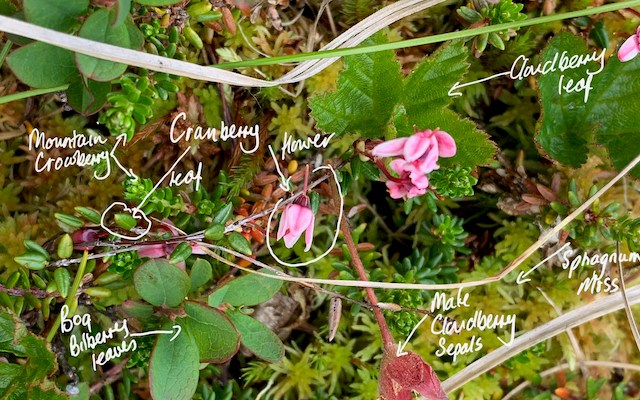
How rich in different flora a boggy marsh area can be!

When looking for an image suitable for highlighting the small cranberry I came across this one. You can see from the covering of sphagnum moss that this is a boggy area, and although few nutrients has a very rich flora. In fact this photo was taken in the area from which I found several of my chosen species to paint.

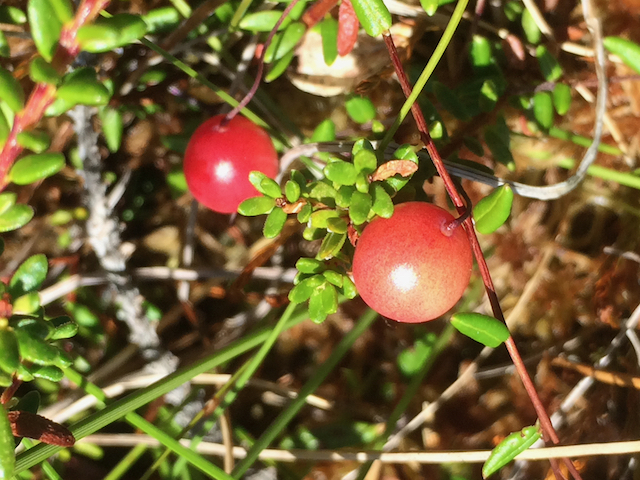
This picture was taken in July 2019. The new small cranberry flowers are out but I also found some shrivelled berries from the previous year. You can see clearly both the flowers and the tiny leaves all attached by a very thin stem meandering through the moss. The bog bilberry leaves have a lovely red edge at this time of year and the cloudberry plants show either the red sepals of the male plant or the immature fruit. In this instance the plant we see is obviously male. The mountain crowberry also does well in the same environment.

Vaccinium oxycoccus subsp. microcarpum 

Vaccinium oxycoccus subsp. microcarpum a tiny insignificant looking plant – but an even more exciting find.

In norwegian the plant is called Tranebær, which directly translated means Crane-berry – or as we call it in English – Cranberry. 

Firstly, why Crane-berry? This is a picture of the flower and perhaps you will get a better understanding of why. 

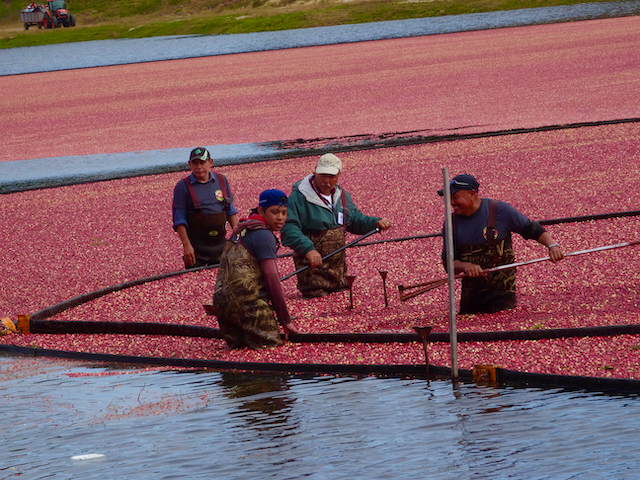
In the USA Cranberries are farmed in huge bogs and this is a significant industry. But the cranberry is slightly different to the one I have painted and is called Vaccinium oxycoccus subsp. macrocarpum. The difference between the two species is that subspecies microcarpum is very tiny and grows wild in the mountains, whereas the subspecies macrocarpum has a much larger berry and leaves. It is generally a larger plant altogether.

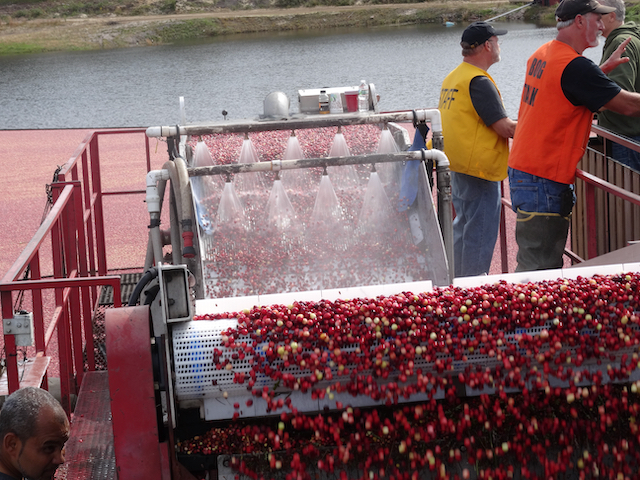
As a comparison I thought it might be interesting to show some of my photos from when I was in teaching botanical art in the USA in 2016. My husband and I visited a Cranberry farm south of Boston. It was intriguing, and I learnt quite a bit about the fruit and what happened to it. Note the size of the North American species of farmed berries at 9-14 mm against the small wild cranberry at 5-8 mm.

One of the questions regularly asked at the farm was why the fruit floats. The plants grow in bogs in America and when the fruit is ripe and the area flooded, the plants are shaken mechanically, releasing the loose fruit. The fruit each have four ovaries which are also air pockets, making the berries float to the surface of the water where they are collected. The small cranberry has a similar construction.

We weren’t actually looking for the wild small cranberry when we found it. We were in a very boggy area and tracing roots of a Cloudberrry plant when we found a small, obviously preceding year’s, fruit. We noticed that running through the Sphagnum moss was a tracery of fine hair-like stems with the tiniest of leaves. We started following this until we found a flower. I had no idea what it was so had to find out. 
In 2017 when we first found the plant, I had no idea how widespread it was or if it was a fruit that people foraged for. Since then I found out that very few seem to know of its existence and it is rarely picked to make jams etc – possibly because it is so small. Since then I also noticed I didn’t see either flower or fruit reliably every year. Sometimes we were unable to find any at all, although hunting in areas we had seen it previously. 2021 was just like this perhaps due to the lack of rain for the previous eight months.

In two of the pictures above you can see the previous year’s berry. It was these that alerted us to the plant and we went on to find the flowers.

It is a very boggy area but you can see some of the other plants in the series including bog bilberry flowers and leaves and the Mountain Crowberry. The other plants there in addition to the Sphagnum moss are heather, Andromeda polifolia or Bog rosemary, Vaccinium uliginosum (Bog bilberry), and Empetrum nigrum subsp. hermaphroditum (Mountain Crowberry). 

I painted the Bog Rosemary before I moved back to Norway and this is now in the Chelsea Physic Garden collection. The Bog bilberry and Crowberry are included in this series.

Although the wild small cranberry is not well known, it is certainly a plant with edible fruit and sometimes we found quite a few. It was amazing to see the marsh dotted with small bright red fruit, making it worthwhile to pick for a dessert or decorate a Norwegian cream cake. Uhmm!

The 2nd part about the Small cranberry will be posted 11th May 2023.

Foraging plants in the norwegian mountains – 10. My working practice

Composition

Do these three pictures have good compositions? It is not easy for you to judge from these as composition is the area within the mount edge – the image and background.

  • Benton Iris ‘Farewell’ is Watercolour and graphite. The painting is part of the Cedric Morris Florilegium.
  • Dying Rosa rugosa is in Watercolour. It was one of the first paintings I did after returning to Norway. The sprig was sticking up above the snow, so it shrivelled quite fast.
  • Rhododendron impeditum is also watercolour and graphite. This picture is part of the Chelsea Physic Garden Florilegium.

Composition in botanical art is not necessarily very straightforward. As botanical art is ‘art’ it should have a main focal point that draws you into the picture. Once your eye is drawn into the picture, something needs to lead it around within that picture and prevent it from being lead off elsewhere.

On top of this, botanical art must be botanically correct. 

The first digital arrangement of my cloudberry sketches

Combining the art and botany for each picture is hugely difficult particularly when you have different sections telling a story about a plant. Having a series of plants in separate pictures that elaborate the story compounds the problem. 

To try and reduce the problem a little I started to arrange the pictures digitally. I scanned some of my sketches and moved them around within a 31 x 25cm area. It gave me something to think about when deciding what to include in each picture and how many more sketches I would need to get all the information I needed.

Scanning and arranging digitally gave me the opportunity to do something similar with my other species and the ability to compare them against each other. This composition looks nothing like the final one, but I kept rearranging until I was satisfied.

I worked hard to compose my set of pictures so that they looked a series. This can be quite difficult when some are from different families 

  1. Rubus chamaemorus – Rosaceae
  2. Vaccinium oxycoccus Subsp. microcarpum – Ericaceae
  3. Vaccinium uliginosum – Ericaceae
  4. Empetrum nigrum subsp. hermaphroditum- Ericaceae
  5. Vaccinium myrtillus – Ericaceae
  6. Vaccinium vitis-idaea – Ericaceae
  7. Arctostaphylos uva-ursi – Ericaceae

The first word in each species is the Genus name from which the plant is derived. Four are Vacciniums from the same Genus.  Six of the plants are from the Ericaceae (heather) Family and you can see this by the similarity of the flowers. One is from the Rosaceae(rose) family, and the stipules on the leaves (tags at the base of the leaves) is a clear indication of this.

Deciding the enlargement was relatively easy with the plants from the Ericaceae Family where the fruit is comparable. But as everything was larger on the Cloudberry picture, only the scale bars can give the size.

My aim with all the pictures was to let people see and understand the incredible flora and edible fruit available in the mountains. Many look at plants and think them pretty, or know where to pick certain fruits, but not so many study the plant and understand how intriguing it really is. This is an opportunity.

What to include in each composition.

I went through my sketchbook and made sure that I had enough information about each plant to fit on my vellum, mounted on blocks by William Cowley’s. I didn’t want to overcrowd each picture. 

The focus was the plant and its fruit, but one can’t do this without highlighting its flowers. I decided to introduce a picture of the flowers and fruit but restrict dissections to the fruit only. That is until I got to the cloudberry which was going to be the most difficult to integrate into the series. But it isn’t called ‘Mountain Gold’ for nothing.

In the end, all but the cloudberry picture included a branch enlarged and branches actual size to indicate habit. Each had an enlarged flower, plus fruit with both longitudinal (LS) and transverse sections (TS). These are the finished longitudinal sections from each fruit; the largest being the Cloudberry.

In the next blog I will be talking about my transfer process. This comes 23 April 2023.

Only Eight weeks until the RHS Exhibition at the Saatchi Gallery in London;

https://www.saatchigallery.com/exhibition/rhs_botanical_art___photography_show_2023

Foraging plants in the norwegian mountains – 9. My working practice

By the lake Fjelløkteren at 1000metres – Ripe Cloudberries mid July

Imagine how the artwork might look if measuring various parts of a chosen species was not accurate. The photos above all contain the Vaccinium oxycoccus subsp. microcarpum – small cranberry. Click on the images to see them larger.

  1. Small cranberry flower in the moss with Bog bilberry leaves, bog rosemary leaves, and heather. Note the tiny leaves of the cranberry lying across the moss surface bottom right.
  2. Small cranberry flower with bog rosemary to the left, bog bilberry leaves and flowers. Note the woody stem that distinguishes it from the bilberry. Sprigs of mountain crowberry also clearly seen with the white line on the back of them – this is the leaf folded back.
  3. Two small ripe cranberry fruit lying on the top of the moss by the side of a larger cloudberry leaf. There is also heather and mountain crowberry leaves. The stems of the small cranberry can be seen across the moss if you know what to look for – narrower than the grass.
  4. Two ripe small cranberry fruit either side of a cloudberry leaf. The reddish stems of the cranberry with the tiny triangular leaves can be seen.
  5. The growing tip of the small cranberry.
  6. A stem and leaf of the small cranberry. A further series of well chosen photos would show the connections of leaves to the stem, the branching and flower connections.

Measuring for the sketches

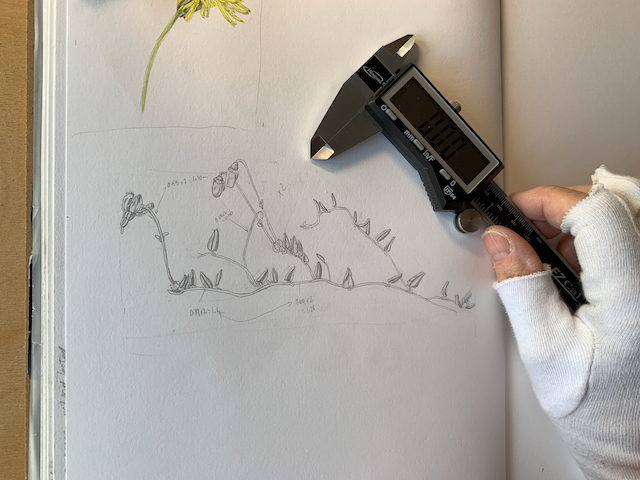
Amongst my original chosen plants for the 2023 exhibit were some very tiny flowers, but each of the species contained some tiny detail. I needed the facility for measuring accurately, particularly whilst sketching and of course for enlarging where needed. 

To the left is my trusty digital calliper in use for measuring the Cranberry. Whenever I take a measurement, I make a note of it with the drawing and additionally check it against the research done on books and the internet.

Unfortunately, I didn’t have this essential tool when initially sketching the Cloudberry and spent several years trying to catch up as already mentioned. As I wasn’t living in Norway at the time, I tried to coincide my visits with the months that I thought I might be able to get the missing detail, but either the plant flowered earlier or later than my visit. In fact, I didn’t get the missing dimensions until 2022 when I was again living in Norway. But even then, it still took several trips up into the mountains to hit the right time!

Another tool I use when making enlargements accurately is a technical divider. You can see it in use here when I did my Bilberry sketches. The divider allows me to measure exactly or enlarged by a specific amount. 

Technical divider adjusted to make a 1.5 enlargement.
Technical divider in use with bilberry sketch.

The other picture here shows the technical divider adjusted to create an enlargement of 1.5. In the ‘old days’ before digitalisation, one could write an enlargement of 1.5 (x1.5) on the illustration. Although this helps when doing the illustration, it will not work if showing artwork digitally on a website etc. 

In such a case one has no idea at which size the original drawing will be seen, therefore scale bars need to indicate exact measurements.

Example: When drawing x 2, or twice the size of the actual subject, one knows that 2cm of the illustration is actually 1cm in real life. So one could draw a 1cm long scale bar with 5mm written beside it to indicate that the 1cm line is in fact equal to 5mm. This means that when looking at the original enlarged illustration, if it measures 5cm, you know that the plant section is 2.5 cm in real life. 

But, these days if viewing an illustration digitally, there is no way of knowing what the size of the illustration is.

Scale-bars from bilberry illustration.

To overcome this if viewing on-screen or in a book, measure the scale bar marked as 5mm (our example) and note the measurement, then measure the whole section on-screen and multiply that measurement with the measurement of your scale-bar. This will give you the size in front of you on your screen or book. But you will want the real-life size and to do this, multiply again with the figure written by the scale bar – in this instance 5mm.

As an example use this picture from my bilberry illustration to work out the size of the finished detail and the size of the actual plant. The picture shows where I planned the scale-bars digitally to repeat in graphite on the artwork. But remember that the scale bar is in mm i.e. 4mm = 0.4cm.

On my screen, the scale bar measures 0.7cm and the section is 2cm high. Therefore 2 x 0.7 = 1.4 x 0.4cm= 0.56 cm. This means that the illustration is 1.4 cm tall, but as the scalebar is equal to 0.4 cm, the live flower is 0.56cm high.

My next blog is scheduled for 20 April 2023

Summer snow in the Norwegian mountains

Whilst everyone else is suffering extremely high temperatures in Europe, we are experiencing +4 high in the mountains of southern Norway! I believe it is warmer at the North Cape.

However, as there is now no longer a direct ferry from the UK to Norway, we drive here over several days, with our cargo of painting equipment. A necessity for the job I am going to do whilst here.

On the way we stopped off in Amsterdam to visit my son and partner and had a cycle ride to the coast in 37 degrees. It was almost a relief to eventually get to a cooler climate, although the day we arrived it was in the high twenties lower down in the valley.

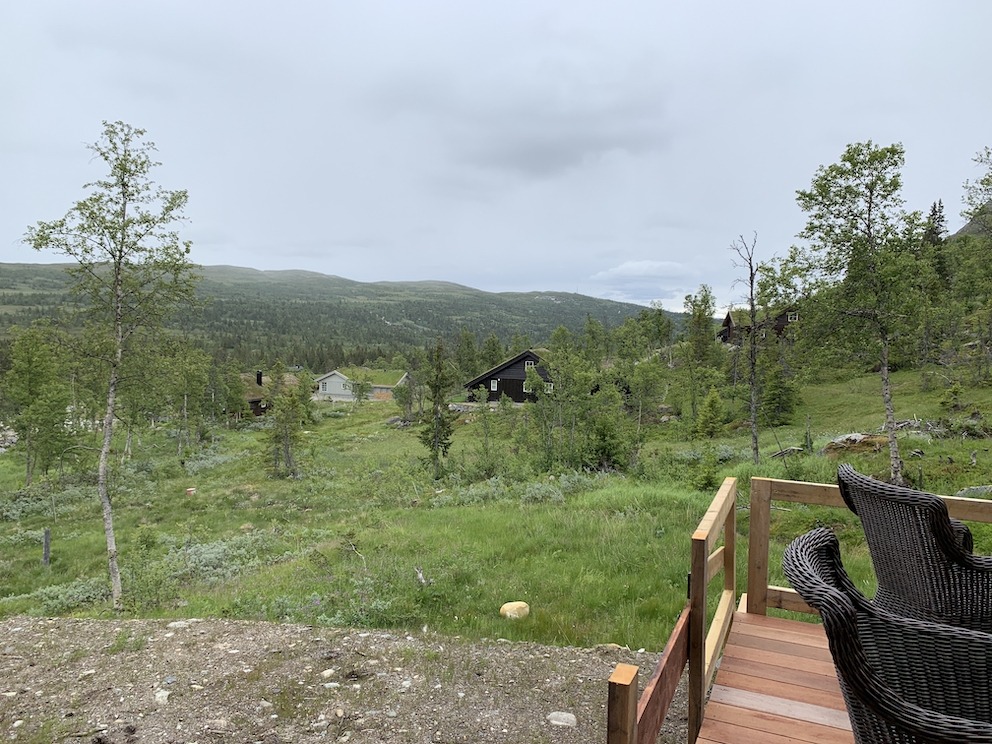
Today’s view from our rented cottage.

Since then, the temperature has gradually sunk even lower. Today we are awaiting my daughter who lives on the Norwegian coast, advising her to bring  winter woollies. I didn’t dare tell her that it has been snowing today – although it hasn’t settled.

So why am I subjecting my sun loving and warmth seeking husband to todays chill in the Norwegian mountains? It’s the plants of course. I am now back to getting all the plant information to paint my pictures for my next RHS exhibit. I know I have spoken about this for a couple of years or so, but my involvement in the Worldwide Botanical art exhibition last year and continuance with setting up the Association of British Botanical Artists (ABBA), rather delayed things.

Because of the delay, I also lost my right to exhibit at the RHS – this year being five years since I last exhibited. I therefore had to apply again. Luckily, my work in general was again accepted as potentially worthy of a medal place, so now I am going to work through my subjects properly and, rather than rushing it, plan to exhibit in 2021.

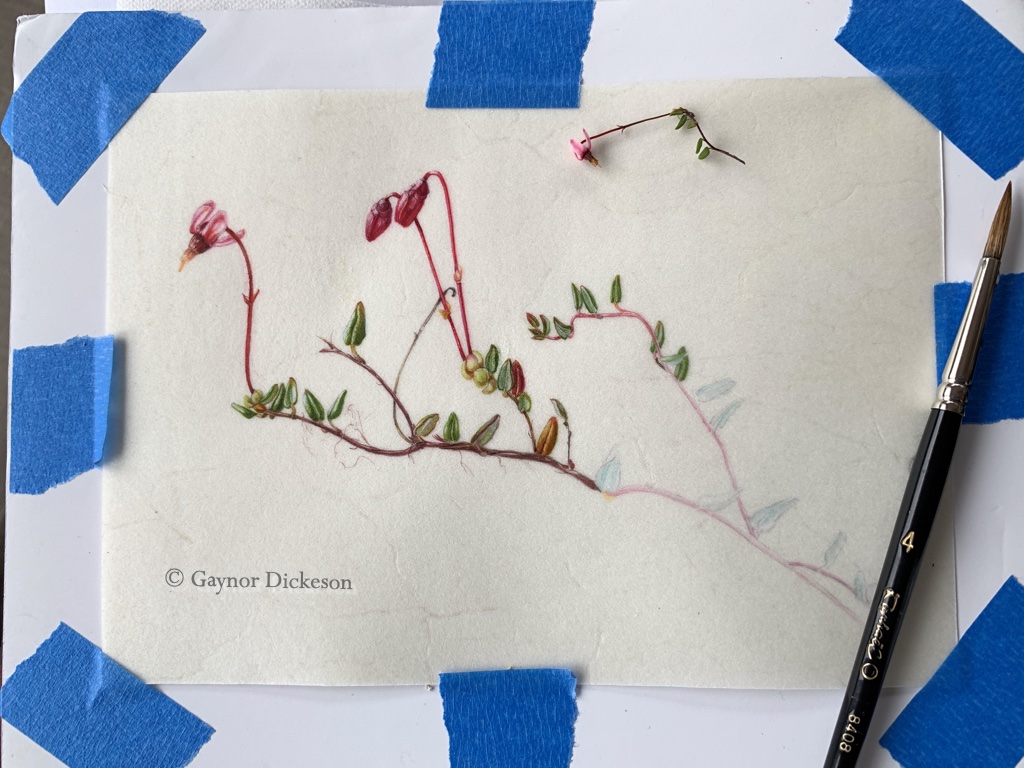
Små Tranebær is Small Cranberry in Norwegian. The practice piece is twice natural size (the actual flower top right) is on vellum – as the final work will be.

This year I am focusing on three of the plants I have chosen and plan to get information I feel is lacking to complete a picture. My first is Vaccinium microcarpum – or Small cranberry. Last year I was able to find ripe fruit and was able to get all the information from that. Previously I had only drawn one flower, so I am concentrating on these now.

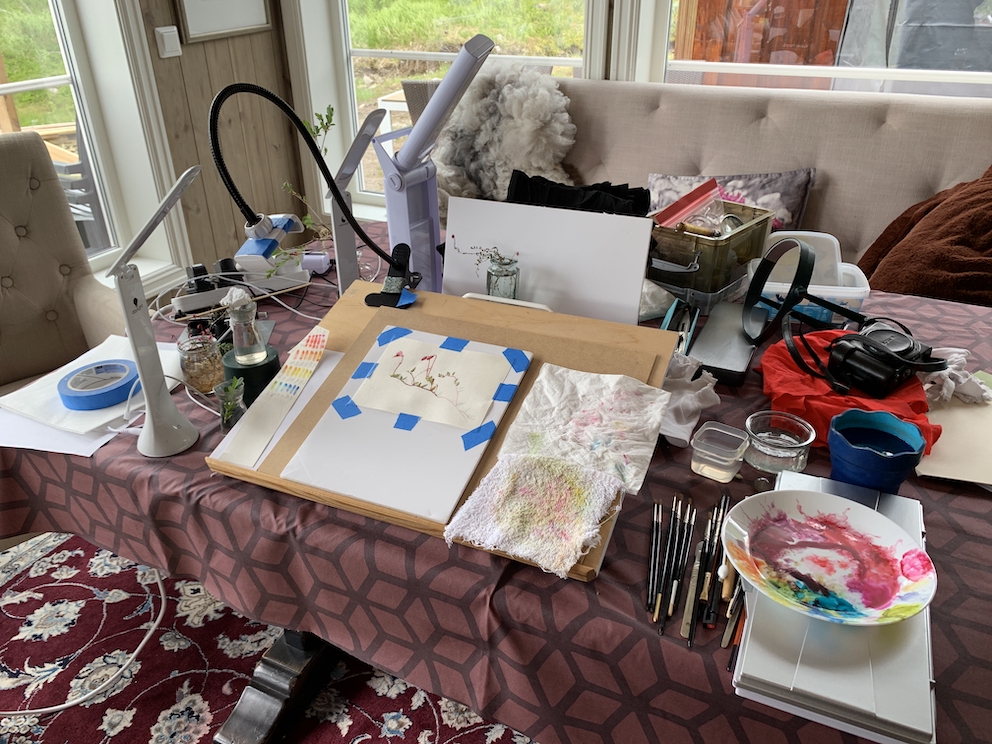
I thought you might be interested in my already messy workplace setup at 910 metres over sea level!

If Denise Walser-Kolar sees this blog, I hope she will notice I have taken on board her teaching. As long as I practice what she taught in Vienna, painting on vellum is going much better – even with the tiny leaves! Thank you Denise.

The other two plants I hope to get some more information on is the Vaccinium uliginosum (Bog Blueberry) and a little from the Rubus chamaemorus (Cloudberry). In both instances, it is only small details I need. I have already noticed that the leaf colour of the Bog blueberry seems to change in the sun. New leaves have a red tinge to the edge of the leaves, older leaves don’t, but in the sun they become red to almost a Perylene Violet (for watercolour artists) colour. I didn’t realise that before.

The Cloudberry fruit is only to be found on female plants. Each plant can be quite huge and spread many metres. Around the cottage I have only seen the male flowers of the Cloudberry – no female ones at all. it might be because it hasn’t warmed up very much yet where we are. The temperatures are set to improve, but I doubt we will be here long enough to benefit from it.

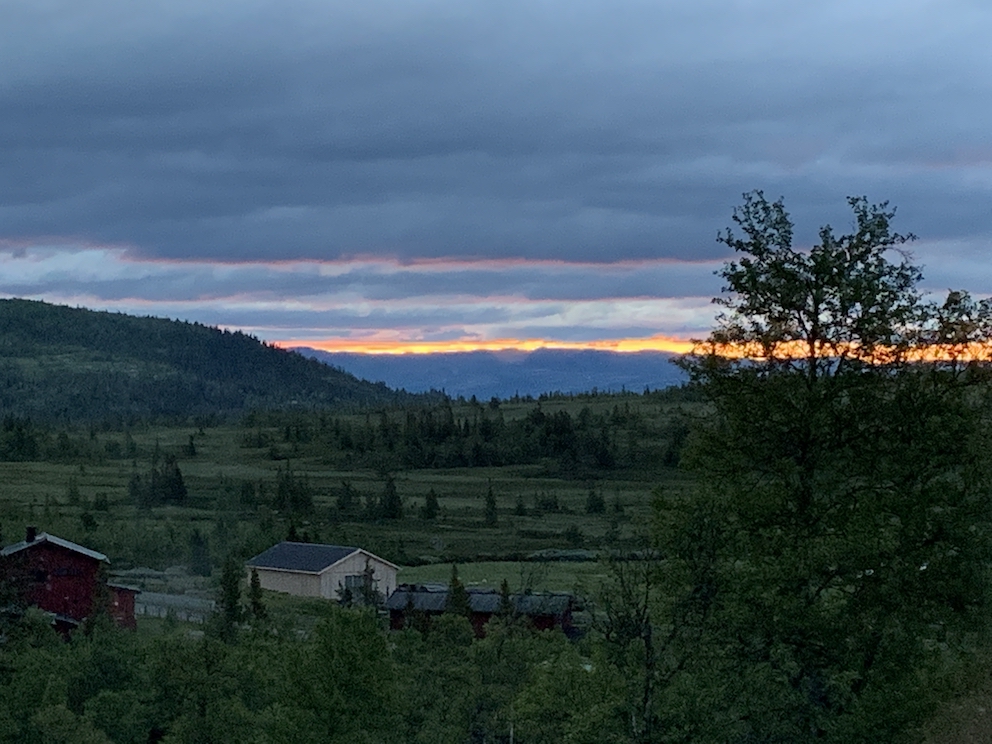
Please don’t get the wrong impression of Norway. The summers can be hot and the winters cold. It is a fantastically beautiful country and every area has its own attraction. I like it in the area we are staying as I lived in the valley for several years. Lastly, a picture of the sun rise a couple of days ago. It doesn’t get totally black at night at this time of year, but this was taken at 03:30.