Capturing Nature: Birds and Botany in Winter

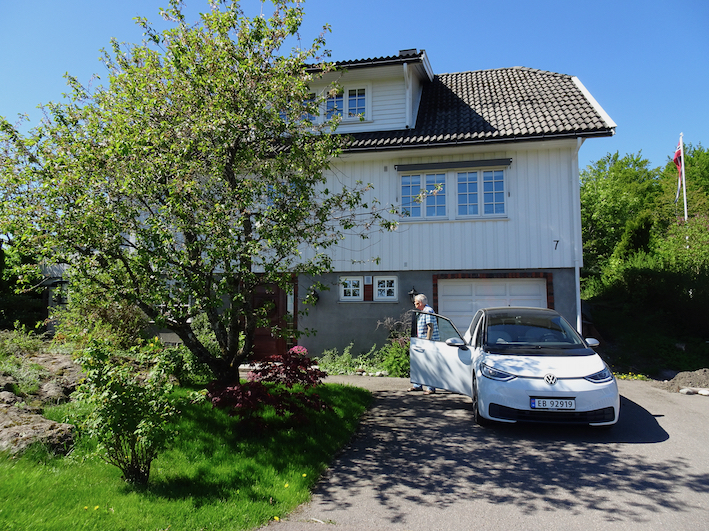
On a walk exactly four years after moving into our Norwegian home.

The above walk was with my children and husband. We went a little further south along the coast from where we live. It was on the edge of a beech wood, very cold and plenty of snow. However, the temperatures were not as low as the day we moved into our new home. On that day, it was minus 15 degrees Celsius!

I have had botanical art students from just as cold climates. They have asked what they should paint when there isn’t too much growing. For my course, I always suggested they might buy indoor plants to complete the course. Once they had finished the course, they could choose their favourite subjects.

A fair amount is still available in the countryside. This can be seen in the picture above, showing the edge of a Beech forest. My garden also contains rose-hips, beech, oak, Rowan, pine, hazel, all of which is accessible above the snow. It also has a lot of wild-life.
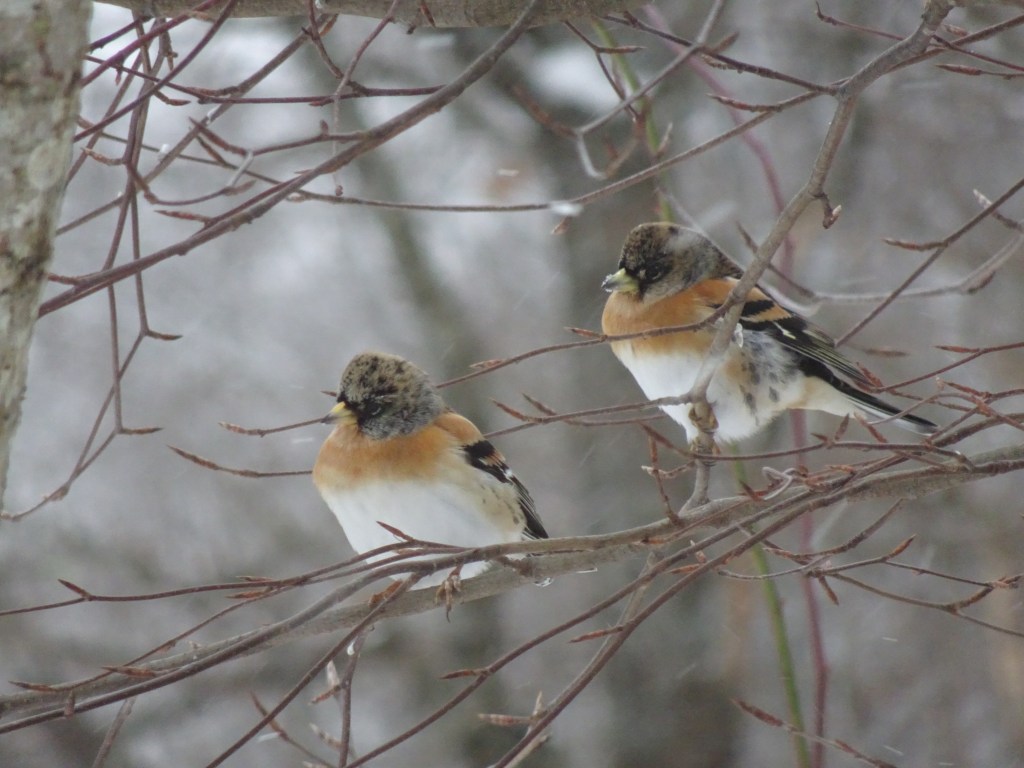
Bramling – Fringilla montifringilla – Bjørkefink in a Beech tree.
Single female Roe deer – probably first winter alone.

Many years ago, during my first 25 years in Norway, I focused on painting birds. At that time, I relied on photos taken with my SLR attached to my telescope. For additional detail I used skins from the museum. Since then, the equipment available to me has changed. It is more affordable now. I can get much better photographs from my trusty little camera than I did from my film reliant SLR.

Gradually we have moved the bird feeders nearer to the house. This allows me to get quite good photos. Feeding the birds in the garden also provides a plentiful supply of nuts and seeds generally. This attracts other animals during the winter when the supply of food is short. Deer are also welcome visitors and mop up after the birds. But we do have to try and protect our fruit trees a little!!

So what do I paint? I decided to combine my love of painting birds, with my love of botanical art?

Many of the bird species move from the mountains to lower lands searching for food during the winter. This includes the Bramling, Yellowhammer, Siskin, Bullfinch and Hawfinch. At the beginning of the winter, their colours can be a little drabber. As spring approaches, they get new plumage. and become very colourful.

Now I spend quite a bit of time photographing these beautiful birds from the comfort of my own lounge. The two pictures above are good examples.

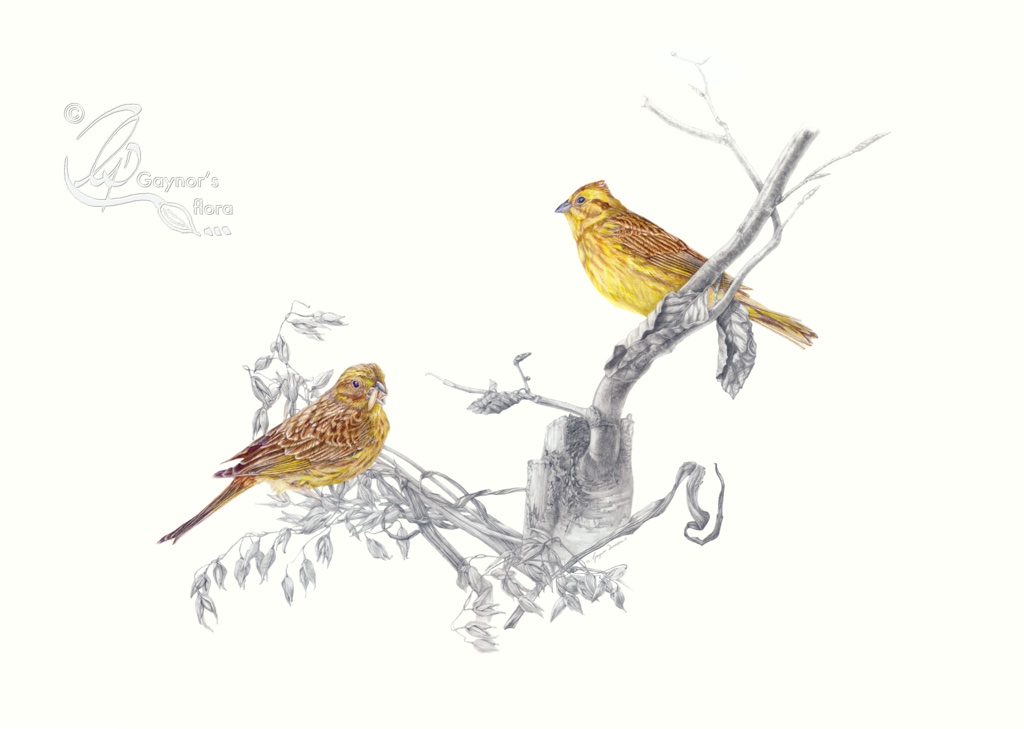
So where has this led me? It is traditional in Norway to put out sheafs of corn for the birds for Christmas. The Yellowhammers seems to be very interested in this food source and flock to the sheafs. This year, we have the corn hanging in a Beech tree, so I had both botanical subjects with the birds. Additionally, I always loved the use of graphite and didn’t start using colour in my artwork until my mid-twenties. So this picture is a combination of glowing colour for the birds and graphite for the botanical detail.

To confirm which is which in this Yellowhammer pair, the female is the more motley colour on the left. I do enjoy painting her more. The Male in striking yellow is on the right. He is very gentlemanly and making sure she is feeding un-molested. All is painted actual size. The finished painting is 52 x 37 cm. Enjoy!
Pang!: arrival of 2024 Norwegian Spring

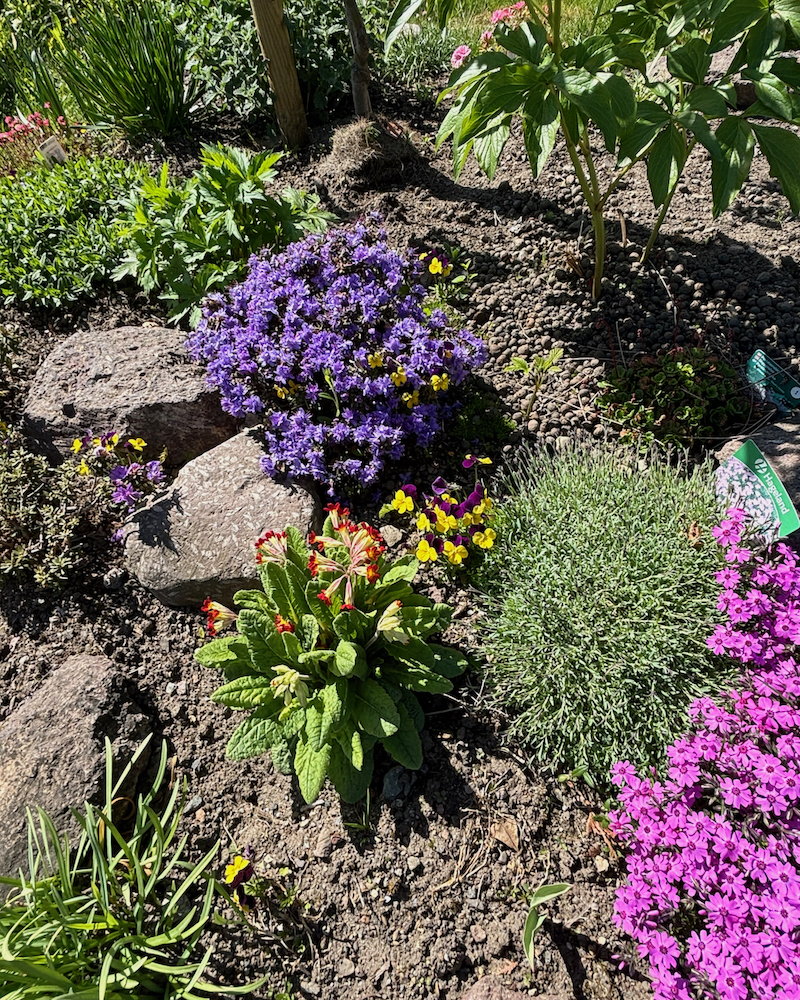
Last snow 5 weeks ago in April and rockery today in May

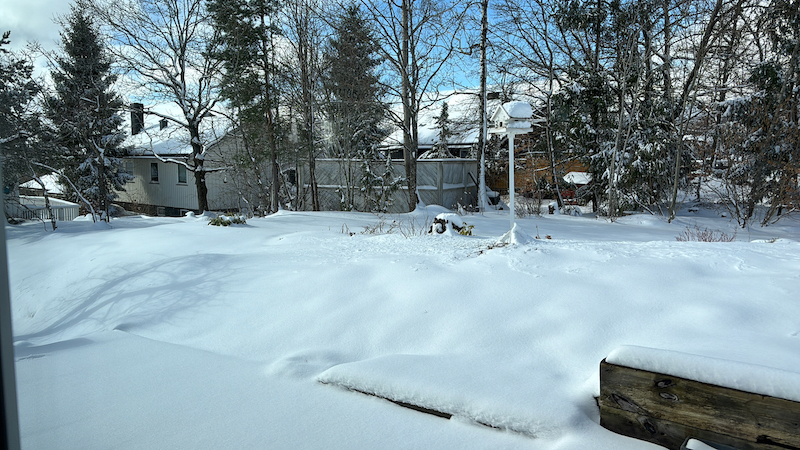
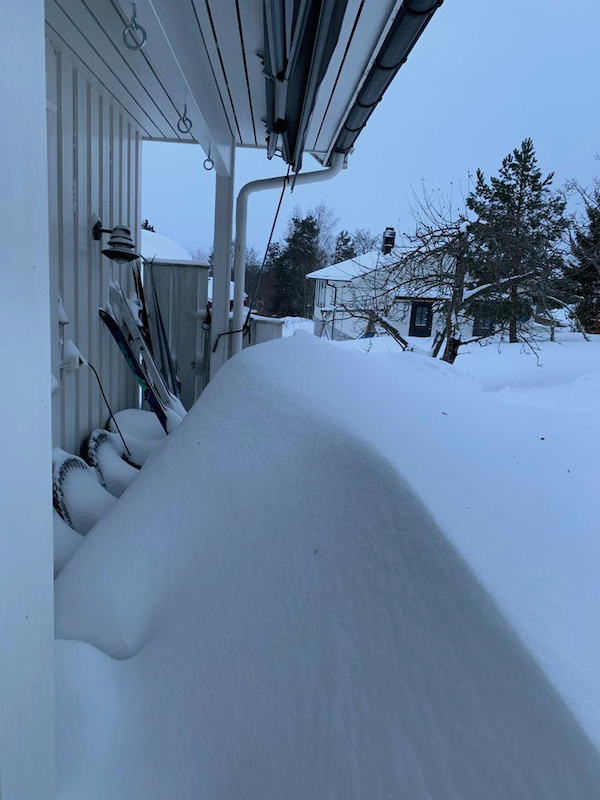
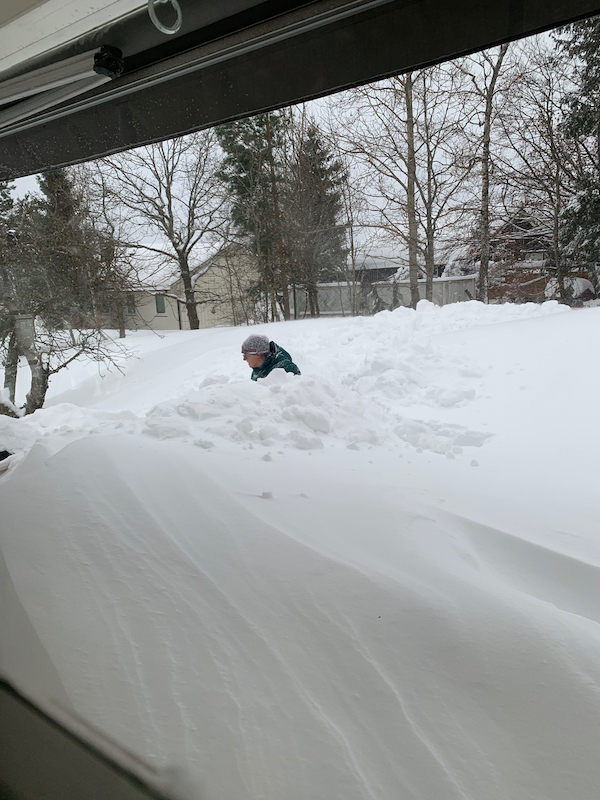
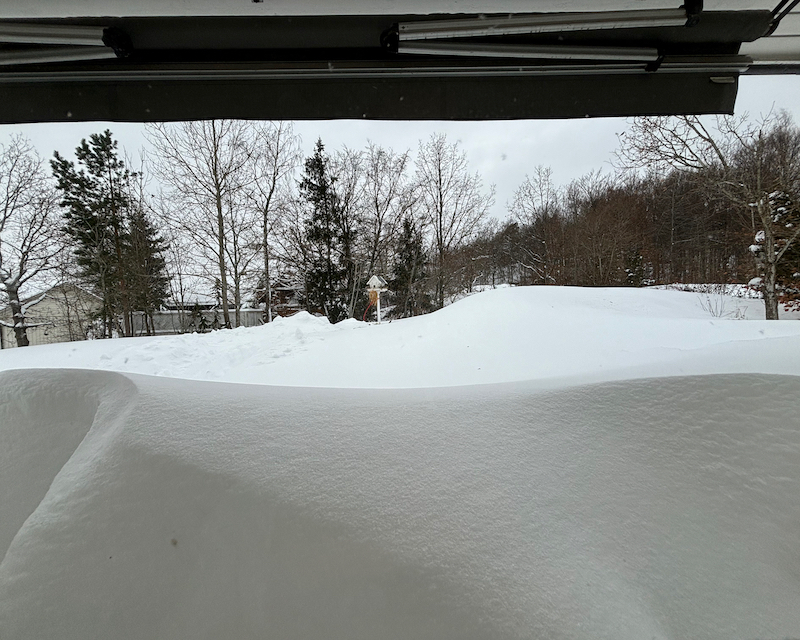
We had a very long cold and snowy winter from 31 October 2023 until the last lot fell on 5th April 2024. In fact, the locals don’t remember so much so near to the Oslo fjord. At one point we had about 2 metres of it and one day we were unable to open any of our doors to get outside. In the end I pushed the kitchen door open a few cm and then used the shovel from a fireside-set to gradually dig my way out.

Of course we had no idea that we would have so much snow and had put wire fences round the apple trees and plants to prevent the deer chewing in the winter. Little did we know that the snow would come well above the fences and there were periods when the deer were really hungry and were able to reach up to the juicy bits on top of the trees!!

I don’t want to bore you with pictures of snow, but have put this little group together:

We thought the winter would never end; I couldn’t even access plants to paint. Then suddenly summer arrived. The snow and ice melted over a couple of weeks, the snowdrops started flowering on the edge of the melting snow. This was quite funny to see because as the snow receded, the white flowers emerged. We thought that the ones first flowering would be over by the time the snow actually went, but each patch lasted quite a while.

The next was looking for some green to appear. Every year the grass is brown in the spring and it looks very dead, but after only a few days it starts turning green. Our house looks out over a valley so we can watch as a haze of green tips appear on the trees – until Pang, the world looks as though it has always looked luscious.

This is how the world looks for us now, just a few weeks later:

What an amazing world this is!

We sat on the kitchen terrace early today and ate out breakfast in the hot sun. The same terrace where I had to use my fireside set to shovel the snow away. Looking across the valley we commented on how the trees have attained the green of leaves having been there quite a while. Even the oak leaves were fully open.

As a botanical artist, this shows how important it is to think about the availability of subjects at different times of the year. I will show a little of what I did during this last winter.

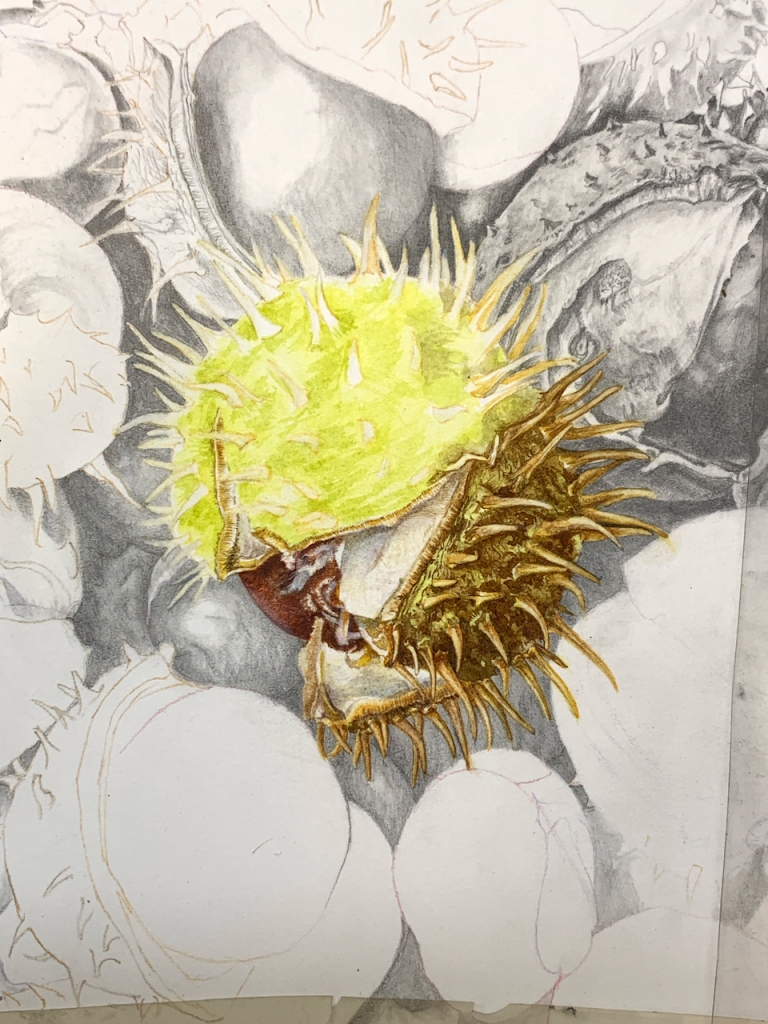
During last autumn we had some family visits and showed them parts of our beautiful Norway including an old fort that was used to protect us from the Swedes!! We took the ferry across the Oslo fjord and visited Old Fredrikstad. It is a lovely place to visit and the star shaped ramparts have lots of Oak trees. This meant that in the Autumn there were lots of conkers which I duly collected.

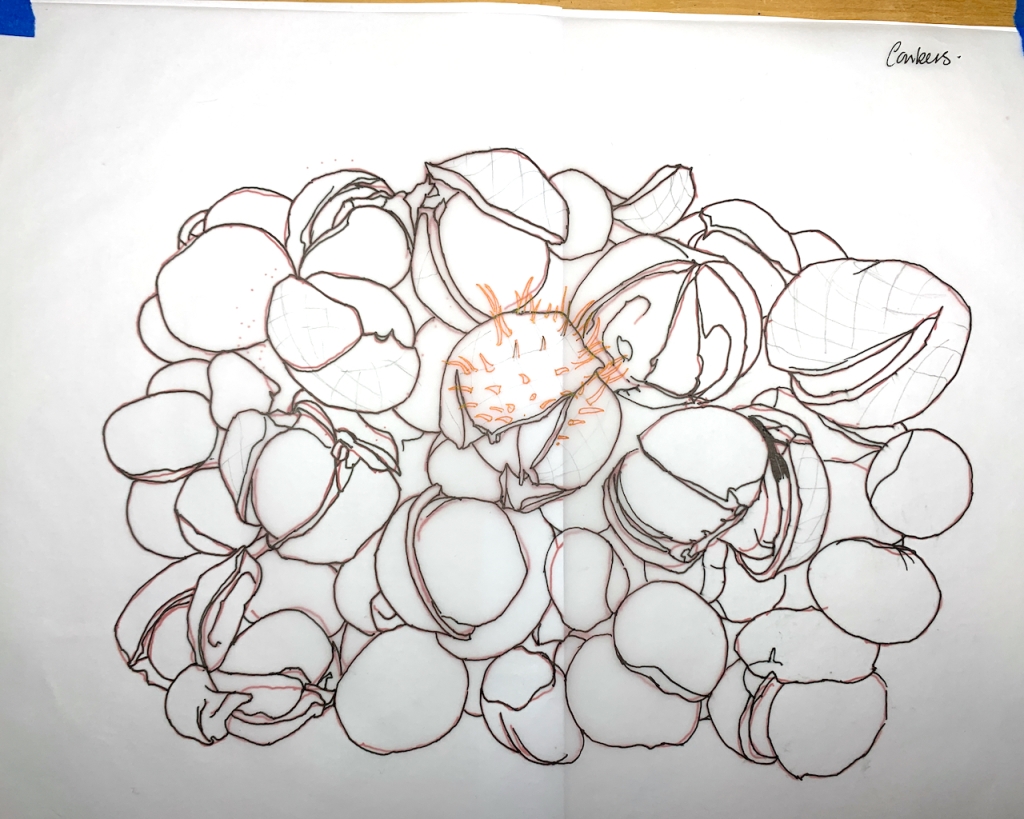
I had some thoughts about wanting to use both graphite and watercolour. In the end, I used everything that came to hand including water soluble graphite, colour pencil and watercolour. I had taken loads of photos of my conker collection, and from this did a line drawing. Of course as the weeks passed the conkers dried, but with the aid of my photos I was able to paint from the conkers in their changing state.

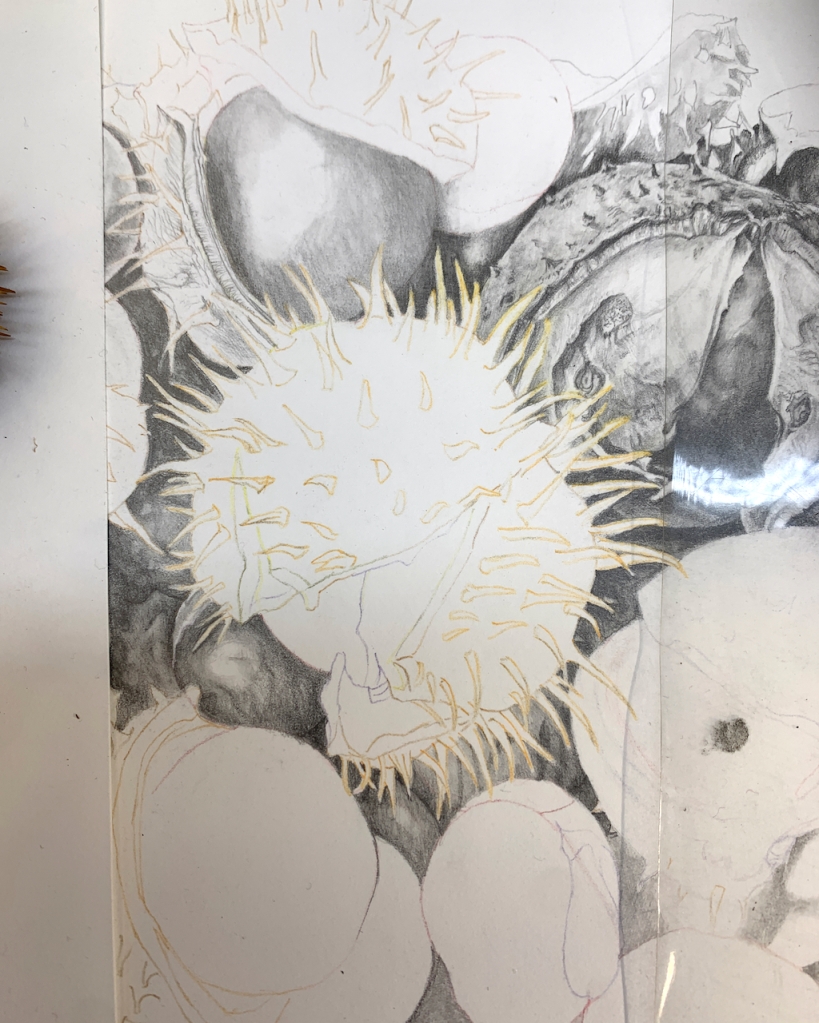
Also as a botanical artist I continue to learn and try to improve. With the picture of Conkers, I was reasonably happy but still wanted to explore new ways of working with graphite. I have always loved using graphite and sections are often found in my pictures.

Whilst in the Netherlands in April I was able to get more graphite. My favourite pencils are Caran d’Ache Grafwood, but with the final picture above, I was trying to reduce the risk of shiny graphite in the areas I wanted to get really dark. How to do that?! I often use water on top of the graphite to set it, but it didn’t quite work here, although I added water soluble graphite on. top.

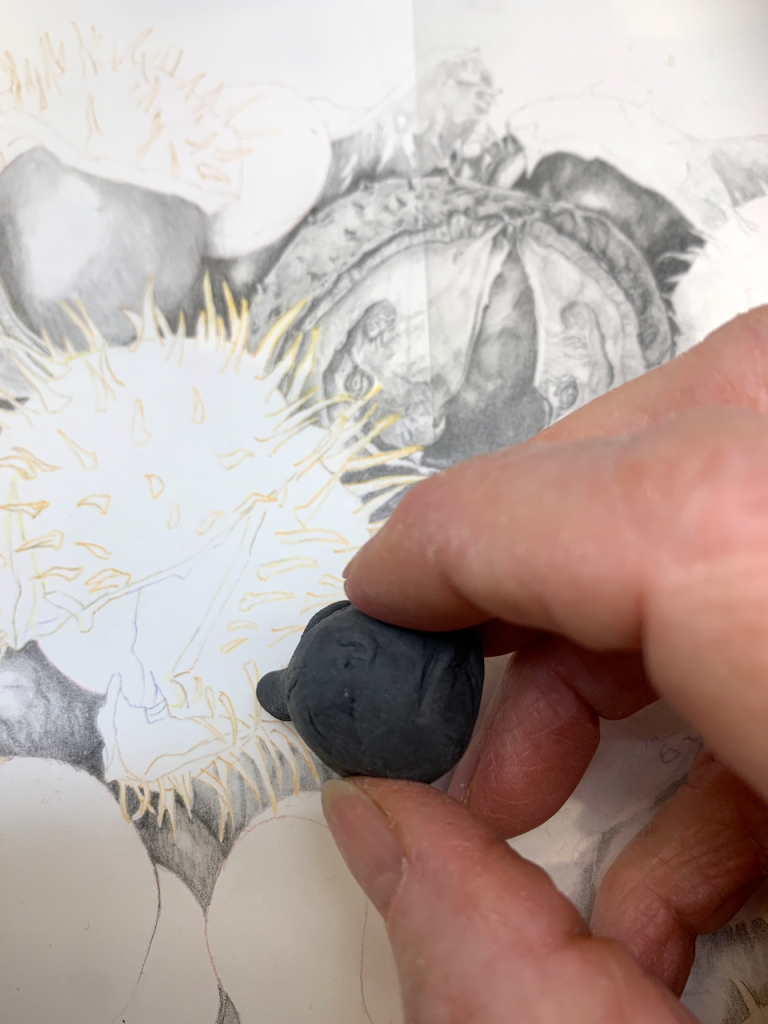
Faber Castell have introduced som Pitt Graphite Matt, which gets rid of most of the shine. I used a combination of the Grafwood and Pitt Graphite Matt in my next picture, but also used graphite powder. If I want it really black and matt, I have also bought powdered carbon, but so far that is just a little too dark.

A plant that has always fascinated me in Norway is the Tussilago farfara – Coltsfoot. I mentioned the Snowdrop appearing from the edge of the snow as it melts, well another plant is the Coltsfoot. It is considered to be the first flower that appears after the snow goes. Along the roadside, the mucky snow melts away leaving dots of yellow here and there. An incredible little flower, but as it seeds like dandelion I don’t think it is appreciated everywhere.

I wanted to show it emerging from the dark winter:

Tussilago farfara – Coltsfoot – Hestehov

Foraging plants in the norwegian mountains – 12. My working practice

Bearded Iris in graphite
Accidents happen

In my last blog I showed you how careful I generally am to cover my artwork as I go along. But in this case I had finished the piece and had it propped up by my computer to scan and print it.

Unfortunately I ran out of pigment in the printer and needed to refill. Once this was done, I sat at the computer to check everything on the screen, looked up and saw this magenta splash across the artwork. I was shocked. How many hours had I used to no avail?

Be careful to keep artwork safe!

In my previous blog I wrote in general terms about the materials I use, including colour. My sketchbook contains notes of the colours used in the sketches, but these are only a guide for the final artwork.

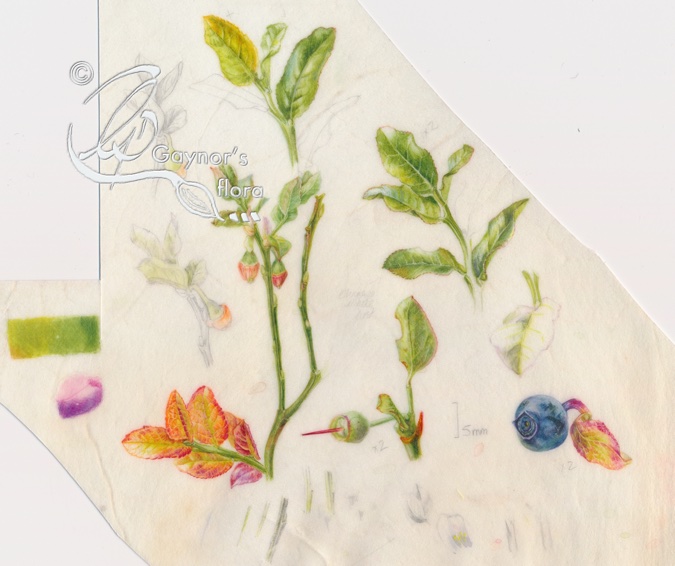
The sketched colours are on white paper and the final artwork is on a warm vellum which can affect the overlaid transparent paint. If possible I try to match up the colours I used in the sketches if I don’t have enough live material to work from. For example, the leaves often change colour over a growing season and if I’m unlucky I might be painting young leaves in the autumn. This happened with the Bilberry leaves.

I try to limit the number of pigments I use in a picture but still have favourites that appear in most paintings. 

Watercolours used to paint the Small cranberry picture.

As an example, I used these colours in the small cranberry picture:

  • Quinacridone Magenta PV122
  • Quinacridone red PR209
  • Perylene violet PV29
  • Quinacridone Gold PO49 (I don’t think single pigment can still be obtained)
  • Winsor Blue Green PB15.

The last three are a must for me, but I might also use a brighter yellow or warmer blue. On this occasion I added a lemon yellow to lift the green in the leaves.

Introduction of graphite

Getting graphite on vellum is normally considered a negative. Graphite does not seem to work in the same way on vellum as it does on paper because of course it is slightly greasy and tends to slide around on the surface. 

I wanted sections of graphite in my pictures to try and give some relief to the colour. The compositions are quite small with a lot of detail. To separate details from each other I wanted to allow some of the picture to fall back and behind sections of colour to create focus.  I therefore decided that elements conveying habit would be either in graphite, or in graphite with a slight colour wash. But how was I going to get the graphite to go on reasonably evenly and to sit? 

I checked out how other botanical artists had handled using graphite on vellum, then tried out various ways of developing a technique on scraps of vellum.

Bilberry trials on vellum with colour and graphite

Luckily, as with graphite on paper, the use of water on top helps it to adhere to the surface. I also learnt that using a little mucky pigment/graphite water and allowing it to dry would also help to control use of the graphite on top. But, some of my details were much too tiny to make full use of this technique.

The way forward was to use a combination of graphite pencil for the finest detail and soluble-graphite. I generally used a graphite pencil first – possibly a 2H, then with a very small brush I either went over it with pure water or used the water mixable graphite. I found that the graphite worked much better where I had used a light watercolour wash first. 

Process for each picture

Once each composition was complete and transferred to the vellum mounted block, I started with the watercolour sections.

Except for the Cloudberry, the main branch which catches the eye, was enlarged to twice its normal size. I normally started with this so that I could determine how much other elements of the picture needed to come forward or fall back. After this I completed the flower and fruit sections.

Once the watercolour-only sections were complete, I worked on the graphite sections. As mentioned before, the use of graphite means that these sections fall a little into the background and give relief to the eye of the beholder. But the detail in those sections needs to be just as clear as for the remainder of the picture. Each part of the picture needs to give new information otherwise there is no reason to include it. In this case, the graphite sections were done life-size.

Last of all came the scale-bars. To work out the best placements for these, I scanned each picture onto my computer and digitally placed and sized the scale-bars, comparing them from picture to picture. This happened in January 2023 when preparing for professional scanning of the artwork.

Actually drawing the scalebars onto the final artwork caused most headaches. Applying the graphite in even lines on the vellum was more difficult than doing the line drawings, but I got there!

Now I will write about each species individually – starting with the next blog 30 April 2023.

Life-size small cranberry flower and stems. Water-soluble graphite being applied with Rafael 8408 size 1 brush over faint graphite pencil lines.

An update: life and botanical art

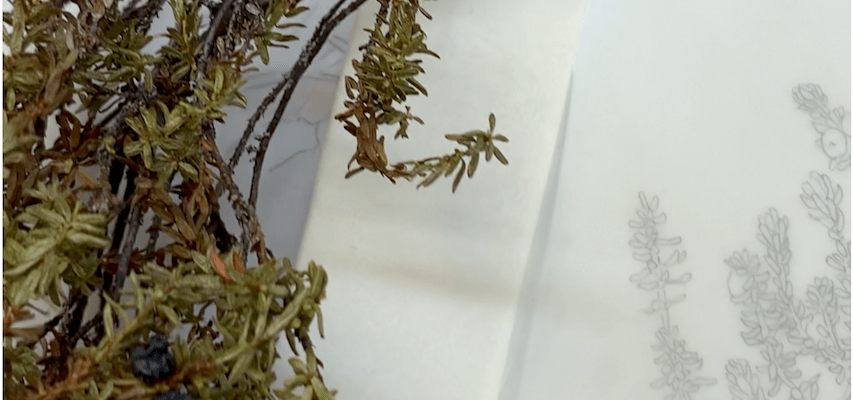
Empetrum nigrum & tracing to vellum

I have been working on four of my six or seven pictures to go to an RHS exhibition in London. This has been a very long-going saga as the process has been interrupted several times since I decided to do it.

Mountain area – home to the plant series.

After the last time I took part in the RHS exhibition in 2014 I decided that I was going to do a series of plants called ‘Foraging in the Norwegian Mountains’. Anyone who has read my blog, which more recently has been rather sporadic, will have heard me talk about the series on numerous occasions.

Whilst living on the South coast of England I travelled to Norway for two weeks each year to sketch the plants I had chosen. This was the only time I had them accessible although I had some similar plants in my garden in Bosham. I have to say that they didn’t flourish there – too warm.

But then other things got in the way;

Invitation to the England part of the Botanical Art Worldwide exhibition

2016-2018, I started up the Association of British Botanical Artists (ABBA) and managed the England entry to the Worldwide Exhibition in 2018.

2018. As founder and president, changed ABBA to a membership organisation

Support from Dr Shirley Sherwood who became the ABBA Patron
ABBA logo from 2019
ABBA logo 2016-2018

2019. By the middle of this year ABBA was well on its way as a recognised botanical art organisation and Elaine Allison took over managing the ABBA project completely. I thought, at last I would have time to paint. I had done some, but not as much as I would have liked and working on the Norwegian plants project had been limited to two weeks each year.

December 2019, Covid hit us all.

Before – Bosham in May – South coast England

Mid 2020. My daughter, living in Norway, expressed her anxiety for us if anything happened. What she actually said was that we were too old to live in England by ourselves and that it was about time we moved back to Norway. Robin, who had never lived in Norway, promised to learn the language and his son (who had just moved back to England) gave his blessing. The rest of 2020 became filled with house selling, packing, moving, home searching and buying – my daughter even coped with us living with her!!

After – Skoppum in May – Eastern Norway

Robin started to learn the language, but all the legal stuff in relation to officialdom and applying for residency in an EEC country, plus details in relation to house buying, fell to me. I managed to paint the Fly agaric – Amanita muscaria and a couple of sketches in my perpetual diary (painting cup half-full), plus continued to advise and mark assignments for my Botanical art online course students.

Long shadows at midday, a month after the sun turned.

January 2021 – we moved into our new home with a view of the Oslo fjord in the distance. The year was used to make the house into our home, although we had a lot to learn about what works here and what doesn’t. The garden is mostly rock, so planting is very much an ongoing trial as we battle with little earth and a temperatures that vary between -20˚C to +35˚C (warming climate). Botanical art is not as well thought of as in the UK, but once the lock-downs are over I already have quite a list of people wanting to do a botanical art workshop.

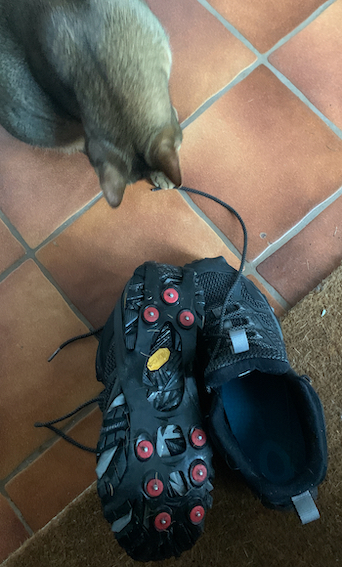
Icy walking is only safe with studs – but the kitten doesn’t care as long as there are laces!

Now I have to plan my botanical art work a little differently living in Norway. We have had snow since November last year but it hasn’t been quite as cold as last winter, although that can change. With recent thaws during the day and minus degrees at night, the snow turns to thick ice. This means I don’t have access to my plants during the winter so I had to change my working process.

‘Foraging in the Norwegian Mountains’ botanical art series on vellum.

NB; I won’t be showing you the finished compositions until they are shown at the RHS exhibition – probably 2023, but will show parts of them.

After all these time delays for the series, all I had was sketches and colour samples in my sketch book, plus some small studies on the vellum I would be using. I had heard the phrase ‘productive procrastination’ and thought I now knew what it meant!

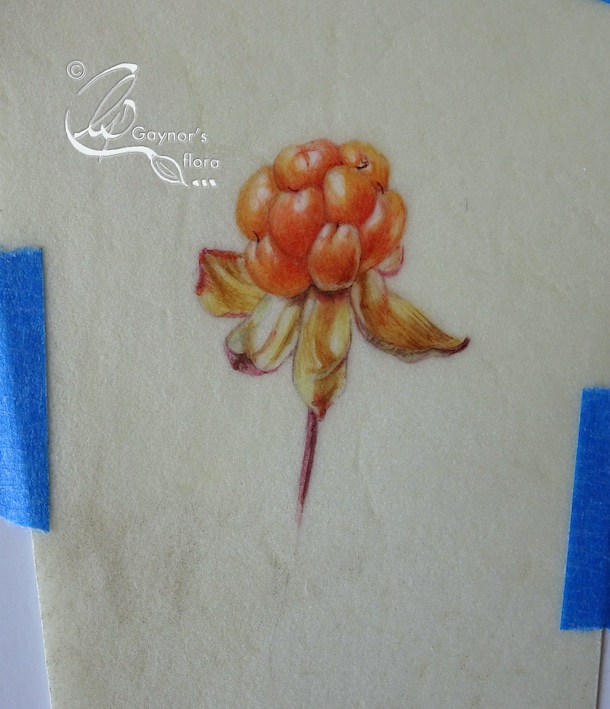
Cloudberry – Multe- Rubus chamaemorus sample on vellum
Sketchbook drawing Crowberry – Krekling – Empetrum nigrum

I had worked out the composition of all of my pictures and how they would be hung as a group at the exhibition. Each picture will be on mounted vellum and shows the plants both enlarged in colour and actual size in graphite. Last summer I painted the colour part of four pictures so that I would have the actual plants and could match colour at the same time. I planned to do the graphite on those four paintings during this winter and so far have completed three of them – except for scale bars.

Graphite on vellum is not easy and depends upon the vellum, which, as a living material can change from one part to another. In some areas I have been able to use pencils, but in others a brush. My last two paintings have very tiny leaves and the last one, Empetrum nigrum which I will show part of here, has been a bit of headache!

Graphite drawing on vellum

With Empetrum nigrum the leaves actual size are about 2mm long and the unripe fruit is about 4mm. I have had to vary the hardness of the pencil used so that I get clean lines, rather than gritty ones. It doesn’t seem to matter if I use my most expensive pencils or not as it is the surface of the vellum that decides. Sometimes I use the pencil first, if too pale I paint a layer of water-soluble graphite on top, then finish off with another layer of pencil, finally lifting off loose graphite and ’fixing’ it with water. It certainly is not as straight forward as using graphite on paper.

This winter, only one more vellum picture to finish off with the graphite drawing. Spring is on its way, although the sun is still low on the horizon; plants will wake up after their winter rest; trips into the mountains to look forward to and planning for the colour part of the final three pictures.

Third part of Andromeda polifolia – Bog Rosemary picture

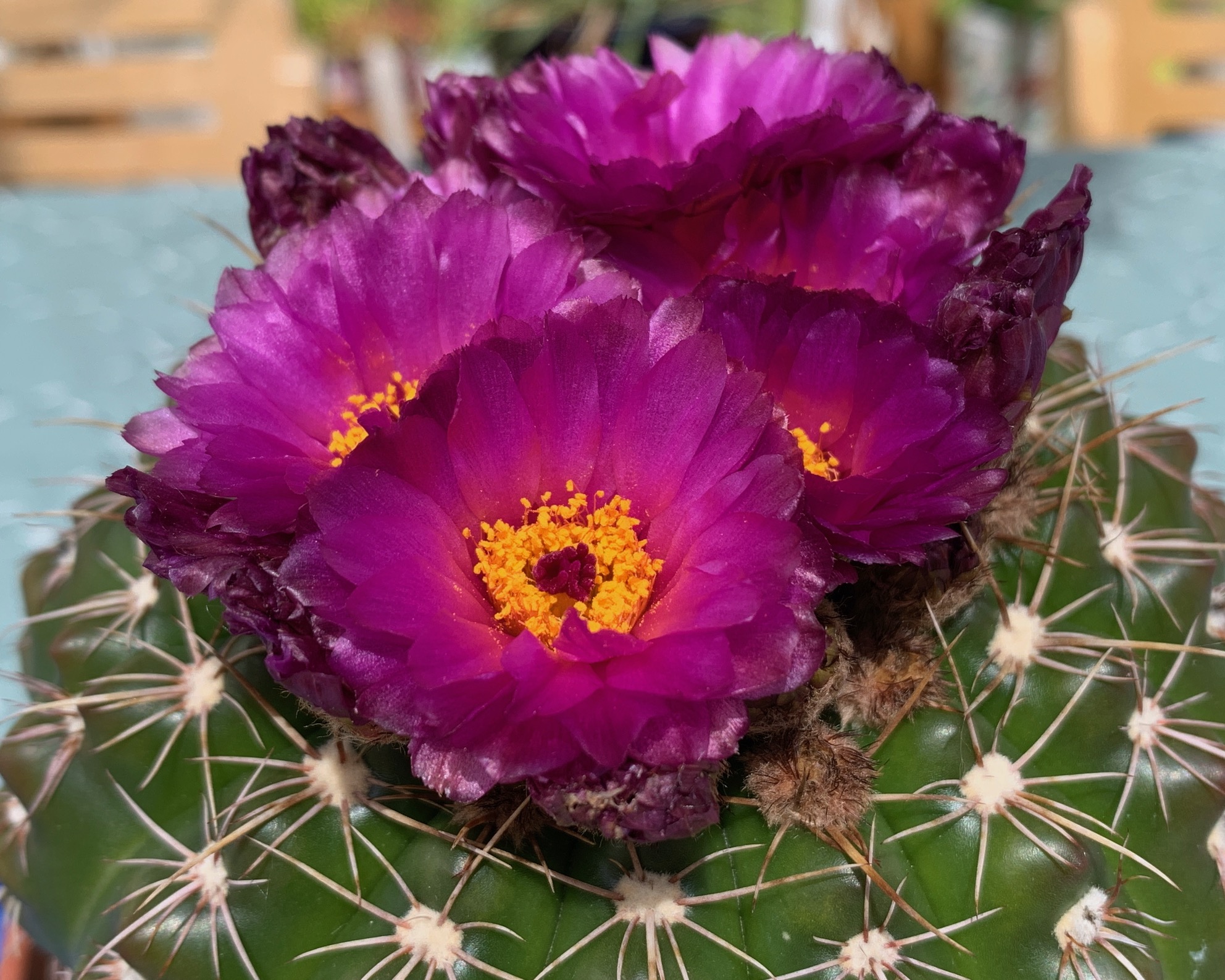
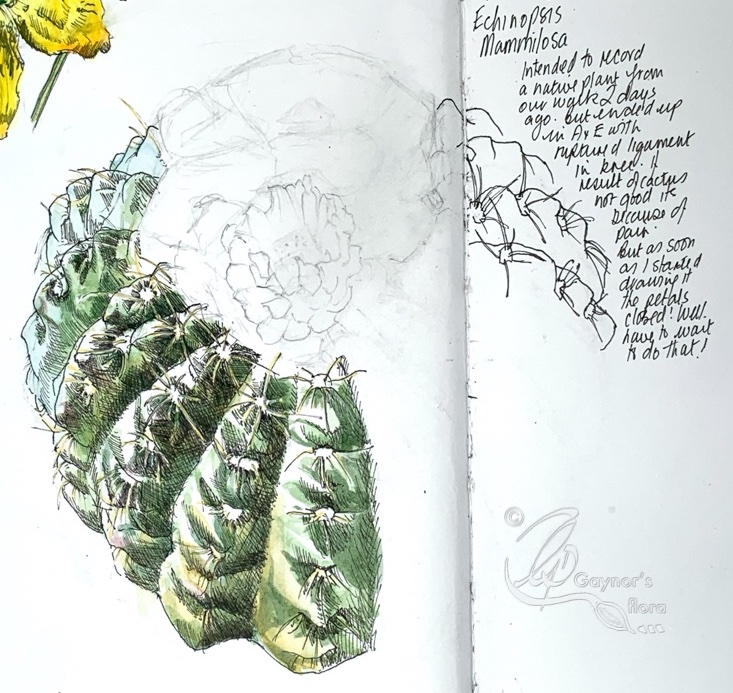
Echinopsis mammillosa ??

No, this is not the Bog rosemary, I will get on to that shortly. It says it is an Echinopsis mammillosa, but as ‘they’ had spelt the 2nd name wrongly, I thought I would check it out. Trouble is the only thing I can find is that it is not what it says it is on the box! If it had been, the flowers would have been on outgrowths from round the side of the barrel. The flowers are all on the top and almost without stems. Can anyone tell me what it is please?

We do have a lot of cacti and it isn’t me that collects them! But I have found them surprisingly intriguing. They were removed from the south facing porch and put on the edge of the pond about three weeks ago. Many have put on a show of beautiful flowers and grown hugely since then. How they will survive this weeks sudden drop in temperature from 25℃ to 0℃, I have no idea. Time will tell.

But, the reason I am showing this plant at all is because I am unable to go on walks at the moment and I am keeping a Perpetual Journal, doing a quick botanical sketch once a week. I saw the above cactus flowering in the sun and decided it would be this week’s topic. As soon as I started sketching, the sun went in and the flowers closed. They have remained closed since due to very little sun. But I did sketch some of the barrel. All I want is just one open flower to show its colour.

I’m sorry I am branching into other topics at the moment due to my incapacity, but the reason for the blog is development of the Andromeda polifolia.

For the last couple of years I have been attracted to very small plants with tiny flowers and/or leaves. But I am convinced that one of the reasons I was attracted to botanical art in the first place was my ability to open up these plants for everyone to see who viewed my work.

One might think that because the plant is smaller and often also the picture, it takes a lot less time to paint and therefore is cheaper. Unfortunately the opposite is true. The smaller the plant, the more difficult it is to portray. As you can imagine, my paintings are not sold by the square metre.

So far I have shown you the parts of my painting that are magnified so that you can see them in detail. But in doing this I also need to give you an idea as to how it looks real size; a ‘habit’ drawing. I wouldn’t want you to go hunting around for a plant with flowers the size depicted in the first blog – you would never find it.

You saw my composition in the first blog and know that I have planned the habit section to be in the centre, drawing all the elements together. When you see the final picture in the next blog, it will be up to you to decide if I have suceeded.

The traced image and start in graphite.

A little of the traced image remains. I  further lighten every section with a putty rubber so that every final visible stroke laid is intended.

The leaves are long (relatively speaking) and narrow, leathery and curled under along the edge. I am carefully showing this first. The upper surface is veined and the colour varies from a pinky hue to a blue-green; the underside is a pale greeney-blue. But of course this doesn’t show in the graphite drawing.

By the time I get this far into the painting, the original leaves may have changed or no longer exist. However, I do have my drawing and loads of photos for reference, but I also have  some of the live sprig given to me by Chelsea Physic Garden. I draw from the plant, but check the direction of each leaf with my line drawing and photos. Sometimes, I might find a more interesting leaf and use that instead, always checking placement and attachment to the stem.

The branch going off to the right is slightly further back than the middle one, therefore has a little less detail. I increased the amount of detail for the middle branch so that you get a better idea of the leaf texture and veins. Note the actual size of the flowers at the top of the middle stem.

Next time I will show you the finished artwork and describe how I do the scaling.

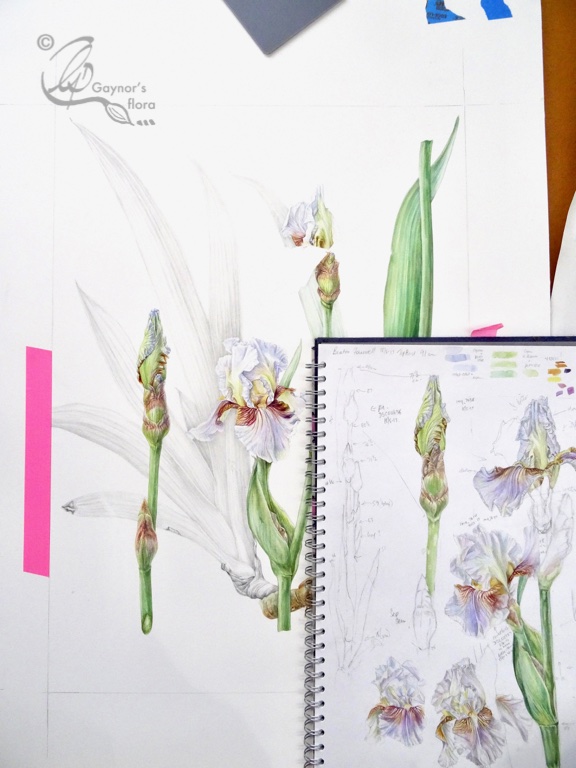
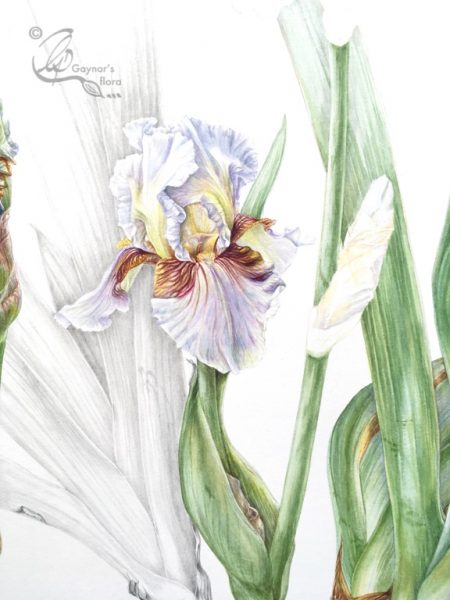
Nearly there with the Benton Iris ‘Farewell’

Hopefully, through this series of paintings with the Benton Iris ‘Farewell’ you will have understood how important it is to plan and prepare a painting from the initial composition , through tonal sketches, practicing techniques to finally the painting.

Because i believe that good preparation is the basis for getting a result in botanical art that I am happy with, I planned this year’s workshops to help others with this process. The next one is 23 -24 March and is all about developing the careful line drawing and using it as a basis for the rough tonal drawing. There are still places, so do get in touch.

But back to the Benton Iris. Actually as the painting has developed I have felt some sadness that there isn’t too much left. Obviously I also learn from doing it and this painting has been rather different to ones I have done before. It has been quite a large painting, it is on 640 gsm which doesn’t feel quite as smooth as 300 gsm paper. I used quite a bit of graphite so that the picture would not be heavy and doing this on the 640 gsm was not so easy. It was important to show all the intricacies of the plant, to get them absolutely right and to make it an attractive picture as well.

Some of the things that I had to include in the flower were:

  • The view showing the Stigmatic lip. This is the view into the flower showing the sexual organs. look very closely inside the back of the flower and you will see a slight transverse ridge; that is the Stigmatic lip. The Stamen – male organ, is vertical, deep inside the flower and just below the transverse ridge. The pollinator climbs over the beard to try and reach the nectar deep inside the throat of the flower, gets pollen on its back and rubs it off on the stigmatic lip, fertilising the plant. You will see this view in more detail in the last blog.
  • The view with the emphasis on the Standard and Fall petals (this blog),
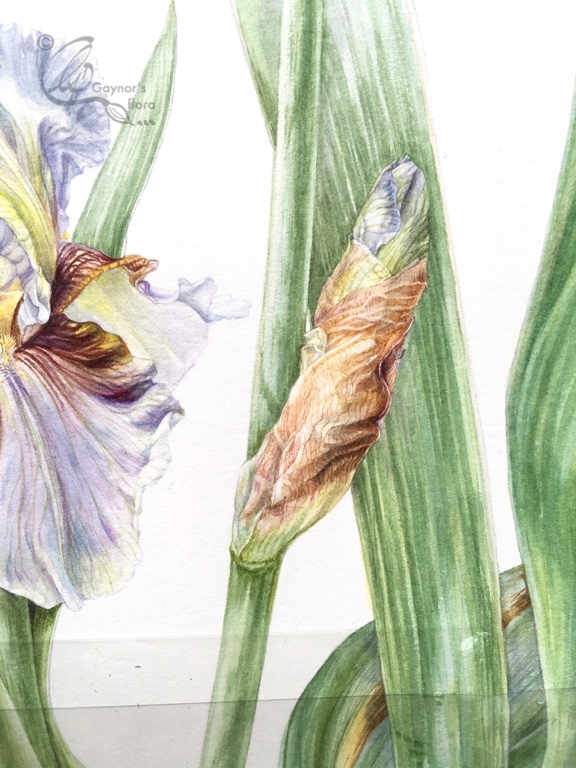
  • Buds developing
  • The height of the flower spike.
  • The height of the leaves particularly related to the spike.
  • The top part of the rhizome.
  • The growth habit (the fan of leaves)

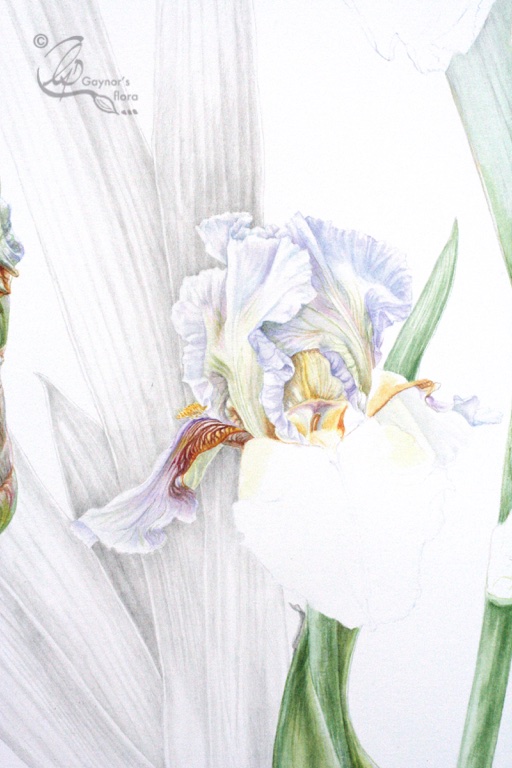
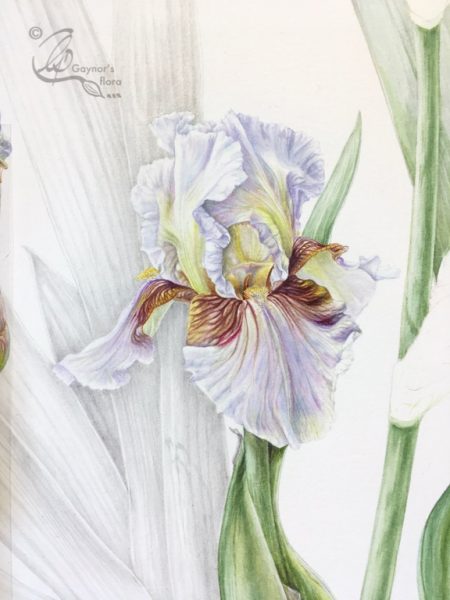
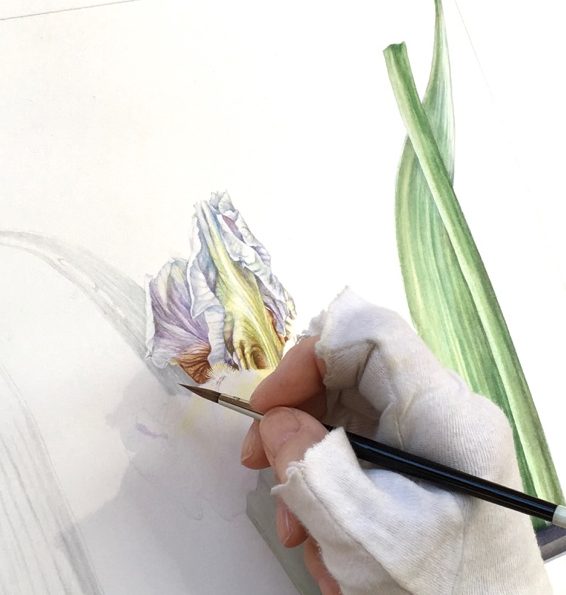
This time my pictures show the development of one of the falls.


This slideshow requires JavaScript.


This is the final stage of the top flower. I will show you the complete painting in the next blog, so that you can judge whether or not the painting is successful. It is the viewer that determines this. 


A little more of my Benton Iris ‘Farewell’

Trying to paint more with the Benton Iris – work that I love doing, has been complicated by all the adjustments in relation to the botanical art exhibition ‘ In Ruskin’s Footsteps’. But you can now see the updated website in relation to the new improved venue (still at Lancaster University) and adjustment to the dates. I will give you the link at the end of this blog.

In my last blog I showed you my progression in relation to the large fan-like leaves of this majestic plant. I chose to include only colour for those on the right hand side of the artwork and graphite on the remaining leaves. This was so that the picture would not be overwhelmingly heavy with green leaves. 

I finished off last time with the bud spike on the left hand side of the artwork. Now I will show you the start of the main flower spike, which needed to be divided in two because of the height of it.


This is customary in botanical art when painting correctly.


It is important to give an indication of the habit of the plant if painting life-size and the plant is very tall; try to include as much of it as possible in the same painting. I have divided the flower spike in two and have shown the cut ends with the same profile at the cut edge.

On this stem you can clearly see the flowers and buds spiralling off.

I have started off with a pale wash for the bud leading up to the main flower before completing the detail with a dry brush technique.

Now the start of the top flower and he developing bud just underneath. This was actually quite difficult to get right.


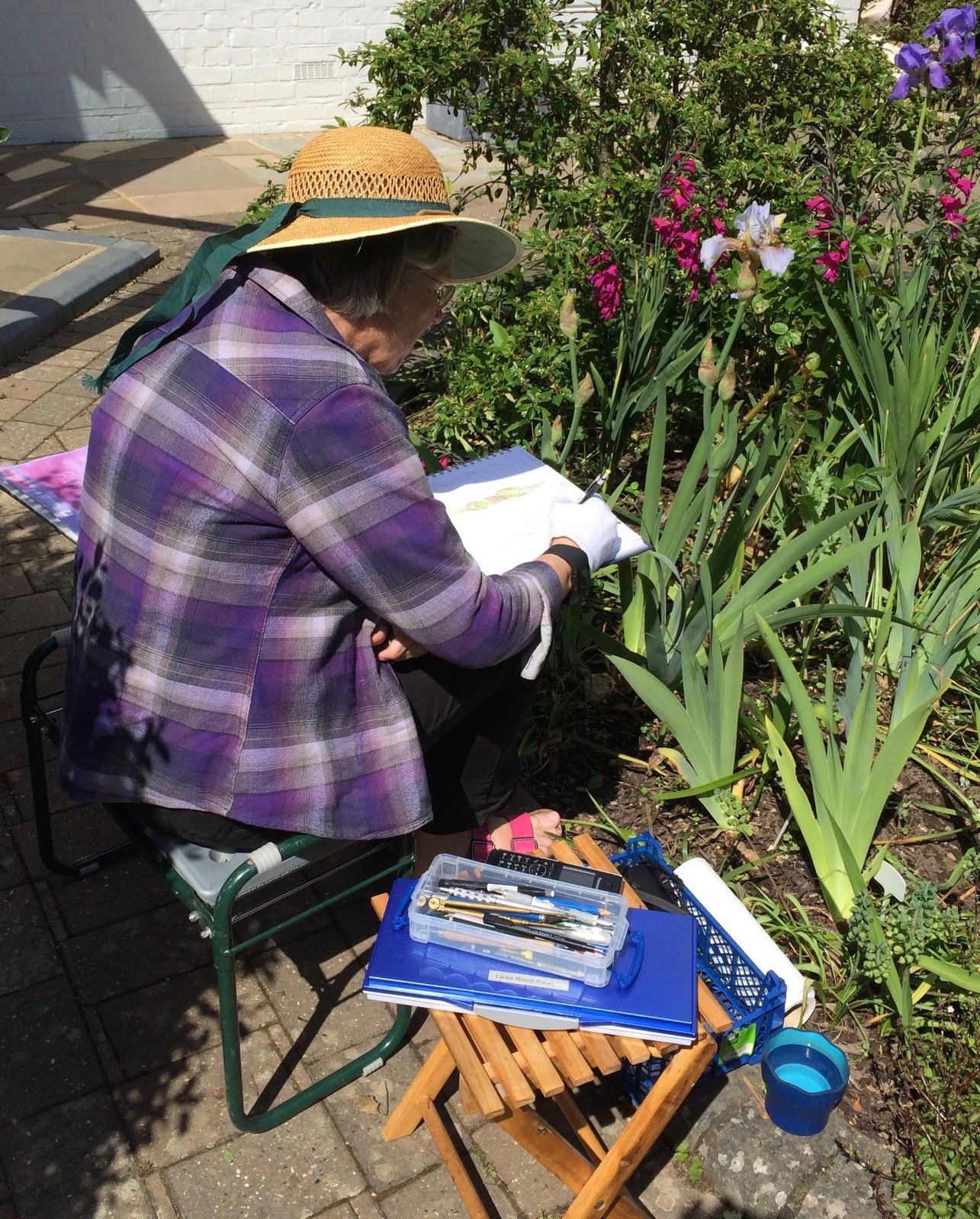
All my sketches were done outside in the garden last year and if you don’t keep your head still while drawing, the detail visible will change.

If you are enjoying following the stages in the development of the Benton Iris ‘Farewell’, you might like to come to my next workshop March 23-24th, where this time we will be concentrating on a line drawing and tonal sketch. Normal, good preparation for any botanical art painting. Get in touch with me via the contact form below if you would like to join us. The details are on the Workshop page of my website.

Look at the last blog of 2017 to remind you about how I started off this Iris. https://gaynorsflora.com/2017/12/30/last-gaynors-flora-blog-of-2017/.

Although botanical art is fairly strict in what is ideally included in a picture, it is quite wide ranging and much wider than for pure botanical illustration. But it is important to remember that what I show you in my blog is my style of working. There are many different styles and none are wrong; It is the result that counts!


Last but not least the link to the Association of British Botanical Art website: www.britishbotanicalartists.com/2018exhibition

Go back

Your message has been sent

Warning
Warning
Warning
Warning

Warning.

Far from common time!

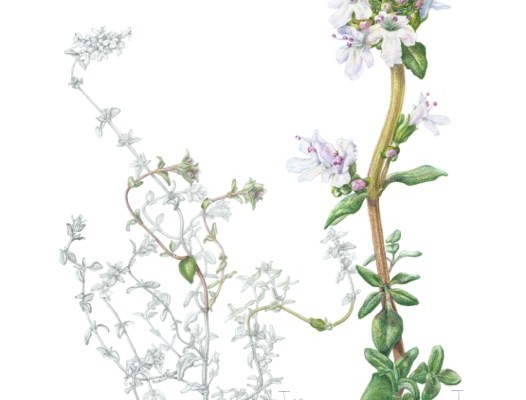
Thymus vulgaris; how did the painting go?

The last time I posted a blog about my Thyme painting was 30 May, when I was doing sketches of it. I had also started my final painting. For those interested you can go back to that blog to see my thoughts (written down) and preparations. Since I started I have been doing a lot of sketches for other plants too, which hopefully I will talk about in due course. You have seen the preparation I did for one of the Norwegian plants.

I eventually returned to the Thymus vulgaris painting, but for some reason I was unhappy with it. This sometimes happens and I know that although I might not have a good reason for starting again, I know that were I to do so, my second attempt often goes without any hitches. On this occasion, I felt that one of the small flowers was a little too dark, so 1 August I started it again. I won’t mention how many hours I used on the first attempt, but the second one took 65 hours – with the sketches and prep in addition.

A few of the pictures I took on the way:

This slideshow requires JavaScript.

And so the final painting that will be delivered at the beginning of October.

Far from common time – Thymus vulgaris. Watercolour and graphite.

Magnolia x soulangeana soon in bloom

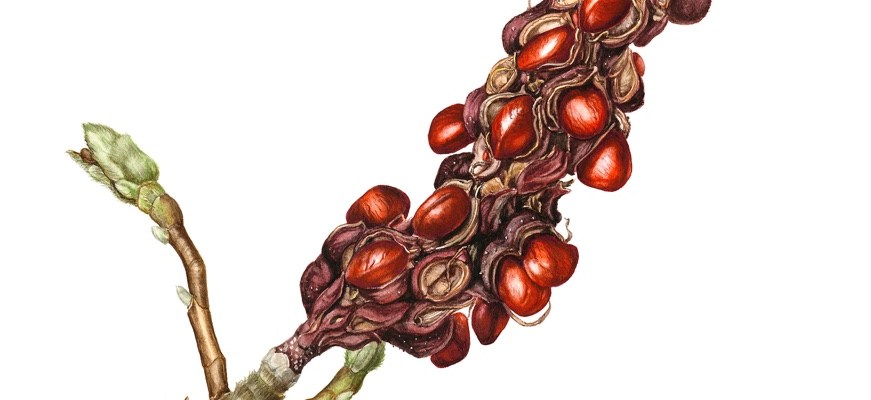
Magnolia x soulangeana: Ripe fruit and seeds. Watercolour on hot pressed paper.

In 2011 I had finished three years work on a series of paintings showing a year in the life of the Magnolia x soulangeana. The series was exhibited at the RHS that year and I won a Silver medal – my first RHS medal. One of the paintings was chosen by the Hunt Institute for Botanical documentation in Pittsburgh, USA and it was first exhibited there in 2013. Since then it has had a three-year tour around the USA with the rest of that exhibition, but is now back in their archives in Pittsburgh.

© Magnolia x soulangeana: Maturing Blooms

I was super lucky to have some huge fruit on the tree the years I was doing the paintings and they were featured. But since then tree from which all the paintings were done, has not produced much fruit at all; in fact nothing until last year when it had a couple of small ones. I think the tree knew that I was painting it’s portrait and wanted to show itself at its most beautiful.

© Magnolia x soulangeana: Ripe fruit and seeds

I am hoping that the tree is building itself up to another magnificent display later on this month. At the moment there are masses of terminal buds in which the blooms develop and you can almost see them growing a little more for each day.

It is obvious that the Magnolia tree means quite a lot to me after having studied it so closely for those three years. I learnt such a lot about it, how it is fertilised and why it is a particular type of bug that  is responsible.

If you want to know more about Magnolia x soulangeana, and you are interested in botanical art as an artist, do book to come to my workshop Friday to Sunday 31 March to 2 April. I still have a few places available.

This is the first time that I have had a workshop on this subject – and you can probably guess why. But now I would love to help others who would like to paint the blooms in watercolour or coloured pencil (dry), or even draw them in graphite.

Get in touch with me as soon as you can so that you don’t lose this opportunity.


Go back

Your message has been sent

Warning
Warning
Warning
Warning

Warning.