FORAGING PLANTS IN THE NORWEGIAN MOUNTAINS: FROM BOG TO SAND.

The title of my exhibit at the “RHS Botanical Art & Photography Show” is as above:

Foraging Plants in the Norwegian Mountains – From Bog to Sand.

Six of my watercolour and graphite paintings are exhibited by order of habitat starting with those growing in the wettest environment to those in the dryest. Seven paintings were completed not just the six, therefore it was a difficult choice to remove one of them. The second one shown below, the small cranberry, is not in the exhibition.

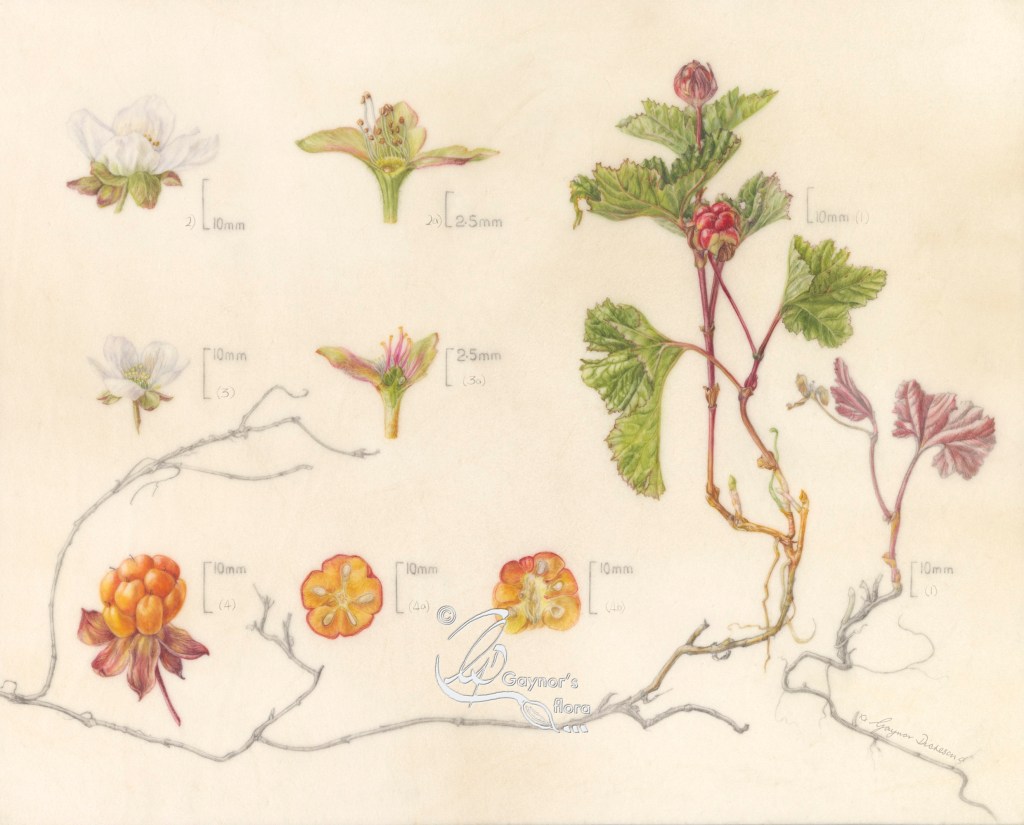
1. Rubus chamaemorus – Cloudberry – Multe
Watercolour & graphite on vellum.
August 2022

1) Habit
2) Male flower – 2a) LS Male flower
3) Female flower – 3a) LS Female flower
4) Fruit
4a) TS fruit
4b) LS fruit

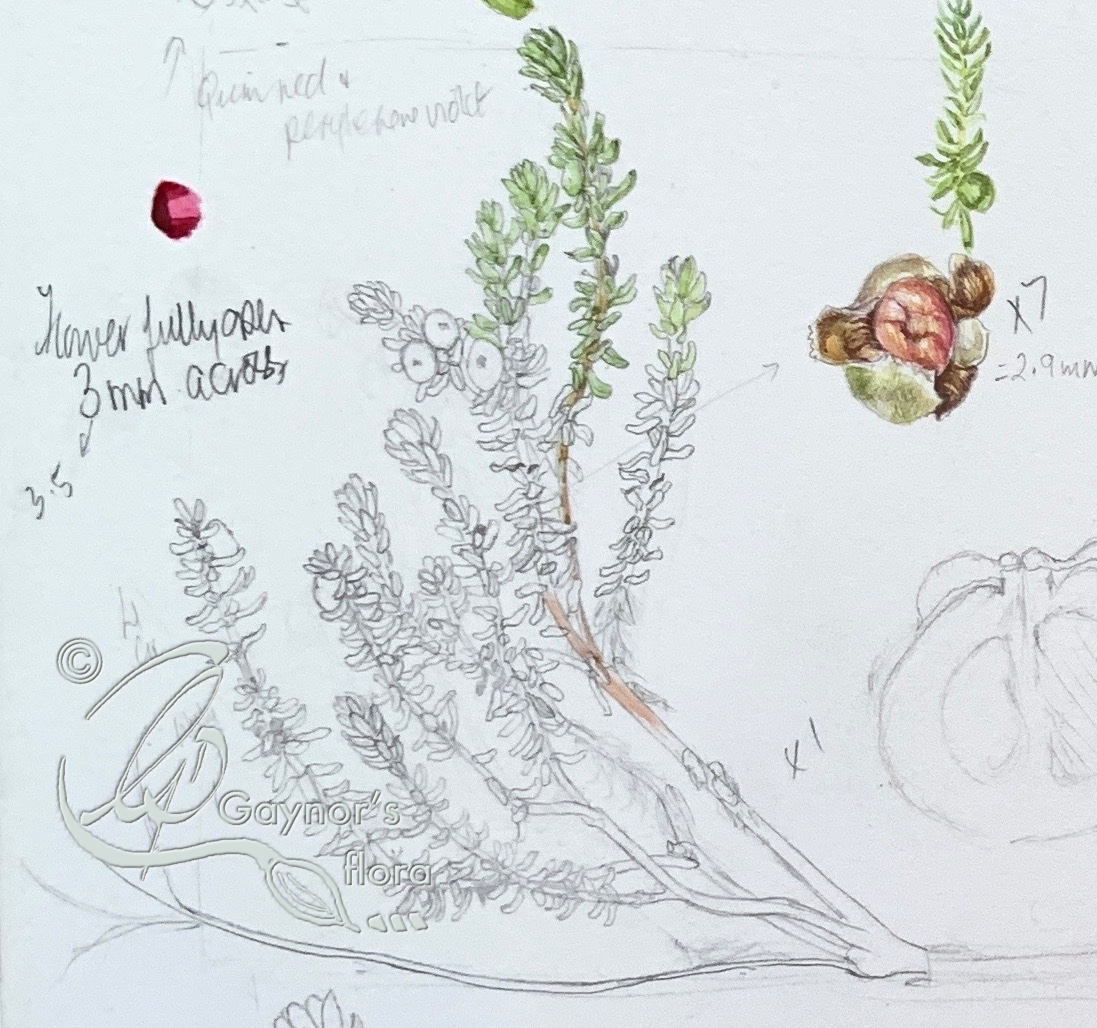
2. Vaccinium oxycoccus subsp. microcarpum – Small cranberry – Små tranebær
Watercolour & graphite on vellum.
January 2022

1). Habit
2). Flower
3). TS fruit
3a) LS Fruit
3b) Fruit

3. Vaccinium uliginosum – Bog bilberry – Skinntryte
Watercolour & graphite on vellum.
December 2021

1) Habit
2) Flower pair
3) Fruit
3a) TS fruit
3b) LS fruit

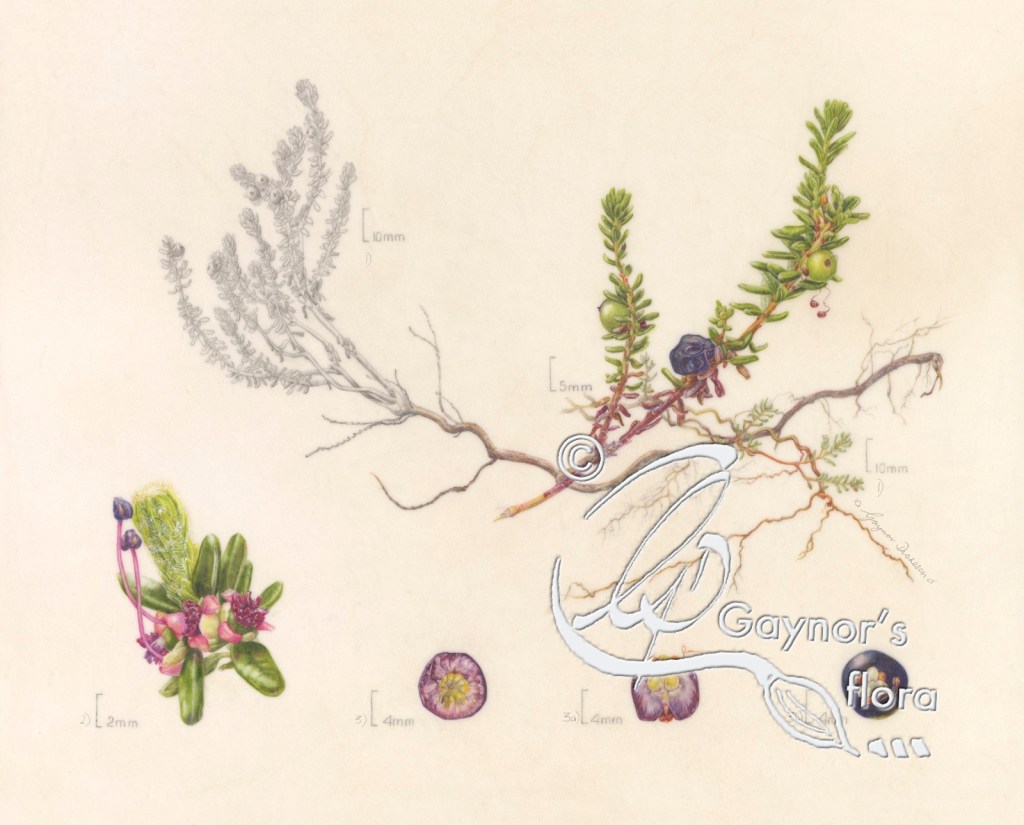
4. Empetrum nigrum subsp. hermaphroditum Mountain Crowberry – Krekling
Watercolour & graphite on vellum.
January 2022

1). Habit
2). Flower
3). TS fruit
3a) LS Fruit
3b) Fruit

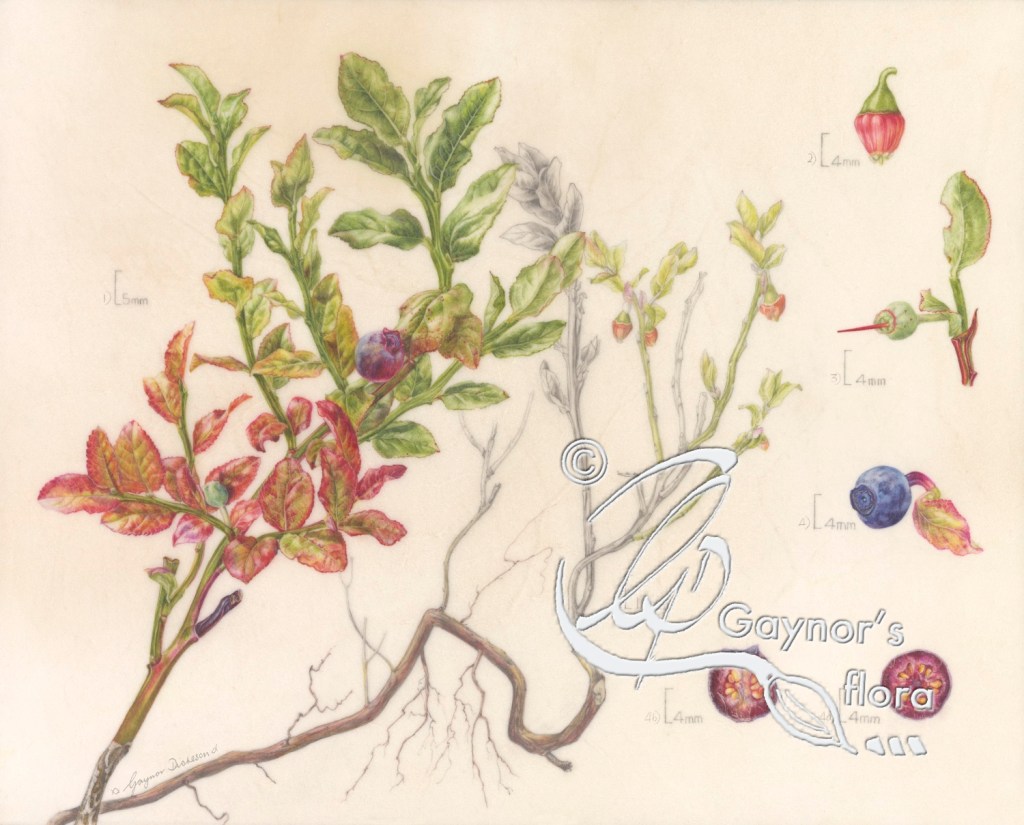
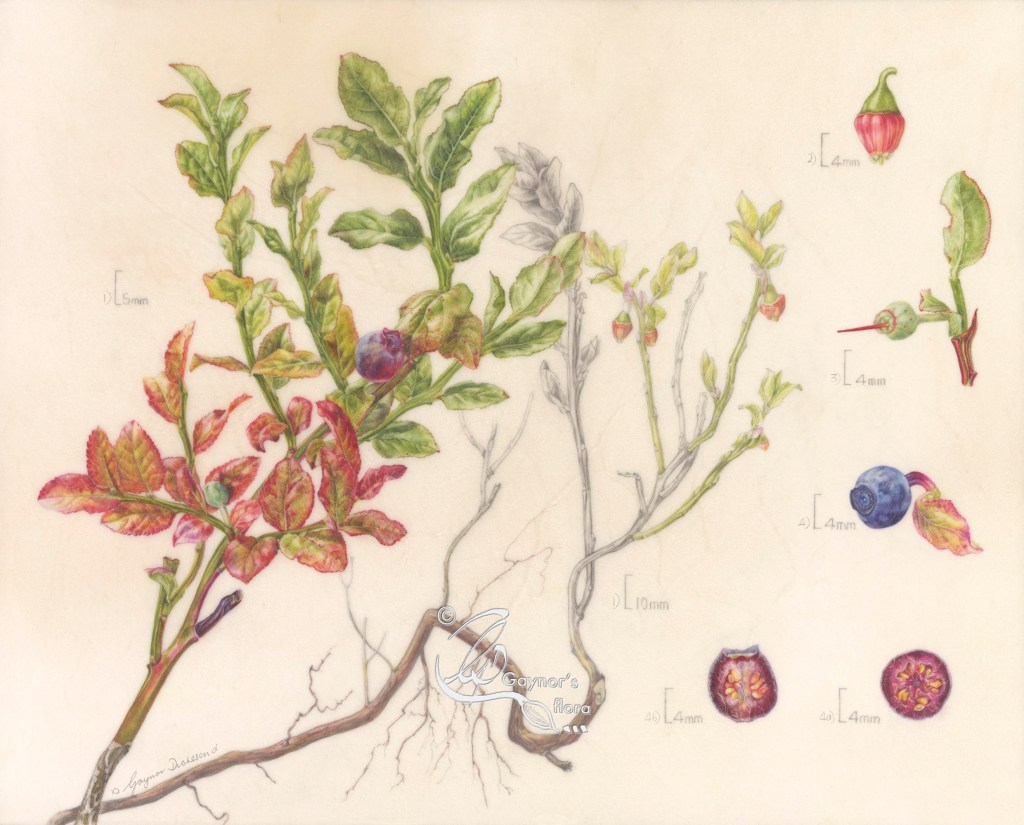
5. Vaccinium myrtillus – Bilberry – Blåbær Watercolour & graphite on vellum.
March 2022

1) Habit
2) Flower
3) Immature fruit
4) Fruit
4a) TS fruit
4b) LS fruit

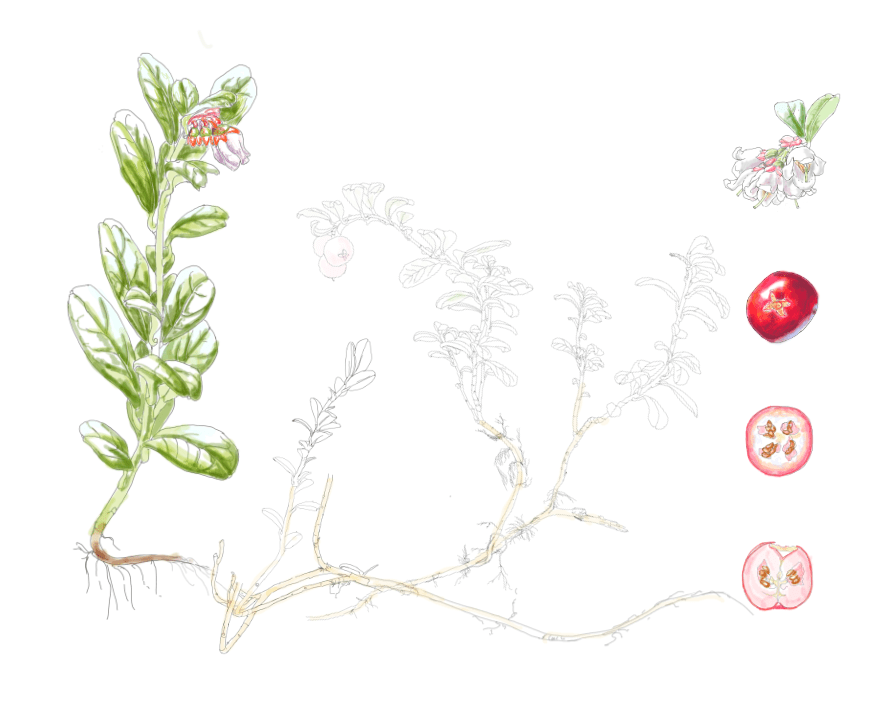
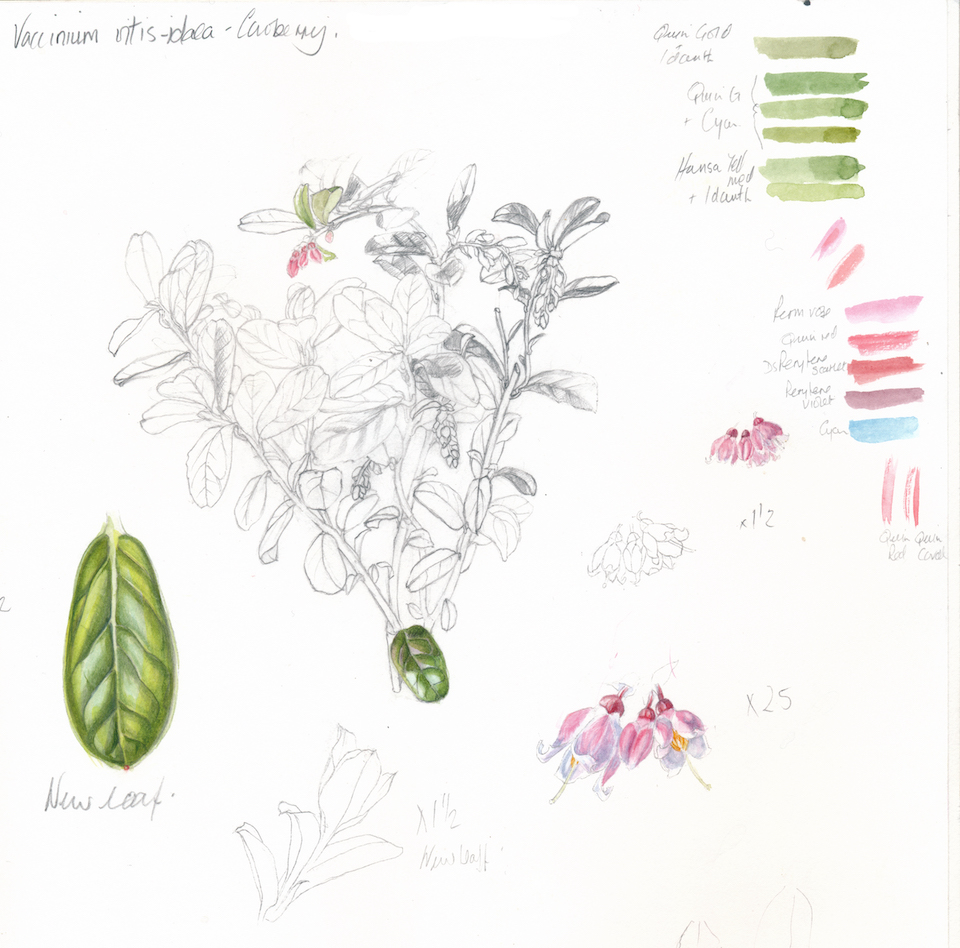
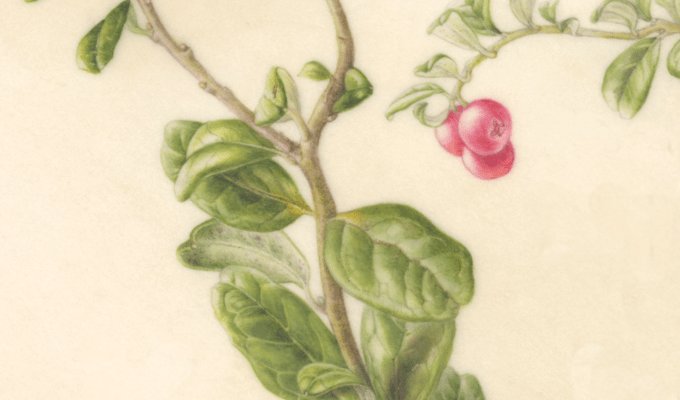
6. Vaccinium vitis-idaea  – Cowberry/Lingonberry -Tyttebær
Watercolour & graphite on vellum.
November 2022

1) Habit
2) Flower cluster
3) Fruit
3a) TS fruit
3b) LS fruit

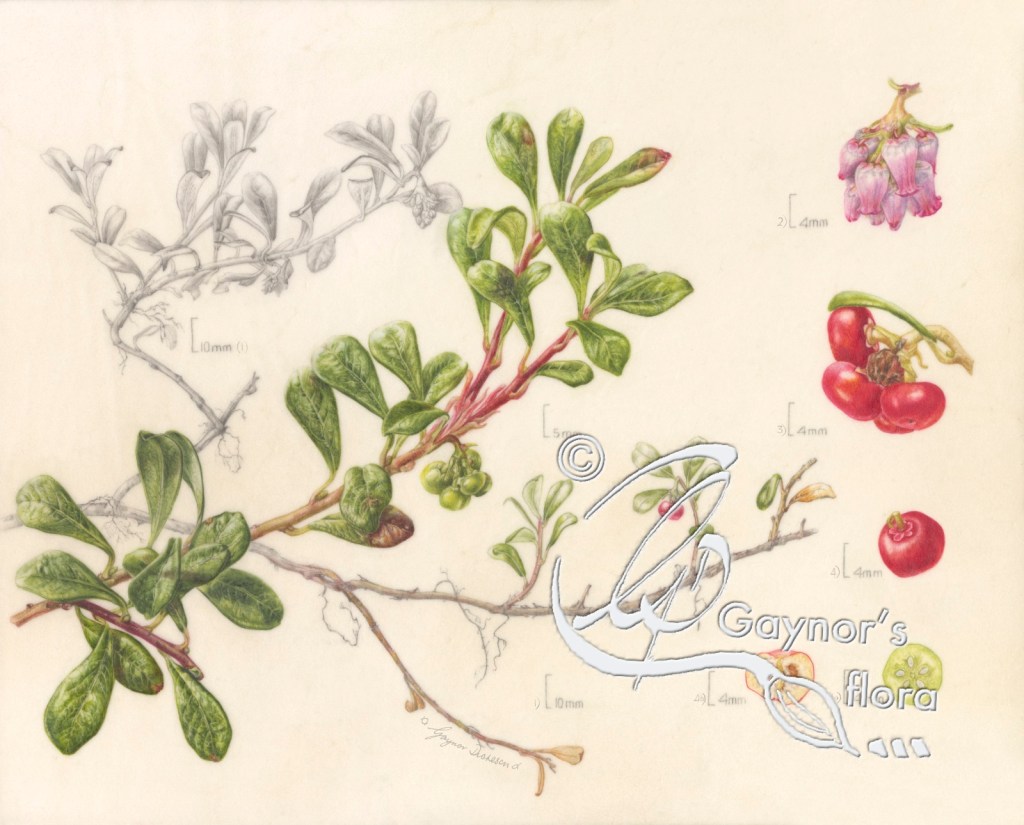
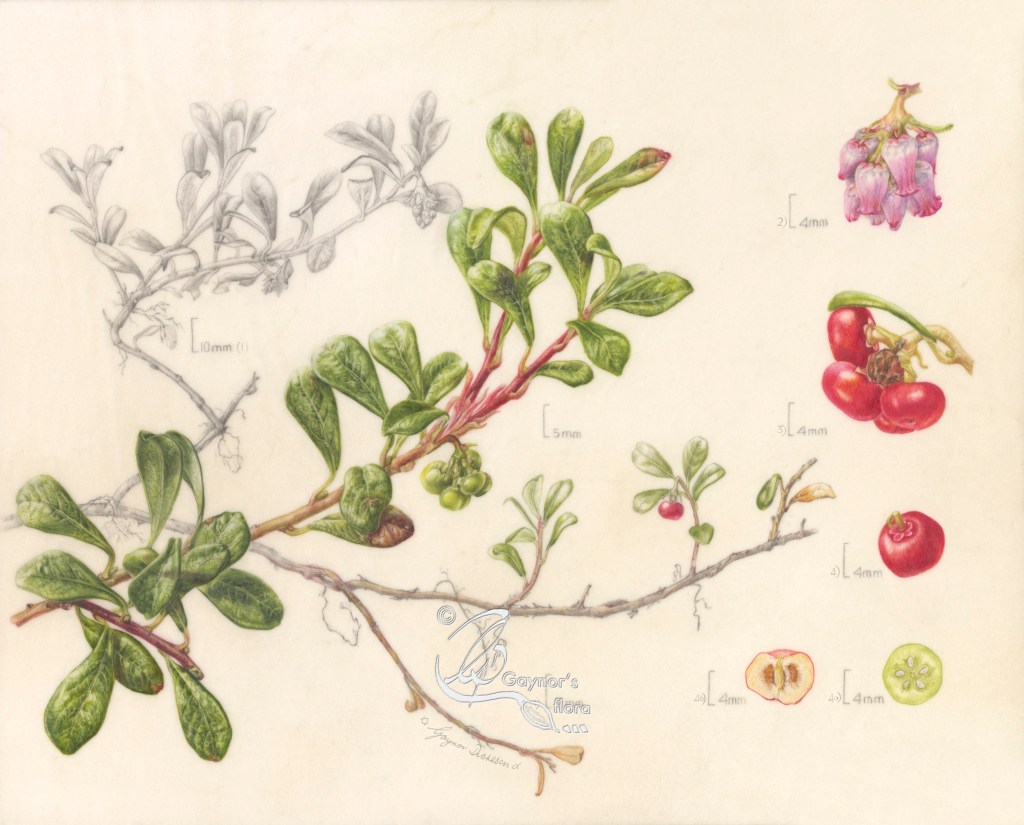
7. Arctostaphylos uva-ursi  – Bearberry – Melbær
Watercolour & graphite on vellum.
October 2022

1) Habit
2) Flower cluster
3) Fruit cluster
4) Single fruit
4a) TS immature fruit
4b) LS ripe fruit

If you have read the blog series you will understand that the Cloudberry and Small cranberry enjoy the wettest environment – bogs and marshes, whilst the Bearberry is often found on a sandy forest floor. The other species are found in various types of environment from damp woods to harsh mountain tops. Some, like the Bog bilberry will grow very well just about anywhere as long as it has water and plenty of sun.

All of the plants in this series live in the Subarctic part of the world and have always provided a lot of nourishment for those living in the far north, the rest of us a little further south and of course animals that roam the area.

Some of the plants typically don’t grow in certain areas as witnessed by the difficulty I had finding the Bearberry. In very hot and dry years some plants produce next to nothing; Cloudberry and Small Cranberry are good examples. Can you imagine the risk that Global warming brings to these plants as well as to us. The warmer the planet gets, the more further north these plants are likely to move making it even harder for us and the animals they support, to find them. As it is, plants that can normally be found further south in Europe, are now beginning to appear in Norway; their pollinators moving with them and having a negative effect on the species that belong.

When choosing to study and paint these plants I didn’t realise how much I would learn about them. I loved the plants (and their fruit) before this, but now have so much respect for them and the environment in which they grow. I hope that I have been able to pass on at least a smidgen of this.

Thank you for following this series.

Latest news: I am really pleased to say that following the judging process yesterday, 14 June 2023, the judges decided to honour me with a Silver Gilt medal. The award ceremony will be held this evening at the Saatchi Gallery during the preview to the exhibition opening tomorrow.

I look forward to getting detailed feedback about my exhibit from the judges this afternoon.

Foraging plants in the norwegian mountains – 24. Lingonberry Pt. 2

Vaccinium vitis idea – Lingonberry plants in dry moss.

The reason for even thinking of doing a series of plants like this was because of this plant – Vaccinium vitis idaea (Lingonberry/Cowberry) and the next plant in this blog series Arctostaphylos uva-ursi (Bearberry). They are fairly similar and their habitats cross over into each other’s. So unless you know what you are looking for you can easily make a mistake.

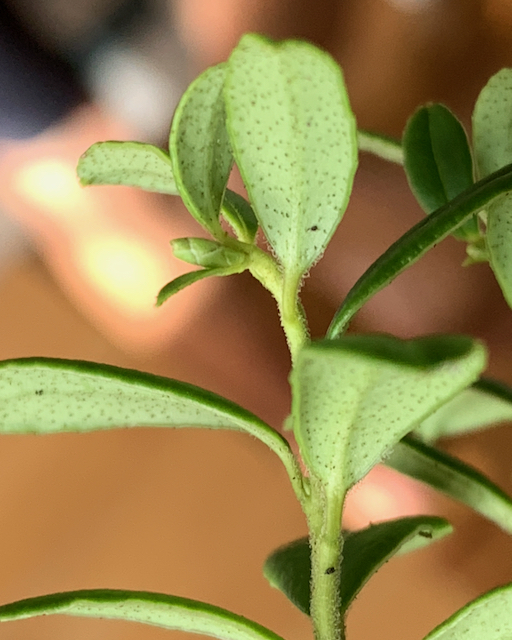
Lingonberry leaf back.

It isn’t a ‘dangerous’ mistake to make, but it can spoil a recipe!

Above is a photo of the Lingonberry in its typical habitat. Both species have leathery leaves as well as similar flowers and fruit. But the Bearberry prefers even drier surroundings than the Lingonberry.

The Lingonberry leaves are oval as you see above, whereas the Bearberry leaves are paddle-shaped; The Lingonberry leaves have small dots on the underside, whereas the Bearberry leaves are finely veined; Both sets of flowers are typically Heather-like, but the Lingonberry flower is bell-shaped and the Bearberry flowers are more urn-shaped. The rhizomes of the Lingonberry sit deeper in the humus than the Bearberry, which are prostrate and limply creep across a surface.

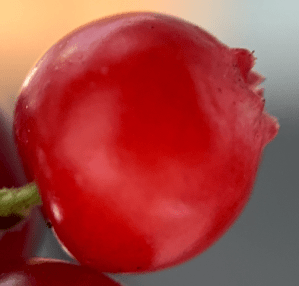
The fruit for both plants are in clusters, but the Bearberry fruit has a slightly flatter spherical shape than that of the Lingonberry. Most importantly the Lingonberry has an inferior ovary (the flower parts arise above the ovary), meaning that the remains of the sepals are at the bottom of the hanging fruit, distal to the pedicel (stalk). The opposite is true of the Bearberry where the calyx (sepals) remain on the fruit around the pedicel. 

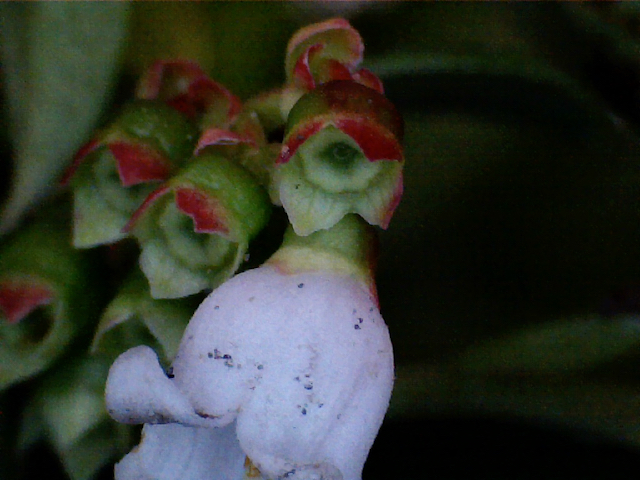
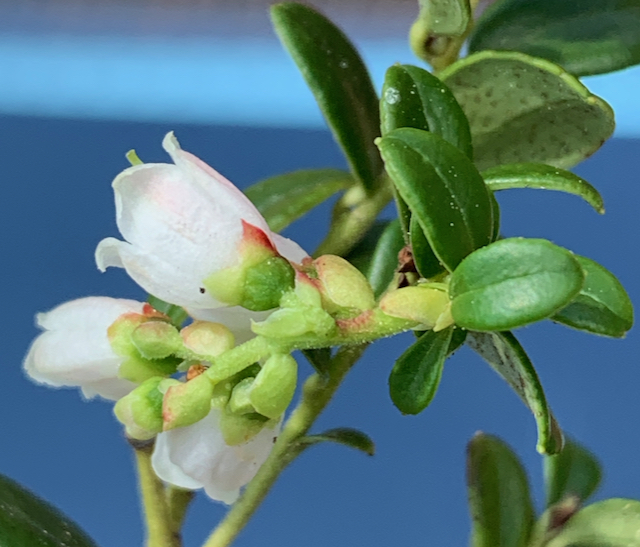
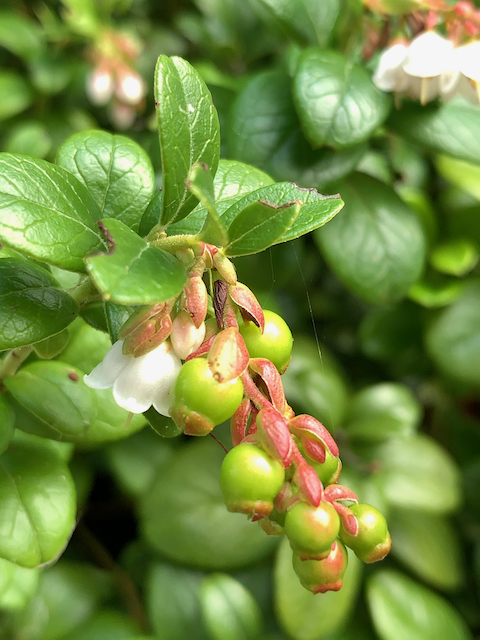
Fruit developing. Petals fallen off to reveal shape of distal end of fruit formed with sepals.

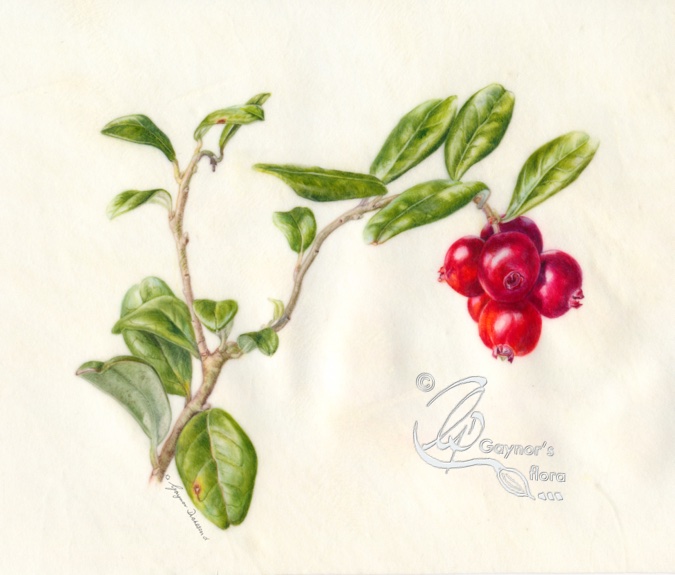
If you look at the painted berry at the beginning of the last blog when I started discussing the species, you can see the remnants of the sepals. Compare it with these three pictures showing the development of the flower and swelling of the ovary in its inferior position.

At the end of the previous blog I showed you some of the sketches I did from various Lingonberry plants. Here you see additional ones and you may notice that they were part of the basis for my final artwork.

Below you see my first compositional plan for the Lingonberry picture, but I didn’t really like it. I suppose in this plan I wanted to avoid painting so many small, but detailed leaves. As you now know they have several diagnostic elements to them, but at the same time are quite shiny. The composition just didn’t give me the right ‘feeling’ of the plant.

One weekend I had been out picking fruit with my daughter and we were discussing the way the plants grew and the impression they gave. We again looked at my planned composition and she suggested I replace the flower on the stem with a fruit cluster.

That was the answer – the series emphasis was about the fruit. I decided to do a trial on vellum of the new piece of stem with the berries and this became the basis for the final composition.

My first sketches of this plant were done in March 2017, but I didn’t start painting the final picture until October 2022 (after harvesting), finishing December 2022. Because this plant is not deciduous, it allowed me to work on the leaves right up until the first fall of snow.


The native range of this species is Subarctic & Temp. Northern Hemisphere including the UK and Norway. It is a subshrub and grows primarily in the temperate biome.

Source: Kew – Plants if the World Online

The species in my next blog scheduled for 8 June 2023 is the Bearberry, favoured by bears when they wake up from their hibernation – or so I am told.

Eva’s Raw Lingonberry Jam

300g Lignonberries

100gm sugar

Blend together the berries and the sugar until berries well macerated. If possible let it stand for few hours in the fridge before being used.

Eva Biringvad gave me this recipe and sent me on a ‘no-return’ journey. Her father made the most delicious bread, so we ate chunks of his bread with sour cream and the raw lingonberry on top. Delicious!

This is also used with meals instead of Cranberry sauce – and it is much nicer.

Foraging plants in the norwegian mountains – 23. Lingonberry Pt. 1


Ripe Lingonberry ready for picking with Bilberry plants already done and dusted.
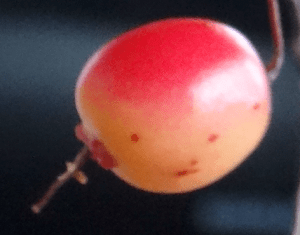
Distal view of ripe fruit – inferior ovary

Vaccinium vitis-idaea, or cowberry, the common english name and tyttebær the Norwegian name is more commonly known as lingonberry if you visit Ikea. It forms the sharpish berry sauce you get with your meatballs!

In fact, there are several ways you can eat the fruit and one of the recipes I will be sharing with you is one where the raw fruit is whipped with sugar – it is absolutely delicious – especially on lovely bread with sour cream!! A friend introduced me to this bad/delicious habit, but I have learnt to restrict myself!

I am glad that we picked quite a bit of fruit this last year and it is safely kept cleaned and ready for use in the freezer. Like the Bilberry, I use it in all sorts of recipes, sometimes even together.

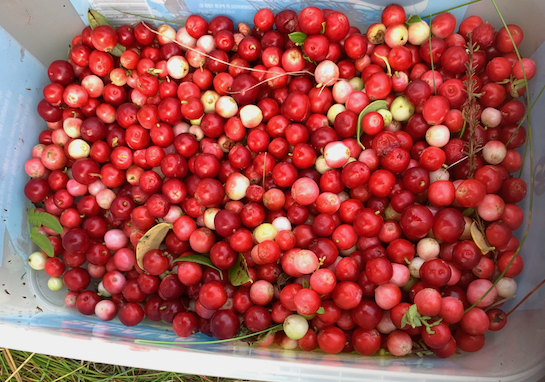
Many will think that the Lingonberry is similar to the small cranberry and in many respects it is. They are both Vacciniums, similar in size; 5- 8mm, but the lingonberry is almost completely spherical whilst the cranberry has a very slightly elongated spherical shape.

Because the Lingonberry and Cranberry prefer completely different habitats, there is little risk of picking from the two species at the same time. But, both can be used in the same way and for similar recipes.

The Lingonberry is generally found on heathland and shrubby areas, but as discussed in my blog released 7 May, the Small cranberry grows in very boggy areas covered with sphagnum moss.

The next two picture were taken late September at 1100 metres over sea level. The red berries are

the Lingonberry and you can see that as they hang in bunches they are easy enough to pick. Unlike the bilberry (the red/yellow leaves), the fruit is pretty solid and bullet-like making them even easier to pick that that species. In the same picture is the Mountain Crowberry with their black berries, heather and some very short birch.

We are lucky enough to have some Lingonberry also growing in our garden, but in the two years we have been here I haven’t seen any fruit. Possibly this is because the plants are in shade and it has been very dry since we have been here, and our house is on rock. Therefore, with climate change even the native plants suffer. There is more fruit as one walks from our house into the protection of the woods. Often it grows on the top of extinct anthills, indicating how the seeds were transported.

The Vaccinium vitis-idaea (Cowberry) and the Arctostaphylos uva-ursi ( Bearberry) are, in fact, the main reason that I thought to do this series of plants. I have already written about the similarity between the Vaccinium myrtillus (Bilberry ) and the Vaccinium uliginosum (Bog bilberry), and in that case mixing the one with the other won’t spoil a recipe. But because the Cowberry and Bearberry are so similar, mistakes can be made and although both edible, Bearberry is dry and tasteless and has large stones rather than small seeds.

I will talk about the Bearberry as the last plant in this series. But the second section about the Lingonberry is scheduled for 6 June 2023.

When I wasn’t walking in Norway …

…..I was either hunting for plants or painting.

I had a list of plant detail that I had worked out I needed to complete the composition planning for my series of pictures. My vellum size for each piece is 25 x 31 cm – which I suppose relatively speaking is quite small. But all but one of my plants is very small with leaves varying from 2-6mm long on the Vaccinium microcarpum, to the Rubus chamaemorus where the leaves vary hugely in size.

Vaccinium microcarpum – Small Cranberry – Leaves 2-6mm long.

Impetrum niger ssp. Hermaphroditum – Crowberry – Leaves 3-6 mm long

Rubus chaaemorus – Cloudberry (image is 13cm high)

I decided that rather than work on all seven pictures at once as I have done so far, I would work on half this year and the rest next year. For all of them I needed to do some colour matching on vellum as this will be different to the colours I have used on paper. You have already seen the small piece I did on the Cranberry a couple of blogs ago. You may also have noticed the difference to the actual flower size (tiny) and the painting  which I did at twice the size.

Luckily enough although there is a slight difference in the terrain from which each of the plants come from, we have found each species within walking distance of the cottage in which we have been staying. The Cloudberry and the Cranberry can be found intertwined with each other in the soggy sphagnum moss – but not always. The Bog Blueberry (Vaccinium uliginosum) comes from a similar area, but I have seen it reaching up the side of rugged outcrops. The Crowberry can be found all over the mountains although the Ssp Hermaphroditum can only be found at higher altitudes. The Bilberry can also be found pretty well most places, but doesn’t seem to be above the tree-line and doesn’t seem to like really boggy areas. The Cowberry – Lignonberry (Vaccinium vitas-idaea) is spread on ant mounds and rocky outcrops.  Common Bearberry (Arctostaphylos uva-ursi) likes much drier conditions and is often found in pine woods. But we did find an example not far from the cottage. Last year Robin drove about 150km to find a spot that I knew about!

Below is the colour sample of the Bog blueberry done this year. The very new new leaves start out quite red and as they get older they become bluer and stiffer. Sorry the photo is a little dark.

Vaccinium uliginosum – Bog blueberry – Watercolour on vellum 5×7″, painted twice natural size.

Go back

Your message has been sent

Warning
Warning
Warning
Warning

Warning.

The length botanical artists go to get the right plants!

My daughter, husband and I ready to battle the elements on our first hike together this working holiday. We managed 3 km in 4 hours!

Preparing to climb the mountain behind the cottage in the bitter cold and hail!

It was bitter cold and hailing when we started out, with a temperature of only 2º, and the wind coming from the north! It felt quite a tough climb particularly as I wasn’t in as good shape as I used to be. But the views were worth it, as were seeing the variety of plants.

On the way up we saw quite a lot of wild flowers from Wood Cranesbill, Bilberry, Bog Bilbury or Blueberry, Cowberry (or for Ikea addicts – Lignon berry), Bog Rosemary, and loads of Chickweed Wintergreen everywhere we looked.

Its funny, but this last plant really livened up the steep slopes and the Norwegian translation of its name felt more like the experience we had of it – Star of the Woods!

Wood crane’s bill – Geranium sylvaticum

We rapidly got above the tree line with lots of heathers (most of the plants I have mentioned come from that family) and low lying Mountain Birch.

The small plateau on which we arrived had a lake and a further track leading over the mountain top. Patches of winter snow still lay there.

Rypebaer, Arctostaphylos alpina – Arctic Bearberry

On a patch of rock clung another plant carrying its immature fruit – The Artic Bearberry. I have heard of it, but hadn’t really made particular note of it before. Perhaps the redness of its autumn colour confused me with the red of the prostrate Mountain Birch.


Vaccinium uliginosum – Bog blueberry/bilberry – Skinntryte

This is the other plant I managed to colour match on vellum whilst up in the mountains. But I will update about that one in a later blog.

Cold but stunningly beautiful!

UK native plants packed for RHS botanical art exhibition

Packed and ready to go.

Tomorrow two of us are travelling up to London to set up the ABBA table in the RHS Lindley Hall, Vincent Square near Victoria Station. It will be the RHS botanical art show with the best of International botanical artists showing their work. Neither of us are exhibiting our own work this time, but we will be demonstrating different techniques.

The main reason for having the table at the exhibition is to talk about the plans for the Worldwide Botanical art day in May 2018 and to encourage British botanical artists to take part. A new Association of British Botanical Artists (ABBA) formed to do this has put an initial ‘call for entries’ on it

Www.abba2018.wordpress.com

On  Friday and Saturday this week, I have chosen to demonstrate a sketch book or study page in graphite and watercolour from  one of the native plants I have packed to take with me. Come along and see how I do this.

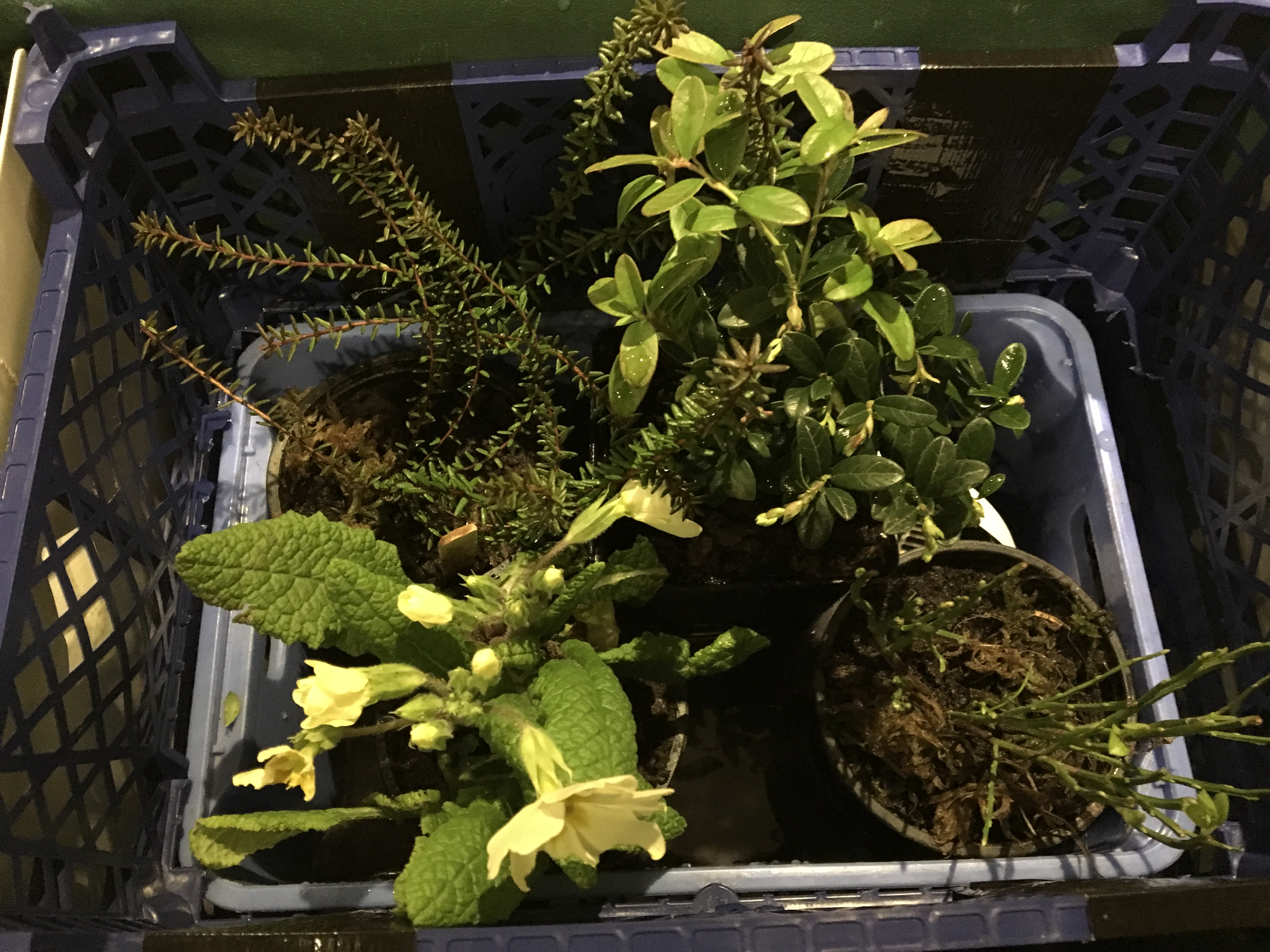
Apart from the Primrose, do you know what these plants are called?

The one on the right, with hardly any leaves just yet, is a Bilberry. This is a small wild blue berry. It doesn’ look very interesting at the moment, but if you are going to paint the portrait of a plant, including something from various stages in its life cycle, makes the resulting picture more interesting.

The plant above  the Bilberry with the small oval leaves is Cowberry and has small red berries. You might know it as Lignonberry and has smaller and sharper tasting berries than cranberries. This plant has the beginnings of tiny flower buds.

The one above the Primrose is a Crowberry and will eventually have small, almost black berries. Again the plant doesn’t seem so interesting in this stage of its life, but I think might offer some challenges whilst painting its portrait.

Common for for all three species ( not the Primrose) is that they all produce fruit that is edible.

I am lucky enough to be able to do some sketches now, while the plants are only just coming out of their winter state. This will be particularly useful for me and for future work I have planned.

Do come and see us at the RHS, Lindley Hall, Vincent Square, Friday and Saturday.