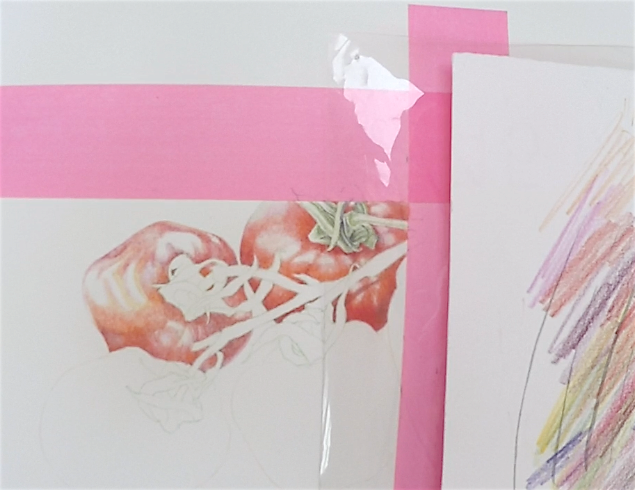
A new YouTube video – tomatoes in coloured pencil

I mentioned previously that I had been trying out various papers to use with coloured pencil, rather than my favourite, Fabriano Classico. The trouble is that I kept on having to start my tomato picture again and the ultimate goal was to film the process to use with my online botanical art course.

In the end I gave up and the video is based on my fourth attempt, but with my favourite paper! I hope that this will make some people happier about their numerous attempts with whatever media they might be using.

Having read the above, you will think that I didn’t find any suitable replacements for the Fabriano, but that isn’t quite true. The problem was that I chose what seems to be a simple subject, which in reality wasn’t all that simple to do. The tomatoes are very red, smooth and shiny. The red was the problem.

For those who work with coloured pencil, they will know that the colours are translucent and therefore the colour or colours that you are aiming for are in fact a layered mix of different colours. The tomatoes were a yellowy red – simple; but they also had areas of deeper red, areas of pinky-red, colder areas and warmer areas.

I have also been painting a Crocosmia ‘Lucifer’ recently, and I encountered similar problems with that, because of the red.

I suppose what I am trying to say is that if is difficult, try and try again; it will be worth it. Particularly with coloured pencils it is worth trying out different mixes before you start and sometimes simpler is best.

I finished the series of videos for the course, starting off with tracing the line drawing, a separate short video for each of the tomatoes and then one for the sepals and truss. But unless you are signed up for the course you will only see this video which concentrates on the second tomato. It is speeded up considerably, therefore not going into huge detail about techniques. But you do see how the tomato develops and the list of colours I used for the whole picture is in the information section underneath the video.

Three tomatoes-2nd tomato

This is the Youtube video linkThe second of three tomatoes in coloured pencil.
This coming weekend is the ever popular Fruit and veg botanical art workshop. It looks as though it won’t be such glorious weather as has been for the last couple of days, so everyone will be able to concentrate on their painting, but be rewarded with strawberries and cream at the end of it!

Bad news and good news.

A few days ago we were walking round the garden and noticed that one of the Fuchsias seemed to have real problems with flowering. On closer examination the growing tips were curled up with the new flower buds curled into them. We then checked out another fuchsia in the front garden which had flowered. It was the only one we had with variegated leaves. But that too seemed to be infected. We had no idea what this was, so Robin had a look on the net.

Distorted growing tip of a Fuchsia plant

Apparently it is the Fuchsia gall mite and has been written about by the RHS. It had first been seen in Brazil in the late 1970’s and has since spread to areas with warm climates, reaching Fareham on the south coast of England only a short time ago.

The only thing to do with it is remove it completely as removing the distortions doesn’t get rid of the mite and neither do pesticides – which we wouldn’t want to use unless there was no other way. When removing the plant, it either has to be burnt or got rid of safely – not on the compost heap. The mode of transportation is you and I, birds and the wind. Therefore we have to be careful that we clean tools, change clothes and wash hands after handling it.

I have just found it in the back garden too, but so far it has only affected one of the fuchsias (all hardy). Therefore we have to get rid of it as soon as possible. However, before doing so I thought I would take some pictures. The mite is 0.25 mm long, therefore too small to be seen with the naked eye. But I have one or two microscopes and have taken some stills and a short video.

First, two stills so that you know what to look for:

Fuchsia gall mite still_1 copy


The same gall mites taken within seconds of the first picture.

I had hoped to show you a short video I took of a mite moving along a stem, but unfortunately I haven’t found a way to include it on a WordPress page. But needless to say, the mite is very bad news for those with Fuchsias at least living in the south of the UK . But perhaps this will be a warning to have a look at your Fuchsias and remove those infected as soon as you can.  This could minimise spreading.

Now the good news. The American Society of Botanical artist (ASBA) has its annual conference in Pittsburgh in October. I know I have mentioned this before. I was asked to teach and the online registration was opened on 23 July. I booked the workshops that I wanted to attend, but also checked out my own workshop.

I couldn’t believe it and I thought there was a difference between the meaning of the American and UK English words ‘waiting list’. I picked up the courage to ask and found that they meant the same thing. Already on the first day of registration, my workshop was fully booked with a waiting list! I have to keep my fingers crossed now that I can still get crab apples as subjects for the conference. At the moment, I have loads of different ones ripening here, but how they are ‘over there’ is another matter. Perhaps someone could tell me if they are likely to have any left at the time of the conference?

Screen Shot 2016-08-13 at 16.19.58

Fourth Gaynor’s Flora update

I am so glad that I have these blogs to look forward to each day. They are helping to remind me about the lovely things I have done over the last few weeks. Particularly as I am still catching up with all the undone things, including doing a coloured pencil video.

I am really struggling with the video. I expect that those who are just starting out in botanical art will be relieved to hear that someone who has been doing it for a while, continues to struggle in periods. But the reason that I am struggling is because I am trying out different papers to use with coloured pencils, so that I can advise my students. The subject is tomatoes.

I think that I am now on my third attempt. Its not that I don’t get good enough results, it’s just that I feel I have to adjust my technique for each of the different papers I use. But I suppose that is something new learnt.

First Tomato picture attempt on Strathmore 500 Bristol Plate.
Incomplete first tomato picture attempt on Strathmore 500 Bristol Plate.

Going back to catching up.

A lot had been going on over the last few months with a great deal of time spent on writing the online botanical art course, exhibitions, demonstrations and teaching. I felt I needed a break, but my head was still working ‘twenty to the dozen’. My workshop in Norway was unfortunately cancelled, therefore this time we would be taking a holiday there. I still had work to do on the botanical art course and informed family that this was the case.

I have a strong and determined family! After one day spent working, I was told that enough was enough. I was unhappy at the time as of course I still had to do the work. But since then I have every reason to be grateful to my daughter in particular. I had a holiday and had a proper rest. Maybe I was a pain to everyone else!

Whilst in Norway I didn’t get much painting done either. But we stayed with some friends at their cottage in the mountains and I think I now have a group of subjects to paint for an exhibition at the RHS. It won’t be next year, but if I get my act together, possibly the year after.

As here in the UK one is not allowed to pick certain plants. But I made a note of the plants around my friend’s cottage and I think they will make a very good subject series.

© Skinntryte page

I know that this page in my small Moleskin drawing book looks very boring. But this is how botanical art paintings start, particularly when planning a series of paintings. I’m afraid that I have written the Norwegian names, but you will also see the scientific names if you want to look them up.

Three of the plants are important for fruit picking in Norway –

  • The Vaccinum vitas-idaea is called Tyttebær in Norwegian and Lingon in Swedish (goes with your Ikea meatballs), but Cowberry in English. They are the same genus as the Cranberries we buy in the shops, but a smaller species.
  • Blåbær is Blueberry in English, but again a different and smaller species from the ones we buy in the shops.
  • Multe is Cloudberry in English. They are the most sought after and difficult to find – but generally one knows of a ‘spot’, and doesn’t tell anyone else! There are very special rules governing Cloudberries. One is not allowed to pick the flower and definitely not allowed to pick the fruit until it is fully ripe. If you are caught with red fruit you are fined.

In 1974 and long before I knew the importance of Cloudberries,  my parents visited me in Norway  and we took them into the mountains. My mother loved these delicate white flowers and picked a whole bunch of them!!

Skinntryte is also a form of blueberry. I have found several English names for it including Whortleberry and Bilberry. They grow with Blueberries and for those who don’t know the difference, they might also pick these.

Krekling is apparently becoming more interesting to harvest. It is Crowberry in English.

Of course Tettegras is the Common Butterwort, which is a carnivorous plant. When picking fruit in the mountains, I think one is very glad that there is something that digests all the buzzy, biting things!

Last of all, the Flekkmarihånd is the Marsh Orchid and just beautiful.

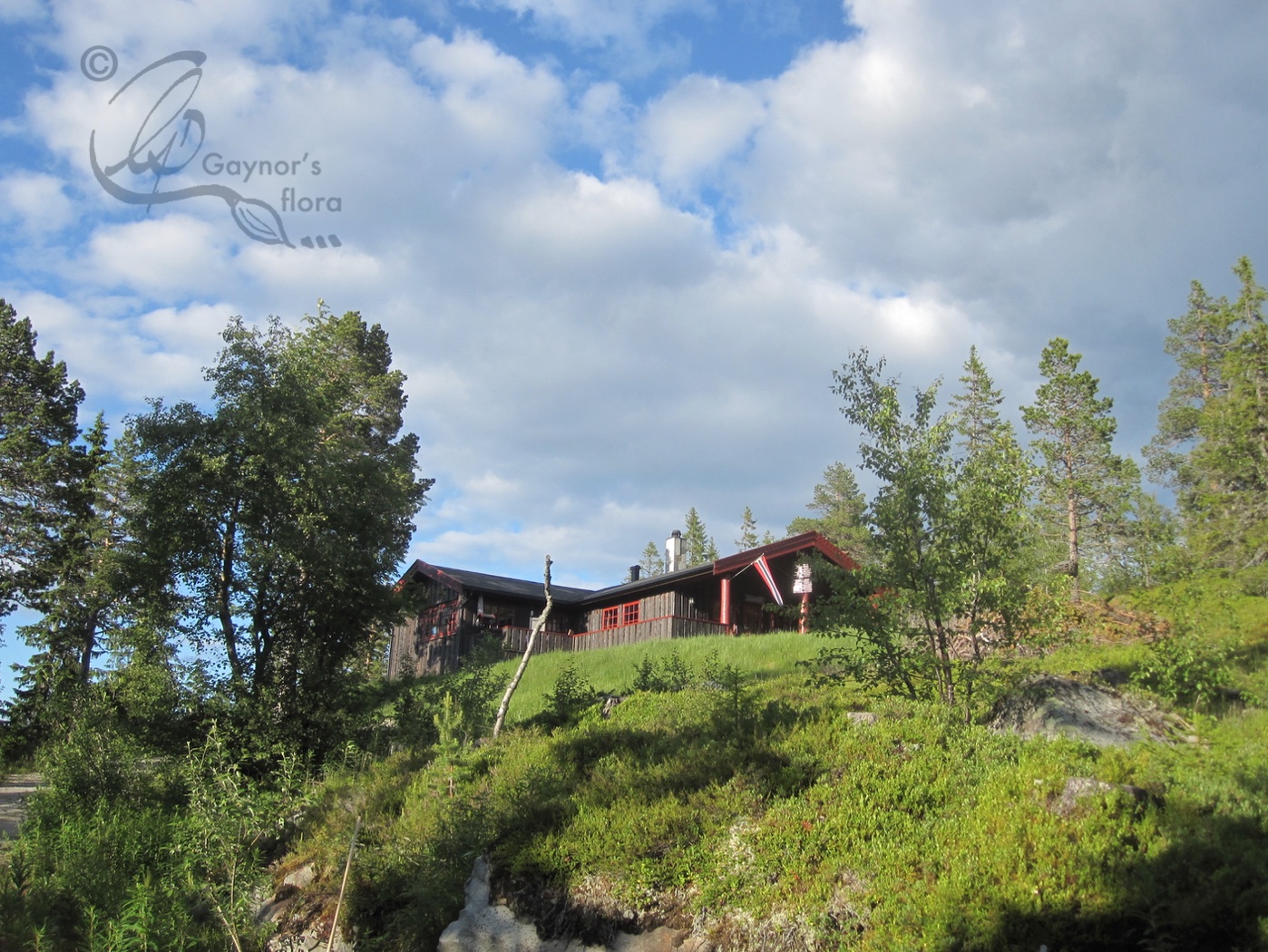
This is my friend’s cottage in the mountains. They have invited me back next year to continue painting the series. Thank you Eva and John.

© 1.Eva & John's hytte

Third Gaynor’s Flora update

Earlier in the year I was contacted by the ASBA and asked if I would teach at the next Annual conference in Pittsburgh. I of course said yes. I was then contacted once again and asked if they could publish one of my botanical art pieces on the front page of their quarterly magazine, with an article about me on the inside. This edition coincided with the program for the annual conference in October where, of course, I was due to teach. How could I say no!

ASBA Botanical Artist quarterly magazine

Registration for the conference was opened 23 July. But more about this later.

In my blog of May 17th (Norway’s National day), I was conducting a workshop in Bosham and showed pictures of a pair of ducks in the pond. They became regular visitors for a while, but luckily they decided that our pond was not actually the safest bet for a couple of birds to make their home. We have cats, although the ducks were left alone, they were wary.

Ducks are apparently notorious at damaging garden ponds. But towards the end of May, beginning of June, we still had a lot of yellow Irises in the pond – Iris pseudacorus. I was busy trying out different papers to be able to give advice to coloured pencil artists, so decided to start painting one of the Irises.  We have had problems with Fabriano hot pressed papers – my paper of choice, therefore finding an alternative paper until they make a new batch in 18 months time, is a priority.

This coloured pencil drawing is done on Strathmore 500, Bristol plate. What do you think?

© 09.Iris pseudacorus


Botanical art entry provisionally accepted for New York

x zumi"Golden Hornet" crab apple in coloured pencil.

The American Society of Botanical Artists(ASBA) has provisionally accepted one of my pictures for its New York exhibition this November. However, I daren’t take it as a ‘fait accompli’  just yet as the jury have only seen the digital version of my picture so far.

Just like having work accepted at the Hunt Institute of Botanical Documentation, the ASBA  reserve the right to refuse any artwork if it isn’t up to scratch when they see it in real life. So I am still keeping my fingers (and toes) crossed that they will like it. I had to un-cross them long enough to have half a glass of bubbly which my very happy husband poured for me. I’m also rather chuffed!

But this is the picture they have chosen:

Malus x zumi  "Golden Hornet" crab apple in coloured pencil.
Malus x zumi “Golden Hornet” crab apple in coloured pencil.

Today I was demonstrating coloured pencil at the Society of Floral Painters Exhibition in Chichester. Being British, I was also aware that the sun was shining outside, but as I was painting a very sunny yellow Iris from the pond in the back garden, the sun was brought into the exhibition.

I would have liked to show you the results of that exercise as I am trying to find the right paper for use with coloured pencil. This is to replace the Fabriano hot pressed papers that we botanical artists are struggling with. Unfortunately I am not convinced yet that I have found a paper that suits me and my style when using coloured pencil. But I know that I have found a lovely Strathmore paper to use with watercolour.

I have realised that yesterday’s blog showed a poster with a painting of the Strelitzia-reginae ‘Bird of Paradise’ plant, but the signature was too small to read. The honour for that lovely piece of work should fall on the Chairperson of the SFP, Gill Jelley.

Ménagerie à trois plus botanical art workshop

Please note the difference in spelling!

We have four cats, a pond with visiting ducks, a pair of Crows, Chaffinches, Wrens, Robins (as well as my husband and sister)Blackbirds, Goldfinches, Bearded Tits, Blue tits and Great Tits, two sorts of Woodpeckers, squirrels, rats and the normal rodents etc.

Although we have the cats, birds seem to feel very happy i the garden and seem to be left alone. In fact, one day there was a pheasant in the garden and the ginger one  – Fudge decided he wanted to join him, so walked towards the bird with his tail in the air. They seemed to spend a happy time following each other gently round the garden! The only things that seem to come to grief are the rats – 22 in 18 months!

During the workshop one of the students had her dog with her. She was a little worried at first as she thought her dog might chase the cats. The black & white cat – Allsorts (as in liquorice), brother of Fudge, knows how to deal with dogs. He just sits and stares them down. It always works. I think he took five minutes to train the dog!

These were some of the views from the conservatory during the workshop at the weekend!

This slideshow requires JavaScript.

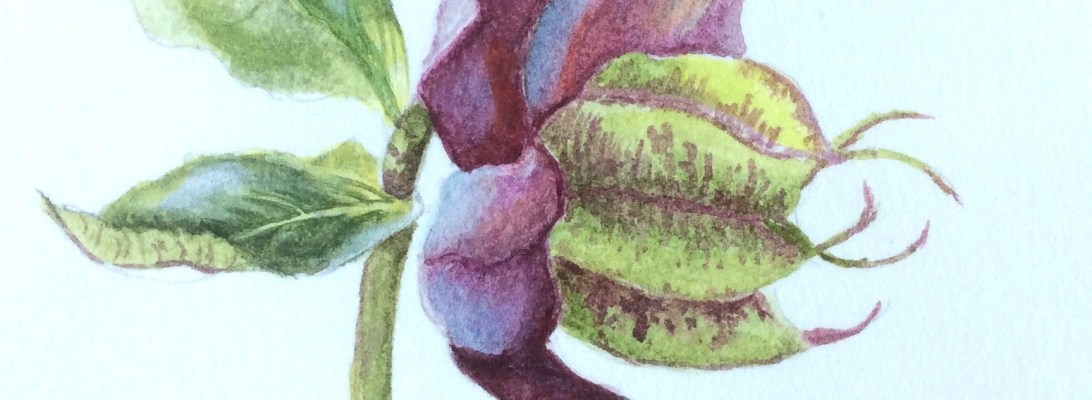
There was a botanical art class between Friday and Sunday. The title was May blossom and Irises. Irises are usually the topic of choice, but there was a whole garden to choose from. In the end there were 1 1/2 Iris pictures, two Canary Rose pictures, one crab apple blossom, a very pregnant Hellebore  and none of the yellow Irises from the pond. Three people used coloured pencil and two watercolour.

From my perspective the workshop was enjoyable and the feedback I have got is that those taking part also enjoyed it and learnt something too.

I am now taking on people who want to start the online botanical art course in June. To see what it is all about, have a look at my webpage on the subject. I restrict the number of people I take on board each month so that it is best to reserve your place as soon as possible. https://gaynorsflora.com/tuition-2/online-botanical-art-course/

This slideshow requires JavaScript.

And the results of the weekend so far. As I forgot to take it before packing up, there is one picture missing, but hopefully we will see the finished result in due course.

This slideshow requires JavaScript.


Visit me during the Chichester Art Trail

Over the next two weekends I am taking part in the Chichester Open studios event.

Our conservatory will be ably manned by Robin and he is looking forward to see people arriving to look at my botanical art which is hung there for the occasion. Whether or not the weather remains cold, you will be welcome to have a cup of tea – or coffee with us.

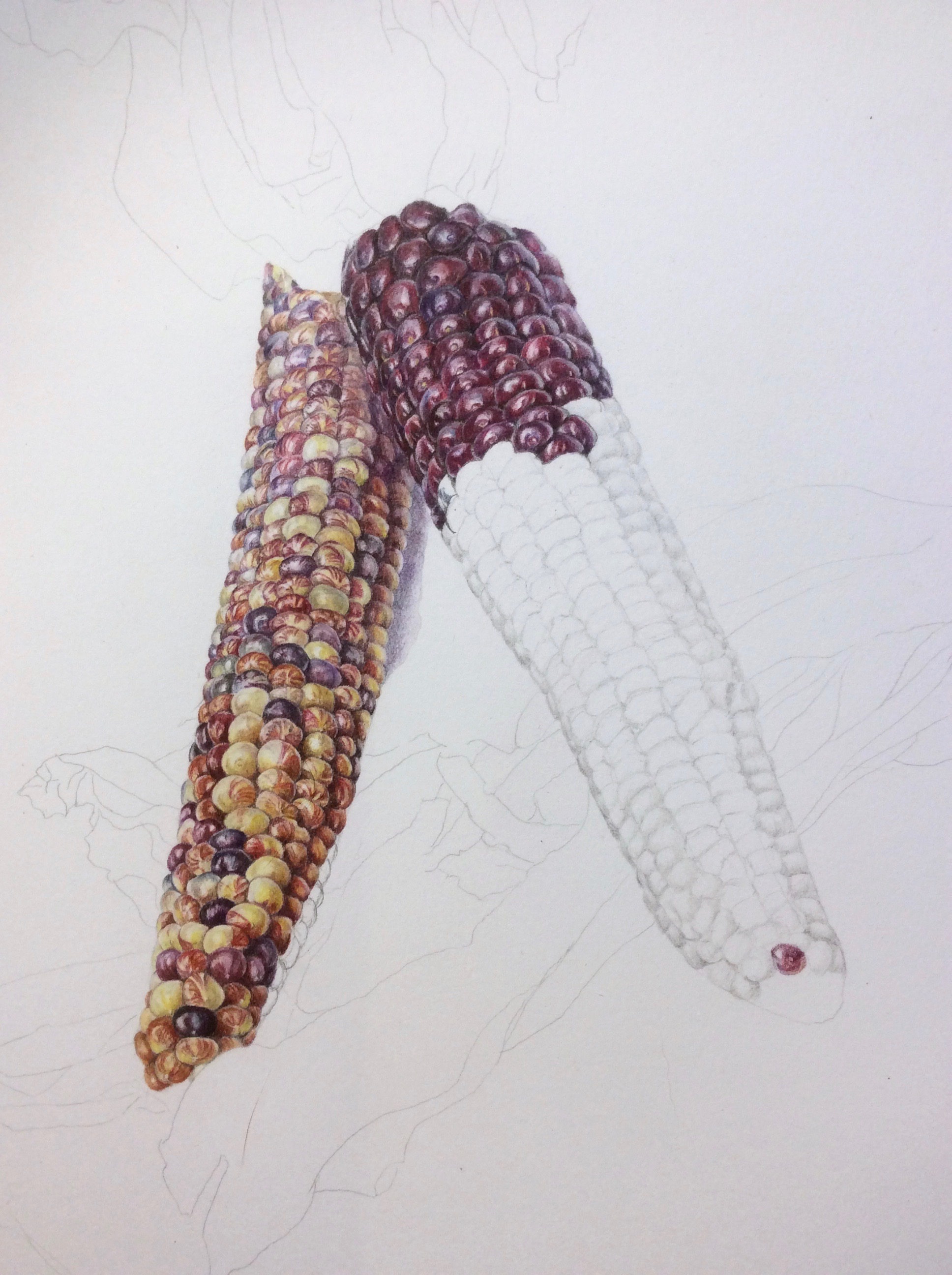
However, I will be down in the shed painting. Some people have watched the development of the Indian corn picture, which has only been done at open studio events or exhibitions. One of these days I will have to find a subject that is equally long lasting. But I know that several people have been coming on a regular basis to see the development of this picture. This is what it looked like following a demonstration in November last year.

Indian Corn in coloured pencil

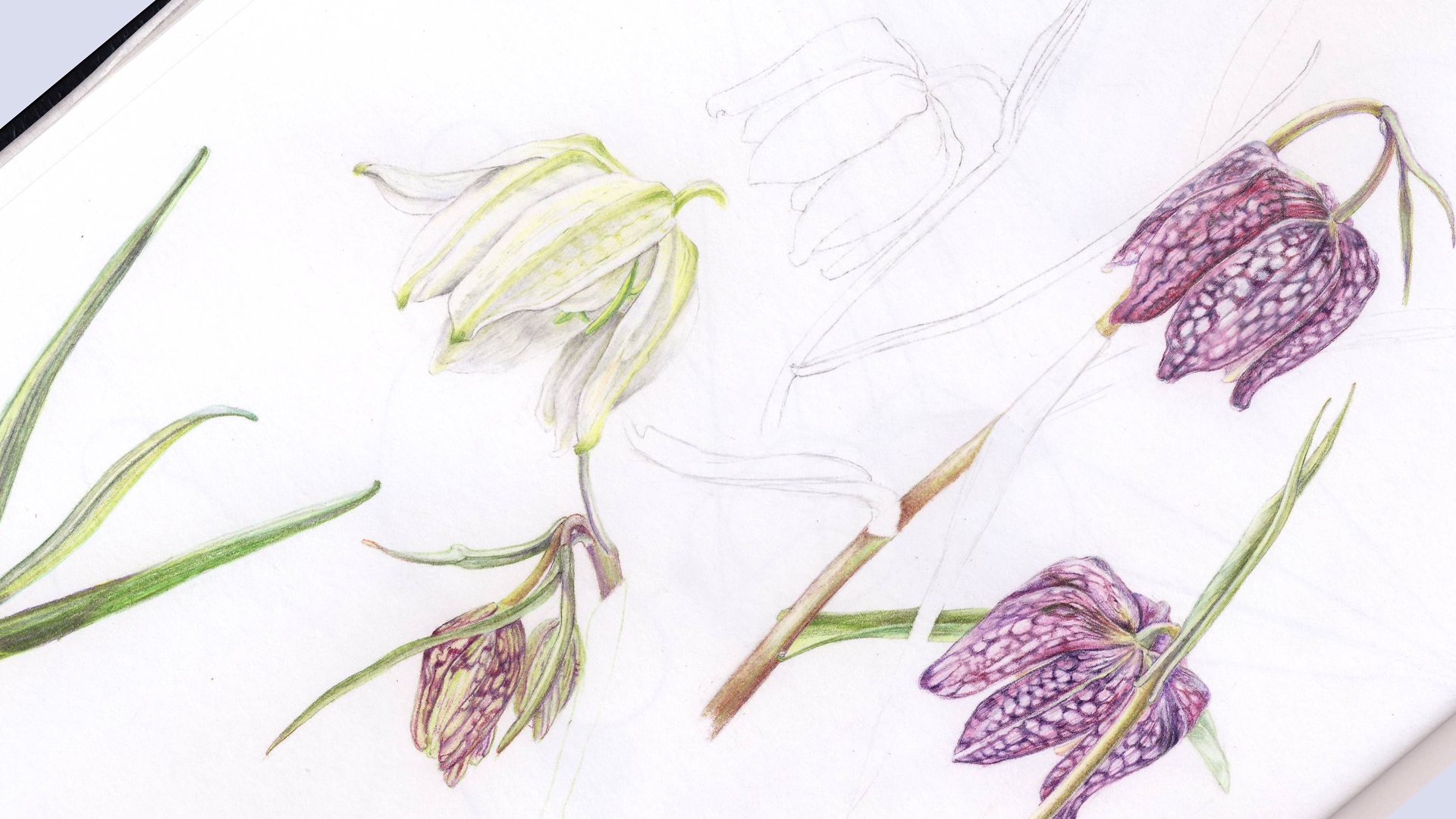
Additionally I am also painting a Fritillary for a commission, so you might very well see me doing some of that. These are some of the sketches in my sketchbook .

Fritillaria meleagris in coloured pencil.

The commission is in watercolour.

I am looking forward to seeing you here. Don’t forget to tell me who you are and where you come from. Here is the link on my website giving you the address to head for:  https://gaynorsflora.com/exhibitions/

A blog about paper testing!

I hope you will be interested in the topic of this blog! There are loads of photos that can be perceived as dull if you are not interested in the subject. I have used my iPhone for some pictures, in addition to two different microscopes connected to the computer. If I call myself a botanical artist, why not use the equipment to find out about the paper we use.

The topic of the day is to find a paper as good as Fabriano paper, loved by many botanical artists. Some may have heard that Fabriano hot pressed paper seems to have changed recently. The manufactures have apparently changed their process for commercial reasons. But one result seems to be that people find that the paper is no longer as smooth as it was.

The papers that seem affected are Fabriano Classico 5 and Fabriano Artistico – both hot pressed. I have used Fabriano since the early eighties, so the thought of having to find something else was a little upsetting. But put into context with all the terrible things going on in the world, it is a minute problem.

R.K.Burt’s in London identified the problem earlier in the year and contacted St Cuthberts Mill, the company that makes Saunders Waterford paper. They immediately put everything in place to come to our aid and have even changed their sizing process. The sizing seems to be the main reason why we all like Fabriano – but of course it may not be the only reason.

I have decided to put the photos in four different galleries. I compared Fabriano 5 with the two Saunders Waterford’s papers – Botanical Ultra Smooth (50% cotton replacement for Fabriano 5) and High White (100% cotton replacement for Artistic0).

  1. First Fabriano 5 painted on the non-mesh side:

This slideshow requires JavaScript.

2)  Saunders Waterford High White painted on non-mesh side (except for one example). The non-mesh side held the label, :

This slideshow requires JavaScript.

3) Saunders Waterford Botanical Ultra smooth. Painted on mesh side (with label) :

This slideshow requires JavaScript.


4) Saunders Waterford Botanical ultra painted on non-mesh side:

This slideshow requires JavaScript.

My opinion so far, not having painted a complete picture with either media on the two new papers:

There seems to be a clear difference between the mesh pattern and non mesh patterned sides, but more significantly with the Botanical Ultra Smooth. I found it easier to get better layers and deeper colour on the non-mesh sides of both papers. I also found that the coloured pencil result was not good on the Botanical Ultra Smooth mesh side, but worked well on the reverse. It seemed pale and fluffy on the mesh side, but much easier to get depth of colour on the reverse. In fact, although I didn’t Use as many layers as I might in a complete picture, I liked it the result.

The effect wasn’t quite the same with the High White as neither side became fluffy with CP.

With the watercolour washes on both Saunders Waterford papers, close views of the washes seemed to show the white of the paper in between the fibres. This became accentuated with more layers. This was quite strange. Also it wasn’t easy to get an ultra clean edge to the pigment line although I particularly went over with a damp brush, using a magnifying glass.

Looking at the views in the microscope, one can almost understand why. I used the microscope, because when looking at the mesh-side of the Botanical Ultra Smooth in the sunshine, the surface seemed to be covered with fibres that weren’t visible before I did anything on the paper. That could also explain the fluffiness of the CP on that side.

But comparing Fabriano with Saunders Waterford, the length of the fibres seemed different and the way the fibres accepted colour seemed different too. It also seemed that with watercolour, the pigment tracked out along the filaments on the edge of the painted section, much more with the Saunders than the Fabriano. Trying to go along the edge with a damp brush and magnifying glass didn’t make much difference.

I think that we might have found replacements for the coloured pencil paper, as long as I use the right side of the paper,  the non-mesh side. By the way, it is even more difficult to determine the right side with Saunders than the Fabriano, as the mesh pattern is very faint.

I am writing the coloured pencil section of my online botanical art course at the moment, so I intend to use this paper for the demonstrations and YouTube videos. I probably won’t be doing so much watercolour whilst I am doing this, so I hope others will be able to give more useful information about that.

I hope that what I have written so far will useful.


Next botanical art workshop in Bosham

The next botanical art workshop in Bosham is Friday to Sunday, 18-20 March. The topic is ’Spring is on the way: flowers and bulbs’.

There is a huge opportunity to paint almost anything flowering in the garden, but particularly plants with their bulbs. I have noticed over the years that people love to see a flowering bulb. Painting the bulb is almost a welcome relief from the detail of the plant itself. Also, the difference in texture between the softness of the bloom and the solidness of the bulb gives additional opportunities for learning.

What is likely to be around then? It is only two weeks away and there is already a lot out there. I have some Crocosmia Lucifer corms growing in the garden, which you are very welcome to use as we have too much. The way they grow is quite intriguing and although they won’t have any flowers on them yet, the green spikes of the new leaves will be showing.

There are loads of flowering bulbs at the garden centre, such as small Irises, late flowering tiny daffs and even Fritillaria. If you have any in your garden, more the better. I know that normally the garden centre sell the flowering bulbs much earlier than they pop up in the garden. The Fritillaria below is the result of one such example. I don’t think they have begun to show in the garden yet, but the garden centres are selling them.

You can use either watercolour or coloured pencil. A delicious lunch is served each day as well as plenty of coffee, tea and biscuits.

Anyway, I still have some places available, so get in touch quickly to book your place.

Fritillaria meleagris FB event

Go back

Your message has been sent

Warning
Warning
Warning
Warning

Warning.