Teaching at West Dean

Thus last week has been incredibly unexpected – and busy.

Last week my husband and daughter made quick decisions about moving her goods and chattels from Amsterdam to her new lovely home in Tønsberg, Norway. I was not too happy as this meant I wouldn’t see her new home -yet. But as I had classes, these were my primary responsibility and I couldn’t let my students down.

I remained at home licking my wounds, but consoling myself that I would have plenty of time to paint.

After a few days, I got a call from West Dean. They said it was a mercy call, asking me to step in for one of the teachers; a colleague whose work and techniques I know well. I made a few calls to re-arrange my own plans, and stepped in!

Obviously, before I arrived at West Dean I did worry a little about what I was letting myself into, but trusted that my friend had made notes of what she had planned. When I arrived, I met a really lovely, welcoming group of people and a programme.

Because the morning had been wasted, I worked with the group unto 21:15 to catch up so that they wouldn’t lose out on too much. They weren’t going to get the tutor they signed up for, but it was important not to lose out on more than this. By the way, the topic was about mixing colour in watercolour.

During the remaining days, I got to know the group fairly well and an extremely good time was had by all – at least as far as I could see. I enjoyed myself and as usual learnt a lot from them too. I stuck to the programme already laid out, giving the students the information and showing the technique that my colleague used. As can be expected I was able to make additional suggestions from my own techniques which they found useful.
20131116-204025.jpg

20131116-204042.jpg

20131116-204106.jpg
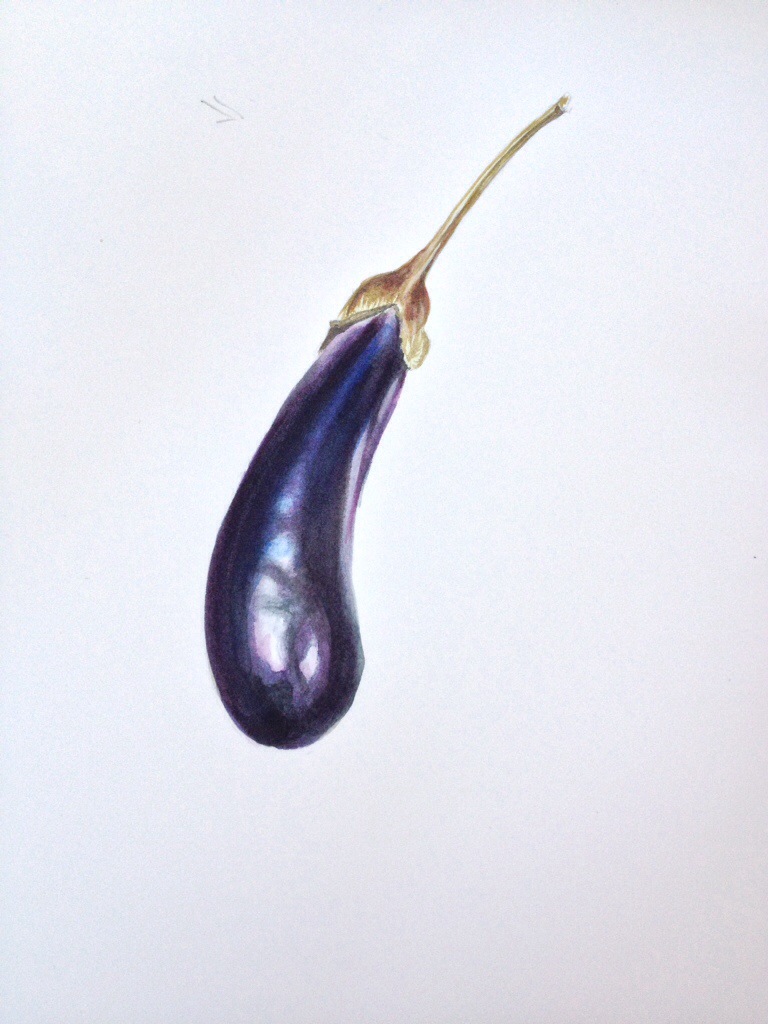
All very quick demos on the course.

Botanical art workshop – Autumn colours – in Bosham

Well, I mentioned that I was due to have a botanical art workshop from Friday until today. Are interested in how it went?

I have been allowed to take the following pictures and you can judge from these how it went. I and the people who came, would obviously be very interested in your feedback, so please comment.

20131103-225647.jpg

20131103-225707.jpg

20131103-225738.jpg

20131103-225752.jpg

Some of the subjects.
As usual, we took a photo once the position of the subjects had been arrived at. As I have suggested previously, it is worth doing this as we are painting from living things and they change over time. If something wilts, we can replace that element and if we knock something out of position, we can re-arrange. We still paint from living subjects.

20131103-230349.jpg

Enjoying the company and the opportunity to paint.

20131103-232501.jpg
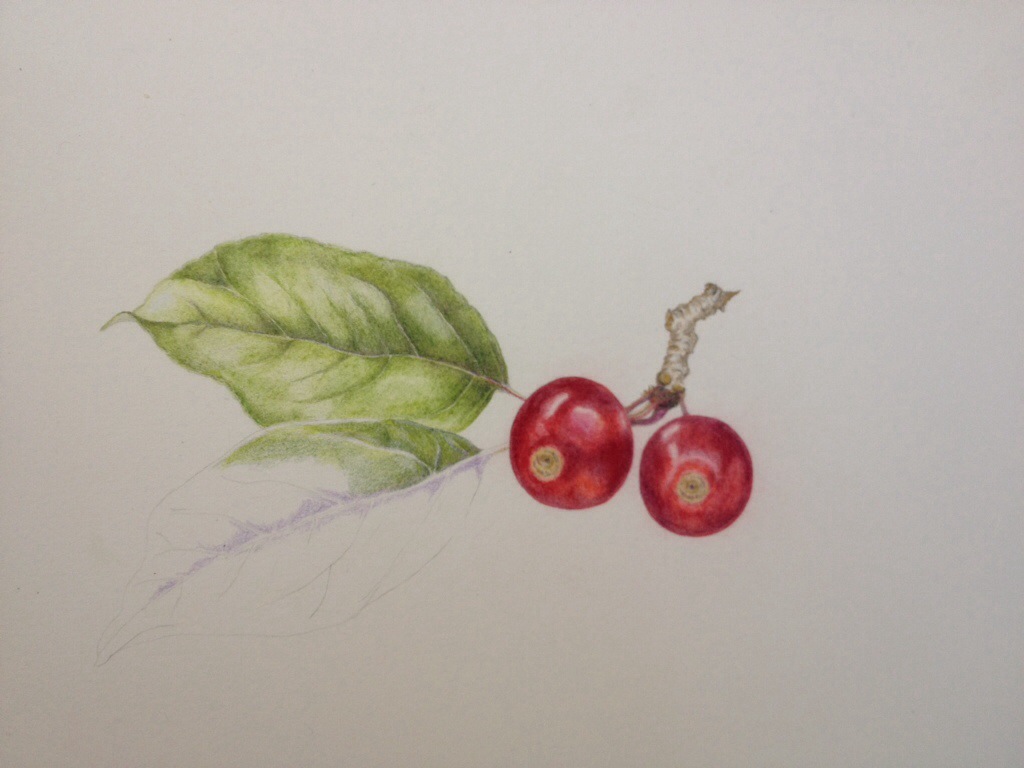
Glory tree – Coloured pencil

20131103-232604.jpg
Malus Gorgeous – coloured pencil

20131103-232705.jpg
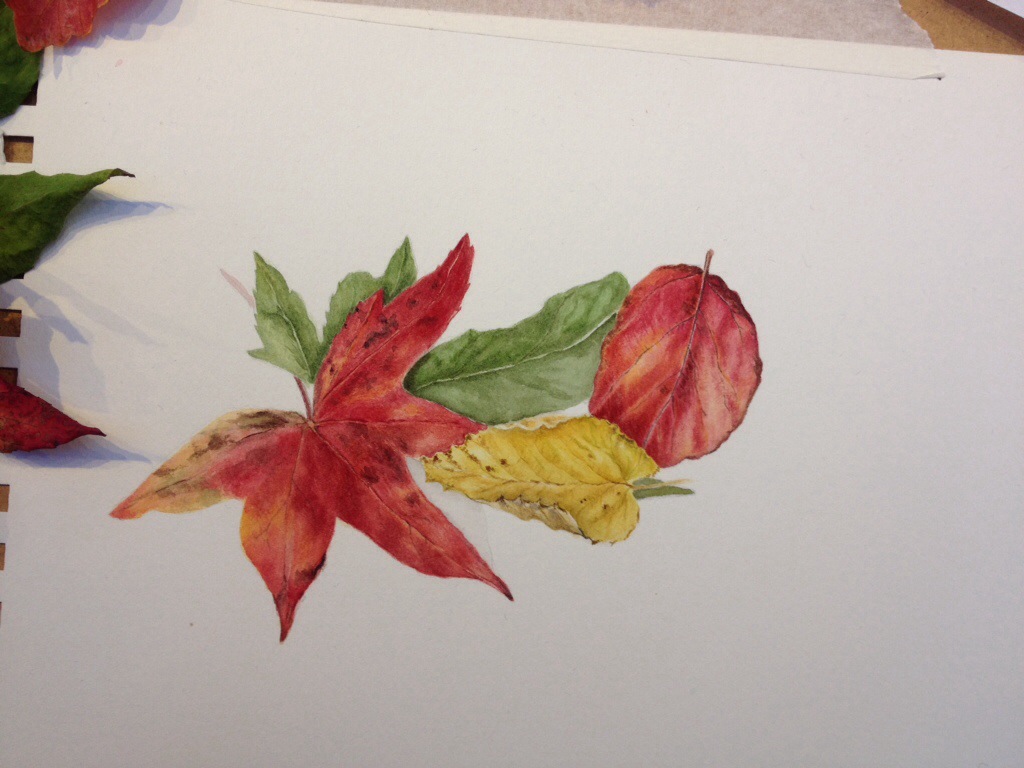
Fallen leaves – Watercolour

20131103-232756.jpg
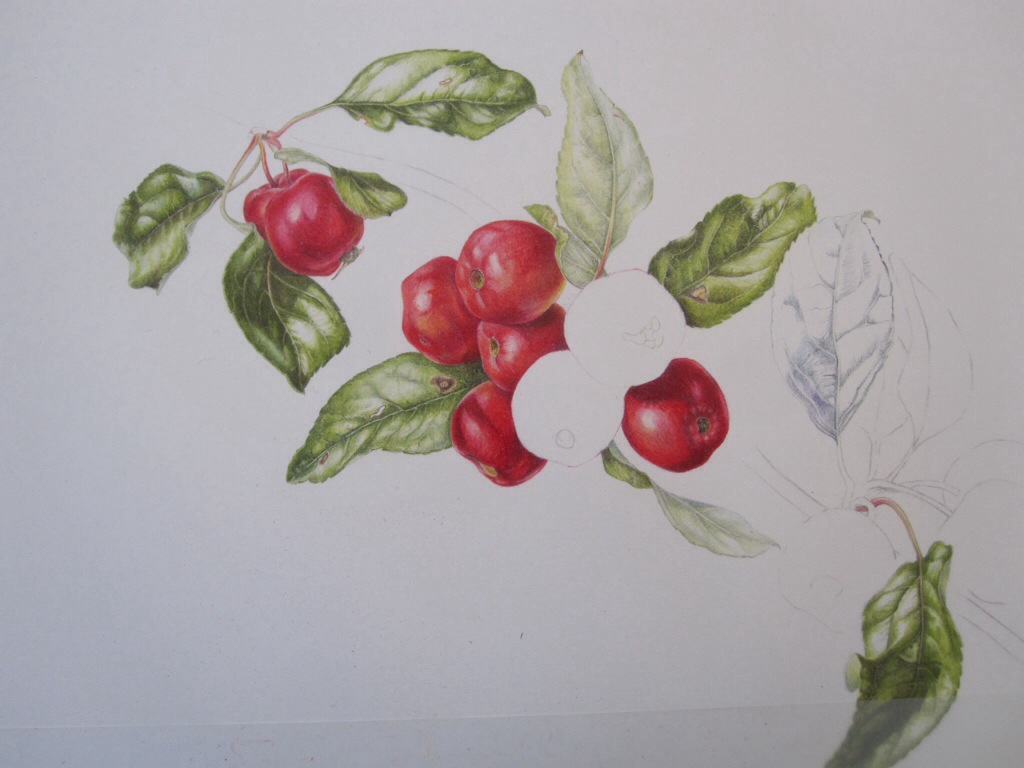
A pear plus Malus Gorgeous and Golden Hornet crab apples – Coloured pencils.

I think that you will agree that these are lovely pictures that are well on their way to completion. But, what is even more amazing is that some of the students had not done much in the way of their chosen medium previously and they accomplished so much in this one workshop. It was exciting to watch them develop. No wonder I enjoy teaching!

Do you use photographs in botanical art?!!!!

Yes. Sort of.

Some of my paintings take around two years to complete especially if I am doing a series of paintings and they include; A year in the life of………

How do you complete a series of paintings if the series is from the same genus and they bloom and fruit at similar times?

This is how I do some of it. As an example I will use the picture that I have been working on this week. Malus Gorgeous.

In the spring last year I did some sketches, colour detail and size of the blossom. I had to do five other crab apple trees at the same time and, during a ten-day period. This year I did dissections of blooms from the same trees and preparation sketches of the dissections to include in the pictures.

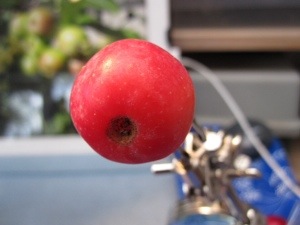
Going back to the Malus Gorgeous specifically, this summer I planned the composition and sketched this out on my final paper. I used elements from various pictures I had taken of the small tree. Bearing in mind that the apples were not full size and far from ripe and the finished painting was to include ripe fruit. The photographs were and are only a rough guide. This is the photograph I used for the main bunch of fruit.

20131018-202924.jpg

I had to enlarge the fruit slightly to the size they were likely to be when ripe, allowing for the fact that even this allowance might be slightly out. I had measured the ripe fruit the previous year so had a good idea of the size. I then started painting the leaves.

I picked the leaves I intended to paint, one at a time. None of them the ones in the photo. Some were more interesting than others, but I had to make sure that the leaves I picked were the ones arising from the fruit spur. These were the type I had included in my picture, and not those born on new shoots, as these are more leathery and differ quite a bit.

20131018-205331.jpg

I positioned each leaf as I had sketched it in my composition and painted it into the picture until most of the leaves were in place.

I have been doing the same with the apples. These are this years ripe apples. They have started falling off the branches, therefore I had to get on and paint them whilst I could – particularly if I wanted the series finished to exhibit at the RHS next year. That is if I get exhibition space.

20131018-210219.jpg

Funnily enough and, luckily, the apples seem to last different lengths of time on the trees. But there isn’t much in it, so I have to plough on until all the apples are finished.

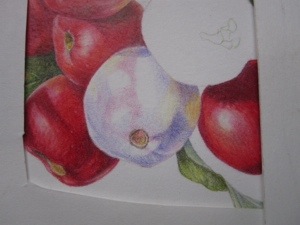
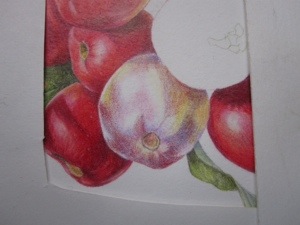
Some of the pictures of the apples being painted – with coloured pencil used dry in case anyone was wondering.

20131018-211337.jpg

20131018-211407.jpg

20131018-211426.jpg

20131018-211727.jpg

Today I managed to do all the apples. I have a couple more leaves to do and then have the dissections and branches to put in the picture. But that won’t happen yet as I have to catch up on all six pictures. The sketches Of the dissections that I have in my sketchbook will give me enough information to do this at a later time. Don’t forget that once everything is in place it has to be tied together with shadows etc in the right places.

As you see I do use photographs in botanical art, but every element in my pictures are painted from life.

By the way, comments or queries are very welcome.

My sketchbook page.

20131018-213801.jpg

Thursday, Final day in the Adirondacks

Since we have been here we have tried to get one or two postcards for people without email. We had almost given up, when lo and behold a shop appeared with one or two. Now we can rest easy, but anyone reading this will not be getting a snail mail card from us. Obviously, the use of emails etc has had a real effect on such niceties. Today we sent a picture to friends and family that will not be appearing in the blog – us as we are!

Anyway, this is our last day in the Adirondacks. We have just been planning the next but last leg of our journey back to Boston. Today, like every other day has not worked out as planned ( I hope tomorrow will), but has been far better than that. Today we had planned a trip along some tracks above us in the mountains. But when we drove up, although the trackers were well marked on our maps, they were gated, barred and bolted. What to do? We started back again down the mountain (luckily driving), got lost (with the map) and found ourselves at McCauley mountain chair lift. So up we went.

The picture to family and friends was a unflattering picture of us on the chair lift.

But these pictures are ones taken before and during the lift. Note the change in colour scheme.

20131003-212215.jpg

20131003-212325.jpg

20131003-212359.jpg

We stayed up at the top for a few hours. Robin had forgotten his painting things. I had mine and found a baby maple tree to try and capture the bright red of the leaves. It was so still up there except for the crickets and some sort of animal that had a high frequency sound- almost like something electrical. It wasn’t, but we don’t know what it was. Robin chased around the top a bit as it moved around, to see if he could identify it. In the end he gave up and settled down to watch the gentle clouds – with his eyes closed. When he eventually opened his eyes again he commented how quiet it was – he was right, he had stopped snoring so I could take out my earplugs!

20131003-213621.jpg

20131003-213700.jpg

20131003-214049.jpg

Gradually the sun began to fade a little as it got more cloudy, so we decided to pack up our things and take the trail down the mountain. I have to admit it wasn’t a big mountain – more like a large hill. But it had ‘mountain’ in its name and it was used during the winter for slalom skiing. Apparently the trail down was less than a mile, so you can make your own impressions from it.

Whilst on the top I burnt my shins and the back of my neck. I think that may probably be the last hot sun we are likely to experience this year. But I could be wrong.

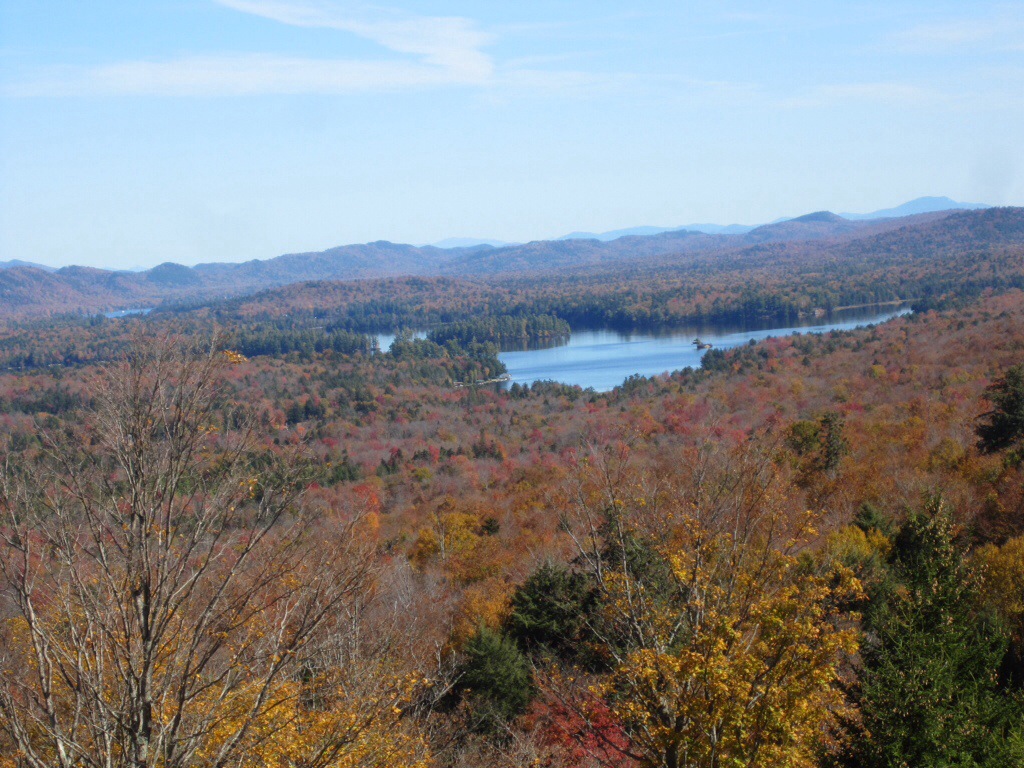
What is so incredible is that since we have been here in Old Forge, the leaves have changed so much. When we arrived on Monday we were impressed with the colours, but the next day they were really amazing. Today I would definitely say that they are on the wane. A lot of leaves have fallen, therefore there is a lot of bare branches. Where the leaves are still clinging to the trees they are often shrivelled and brown. Mixed with some of the deep and bright reds still around, it is still an incredible sight in the sharp clear sunlight.

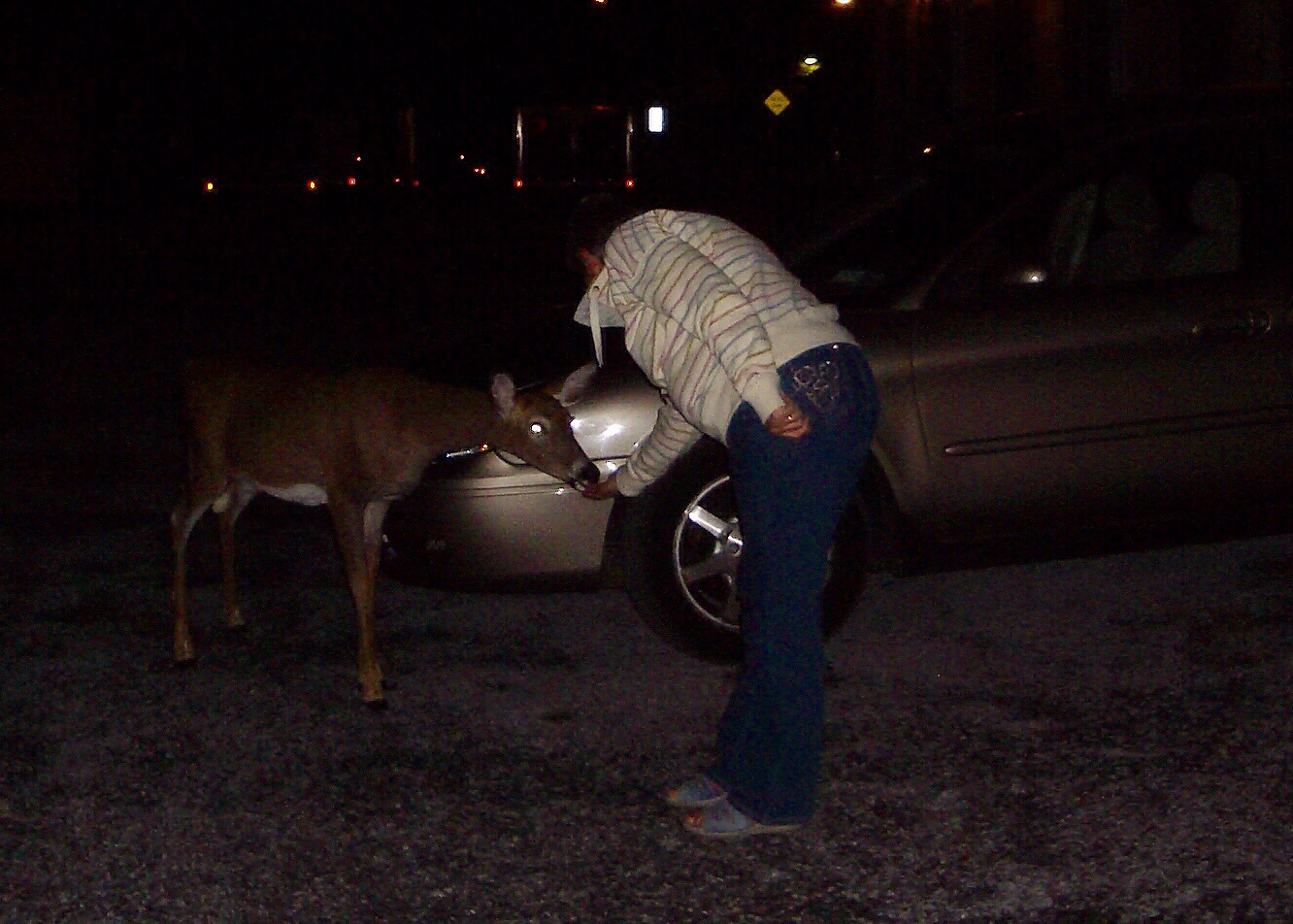
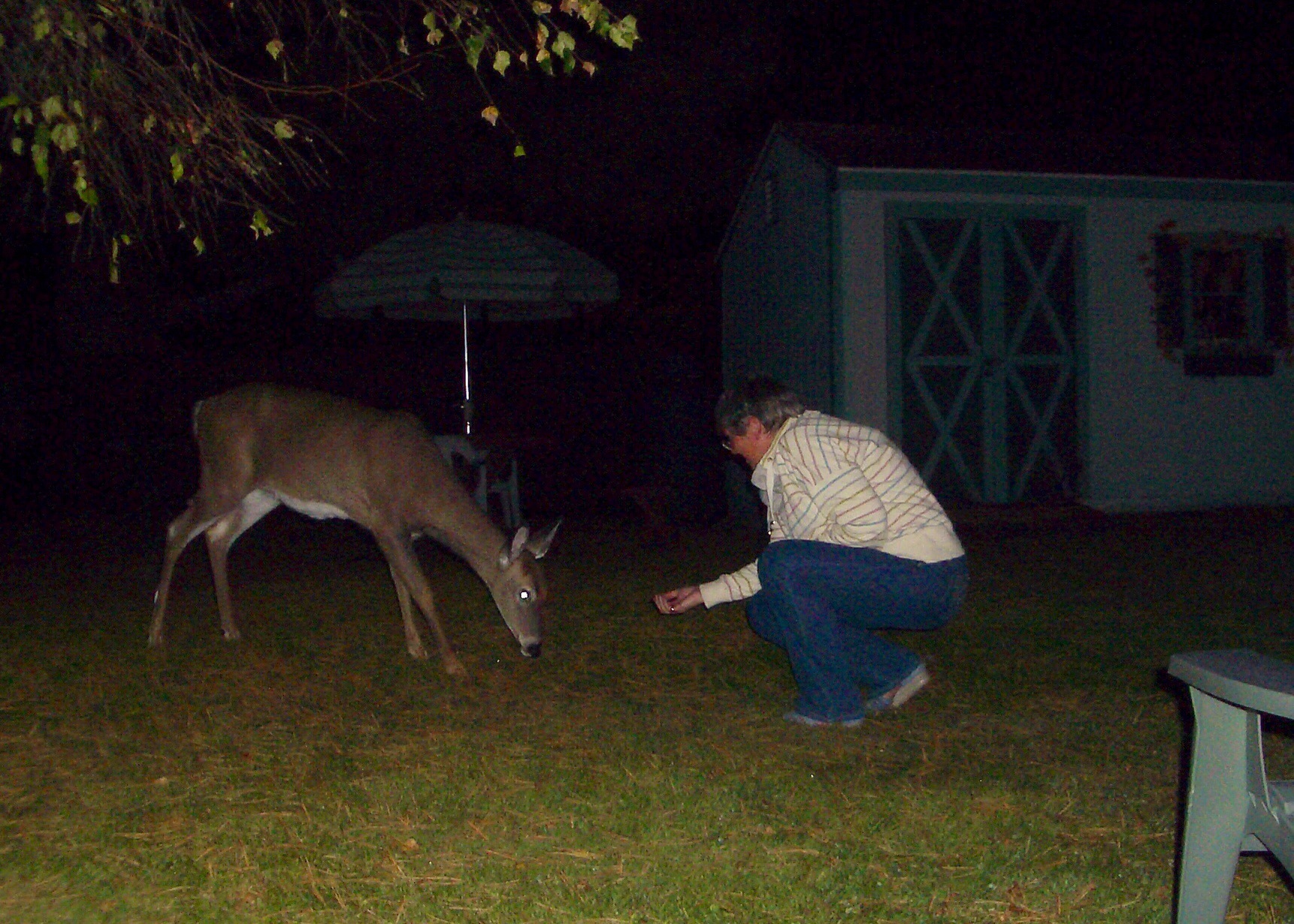
We see white tailed deer every day, mostly in the early morning or evening. They seem to like eating apples and crab apples fallen from the trees in gardens. No-one seems to mind this at all. One isn’t allowed to feed them and I haven’t seem them rummaging for food. This evening when we came back from eating our supper, one appeared outside our door. I happened to have a handful of crab apples I had picked, so held them out – not really expecting the deer to come over to me. It did. So Robin took these pictures. It is such a privilege to have a wild animal feed from your hand.

20131003-220232.jpg

20131003-220312.jpg

Sarah Simblet course

← Back

Thank you for your response. ✨

I came back nearly a week ago from a weeks course at the Ruskin School of Drawing with Sarah Simblet as the tutor. I had an amazing week away.

The course was Botanical drawing. Sarah has authored several art books, on drawing in general, anatomy for the artist, botany for the artist and is now working on a new book. She is a very good artist and also does a lot of research in the areas in which she chooses to teach. To cap it all, Sarah is a lovely person and very supportive of her students when struggling with new media.

The reason for going on the course was to draw in pen and ink. I have always been intimidated by this medium and therefore hoped that I would be less so once I had had a little expert tuition. Sarah constantly draws in black and white and in reality with her work you feel that you are looking at it in colour. Getting to that level of expertise would be something I would love to achieve, but it possibly won’t be in this lifetime.

Sarah got us to relinquish our feelings of control when drawing by using unusual implements. After this she encouraged us to build ourselves up again using the new medium (ink) and new implements (pen). It was exciting. I can’t show you pictures of the pulling down, but this is an example of learning to build up again. It is a plant I have never seen before – Molucella laevis. Very attractive. In fact whilst in Oxford I did see another painting of one.

We went to the Herbarium and were given a treat. All of Ferdinand Bauer’s work that went into the Flora Graeca was laid out for us. It was amazing. His sketch books and all his notes were there. He had a colour coding system that he used when doing his sketches in situ. He could spend years away from any studio and when he returned he used his notes to make his botanical paintings for the Florum. Therefore we were able to see his actual sketches, notes and final paintings before they were eventually published.

I made new friends on the course who are from around the world. Two I will be meeting again in a few weeks time at the opening of the Hunt Institute of Botanical Documentation Exhibition in Pittsburgh.

I am now coming down to earth and catching up on all I need to do. But  hopefully I will get my act together to keep the blog updated.

Thank you for reading this. I do recommend Sarah Simblet’s summer courses.

Molucella laevis 180713

Teaching with Fieldbreaks at Goodnestone Park Gardens

On Monday of this week I went to Kent to teach at Goodnestone Park Gardens. What a beautiful area. It is so peaceful and they are so welcoming there.

This is the second year that I have had classes at Goodnestone Park with Fieldbreaks and the workshops are seemingly more popular each time.

I had a lovely group of people with half of them using coloured pencil, one eventually chose to use graphite and the remainder watercolour.

I think that things were about a week behind in comparison to where I live. In some places you could almost see the green tips begin to appear on the hedging, there were loads of daffodils, no tulips, the Magnolia x soulangeana was still closed but nearly ready to burst although the Magnolia x stillata was fully open and the Camelias were glorious. There was in fact a lot to choose from if only you looked and were able to see. The flowers eventually chosen to paint were the above, plus Primroses, Periwinkle, Hellebore and Fritillary. The results were very good and as far as I can tell, all those taking part were pleased with their results.

I get quite chuffed when students achieve what they set out to do – and in some instances even exceed that.

The only thing I hadn’t been prepared for was the summer warmth. I had layers to keep me warm, but even so I hadn’t expected it to be as warm and lovely as it was.

I will be having another workshop at Goodnestone Park with Field Breaks in June. Come and join us in this peaceful environment.

Starting last picture again!

Well. I guess that any artist feels in a quandary when they feel a picture isn’t going as well as they want it to. But, starting a botanical art picture again, and at that, one in coloured pencil, needs some determination.

After starting the most recent Crab apple picture, nothing seemed straight forward with it. Each leaf was an effort and heavy going and I felt that its expression of lightness was compromised. Each one seemed to take forever and didn’t seem quite right. After I took breaks, going back with fresh eyes helped, but I still had the overall feeling that it wasn’t the best picture I had done to date.

Unfortunately I am a perfectionist and if what I am doing isn’t the best I can do, I’m not happy!

Anyway, I made the decision to start it again. This time the leaves seem to be developing much better and I am happy with the result so far. I just have to make sure I don’t mess it up over the rest of the picture. I have a long way to go, so anything can happen.

By the way, I have decided to say which crab apple I am doing at the moment. It is Malus Evereste. A beautiful stripy little apple. Some of them have double ‘bums’ underneath!

I decided on this one a couple of years ago as someone brought some branches to one of my workshops. I ended up doing sketches from the ones left behind after the workshop. Since then I have also found a source for a tree to paint in the village. But, as with the other five pictures in the series, I can only include the information I have already received.

Attached is the part of the painting completed before I ditched it!

20130318-233725.jpg

Prep for RHS Botanical art exhibition 2014

Following on from my last exhibit in 2010 with the RHS, I am working up to another exhibit. The question is, will I get the required number of pictures done in time and will I be offered a place in the London exhibition?

Last time I painted a series of Magnolia x soulangeana pictures in watercolour. This time I am painting a series of Crab apple pictures in coloured pencil. Each of them will be a different crab apple.

I have done a certain amount of preparatory work. I have sketches of each of the apples and during the short flowering time last year I did sketches of each of this chosen plants in flower. I had my work cut out doing the sketches in time.

So far during the winter I have decided roughly what needs to be included in each picture and have started a couple of the series using the sketches I already have of the apples. I intend to keep people up to date with what I am doing.

I foresee the first significant problem arriving in April during the short blossom time as I have decided to do detailed drawings from dissections of each of the plant. Flowering lasts about two weeks!

20130309-001641.jpg

Follow my blog to see how the process develops.

Why would someone go into my garden and strip a rose tree?

Today I started a three-day botanical art workshop on Roses. My garden has a lot of roses as we have planted quite a few, mostly with a beautiful scent.

When we originally moved into our home five years ago there were no roses in our front garden which is south facing. We changed that and in the evening the smell is very powerful and heady.

One of the most impressive looking roses is a standard called ‘Deep Secret’. It is a rich velvety red rose with a particularly rich scent that suits its appearance.

This summer it was covered in juicy buds which have only just started opening. It was an ideal subject for my students this weekend. I say was because……..

…….This morning when taking my students out to cut a rose each as a subject, EVERY SINGLE ROSE AND BUD HAD BEEN CUT OFF. Not only that, the flowers had been picked to pieces and had been dropped in a trail along and out of our drive into the lane. Why would anyone do this? Why would someone be so destructive?

Luckily I had other roses and all were able to choose one they liked. Day one of the first day of the workshop has gone off without further complications. By the way the students are a lovely group of people.