


In my last blog I showed you how careful I generally am to cover my artwork as I go along. But in this case I had finished the piece and had it propped up by my computer to scan and print it.
Unfortunately I ran out of pigment in the printer and needed to refill. Once this was done, I sat at the computer to check everything on the screen, looked up and saw this magenta splash across the artwork. I was shocked. How many hours had I used to no avail?
Be careful to keep artwork safe!
In my previous blog I wrote in general terms about the materials I use, including colour. My sketchbook contains notes of the colours used in the sketches, but these are only a guide for the final artwork.
The sketched colours are on white paper and the final artwork is on a warm vellum which can affect the overlaid transparent paint. If possible I try to match up the colours I used in the sketches if I don’t have enough live material to work from. For example, the leaves often change colour over a growing season and if I’m unlucky I might be painting young leaves in the autumn. This happened with the Bilberry leaves.
I try to limit the number of pigments I use in a picture but still have favourites that appear in most paintings.

As an example, I used these colours in the small cranberry picture:
- Quinacridone Magenta PV122
- Quinacridone red PR209
- Perylene violet PV29
- Quinacridone Gold PO49 (I don’t think single pigment can still be obtained)
- Winsor Blue Green PB15.
The last three are a must for me, but I might also use a brighter yellow or warmer blue. On this occasion I added a lemon yellow to lift the green in the leaves.
Introduction of graphite
Getting graphite on vellum is normally considered a negative. Graphite does not seem to work in the same way on vellum as it does on paper because of course it is slightly greasy and tends to slide around on the surface.
I wanted sections of graphite in my pictures to try and give some relief to the colour. The compositions are quite small with a lot of detail. To separate details from each other I wanted to allow some of the picture to fall back and behind sections of colour to create focus. I therefore decided that elements conveying habit would be either in graphite, or in graphite with a slight colour wash. But how was I going to get the graphite to go on reasonably evenly and to sit?
I checked out how other botanical artists had handled using graphite on vellum, then tried out various ways of developing a technique on scraps of vellum.
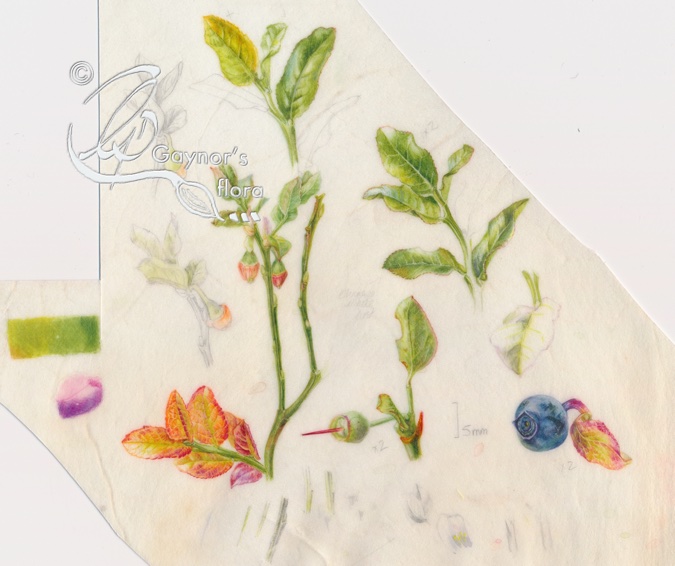
Luckily, as with graphite on paper, the use of water on top helps it to adhere to the surface. I also learnt that using a little mucky pigment/graphite water and allowing it to dry would also help to control use of the graphite on top. But, some of my details were much too tiny to make full use of this technique.
The way forward was to use a combination of graphite pencil for the finest detail and soluble-graphite. I generally used a graphite pencil first – possibly a 2H, then with a very small brush I either went over it with pure water or used the water mixable graphite. I found that the graphite worked much better where I had used a light watercolour wash first.
Process for each picture
Once each composition was complete and transferred to the vellum mounted block, I started with the watercolour sections.
Except for the Cloudberry, the main branch which catches the eye, was enlarged to twice its normal size. I normally started with this so that I could determine how much other elements of the picture needed to come forward or fall back. After this I completed the flower and fruit sections.
Once the watercolour-only sections were complete, I worked on the graphite sections. As mentioned before, the use of graphite means that these sections fall a little into the background and give relief to the eye of the beholder. But the detail in those sections needs to be just as clear as for the remainder of the picture. Each part of the picture needs to give new information otherwise there is no reason to include it. In this case, the graphite sections were done life-size.
Last of all came the scale-bars. To work out the best placements for these, I scanned each picture onto my computer and digitally placed and sized the scale-bars, comparing them from picture to picture. This happened in January 2023 when preparing for professional scanning of the artwork.
Actually drawing the scalebars onto the final artwork caused most headaches. Applying the graphite in even lines on the vellum was more difficult than doing the line drawings, but I got there!
Now I will write about each species individually – starting with the next blog 30 April 2023.


 GAYNOR'S FLORA