FORAGING PLANTS IN THE NORWEGIAN MOUNTAINS: FROM BOG TO SAND.

The title of my exhibit at the “RHS Botanical Art & Photography Show” is as above:

Foraging Plants in the Norwegian Mountains – From Bog to Sand.

Six of my watercolour and graphite paintings are exhibited by order of habitat starting with those growing in the wettest environment to those in the dryest. Seven paintings were completed not just the six, therefore it was a difficult choice to remove one of them. The second one shown below, the small cranberry, is not in the exhibition.

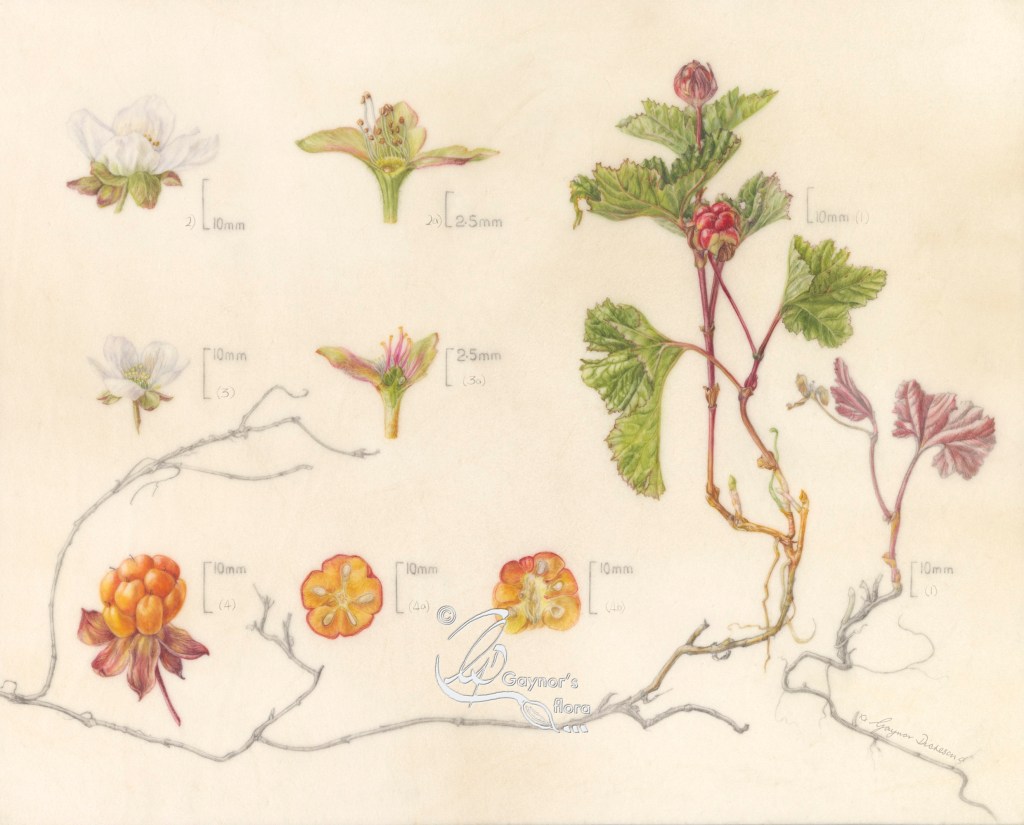
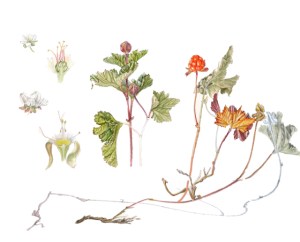
1. Rubus chamaemorus – Cloudberry – Multe
Watercolour & graphite on vellum.
August 2022

1) Habit
2) Male flower – 2a) LS Male flower
3) Female flower – 3a) LS Female flower
4) Fruit
4a) TS fruit
4b) LS fruit

2. Vaccinium oxycoccus subsp. microcarpum – Small cranberry – Små tranebær
Watercolour & graphite on vellum.
January 2022

1). Habit
2). Flower
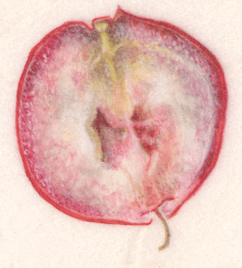
3). TS fruit
3a) LS Fruit
3b) Fruit

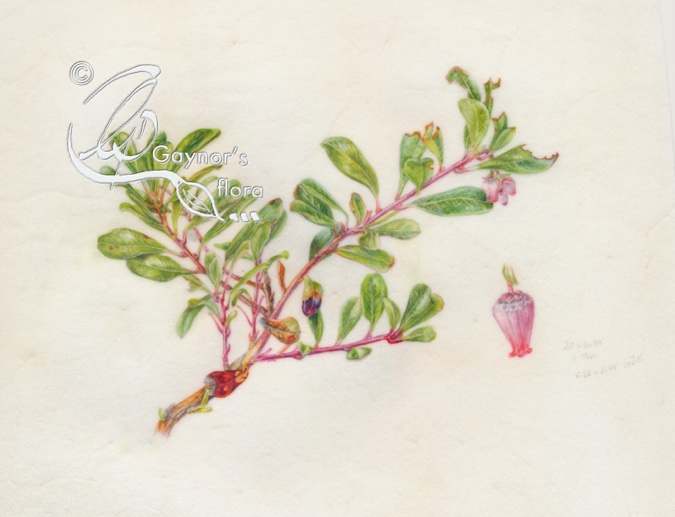
3. Vaccinium uliginosum – Bog bilberry – Skinntryte
Watercolour & graphite on vellum.
December 2021

1) Habit
2) Flower pair
3) Fruit
3a) TS fruit
3b) LS fruit

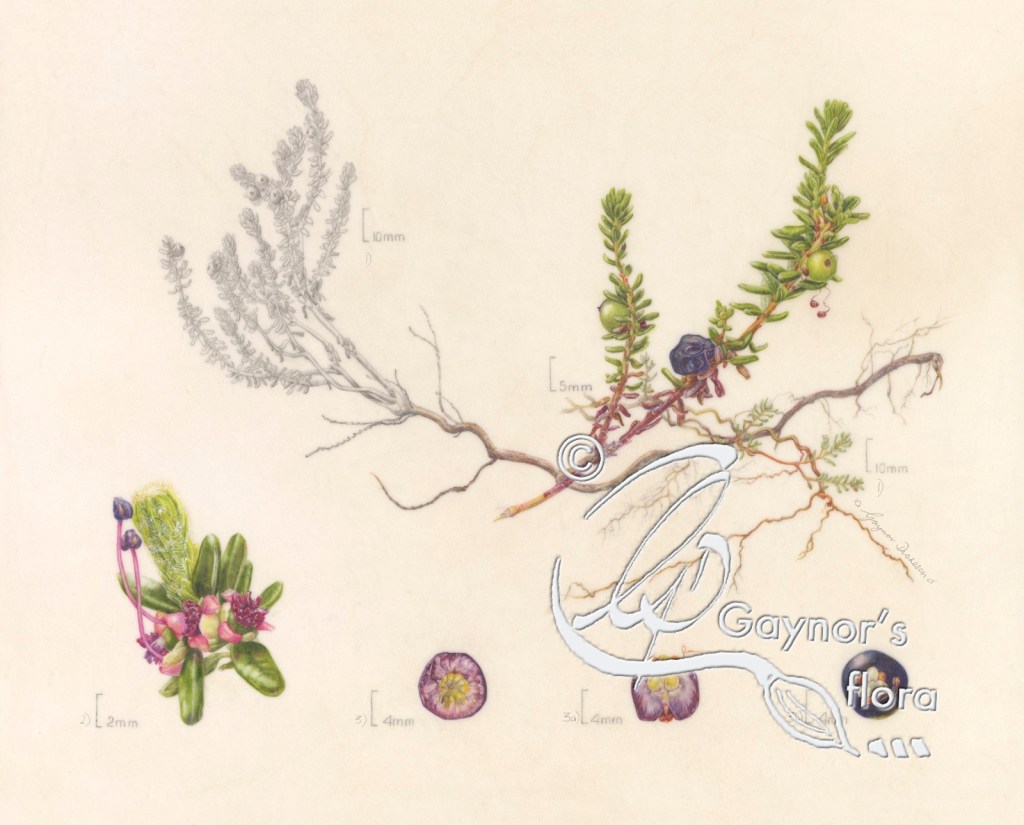
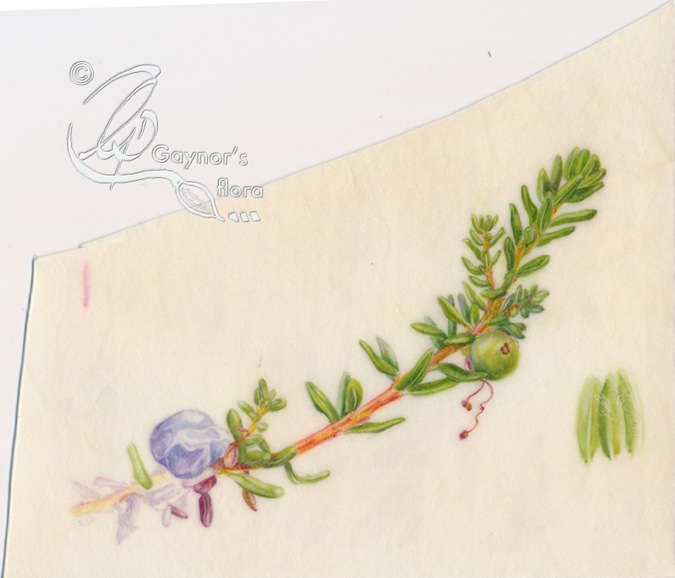
4. Empetrum nigrum subsp. hermaphroditum Mountain Crowberry – Krekling
Watercolour & graphite on vellum.
January 2022

1). Habit
2). Flower
3). TS fruit
3a) LS Fruit
3b) Fruit

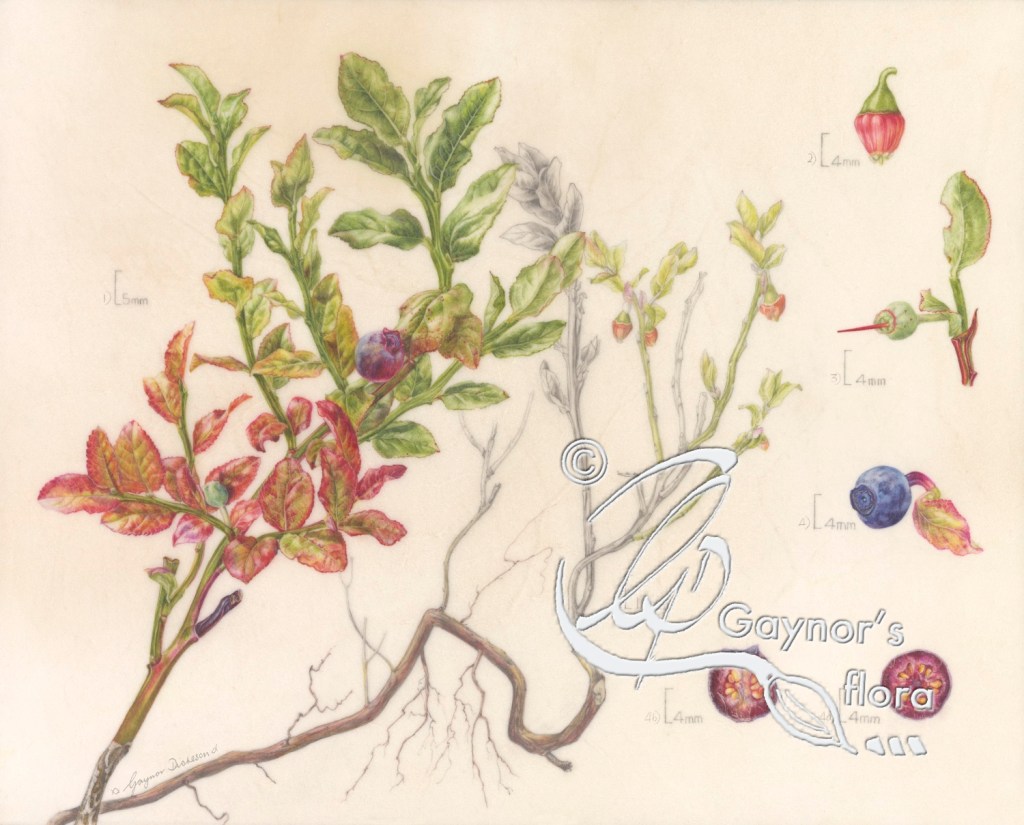
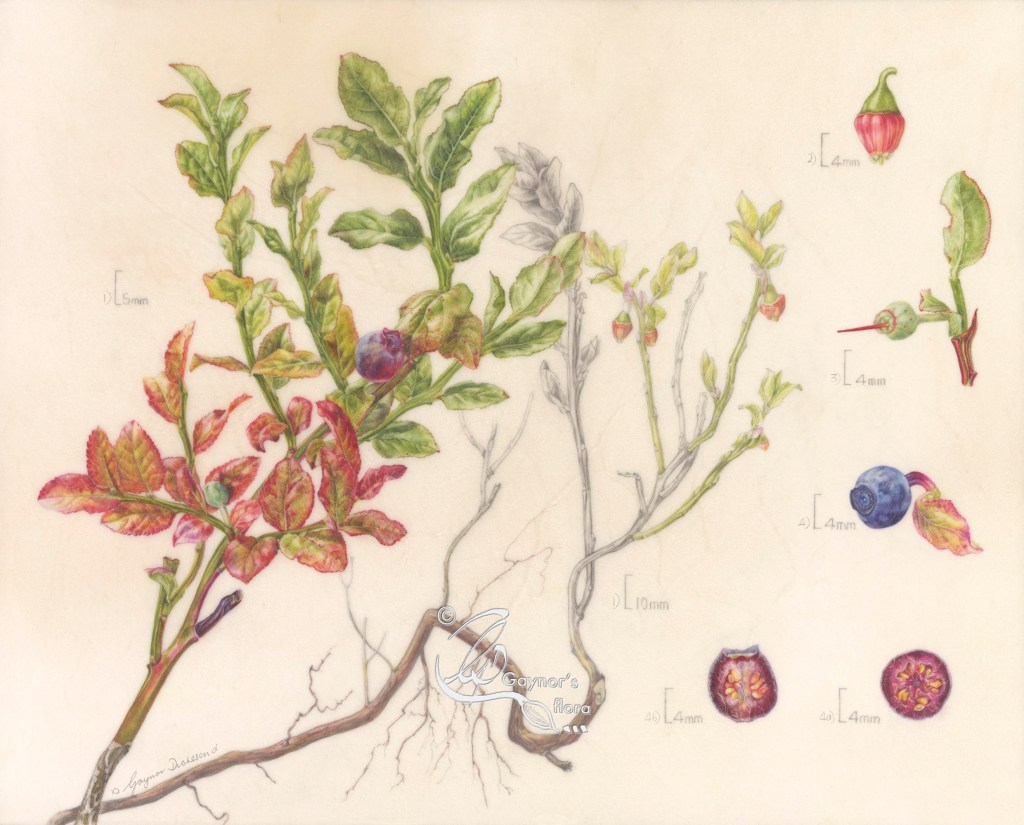
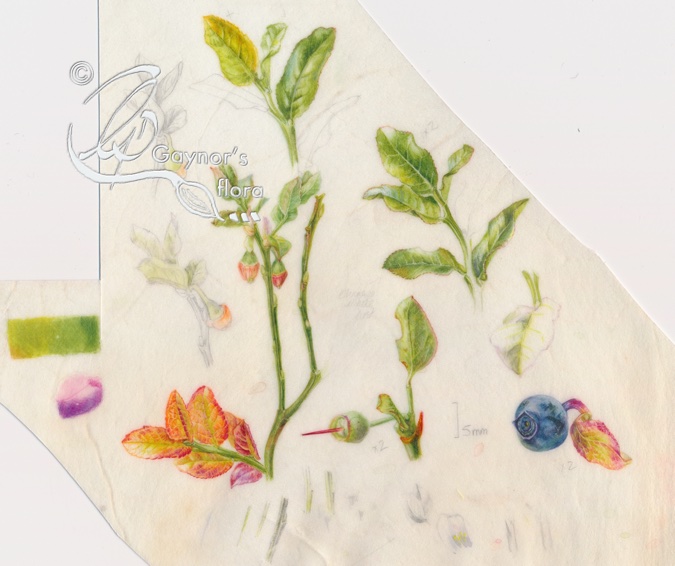
5. Vaccinium myrtillus – Bilberry – Blåbær Watercolour & graphite on vellum.
March 2022

1) Habit
2) Flower
3) Immature fruit
4) Fruit
4a) TS fruit
4b) LS fruit

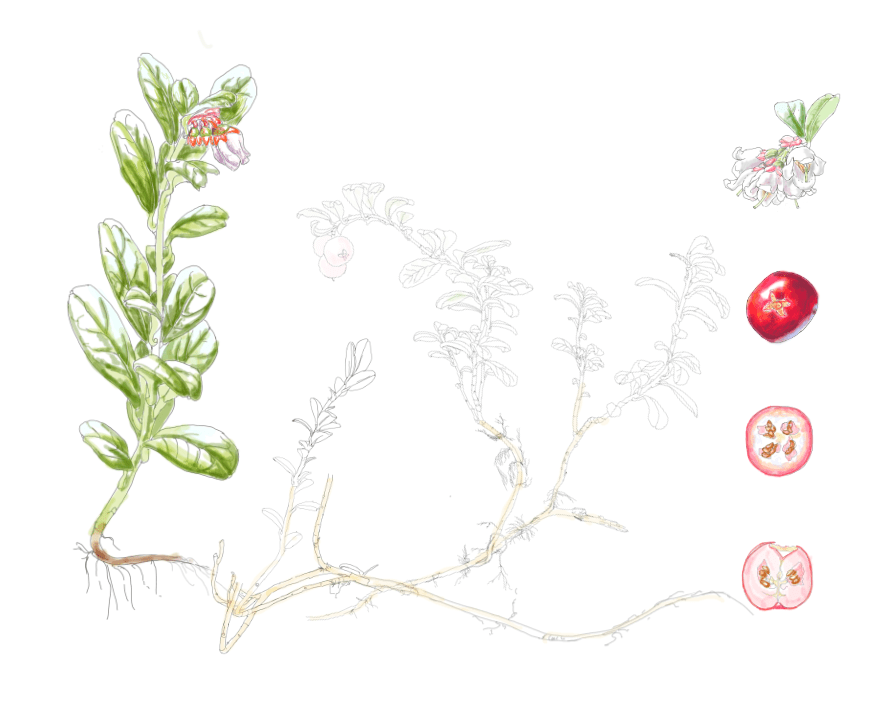
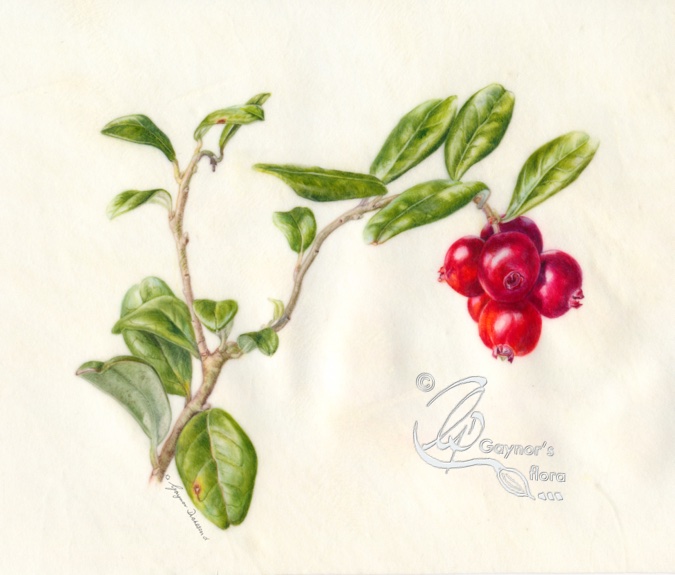
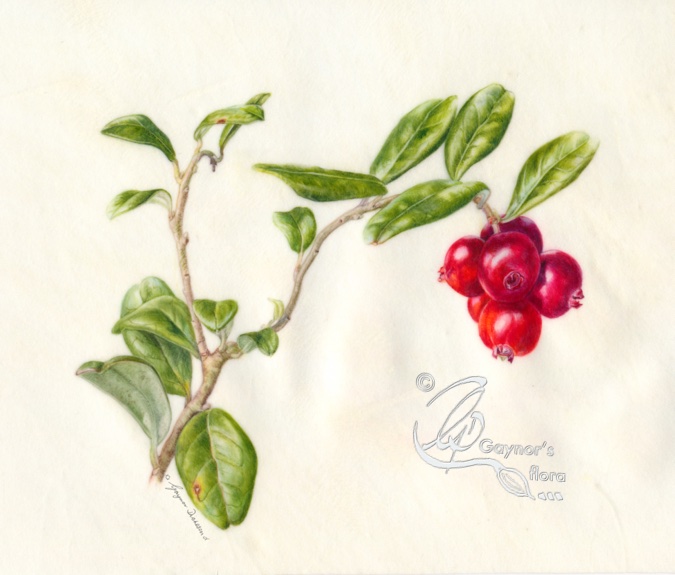
6. Vaccinium vitis-idaea  – Cowberry/Lingonberry -Tyttebær
Watercolour & graphite on vellum.
November 2022

1) Habit
2) Flower cluster
3) Fruit
3a) TS fruit
3b) LS fruit

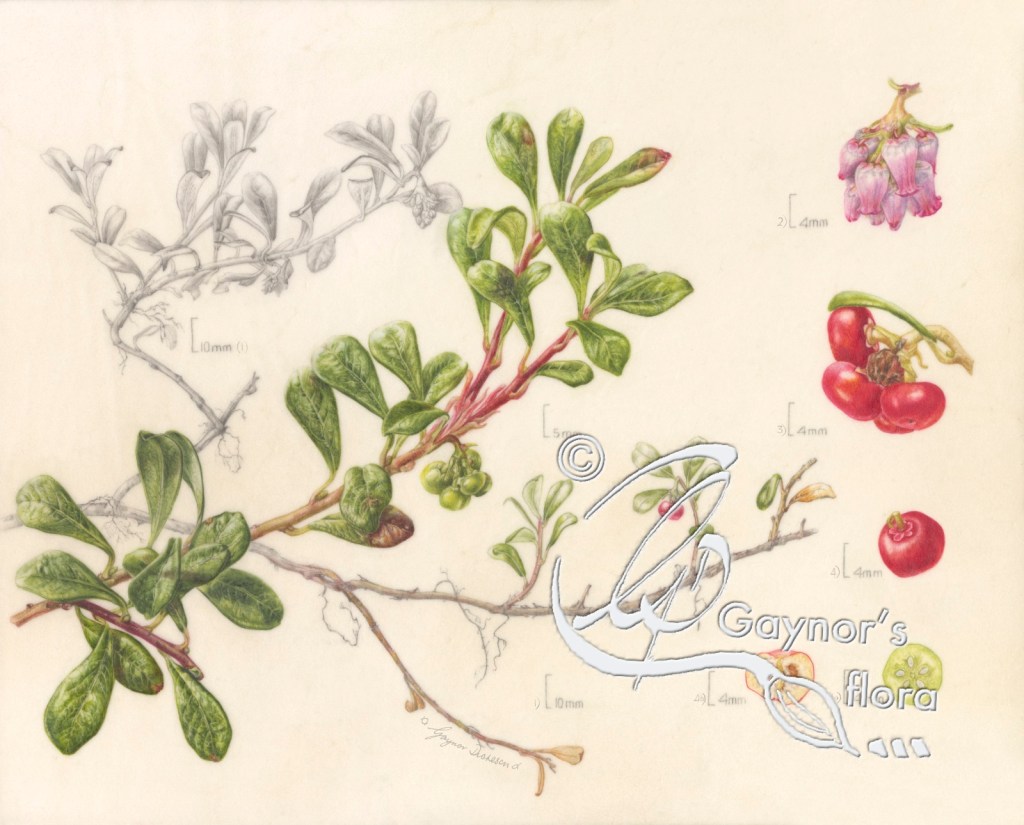
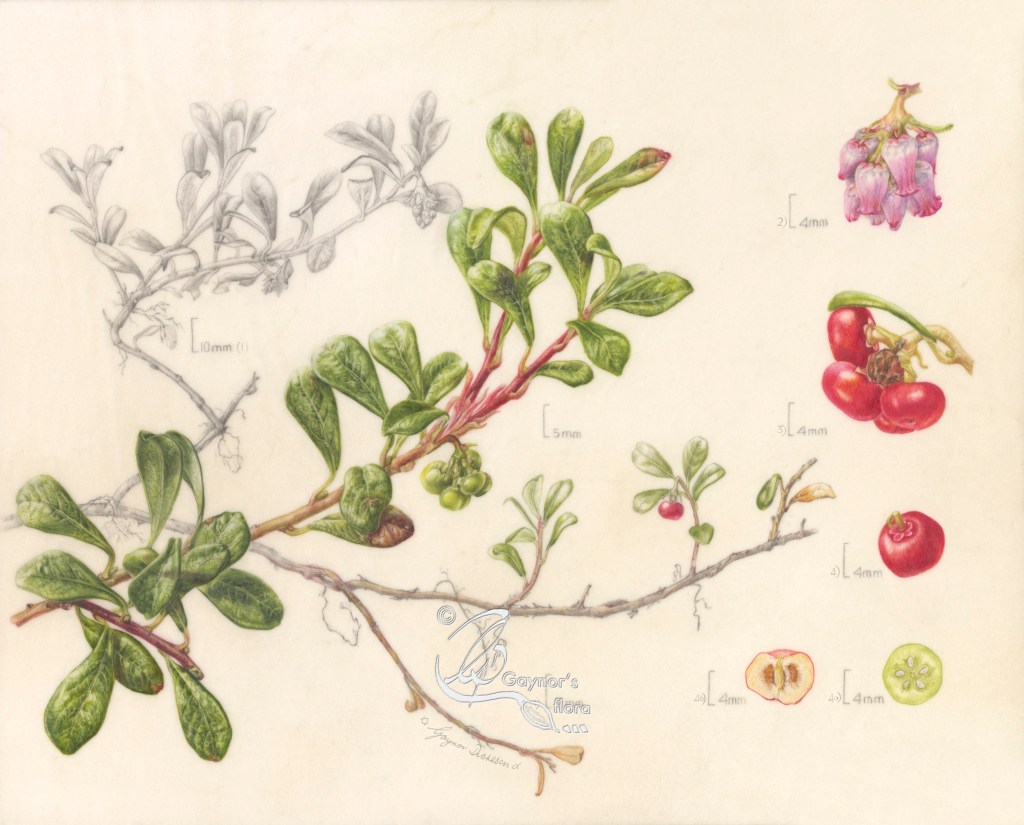
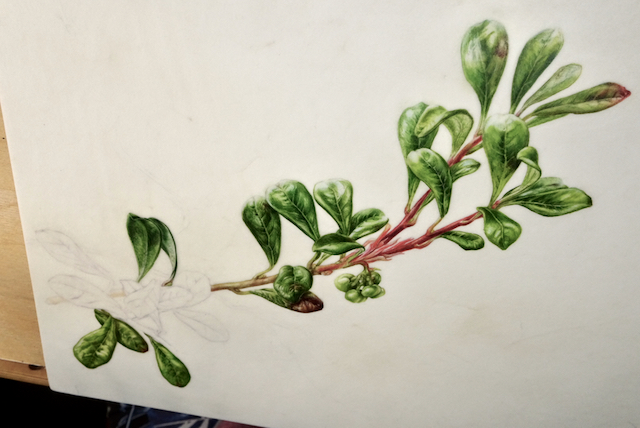
7. Arctostaphylos uva-ursi  – Bearberry – Melbær
Watercolour & graphite on vellum.
October 2022

1) Habit
2) Flower cluster
3) Fruit cluster
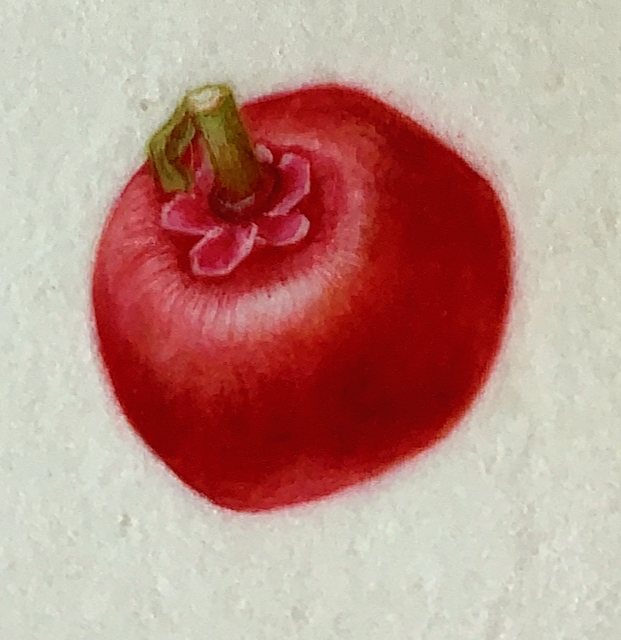
4) Single fruit
4a) TS immature fruit
4b) LS ripe fruit

If you have read the blog series you will understand that the Cloudberry and Small cranberry enjoy the wettest environment – bogs and marshes, whilst the Bearberry is often found on a sandy forest floor. The other species are found in various types of environment from damp woods to harsh mountain tops. Some, like the Bog bilberry will grow very well just about anywhere as long as it has water and plenty of sun.

All of the plants in this series live in the Subarctic part of the world and have always provided a lot of nourishment for those living in the far north, the rest of us a little further south and of course animals that roam the area.

Some of the plants typically don’t grow in certain areas as witnessed by the difficulty I had finding the Bearberry. In very hot and dry years some plants produce next to nothing; Cloudberry and Small Cranberry are good examples. Can you imagine the risk that Global warming brings to these plants as well as to us. The warmer the planet gets, the more further north these plants are likely to move making it even harder for us and the animals they support, to find them. As it is, plants that can normally be found further south in Europe, are now beginning to appear in Norway; their pollinators moving with them and having a negative effect on the species that belong.

When choosing to study and paint these plants I didn’t realise how much I would learn about them. I loved the plants (and their fruit) before this, but now have so much respect for them and the environment in which they grow. I hope that I have been able to pass on at least a smidgen of this.

Thank you for following this series.

Latest news: I am really pleased to say that following the judging process yesterday, 14 June 2023, the judges decided to honour me with a Silver Gilt medal. The award ceremony will be held this evening at the Saatchi Gallery during the preview to the exhibition opening tomorrow.

I look forward to getting detailed feedback about my exhibit from the judges this afternoon.

Foraging plants in the norwegian mountains – 26. Bearberry Pt. 2

Depending upon where one lives and picks fruit in Norway, some people are not aware of the bearberry and its identification problems. In fact, initially I had real problems finding an example of the bearberry to draw from.

The first find of the Bearberry plant in 2017

Many years ago I had experienced the misfortune of mixing up the two berries and knew that they could grow in similar locations. But to begin with I didn’t find any near the cottage we had rented. We therefore went on a field trip in the car and drove to an area where I knew they had grown 50 years before. Unfortunately, things had changed, and we found houses instead!

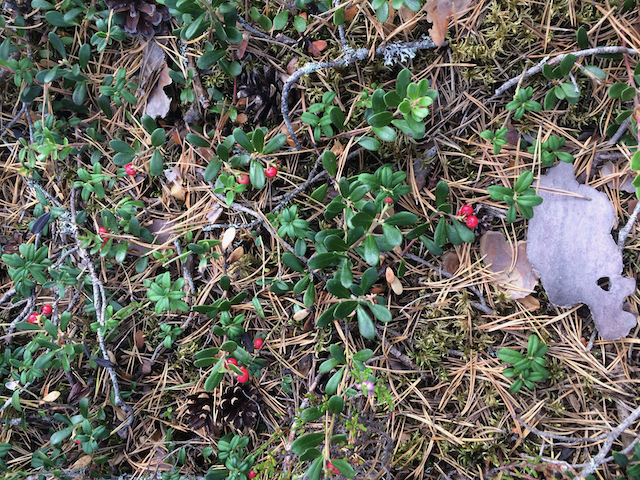
Eventually, in the next valley, we found both bearberry and lingonberry growing together on a sandy forest floor.

The following year in 2018 my poor husband enjoyed a solo 200km return journey to get a sample for me! Fortunately I was using GPS to record the position of every specimen found and he used this to find the forest area.

It was with relief that in 2019 we eventually found some growing very well, close to the main road below our rented cottage up in the mountains. Now I could truly say that all of the plants were from the same area!

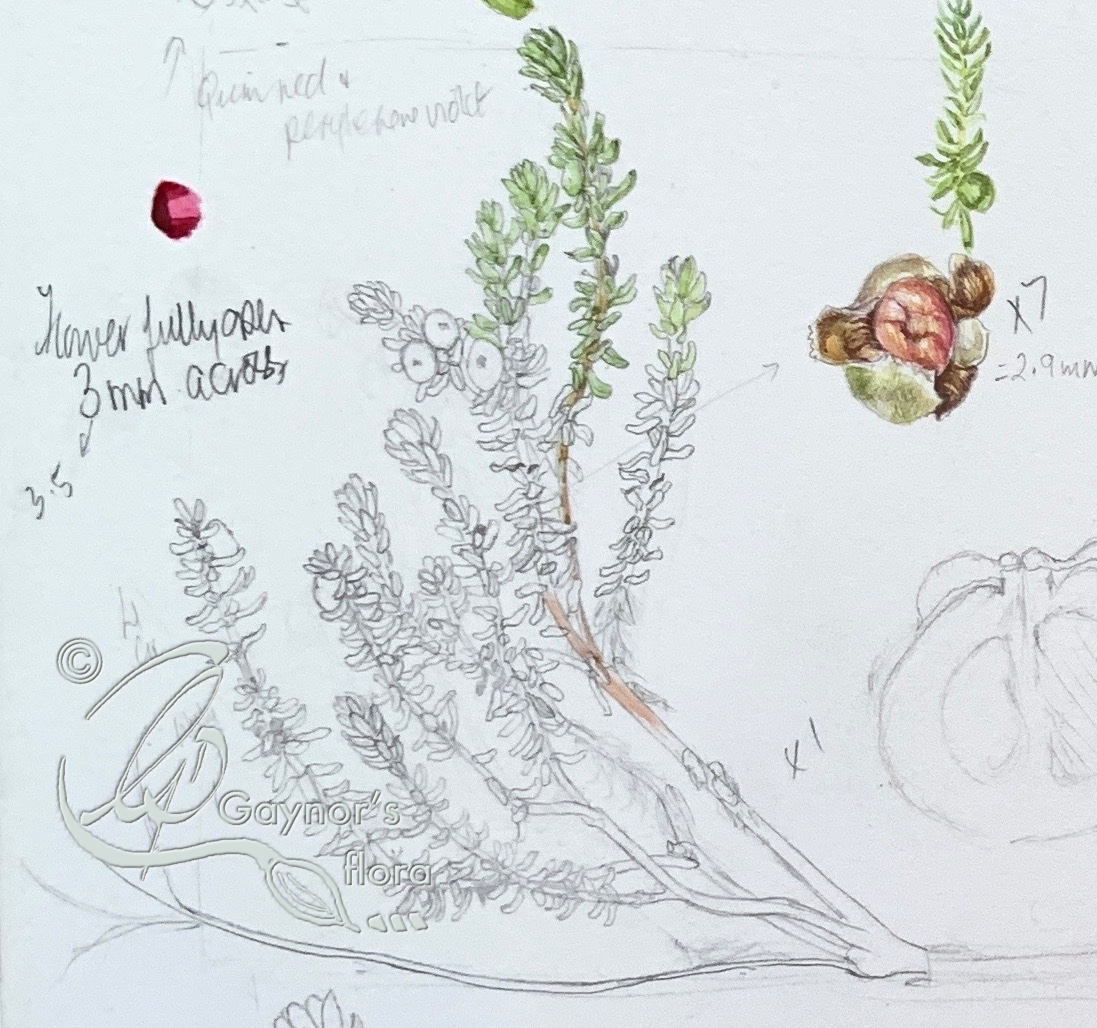
Bearberry sketch from my ‘perpetual diary’

I did quite a few different sketches of this plant and like so many of the  plants in this series, found that it often starts setting its buds in the autumn in preparation for the following season.

I therefore decided to wait until the following year to try and get an immature fruit. As it happens, I had to wait four years until I could get a sample at the right level of maturity. But at least I managed it and got some good detail.

Bearberry sketchbook page. As usual a lot of research found space along the bottom of the page.

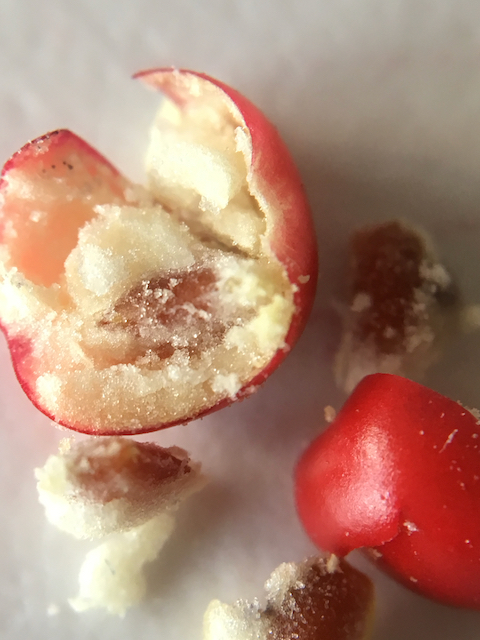
But I think one of the biggest headaches when collecting information was doing a transverse section (TS) of the fruit. The fruit contains relatively large hard seeds, as it is a stone fruit. Carrying out a LS on a ripe fruit was simple as I had no need to cut through any seeds.

But the TS was another kettle of fish! Each seed was about 2.3 mm long and very hard. There was no way I could cut through this without crushing the whole fruit and destroying the chance to draw this section as I had for every other picture. 

My trial piece on vellum helped me with my colour decisions for the final artwork. I started the sketches in 2017 and in June 2022 I started the final piece, finishing it in October 2022. 

A squashed TS!
Bearberry trial piece on vellum

The native range of this species is Subarctic to N., W. & Central U.S.A. including the UK and Norway.  It is a subshrub and grows primarily in the temperate biome.

Source: Kew – Plants of the World Online

The photos above are a quick reminder of my process for this series. The various elements are traced to the vellum block and sometimes I go over these with a non-permanent watercolour outline. The main branch has generally been completed at twice the natural size and the sections in graphite or graphite and watercolour wash are normally natural size to show habit. Graphite is used to allow these sections to fall into the background making the overall picture less heavy.

Bearberry leaf tea infusion

Pour 150ml of boiling water over 2.5g of finely chopped or coarsely powdered, fresh or dried bearberry leaves and strain after 10 to 15 minutes. If you want to keep the content of tannins as low as possible, prepare a cold-water maceration. To do this leave the leaves in the cold water for 6 to 12 hours, then strain and heat the tea.

Uses

Inflammatory diseases of the urinary tract – NOT KIDNEY problems – “if treatment with antibiotics is not necessary.” Bearberry leaf infusion is classified as traditional herbal medicinal. Based on many years of experience, bearberry leaves can be used to treat symptoms of recurrent cystitis (e.g. burning sensation during urination and/or frequent urination in women), if there are more serious causes or symptoms remain, seek medical attention.

Tea infusion: drink a warm cup of bearberry leaf tea up to 4 times a day;

See https://arzneipflanzenlexikon.info/en/bearberry.php for more information.

Bearberry preserve

Ingredients:

  • 2 quarts bearberries, rinsed and without stems
  • Sugar (see instructions for amount of sugar)
  • 1 teaspoon lemon juice
  • 1 package pectin (about 3 ounces)

Instructions:

Put the berries in a pot and cook over medium heat until soft; about 5-10 minutes. Crush the berries, then run them through a sieve or cheesecloth to remove the seeds. Retain as much of the pulp as possible.

Return the juice and pulp to the pot, adding one cup of sugar for every cup of juice and pulp. Add the lemon juice, mix thoroughly, and heat to a boil.

Boil for a minute or two, then stir in the pectin. Allow the preserves to cool and set.

www.virily.com

My last blog about this series of pictures is scheduled for 15 June 2023. It is the day we get the results of the RHS judging, so I hope to include my result. I will show the final pictures which I have been keen to conceal until the judging process is complete.

Foraging plants in the norwegian mountains – 25. Bearberry Pt. 1

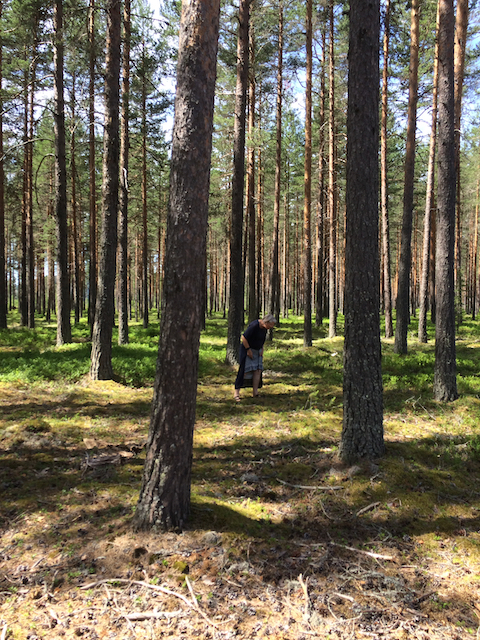
The forest floor at Vikersund
Bearberry fruit

Arctostaphylos uva-ursi or the common English name of bearberry and norwegian name of melbær. 

The Norwegian name, when translated, literally and aptly describes the melbær,  flour-berry. The berries are edible, dry, tasteless, and floury. But they are considered an important  ‘survival food’ and eaten in sauces by some northern indigenous people with fish, venison, elk and bear.

When describing another plant in this series, Vaccinium vitis-idaea (cowberry/lingonberry), I mentioned that these two plants were the main reason that I wanted to do research and illustrate this series of plants. I wanted to show how they can be distinguished so that both can be used and enjoyed. Getting things wrong – mistaking one fruit for the other – is not dangerous, but it can spoil the effect of a recipe intended for Lingonberries.

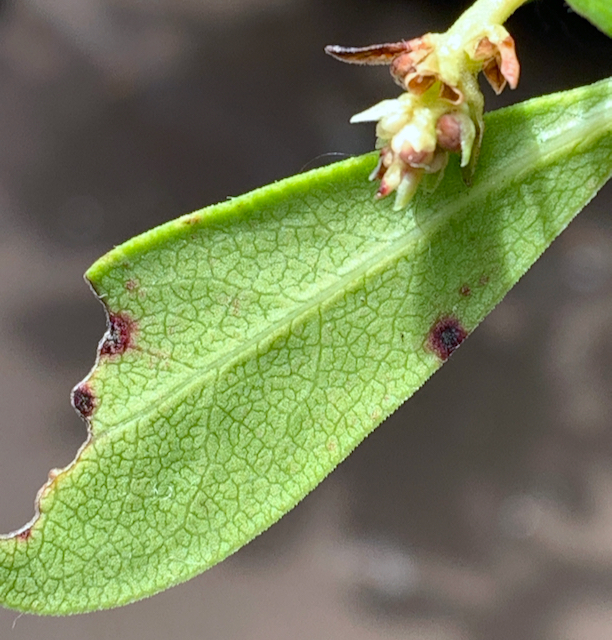
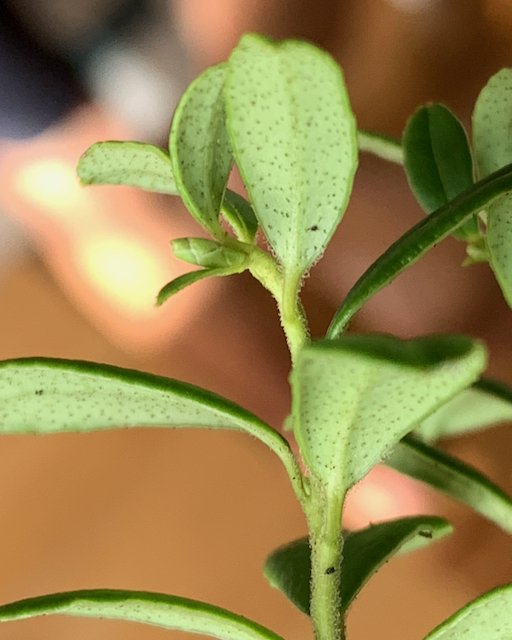
Both plants have leathery leaves as well as similar fruit and flowers and although they can grow in the same habitat, the bearberry does better in drier surroundings. In the last blog I showed the back of the Lingonberry leaf which is more oval-shaped, but now I will show you the back of the bearberry leaf which is paddle-shaped.

The photo of the Bearberry leaf was taken in September when the tiny flower buds start to appear – establishing themselves before the snow appears so they can make an early start as soon as it is gone.


To the left is the ‘veiny’ Bearberry leaf and to the right the ‘dotty’ Lingonberry leaf

As you see, the Vaccinium vitis-ideae – lingonberry leaf has small dots on the underside, whereas the bearberry Arctostaphylos uva-ursi leaf has a fine network of veins.

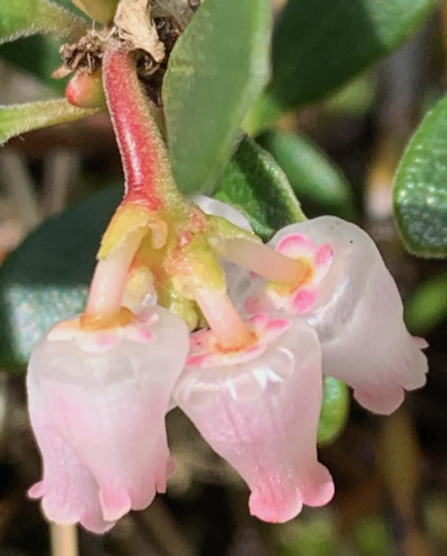
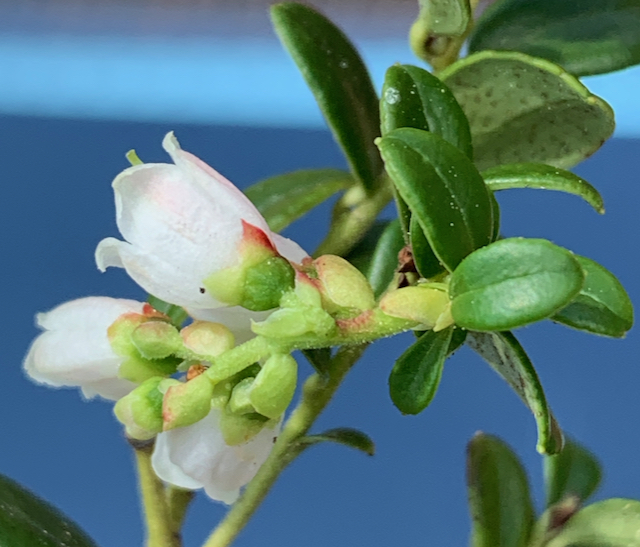
The bearberry is not a member of the Vaccinium Genus, but is part of the Arctostaphylos Genus. However they are both part of the Ericaceae (heather) family. This means that in both species the flowers are typically heather-like, although the bearberry flowers are more urn-shaped and the lingonberry flower is bell-like .


Bearberry urn-shaped flowers to the left and Lingonberry bell-shaped flowers to the right
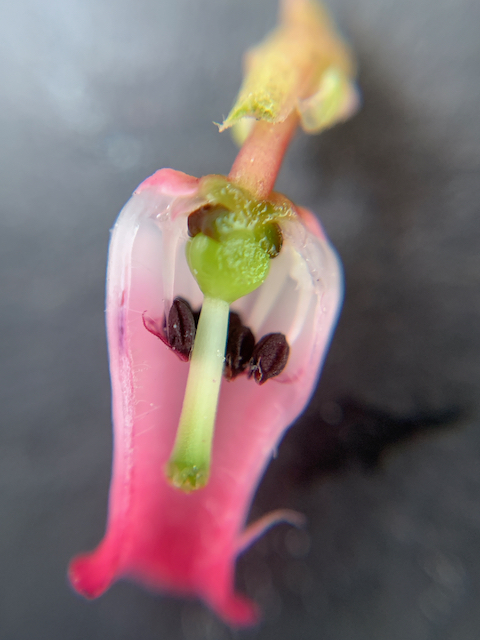
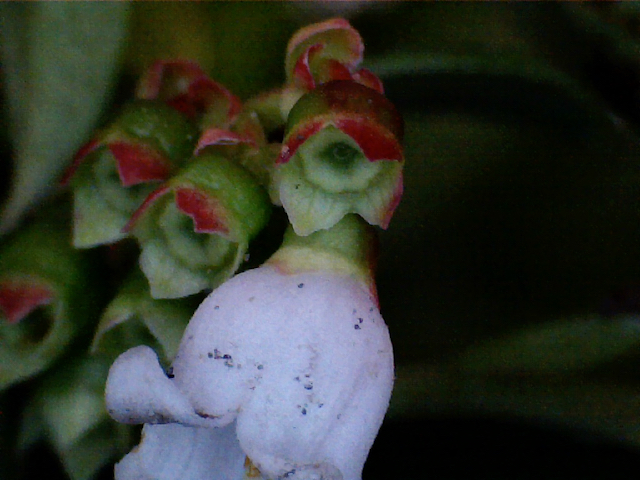
Longitudinal section of Bearberry flower

The rhizomes of the bearberry lie prostrate down rock walls or across the sandy forest floor, whereas those of the lingonberry sit deeper in the humus.

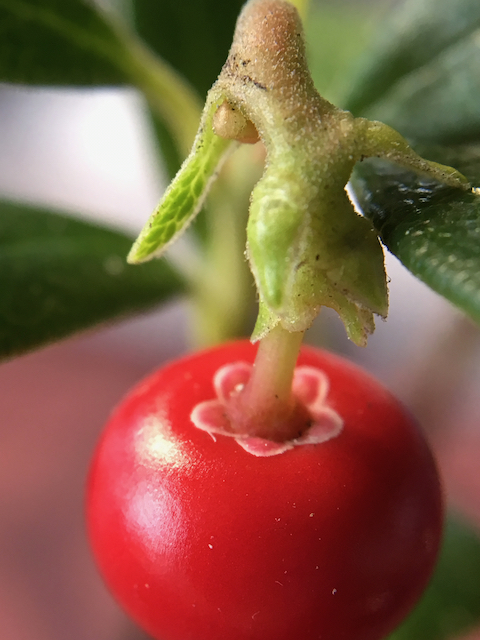
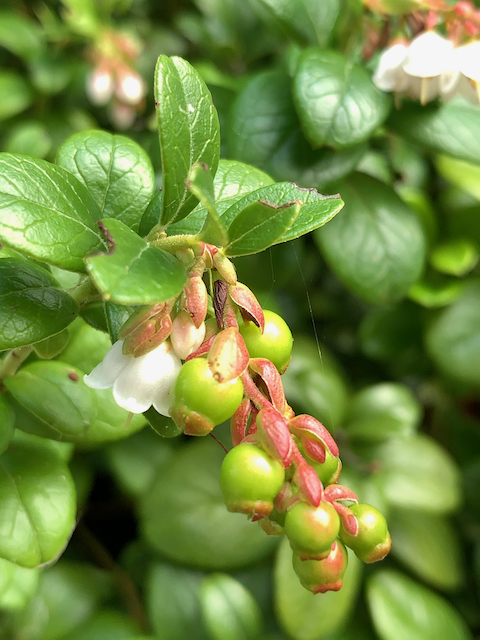
Both plants have clusters of red fruit, but the Bearberry fruit has a slightly flatter spherical form than that of the Lingonberry. Most importantly the Bearberry has a superior ovary (the gynoecium – [female reproductive part] is above the attachment point of the floral whorls [petals etc]), meaning that the remaining sepals are at the top of the hanging fruit, nearest the pedicel (stalk). The opposite is true of the Lingonberry where the remains of the sepals are at the bottom of the hanging fruit, distal to the pedicel.

This is a photo of the longitudinal section  (LS) of one flower. It clearly shows that it has a superior ovary.


To the left, Bearberry fruit with sepal remnants near pedicel. To the right, Lingonberry fruit with Sepal remnants distal to pedicel.

The second blog about the Bearberry species is scheduled for 11 June 2023. That will be the last blog about the series, although I will show the completed pictures on 15th June.

Foraging plants in the norwegian mountains – 24. Lingonberry Pt. 2

Vaccinium vitis idea – Lingonberry plants in dry moss.

The reason for even thinking of doing a series of plants like this was because of this plant – Vaccinium vitis idaea (Lingonberry/Cowberry) and the next plant in this blog series Arctostaphylos uva-ursi (Bearberry). They are fairly similar and their habitats cross over into each other’s. So unless you know what you are looking for you can easily make a mistake.

Lingonberry leaf back.

It isn’t a ‘dangerous’ mistake to make, but it can spoil a recipe!

Above is a photo of the Lingonberry in its typical habitat. Both species have leathery leaves as well as similar flowers and fruit. But the Bearberry prefers even drier surroundings than the Lingonberry.

The Lingonberry leaves are oval as you see above, whereas the Bearberry leaves are paddle-shaped; The Lingonberry leaves have small dots on the underside, whereas the Bearberry leaves are finely veined; Both sets of flowers are typically Heather-like, but the Lingonberry flower is bell-shaped and the Bearberry flowers are more urn-shaped. The rhizomes of the Lingonberry sit deeper in the humus than the Bearberry, which are prostrate and limply creep across a surface.

The fruit for both plants are in clusters, but the Bearberry fruit has a slightly flatter spherical shape than that of the Lingonberry. Most importantly the Lingonberry has an inferior ovary (the flower parts arise above the ovary), meaning that the remains of the sepals are at the bottom of the hanging fruit, distal to the pedicel (stalk). The opposite is true of the Bearberry where the calyx (sepals) remain on the fruit around the pedicel. 

Fruit developing. Petals fallen off to reveal shape of distal end of fruit formed with sepals.

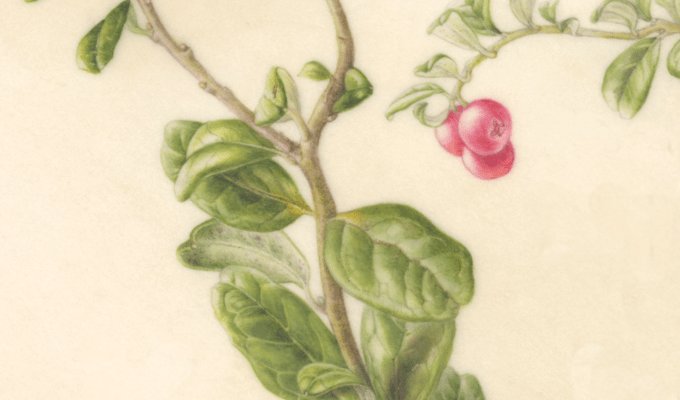
If you look at the painted berry at the beginning of the last blog when I started discussing the species, you can see the remnants of the sepals. Compare it with these three pictures showing the development of the flower and swelling of the ovary in its inferior position.

At the end of the previous blog I showed you some of the sketches I did from various Lingonberry plants. Here you see additional ones and you may notice that they were part of the basis for my final artwork.

Below you see my first compositional plan for the Lingonberry picture, but I didn’t really like it. I suppose in this plan I wanted to avoid painting so many small, but detailed leaves. As you now know they have several diagnostic elements to them, but at the same time are quite shiny. The composition just didn’t give me the right ‘feeling’ of the plant.

One weekend I had been out picking fruit with my daughter and we were discussing the way the plants grew and the impression they gave. We again looked at my planned composition and she suggested I replace the flower on the stem with a fruit cluster.

That was the answer – the series emphasis was about the fruit. I decided to do a trial on vellum of the new piece of stem with the berries and this became the basis for the final composition.

My first sketches of this plant were done in March 2017, but I didn’t start painting the final picture until October 2022 (after harvesting), finishing December 2022. Because this plant is not deciduous, it allowed me to work on the leaves right up until the first fall of snow.


The native range of this species is Subarctic & Temp. Northern Hemisphere including the UK and Norway. It is a subshrub and grows primarily in the temperate biome.

Source: Kew – Plants if the World Online

The species in my next blog scheduled for 8 June 2023 is the Bearberry, favoured by bears when they wake up from their hibernation – or so I am told.

Eva’s Raw Lingonberry Jam

300g Lignonberries

100gm sugar

Blend together the berries and the sugar until berries well macerated. If possible let it stand for few hours in the fridge before being used.

Eva Biringvad gave me this recipe and sent me on a ‘no-return’ journey. Her father made the most delicious bread, so we ate chunks of his bread with sour cream and the raw lingonberry on top. Delicious!

This is also used with meals instead of Cranberry sauce – and it is much nicer.

Foraging plants in the norwegian mountains – 10. My working practice

Composition

Do these three pictures have good compositions? It is not easy for you to judge from these as composition is the area within the mount edge – the image and background.

  • Benton Iris ‘Farewell’ is Watercolour and graphite. The painting is part of the Cedric Morris Florilegium.
  • Dying Rosa rugosa is in Watercolour. It was one of the first paintings I did after returning to Norway. The sprig was sticking up above the snow, so it shrivelled quite fast.
  • Rhododendron impeditum is also watercolour and graphite. This picture is part of the Chelsea Physic Garden Florilegium.

Composition in botanical art is not necessarily very straightforward. As botanical art is ‘art’ it should have a main focal point that draws you into the picture. Once your eye is drawn into the picture, something needs to lead it around within that picture and prevent it from being lead off elsewhere.

On top of this, botanical art must be botanically correct. 

The first digital arrangement of my cloudberry sketches

Combining the art and botany for each picture is hugely difficult particularly when you have different sections telling a story about a plant. Having a series of plants in separate pictures that elaborate the story compounds the problem. 

To try and reduce the problem a little I started to arrange the pictures digitally. I scanned some of my sketches and moved them around within a 31 x 25cm area. It gave me something to think about when deciding what to include in each picture and how many more sketches I would need to get all the information I needed.

Scanning and arranging digitally gave me the opportunity to do something similar with my other species and the ability to compare them against each other. This composition looks nothing like the final one, but I kept rearranging until I was satisfied.

I worked hard to compose my set of pictures so that they looked a series. This can be quite difficult when some are from different families 

  1. Rubus chamaemorus – Rosaceae
  2. Vaccinium oxycoccus Subsp. microcarpum – Ericaceae
  3. Vaccinium uliginosum – Ericaceae
  4. Empetrum nigrum subsp. hermaphroditum- Ericaceae
  5. Vaccinium myrtillus – Ericaceae
  6. Vaccinium vitis-idaea – Ericaceae
  7. Arctostaphylos uva-ursi – Ericaceae

The first word in each species is the Genus name from which the plant is derived. Four are Vacciniums from the same Genus.  Six of the plants are from the Ericaceae (heather) Family and you can see this by the similarity of the flowers. One is from the Rosaceae(rose) family, and the stipules on the leaves (tags at the base of the leaves) is a clear indication of this.

Deciding the enlargement was relatively easy with the plants from the Ericaceae Family where the fruit is comparable. But as everything was larger on the Cloudberry picture, only the scale bars can give the size.

My aim with all the pictures was to let people see and understand the incredible flora and edible fruit available in the mountains. Many look at plants and think them pretty, or know where to pick certain fruits, but not so many study the plant and understand how intriguing it really is. This is an opportunity.

What to include in each composition.

I went through my sketchbook and made sure that I had enough information about each plant to fit on my vellum, mounted on blocks by William Cowley’s. I didn’t want to overcrowd each picture. 

The focus was the plant and its fruit, but one can’t do this without highlighting its flowers. I decided to introduce a picture of the flowers and fruit but restrict dissections to the fruit only. That is until I got to the cloudberry which was going to be the most difficult to integrate into the series. But it isn’t called ‘Mountain Gold’ for nothing.

In the end, all but the cloudberry picture included a branch enlarged and branches actual size to indicate habit. Each had an enlarged flower, plus fruit with both longitudinal (LS) and transverse sections (TS). These are the finished longitudinal sections from each fruit; the largest being the Cloudberry.

In the next blog I will be talking about my transfer process. This comes 23 April 2023.

Only Eight weeks until the RHS Exhibition at the Saatchi Gallery in London;

https://www.saatchigallery.com/exhibition/rhs_botanical_art___photography_show_2023

Foraging plants in the norwegian mountains – 7. History of the project

Above are the seven plants I chose with trial pieces on vellum offcuts.

The species I chose, with common names also in English and Norwegian

  1. Rubus chamaemorus – cloudberry -multe
  2. Vaccinium oxycoccus subsp. microcarpum – small cranberry – tranebær
  3. Vaccinium uliginosum – bog bilberry – skinntryte
  4. Empetrum nigrum subsp. hermaphroditum– Mountain crowberry – krekling
  5. Vaccinium myrtillus – bilberry – blåbær
  6. Vaccinium vitis-idaea – cowberry/lingonberry – tyttebær
  7. Arctostaphylos uva-ursi – bearberry – melbær

I have listed the plants in the order according to the type of ground in which they grow – from boggy to sandy:

  • The cloudberry and small cranberry often found intertwined together in the boggy moss of a swampy lake edge. 
  • The bog bilberry is more of a bush and guards the very marshy plants perching on rocks in the marsh. 
  • The Mountain crowberry grows in various areas from rocky outcrops at the edge of a swamp, to tiny examples without much soil, clinging to the rock on mountain tops.
  • The bilberry and cowberry are generally in a similar habitat in damp woods and forests; the cowberry can be the main plant on an old wood ant heap often with bilberry and mountain crowberry.
  • Bearberry grows in sandy areas on the edge of forests or creeping down over smooth rock.

The next stage of this blog goes into my working practice for this series. After which I will talk a little about each of the species and how I painted the final pictures. I will use the above order of plants as I would love others to learn more about them, where to find them and their uses. 

The next blog will be on 13 April 2023.

Foraging plants in the norwegian mountains – 6. History of the project

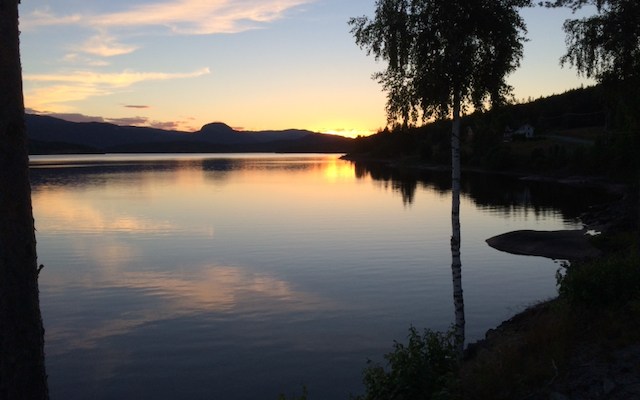
My best view – Andersnatten at 23:00 in June.

Anyone would think I am trying to sell Norway. I am, it is a fantastically beautiful country. The picture above is in Sigdal, the valley below Haglebu. It is the view we had from the house we built in the late 1970’s. It is from here that I learnt to love Norwegian flora.

In the previous blog I finished off by saying that I still hadn’t seen any sign of one of the two species that got me going with this series of plants. This was the Bearberry (Arcostaphylos uva-ursi). I had already found out that they were not known to grow in the county I now live – along the west side of the Oslo Fjord; In fact locals didn’t seem to know about the plant!

In 2017, that very first summer of sketching, I managed to do some sketches of each of the five species already found. This gave me a feel for the plants but I still needed to do a lot of research into them. I had found that the cloudberry is dioecious – the male and female reproductive organs are separated in two different organisms; each plant is either male or female. My girlfriend from whom we had borrowed the cottage that year, was not aware of this. But, it seems, she was not alone in this as it was a surprise to many Norwegians with a cursory knowledge of the plants around them.

There was plenty of mountain crowberry ( Empetrum nigrum subsp. hermaphroditum) in the area round the cottage. The crowberry is a family of plants that isn’t quite straight forward in that the species at lower altitudes is dioecious like the Cloudberry, but at this altitude in the mountains is more generally a subspecies called ‘hermaphroditum’. This means it carries both male and female reproductive parts.

Finding plants and choices in 2018

The cottage at Flatvollen, near Haglebu. 906 metres over sea level.

As I realised I was going to need quite a few years to complete my series with only two weeks at a time when we could get to Norway, we decided to rent a cottage at a higher level in the mountains. We looked at an area where I had used to go skiing when younger – Haglebu at the top of the Sigdal valley where it goes over the mountain then steeply down into the next valley. This time we found a cottage at 906 metres over sea level and I could see that I would be near the plants I intended to paint. Although I still hadn’t found the one plant I had been looking for.

In front of the cottage there was quite a boggy plain and I knew that I could get plants such as Cloudberry there. Behind the cottage was steep mountain and I knew most of the other plants would be available to me there. 

We went for a short hike and explored. The marshy area was quite wet, but there were a lot of Cloudberry plants. Unfortunately, it was too late in the season to see any flowers but getting onto my hands and knees I got a real surprise. Weaving in and out of the boggy moss was the tiniest plant, with the smallest flowers and leaves. The plant was so insubstantial but lying on top of the moss were the remains of some red berries. This was Vaccinium oxycoccus Subsp. microcarpum (small Cranberry). The Cranberry bought in our shops is Vaccinium macrocarpum – large cranberry, and of course cultivated in large amounts in the US. 

I had just found my 6th plant, but still not the bearberry.

Below you see the small cranberry on top of the moss with sprigs of bog bilberry and mountain crowberry and a little Betula nana (Dwarf birch), often found as the last tree (no more than a low shrub) on the tree line.

I had to remind myself that the reason for getting interested in this series of plants was because the bearberry often got mixed up with the lingonberry (cowberry), and this often happened at lower elevations. I needed to continue my hunt for the species.

We went hunting and eventually I found quite a few plants in a dry sandy forest area in the next valley. This was Arctostaphylos uva-ursi (bearberry). I now had my seven species, although one of them was not in the immediate area where I was collecting my samples. That is, until I found some very near the cottage, growing down a rock face.

Finding the Arctostaphylos uva-ursi (bearberry)

More on the 9 April 2023

When I wasn’t walking in Norway …

…..I was either hunting for plants or painting.

I had a list of plant detail that I had worked out I needed to complete the composition planning for my series of pictures. My vellum size for each piece is 25 x 31 cm – which I suppose relatively speaking is quite small. But all but one of my plants is very small with leaves varying from 2-6mm long on the Vaccinium microcarpum, to the Rubus chamaemorus where the leaves vary hugely in size.

Vaccinium microcarpum – Small Cranberry – Leaves 2-6mm long.

Impetrum niger ssp. Hermaphroditum – Crowberry – Leaves 3-6 mm long

Rubus chaaemorus – Cloudberry (image is 13cm high)

I decided that rather than work on all seven pictures at once as I have done so far, I would work on half this year and the rest next year. For all of them I needed to do some colour matching on vellum as this will be different to the colours I have used on paper. You have already seen the small piece I did on the Cranberry a couple of blogs ago. You may also have noticed the difference to the actual flower size (tiny) and the painting  which I did at twice the size.

Luckily enough although there is a slight difference in the terrain from which each of the plants come from, we have found each species within walking distance of the cottage in which we have been staying. The Cloudberry and the Cranberry can be found intertwined with each other in the soggy sphagnum moss – but not always. The Bog Blueberry (Vaccinium uliginosum) comes from a similar area, but I have seen it reaching up the side of rugged outcrops. The Crowberry can be found all over the mountains although the Ssp Hermaphroditum can only be found at higher altitudes. The Bilberry can also be found pretty well most places, but doesn’t seem to be above the tree-line and doesn’t seem to like really boggy areas. The Cowberry – Lignonberry (Vaccinium vitas-idaea) is spread on ant mounds and rocky outcrops.  Common Bearberry (Arctostaphylos uva-ursi) likes much drier conditions and is often found in pine woods. But we did find an example not far from the cottage. Last year Robin drove about 150km to find a spot that I knew about!

Below is the colour sample of the Bog blueberry done this year. The very new new leaves start out quite red and as they get older they become bluer and stiffer. Sorry the photo is a little dark.

Vaccinium uliginosum – Bog blueberry – Watercolour on vellum 5×7″, painted twice natural size.

Go back

Your message has been sent

Warning
Warning
Warning
Warning

Warning.