From Sketch to drawing – Learn to draw botanical images.

This is the title of the next workshop in Bosham, Nr Chichester.

I still have some places on the workshop Tuesday 25 – Thursday 27 March. Would you like to join us?

In every workshop I run, I always set off time to compose and sketch out the picture that is to be painted. As often as not people are reluctant to spend time on the drawing, thinking that it will sort itself out when the paint or coloured pencil goes on. It won’t! your final picture will only be as good as the drawing you use as a ‘master’.

Now you have the opportunity to learn the tricks of drawing your botanical subject easily. Remember that awkward leaf that sticks directly towards you? How difficult do you find drawing it? Just follow the tips I will give you, and reduce the problems you have in the future.

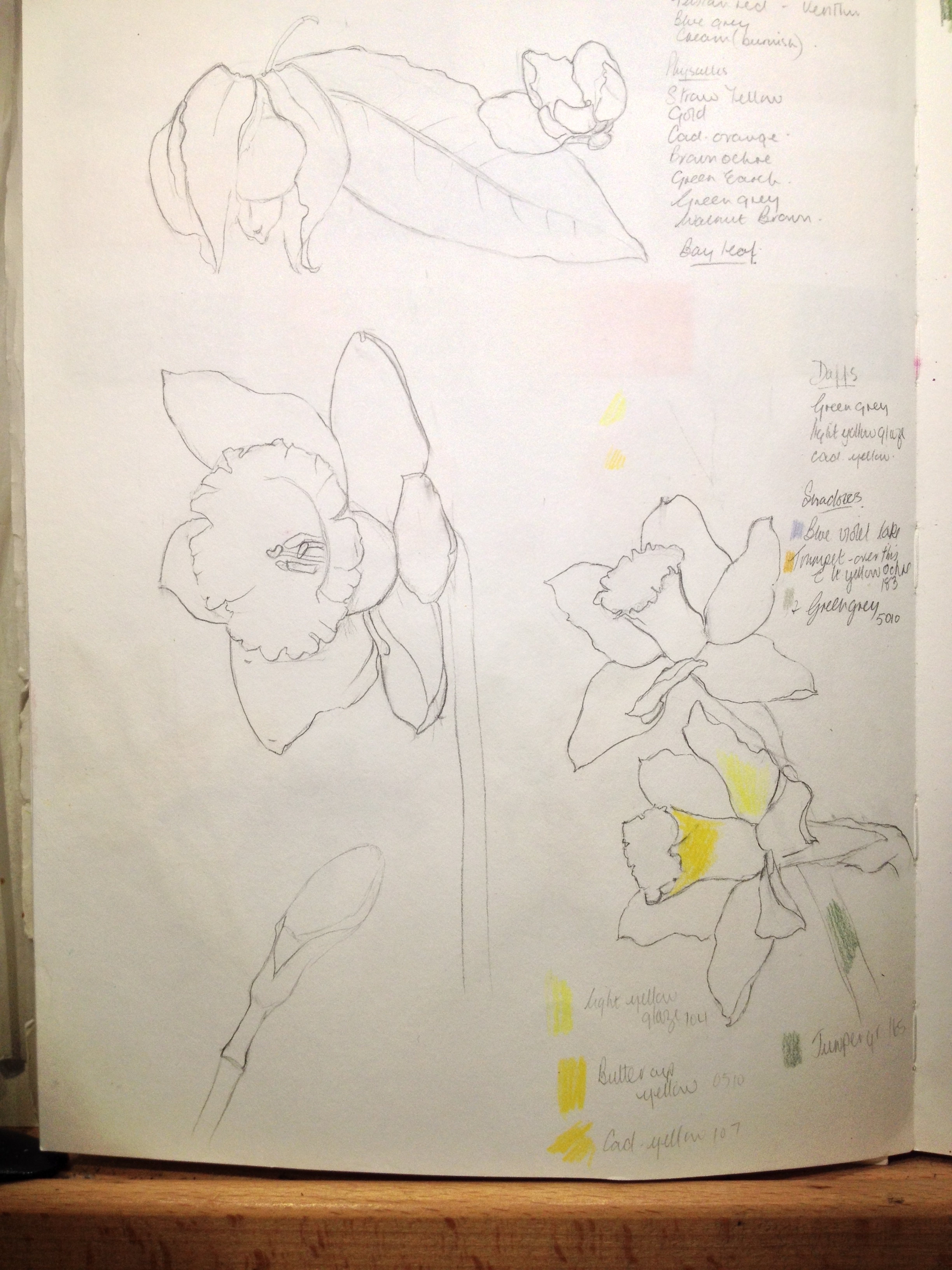
What about drawing a load of petals round a centre part – do they meet when you get round to the other side? Again, find out how to do this. Or a daffodil; getting the trumpet right?

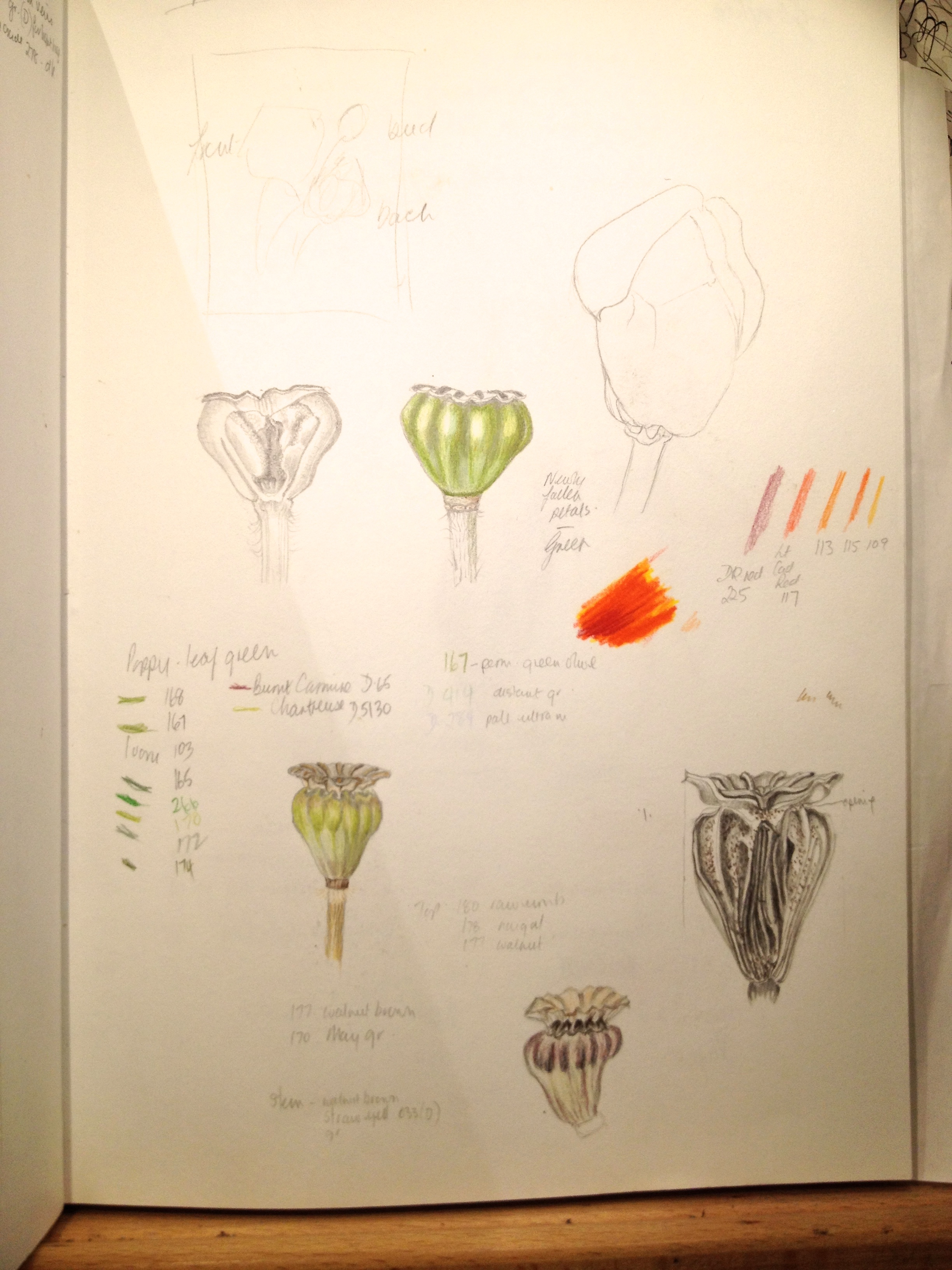
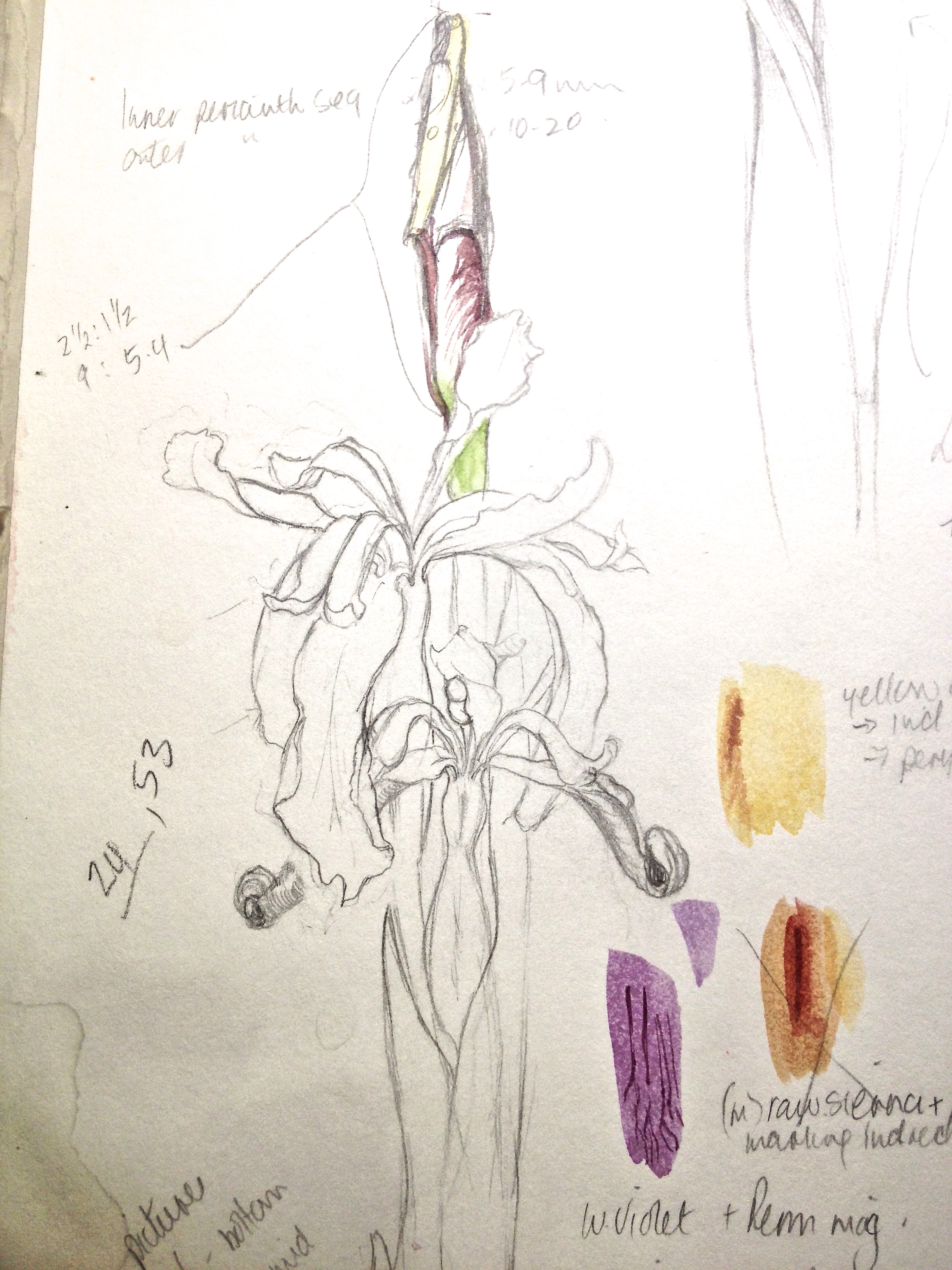
Here are some sketches from my sketchbook and  a couple of final drawings done with graphite.

If you want to join us, go onto my website and contact me via the contact form. Its on http://www.gaynorsflora.com

Magnolia x soulangeana seeds
Oriental poppy seed-head sketch & colour matching

Daffodils from sketchbookDaffodils from sketchbook

Stinking iris from Sketchbook. sketch & colour matching.
Final Euonymus leaf in graphite on Bristol board

Do you use photographs in botanical art?!!!!

Yes. Sort of.

Some of my paintings take around two years to complete especially if I am doing a series of paintings and they include; A year in the life of………

How do you complete a series of paintings if the series is from the same genus and they bloom and fruit at similar times?

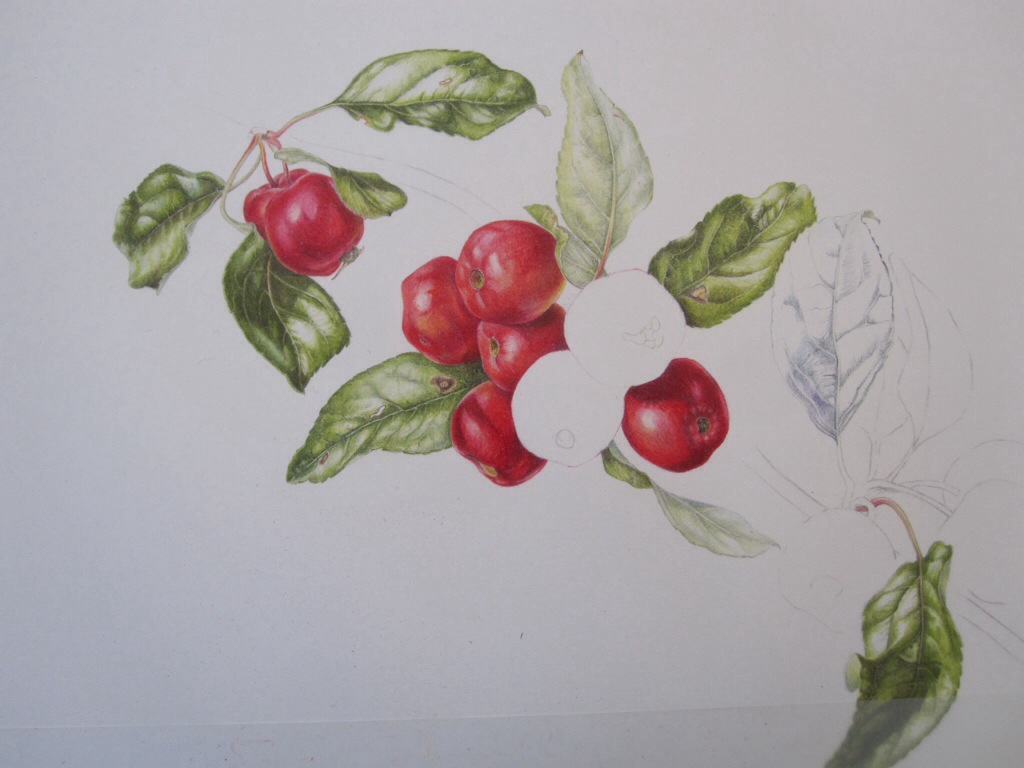
This is how I do some of it. As an example I will use the picture that I have been working on this week. Malus Gorgeous.

In the spring last year I did some sketches, colour detail and size of the blossom. I had to do five other crab apple trees at the same time and, during a ten-day period. This year I did dissections of blooms from the same trees and preparation sketches of the dissections to include in the pictures.

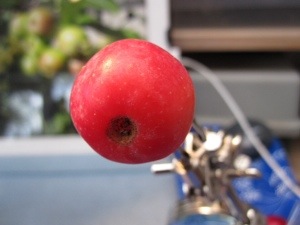
Going back to the Malus Gorgeous specifically, this summer I planned the composition and sketched this out on my final paper. I used elements from various pictures I had taken of the small tree. Bearing in mind that the apples were not full size and far from ripe and the finished painting was to include ripe fruit. The photographs were and are only a rough guide. This is the photograph I used for the main bunch of fruit.

20131018-202924.jpg

I had to enlarge the fruit slightly to the size they were likely to be when ripe, allowing for the fact that even this allowance might be slightly out. I had measured the ripe fruit the previous year so had a good idea of the size. I then started painting the leaves.

I picked the leaves I intended to paint, one at a time. None of them the ones in the photo. Some were more interesting than others, but I had to make sure that the leaves I picked were the ones arising from the fruit spur. These were the type I had included in my picture, and not those born on new shoots, as these are more leathery and differ quite a bit.
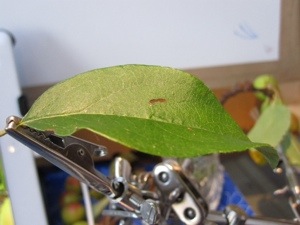
20131018-205331.jpg

I positioned each leaf as I had sketched it in my composition and painted it into the picture until most of the leaves were in place.

I have been doing the same with the apples. These are this years ripe apples. They have started falling off the branches, therefore I had to get on and paint them whilst I could – particularly if I wanted the series finished to exhibit at the RHS next year. That is if I get exhibition space.

20131018-210219.jpg

Funnily enough and, luckily, the apples seem to last different lengths of time on the trees. But there isn’t much in it, so I have to plough on until all the apples are finished.

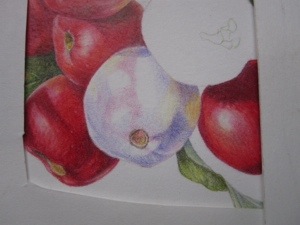
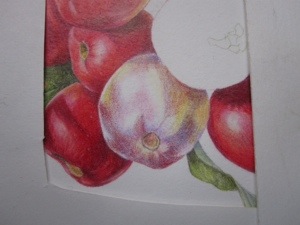
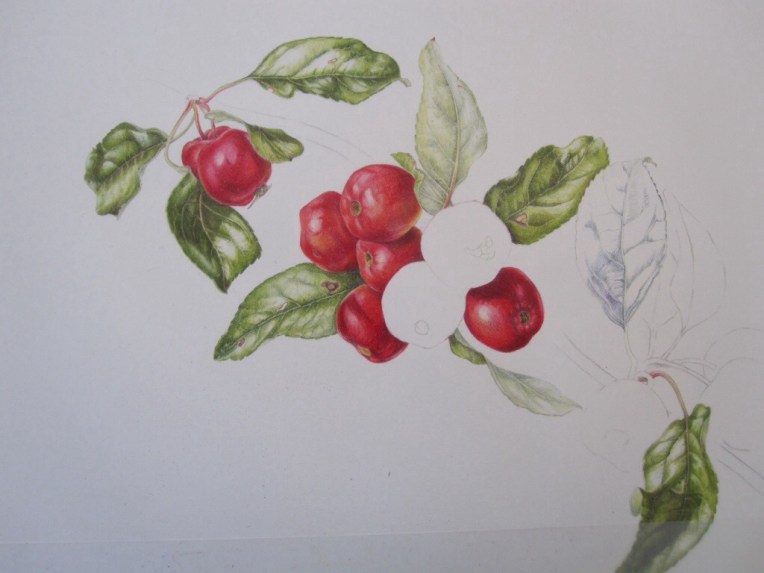
Some of the pictures of the apples being painted – with coloured pencil used dry in case anyone was wondering.
20131018-211337.jpg

20131018-211407.jpg

20131018-211426.jpg

20131018-211727.jpg

Today I managed to do all the apples. I have a couple more leaves to do and then have the dissections and branches to put in the picture. But that won’t happen yet as I have to catch up on all six pictures. The sketches Of the dissections that I have in my sketchbook will give me enough information to do this at a later time. Don’t forget that once everything is in place it has to be tied together with shadows etc in the right places.

As you see I do use photographs in botanical art, but every element in my pictures are painted from life.

By the way, comments or queries are very welcome.

My sketchbook page.

20131018-213801.jpg

Which make coloured pencils do I use?

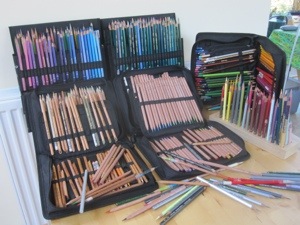
Many people have asked which pencils I use and which ones I prefer.

In reality, I use the pencil from the range which has the colour nearest to what I want. None are good on their own in one flat colour as it then becomes as dead as black does by itself.

I find that Derwent pencils have a slightly chalky feel, but you just can’t do without some of the colours, particularly very pale and very dark ones. I use mostly Artist in this brand, but sometimes I will use Studio as they are a little harder and you can get a finer point than with Artist.

Faber Castell Polychromos are very good as is their range of colours. as they are neither soft nor very hard and the consistency of the colour core is even. There never seems to be any scratchy bits in them as you might find occasionally in other brands. They seem to have the best range of greens for botanical art, although you have to be a bit careful in mixing some of those which lean over to a bluey green, as they might become an unnatural green for flora. But this applies to any brand.

A slightly softer pencil than Polychromos is Caran d’Ache Pablo. They like Polychromos are oil based and not wax based like Derwent and Prismacolour. Their range of colours is very useful and the Luminance range seems to cross over with Pablo, although the range is limited. I find that Pablo pencils are creamy, you can get some detail, although I haven’t managed to get as much as with Polychromos. They too are a lovely pencil to use. One positive thing about Pablo pencils is that you can see at a glance how lightfast they are.

One make that is very useful is the Prismacolour Verithins. I had a few older ones and one of my students gave me a whole set of them. Lucky me! They are a hard thin lead, so you can do very fine detail with them. I often use them for cleaning up the edge of what I am painting (in coloured pencil). However, the greens are all bluey or too sharp in colour for botanical art. I would love to find a toned down green in that range.

The softest coloured pencils are Prismacolour and Caran d’Ache Luminance. Some of the colours in the last range are limited, but cross over with Pablo. Prismacolour have a bigger range of colours Including quite a few useful light and dark colours. I find that the very soft pencils are good as the final layer of colour, particularly if you are trying to get a nice sheen to something.

Unfortunately I only have a few Coloursoft, so it is difficult for me to compare those with the other soft Colour pencil makes, but I understand that they were produced by Derwent to try and replace Prismacolour ( Karisma as was), when they could no longer be sold in the UK. Hopefully at some point I will have more of this range so that I can make a reasonable comparison to the other makes – at least in relation to how I use colour pencils in botanical art.

We all paint differently and use our materials in different ways, but I hope this was useful. Please comment.

20130328-153824.jpg

Tracing to art paper

I have done some art tutorials with ArtTutor.com and they are now live via my website. Look at the page on tutorials and follow the links to download the E-book showing you how to paint a Crab apple picture with coloured pencils. You can also link into one of the tutorials as a taster.

I have had some very positive feedback and essentially this blog is in response to one of these which asked how I transferred my image onto the final art paper.

An image can be transferred in so many ways depending upon how refined you need the transfer to be. The more you rub out on your art paper, the more you damage it’s surface no matter how careful you are. You can use tracing paper, a light-box, your window as a light box, or this way:

I compose a picture using various thumbnails. This leads to a general rough design which forms the basis of the final line drawing.

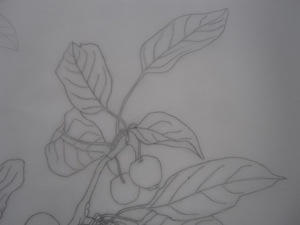
This is part of the line drawing of the picture I am in the process of doing now:

20130325-222407.jpg

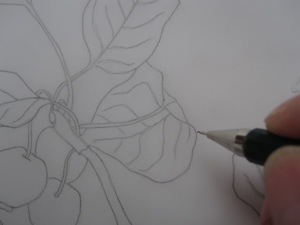
I trace the line drawing onto tracing paper, using a 0.3 clutch pencil.

20130325-222552.jpg

I turn the tracing paper over and draw the line again on the reverse side, being very careful to trace accurately.

20130325-222744.jpg

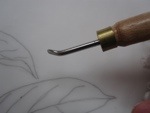
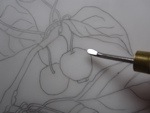
I then place the traced image right side up, on my art paper ( normally Fabriano HP) and, using a Decoupage tool, I rub across the lines. This transfers the graphite from the back side of the tracing paper to the art paper.

20130325-223611.jpg

20130325-223624.jpg

The image left on the paper can then easily be lightened with a putty rubber, without leaving any indentations on the paper.

20130325-223914.jpg

20130325-223923.jpg

I hope this helps those who wonder how best to transfer an image without damaging the art paper or leaving any indentations to get in the way.