Foraging plants in the norwegian mountains – 22. Bilberry Pt. 2

My sketchbooks can be messy in comparison to many!

This is the main double page for my sketches done on the Bilberry plant. I try to keep as much information as possible together so that when I do my final work I don’t have to search too much in the sketchbook. I try to find a hole on the relevant page to add things, either more sketches or research I might have done. I often find that when I am researching on the internet, the gaps are usually left along the bottom edge of the page, so I frequently use this area to write any notes.

As I have already mentioned in the previous blog, there is a similarity in the fruit of the Bilberry and the Bog bilberry, but the stems are very different for starters. The Bilberry stems are very angular and last year’s branches remain green over winter and into the next season. The deer seem to like them and paw away the snow eating the shoots. The Bog bilberry stems are brown and woody; I talked more about this plant in the blogs published 14th and 18th May.

Serious times – the pandemic!
And additional serious times – moving!

By the middle of 2020 I felt that I had enough sketches for most of my final pictures  and had already decided to stop the extended period of ‘productive procrastination’. We were in the middle of the pandemic and for most people, the world had turned upside down. My daughter, living in Norway, felt we were too old to live on our own any longer and she was too far away should anything happen to us. 

The decision to move back to Norway was thought about and made quite quickly. I think we started talking about it mid June and sold our home with the large beautiful garden and the ‘shed’ – my studio, quite quickly.

The actual move came in August 2020. I had planned all my compositions before leaving the UK and when we arrived in Norway I was all set to start painting the final artwork. 

I won’t talk about all the problems moving during a pandemic caused – we were lucky to be completely healthy. But some of the benefits from moving back to the country I loved included being much nearer to the plants in my series. There were lots of others, but I leave that to your imagination.

Goodbye shed at the bottom of the garden.

In between looking for a new home and sorting out all the official stuff and additional problems caused by Brexit, I started working towards doing the first picture. Of course, it had to be the Bilberry. This plant also grows at sea level and was easy to access now.

I only had to walk up into the woods behind my daughters house where we stayed until we finally moved. There were lots of native plants along the tracks, including loads of Bilberry. In our new home, to which we moved in January 2021 when the area was ensconced in snow, we eventually found it contained a lot of Bilberry plants. Heaven or what!?

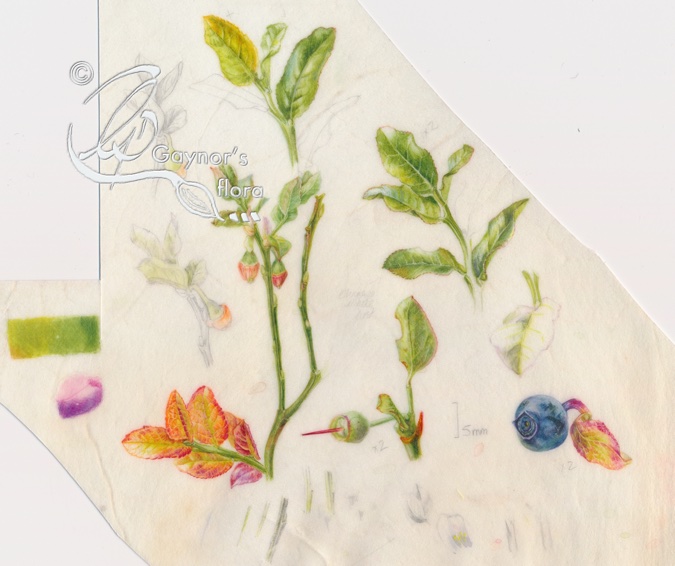
I started with a trial piece of Bilberry parts on vellum and began the final artwork in June 2021, finishing March 2022. 

You can see my work station in our new home below. As is perhaps obvious, I continued to procrastinate a little longer as I just had to do more sketches. Working on the vellum off-cut was extremely useful as I also tried out various methods of introducing graphite. Getting the colours right for the bloom of the nearly black fruit whilst I had them was also important. Painting this on paper had been a completely different kettle of fish!

Hello new ‘shed’. This is one of the bedrooms on the top floor, but now my working area consists of two bedrooms turned into one large room – with a view!
Bilberry trial piece on vellum off-cut.

Making sure that I had samples from all the plants in the series at the right time of year was like putting together a puzzle. The flower sections had to be done in the spring and the fruit at various times over the autumn. Leaves also changed through the seasons. 

But basically, I knew that I had roughly six months of the year to paint the deciduous plants (Bilberry, Bog Bilberry, Cloudberry) and those I didn’t have access to under the snow such as the Cranberry. For the remaining plants I would be able to get leaves throughout the year as long as they weren’t hidden too deeply under the snow. It became a matter of planning and making sure I knew where relevant plants were over the winter. 

The native range of this Vaccinium myrtillus is Greenland, Temp. Eurasia, W. Canada to NW. & W. Central U.S.A. It is a subshrub and grows primarily in the temperate biome. Including both Norway and the UK.

Source: Kew Plants of the World Online
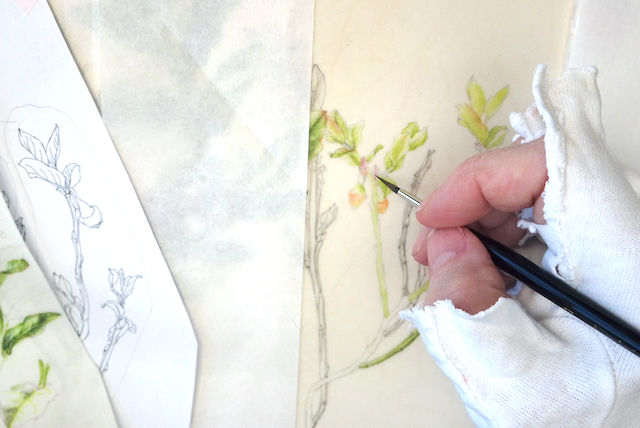
Working on the final artwork – graphite and wash section

Mor Astrid’s (my lovely grandmother-in-law) Raw Bilberry squash

3 l Bilberries 

2.5 l water

75 gm Cream of Tartar

4.5 kg sugar

  1. Rinse through the berries to clean of soil. They don’t need to be thoroughly cleaned of leaves and small stalks.
  2. Bruise/crush berries in a plastic bucket and leave for 24 hrs.
  3. Mix the Cream of Tartar into the water and add to the berries. Stir thoroughly.
  4. Let the mixture stand for 24 hrs.
  5. Strain through a muslin.
  6. Add the sugar to the strained fluid.
  7. Stir thoroughly until the sugar has melted in.
  8. Pour into bottles.

The resulting squash can be mixed with water. It is DELICIOUS.

Keep out of easy reach of children or it will be finished off in no time!!

A suggestion from Polly o’Leary after the Bilberry part 1 blog. Thank you Polly.

In this part of Wales theyre called Whinberries. We used to make them into whinberry and apple pie, or whinberry jam. Or both. Depending on how many we found. No recipes, except the usual – plain shortcrust pastry, not too much sugar, because they’re lovely and tart.
Same with the jam. Never really thought about a recipe, just made it the usual way as they were such a treat.

This came from Jane Hogan following the Bilberry part 1 blog. Thank you Jane

We used to pick bilberries on the North Yorkshire moors when visiting my grandmother. She used to line a pie dish with pastry, pile in the bilberries with sugar and top with another layer of pastry. Served with custard or cream and eaten hot. There wasn’t usually any left to have cold! It used to take ages to pick the bilberries. (A quick look online suggests a pound of bilberries and four ounces of sugar)

On 4 June 2023 I will publish the first part of the Lingonberry blog.
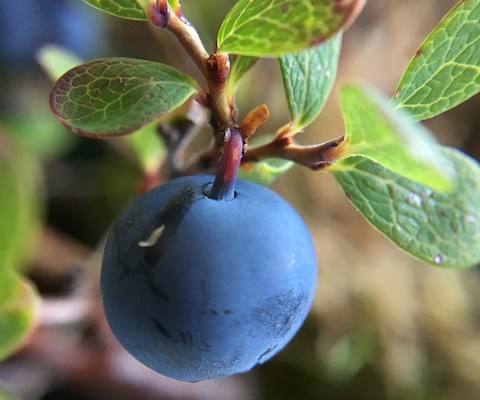
Foraging plants in the norwegian mountains – 17. Bog bilberry Pt.1

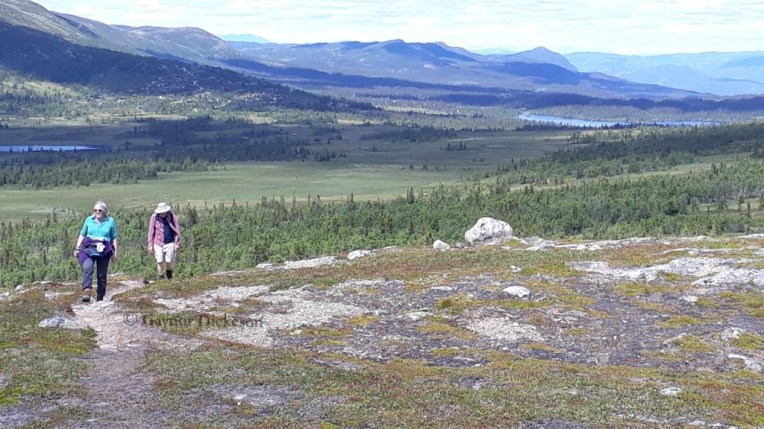
Walking over a mountain top on the other side of the valley from our rented cottage.

The English common name for Vaccinium uliginosum is bog bilberry and one of the Norwegian names is skinntryte.

All the Vacciniums are heathers and in fact all in the series except for the Cloudberry, are in the Ericaceae family

I feel that both the Bog Bilberry and the Bilberry are plants I have always known, although I didn’t meet them until I was 20 years old on my first visit to Norway. Norwegians refer to Bilberries as Blueberries (direct translation is blue berry); Very confusing when these days it is very common to be able to buy Blueberries in the shops; which they actually call blueberries. But they are yet another Vaccinium species!!

Are you still with me!

The scrub on the edge of the marsh containing a mix of some of the species chosen for the series.

The Bilberry and Bog Bilberry cross over onto each others preferred growing patches, and the berries look similar at first glance, although it is fairly easy to pick over a full bucket from a foraging session if needed.

The Bog bilberry seems to grow better amongst the scrubby flora seen across a marshy landscape, but smaller examples also seem to survive on rocky mountain tops where there is a sparsity of nourishment; I’m not sure that they produce much fruit though.

It is easy to see the difference in the growing habit between a Bog bilberry and a Bilberry. For the former, the stem is woody whereas it is green and angular for the Bilberry.

The Bog bilberry fruit at 8-12mm is larger than the Bilberry and does not have the strong ‘good for you’ Anthocyanin content that Bilberries have. The flesh of the fruit is pale and the skin is blue with a bloom.

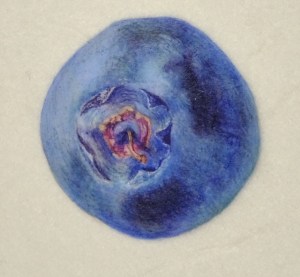
Size of a bog bilberry.

But don’t worry if you have the opportunity to pick both fruits where you are, both are just as edible.

I will be publishing the blog about the Bilberry on 25th May, so be sure to compare the fruit in these blogs and the full painting at the end of the series.

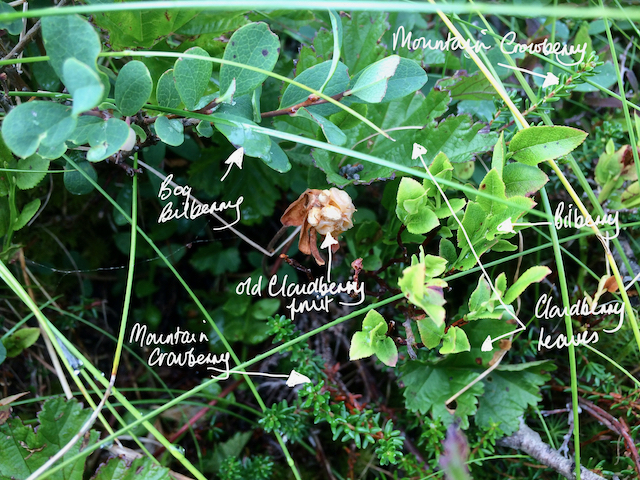
As well as the fruit appearing bluer than Bilberries, the leaves of the Bog bilberry have a slightly different shape and colour. Look at the picture above where you can see both bog bilberry and bilberry leaves side by side and further down where you also see a mix of different species.

Bog bilberry leaves are seen as blue-green, the shape is long and oval, they are slightly thicker than the bilberry with a very visible network of veins . New leaves tend to have a red edge which gradually changes to an overall bluey-green as the season progresses. But constant sun can keep the leaves fairly red towards the tip.

Autumn bog blueberry plants with fruit together with the changing colours of the dwarf birch.
The twin flowers at the end of a shoot.

The flower is typical for the heather family and can be recognised as such almost immediately. But whereas the Bilberry flower is solitary in its leaf axile, the Bog bilberry flowers appear in pairs. I have seen it described on several occasions as looking like a set of testicles!

Getting on to painting this species, I spent a while on researching and drawing sketches of this plant – which I will talk about in my next blog.

But I did at least a couple of trial pieces on vellum where the first one felt very much like a botch job – but I learnt from it. The second one was very useful and helped me to decide what to do – and of course what not to do.

I used this original set-up to to paint the final picture, but as I have described earlier, I can use a sketch and paint from different leaves and branches in front of me. This is exactly what I did for this section of the painting. The final painting is a little different with a focus on the berries rather than the flowers.

The continuing blog on the Bog bilberry is planned for 18th May – the day after the Norwegian national day!

Foraging plants in the norwegian mountains – 16. Small cranberry Pt.2

The marshy area where the small cranberry was found.

Planning the artwork

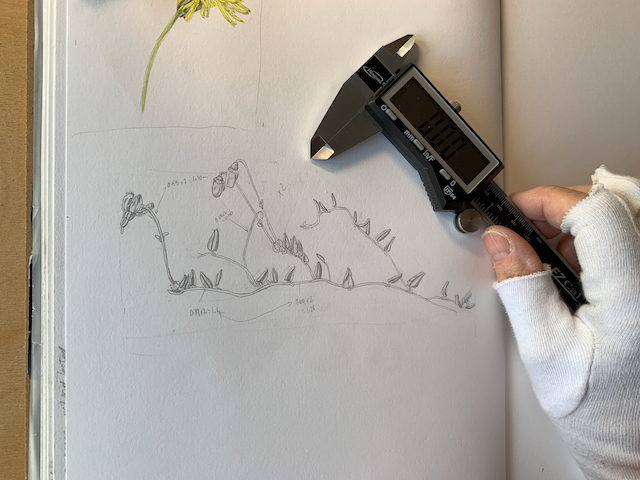
Digital callipers shown in an earlier blog. I use gloves so that fat from my hand is not transferred to the vellum, making it more difficult for pigment to adhere to the surface.
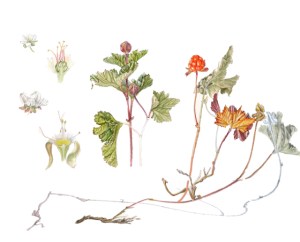
I began sketching the Vaccinium oxycoccus subsp. microcarpum (Small cranberry) in August 2018. The measurements of the tiny details were done using my trusty and accurate digital callipers.

Everything about the plant is tiny – except for the fruit, which is about the same size as a bilberry 5-8 mm.

When I first saw the plant and fruit meandering through the top of the moss, I couldn’t believe that such a slender plant could actually bear the weight of its fruit. As it happens, it doesn’t as everywhere I looked the fruit was either lying on top of the moss or supported by other structures in the marsh. The stems are so tender they are smaller than a blade of grass.

As with each of the other pictures I chose which sketches I would utilise from my sketchbook and arranged them with the help of the computer. I made continual adjustments to all of the plans so that visually they would appear as one exhibit. 

Can you see some of the parts sketched in the final artwork?

Digital plan of the composition. It is nearly the same as the final piece of work.

Each picture in the series was to hang ranged according to habitat from boggy and wet to sandy and dry.

The small cranberry was intended to start off the boggy end. But as the series has taken so long in the making, the criteria for exhibition has changed and I am allowed no more than six pictures.

Unfortunately, although completed, this picture will not be in the exhibit at the Saatchi gallery in June this year, but is still part of this series and will be treated as such in these blogs. I intend to show you all seven of the completed pictures after the judging process.

As with most of the pictures I did small trials on unmounted vellum to make sure I was choosing the right colours.

If you have read all the blogs about this series so far, you will have seen the finished trial piece in section 7, the last part of the history of the project.

The next photo is of that trial piece being worked on. I painted it twice natural size, the same as on the final artwork; you can see the flower sprig used as my model, lying on the vellum. Perhaps now you will have a better understanding of how tiny the species is.

Trial piece on vellum – in progress.

The colours I used: 

  • Quin Magenta PV122
  • Quin red PR209
  • Perylene violet PV29
  • Quin Gold PO49 (I don’t think single pigment can still be obtained)
  • Winsor Blue Green PB15.
  • Lemon Yellow PY175

Most of the trial pieces were painted at the cottage we rented, where I could easily source my subjects. I took over the dining table, with windows and light coming from the left. The family had to accept eating meals either outside or from a low coffee table. I was happy though!

My ‘studio table’ in the mountain cottage.

One of the biggest challenges with this plant was the root system. I remember a comment a judge once made about a botanical art piece; where the roots were likened to something having been put under the tap!

The Cranberry roots lie in very boggy wet areas and the hair-like system seems to fall away from the main stem lying along the upper layer of moss. The hair-like roots do plunge vertically down giving the appearance of having been under a tap! The Cloudberry coming from a similar environment and often intertwined, is not like this.

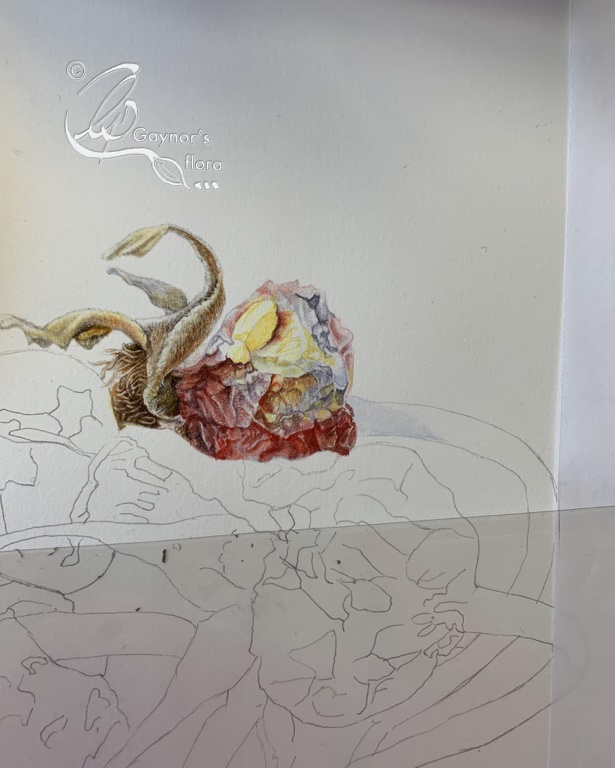
During the annual stay at the cottage in the mountains, in addition to my sketchbook and painting materials I had also cut a piece of Perspex to the exact size of my vellum block. I used this to try out samples of my subject to see how they would flow naturally across the picture.

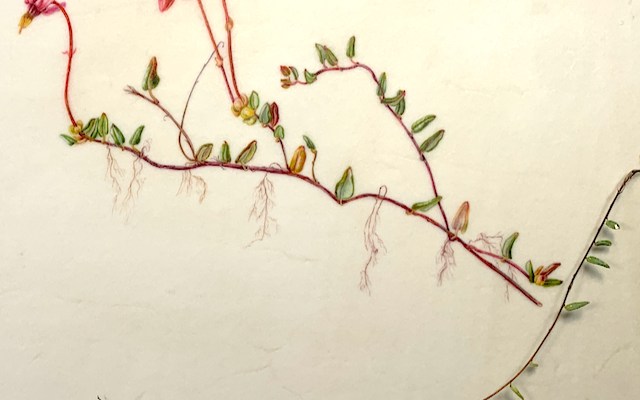
Here you see a thread-like piece of small cranberry plant together with a couple of line drawings from my sketchbook; one drawing is the enlarged section in the trial piece and the other is actual size.

Compare this both with the compositional plan above and the final artwork. The more ways one can look at composition whilst planning a picture, the better will be the result.

I started sketching the small cranberry in August 2018, started work on the final artwork July 2021 and except for scalebars, finished in January 2022. 

The native range of this species is Subarctic to Temp. Northern Hemisphere. It is a subshrub and grows primarily in the temperate biome. This includes Great Britain and Norway.

Kew – Plants of the World Online

Fruit of the Forest liqueur

From Randi and Arne Christian Halseth, Skoppum (thank you)

  • 500 ml Bilberry
  • 50 ml Bog bilberry
  • 150 ml Mountain Crowberry
  • 100 ml Lignonberry
  • 700ml 60% spirit
  • 500 ml sugar.
  1. Put well-ripened berries into a suitable glass and sprinkle with sugar. The berries don’t need to be meticulously cleaned of leaves and tiny stalks. 
  2. Top up with the alcohol. Shake well then refrigerate. 
  3. Turn the jars as often as possible for 4 – 6 weeks.
  4. Strain and pour into bottles. 
  5. Age for a few weeks.
  6. Enjoy

I will start the detail about the Bog bilberry plant in my next blog 14 May 2023

Foraging plants in the norwegian mountains – 12. My working practice

Bearded Iris in graphite
Accidents happen

In my last blog I showed you how careful I generally am to cover my artwork as I go along. But in this case I had finished the piece and had it propped up by my computer to scan and print it.
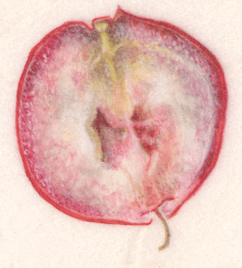
Unfortunately I ran out of pigment in the printer and needed to refill. Once this was done, I sat at the computer to check everything on the screen, looked up and saw this magenta splash across the artwork. I was shocked. How many hours had I used to no avail?

Be careful to keep artwork safe!

In my previous blog I wrote in general terms about the materials I use, including colour. My sketchbook contains notes of the colours used in the sketches, but these are only a guide for the final artwork.

The sketched colours are on white paper and the final artwork is on a warm vellum which can affect the overlaid transparent paint. If possible I try to match up the colours I used in the sketches if I don’t have enough live material to work from. For example, the leaves often change colour over a growing season and if I’m unlucky I might be painting young leaves in the autumn. This happened with the Bilberry leaves.

I try to limit the number of pigments I use in a picture but still have favourites that appear in most paintings. 

Watercolours used to paint the Small cranberry picture.

As an example, I used these colours in the small cranberry picture:

  • Quinacridone Magenta PV122
  • Quinacridone red PR209
  • Perylene violet PV29
  • Quinacridone Gold PO49 (I don’t think single pigment can still be obtained)
  • Winsor Blue Green PB15.

The last three are a must for me, but I might also use a brighter yellow or warmer blue. On this occasion I added a lemon yellow to lift the green in the leaves.

Introduction of graphite

Getting graphite on vellum is normally considered a negative. Graphite does not seem to work in the same way on vellum as it does on paper because of course it is slightly greasy and tends to slide around on the surface. 

I wanted sections of graphite in my pictures to try and give some relief to the colour. The compositions are quite small with a lot of detail. To separate details from each other I wanted to allow some of the picture to fall back and behind sections of colour to create focus.  I therefore decided that elements conveying habit would be either in graphite, or in graphite with a slight colour wash. But how was I going to get the graphite to go on reasonably evenly and to sit? 

I checked out how other botanical artists had handled using graphite on vellum, then tried out various ways of developing a technique on scraps of vellum.

Bilberry trials on vellum with colour and graphite

Luckily, as with graphite on paper, the use of water on top helps it to adhere to the surface. I also learnt that using a little mucky pigment/graphite water and allowing it to dry would also help to control use of the graphite on top. But, some of my details were much too tiny to make full use of this technique.

The way forward was to use a combination of graphite pencil for the finest detail and soluble-graphite. I generally used a graphite pencil first – possibly a 2H, then with a very small brush I either went over it with pure water or used the water mixable graphite. I found that the graphite worked much better where I had used a light watercolour wash first. 

Process for each picture

Once each composition was complete and transferred to the vellum mounted block, I started with the watercolour sections.

Except for the Cloudberry, the main branch which catches the eye, was enlarged to twice its normal size. I normally started with this so that I could determine how much other elements of the picture needed to come forward or fall back. After this I completed the flower and fruit sections.

Once the watercolour-only sections were complete, I worked on the graphite sections. As mentioned before, the use of graphite means that these sections fall a little into the background and give relief to the eye of the beholder. But the detail in those sections needs to be just as clear as for the remainder of the picture. Each part of the picture needs to give new information otherwise there is no reason to include it. In this case, the graphite sections were done life-size.

Last of all came the scale-bars. To work out the best placements for these, I scanned each picture onto my computer and digitally placed and sized the scale-bars, comparing them from picture to picture. This happened in January 2023 when preparing for professional scanning of the artwork.

Actually drawing the scalebars onto the final artwork caused most headaches. Applying the graphite in even lines on the vellum was more difficult than doing the line drawings, but I got there!

Now I will write about each species individually – starting with the next blog 30 April 2023.

Life-size small cranberry flower and stems. Water-soluble graphite being applied with Rafael 8408 size 1 brush over faint graphite pencil lines.

Foraging plants in the norwegian mountains – 11. My working practice

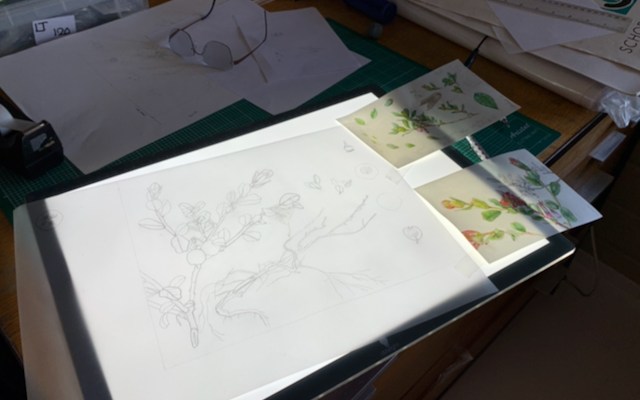
Using a lightbox to make an overall transfer for the bog bilberry picture.

Transfer process

For this series my transfer process hasn’t been very straightforward. Once I knew which sketches I wanted to repeat in the final artwork, I made line drawings of each, scanned them and arranged them on my computer, constantly comparing and assessing. Once I was happy with each composition, I traced each sketch into its place on a sheet of tracing paper (see picture at the top), then transferred the composition to a vellum mounted block. In some instances, I continued to make further adjustments underway.

I also made separate tracings of each element in the design and used these once the overall placement was sorted.

To make a transfer I trace the line drawing onto the right side of tracing paper, and then repeat the process carefully and with a sharp pencil on the backside of the tracing. This allows me to use the tracing several times should it be necessary and leaves only a light line of graphite on my artwork. 

This way of transferring reduces the amount of excess graphite that tends to float around. The pictures to the left demonstrate the transfer process. 

See links to videos and blogs giving more detail on my ‘Online Tutorials’ page. https://gaynorsflora.com/tuition-2/my-tutorials/. ‘How to trace an image to art paper’ contains links to two blogs and a video.

Painting process

Before I start to paint, I arrange some form of cover so that only the section I’m painting is available to me. I might use a sheet of tracing paper, layout pad or clear acrylic sheet – or even a combination. Its easy for accidents to happen, the slip of a brush  or even dropping a laden brush onto the artwork. Accepting this and preparing against there being too much damage is essential for a good result. I have spent time scrubbing out mishaps and I’m sure many others have too.

Bog bilberry covering to protect rest of artwork from splashes and dropped brushes!

Here is my covering for the Bog bilberry picture. I have used a combination of acrylic sheeting and layout paper whilst trying to avoid too much taping directly to the vellum.

Painting on vellum

Painting on vellum is very different to painting on watercolour paper as the pigment lies on the surface rather than absorbing into the paper. Therefore except for the very first layer it is important to paint as dry as possible, otherwise any other layers will lift the preceding layers.

Arctic Tern fired on Ceramic. From an island reserve in the Stavanger fjord in 1989

In some respects, it is a little like painting several layers on porcelain – as I did in the 80’s. Porcelain is very smooth and carefully layering colour on top of an un-fired layer is paramount, or the lower layers are whisked away.

For painting on vellum I use a variety of brushes depending on the level of detail. My first ‘go-to’ brush is a Rafael Kolinski sable brush with a beautiful point; series 8408. The other makes of brushes I use are DaVinci 1505 and Rosemary brushes series 8 and 66. They are all kolinski sable. To lift out I use various synthetic brushes. 

Importantly for all these brushes is a curl free and sharp tip. Brushes wear quickly and the long tip disappears gradually – but the brush still has many useful functions, so they almost never get thrown away.

The watercolours I use are all artist quality but from different suppliers. Most are single pigment and transparent. I have occasionally used Chinese white as an underlay in areas where I need to control ‘lifting out’ as in the Cloudberry flowers.  When lifting off it might leave  a very slight sheen. If I don’t lift the Chinese white off, it mixes with the other colours and dulls them, therefore I have to lift off very carefully to create highlights.

In my next blog I talk a little about the opportunities I had to learn about applying graphite to vellum – That is planned for 27 April 2023.

This is a very short YouTube slideshow from a demonstration I made to some of my students when they were learning to paint on vellum. I painted the tiniest of crab apples on a vellum remnant.

Foraging plants in the norwegian mountains – 10. My working practice

Composition

Do these three pictures have good compositions? It is not easy for you to judge from these as composition is the area within the mount edge – the image and background.

  • Benton Iris ‘Farewell’ is Watercolour and graphite. The painting is part of the Cedric Morris Florilegium.
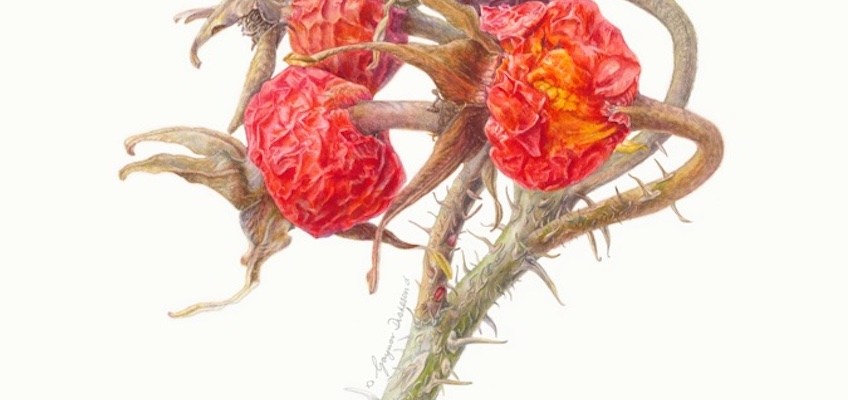
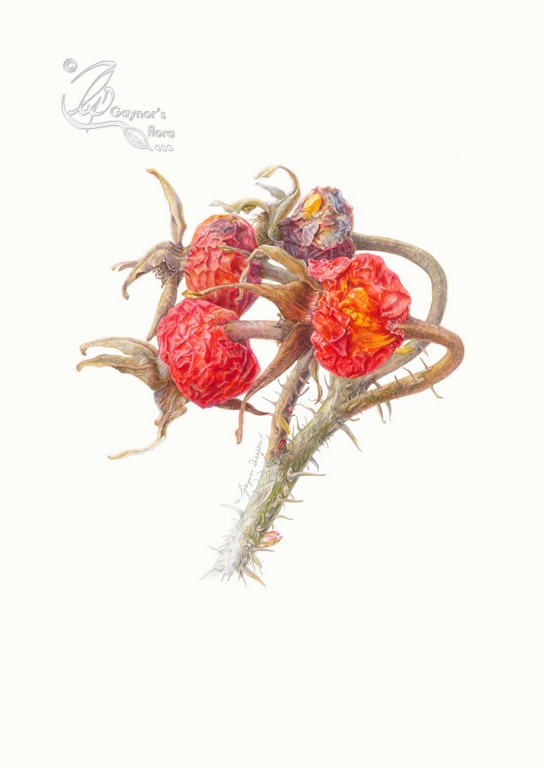
  • Dying Rosa rugosa is in Watercolour. It was one of the first paintings I did after returning to Norway. The sprig was sticking up above the snow, so it shrivelled quite fast.
  • Rhododendron impeditum is also watercolour and graphite. This picture is part of the Chelsea Physic Garden Florilegium.

Composition in botanical art is not necessarily very straightforward. As botanical art is ‘art’ it should have a main focal point that draws you into the picture. Once your eye is drawn into the picture, something needs to lead it around within that picture and prevent it from being lead off elsewhere.

On top of this, botanical art must be botanically correct. 

The first digital arrangement of my cloudberry sketches

Combining the art and botany for each picture is hugely difficult particularly when you have different sections telling a story about a plant. Having a series of plants in separate pictures that elaborate the story compounds the problem. 

To try and reduce the problem a little I started to arrange the pictures digitally. I scanned some of my sketches and moved them around within a 31 x 25cm area. It gave me something to think about when deciding what to include in each picture and how many more sketches I would need to get all the information I needed.

Scanning and arranging digitally gave me the opportunity to do something similar with my other species and the ability to compare them against each other. This composition looks nothing like the final one, but I kept rearranging until I was satisfied.

I worked hard to compose my set of pictures so that they looked a series. This can be quite difficult when some are from different families 

  1. Rubus chamaemorus – Rosaceae
  2. Vaccinium oxycoccus Subsp. microcarpum – Ericaceae
  3. Vaccinium uliginosum – Ericaceae
  4. Empetrum nigrum subsp. hermaphroditum- Ericaceae
  5. Vaccinium myrtillus – Ericaceae
  6. Vaccinium vitis-idaea – Ericaceae
  7. Arctostaphylos uva-ursi – Ericaceae

The first word in each species is the Genus name from which the plant is derived. Four are Vacciniums from the same Genus.  Six of the plants are from the Ericaceae (heather) Family and you can see this by the similarity of the flowers. One is from the Rosaceae(rose) family, and the stipules on the leaves (tags at the base of the leaves) is a clear indication of this.

Deciding the enlargement was relatively easy with the plants from the Ericaceae Family where the fruit is comparable. But as everything was larger on the Cloudberry picture, only the scale bars can give the size.

My aim with all the pictures was to let people see and understand the incredible flora and edible fruit available in the mountains. Many look at plants and think them pretty, or know where to pick certain fruits, but not so many study the plant and understand how intriguing it really is. This is an opportunity.

What to include in each composition.

I went through my sketchbook and made sure that I had enough information about each plant to fit on my vellum, mounted on blocks by William Cowley’s. I didn’t want to overcrowd each picture. 

The focus was the plant and its fruit, but one can’t do this without highlighting its flowers. I decided to introduce a picture of the flowers and fruit but restrict dissections to the fruit only. That is until I got to the cloudberry which was going to be the most difficult to integrate into the series. But it isn’t called ‘Mountain Gold’ for nothing.

In the end, all but the cloudberry picture included a branch enlarged and branches actual size to indicate habit. Each had an enlarged flower, plus fruit with both longitudinal (LS) and transverse sections (TS). These are the finished longitudinal sections from each fruit; the largest being the Cloudberry.

In the next blog I will be talking about my transfer process. This comes 23 April 2023.

Only Eight weeks until the RHS Exhibition at the Saatchi Gallery in London;

https://www.saatchigallery.com/exhibition/rhs_botanical_art___photography_show_2023

Foraging plants in the norwegian mountains – 9. My working practice

By the lake Fjelløkteren at 1000metres – Ripe Cloudberries mid July

Imagine how the artwork might look if measuring various parts of a chosen species was not accurate. The photos above all contain the Vaccinium oxycoccus subsp. microcarpum – small cranberry. Click on the images to see them larger.

  1. Small cranberry flower in the moss with Bog bilberry leaves, bog rosemary leaves, and heather. Note the tiny leaves of the cranberry lying across the moss surface bottom right.
  2. Small cranberry flower with bog rosemary to the left, bog bilberry leaves and flowers. Note the woody stem that distinguishes it from the bilberry. Sprigs of mountain crowberry also clearly seen with the white line on the back of them – this is the leaf folded back.
  3. Two small ripe cranberry fruit lying on the top of the moss by the side of a larger cloudberry leaf. There is also heather and mountain crowberry leaves. The stems of the small cranberry can be seen across the moss if you know what to look for – narrower than the grass.
  4. Two ripe small cranberry fruit either side of a cloudberry leaf. The reddish stems of the cranberry with the tiny triangular leaves can be seen.
  5. The growing tip of the small cranberry.
  6. A stem and leaf of the small cranberry. A further series of well chosen photos would show the connections of leaves to the stem, the branching and flower connections.

Measuring for the sketches

Amongst my original chosen plants for the 2023 exhibit were some very tiny flowers, but each of the species contained some tiny detail. I needed the facility for measuring accurately, particularly whilst sketching and of course for enlarging where needed. 

To the left is my trusty digital calliper in use for measuring the Cranberry. Whenever I take a measurement, I make a note of it with the drawing and additionally check it against the research done on books and the internet.

Unfortunately, I didn’t have this essential tool when initially sketching the Cloudberry and spent several years trying to catch up as already mentioned. As I wasn’t living in Norway at the time, I tried to coincide my visits with the months that I thought I might be able to get the missing detail, but either the plant flowered earlier or later than my visit. In fact, I didn’t get the missing dimensions until 2022 when I was again living in Norway. But even then, it still took several trips up into the mountains to hit the right time!

Another tool I use when making enlargements accurately is a technical divider. You can see it in use here when I did my Bilberry sketches. The divider allows me to measure exactly or enlarged by a specific amount. 

Technical divider adjusted to make a 1.5 enlargement.
Technical divider in use with bilberry sketch.

The other picture here shows the technical divider adjusted to create an enlargement of 1.5. In the ‘old days’ before digitalisation, one could write an enlargement of 1.5 (x1.5) on the illustration. Although this helps when doing the illustration, it will not work if showing artwork digitally on a website etc. 

In such a case one has no idea at which size the original drawing will be seen, therefore scale bars need to indicate exact measurements.

Example: When drawing x 2, or twice the size of the actual subject, one knows that 2cm of the illustration is actually 1cm in real life. So one could draw a 1cm long scale bar with 5mm written beside it to indicate that the 1cm line is in fact equal to 5mm. This means that when looking at the original enlarged illustration, if it measures 5cm, you know that the plant section is 2.5 cm in real life. 

But, these days if viewing an illustration digitally, there is no way of knowing what the size of the illustration is.

Scale-bars from bilberry illustration.

To overcome this if viewing on-screen or in a book, measure the scale bar marked as 5mm (our example) and note the measurement, then measure the whole section on-screen and multiply that measurement with the measurement of your scale-bar. This will give you the size in front of you on your screen or book. But you will want the real-life size and to do this, multiply again with the figure written by the scale bar – in this instance 5mm.

As an example use this picture from my bilberry illustration to work out the size of the finished detail and the size of the actual plant. The picture shows where I planned the scale-bars digitally to repeat in graphite on the artwork. But remember that the scale bar is in mm i.e. 4mm = 0.4cm.

On my screen, the scale bar measures 0.7cm and the section is 2cm high. Therefore 2 x 0.7 = 1.4 x 0.4cm= 0.56 cm. This means that the illustration is 1.4 cm tall, but as the scalebar is equal to 0.4 cm, the live flower is 0.56cm high.

My next blog is scheduled for 20 April 2023

Foraging plants in the norwegian mountains – 8. My working practice

A year in the life of a Magnolia x soulangeana tree. In watercolour and graphite.

In 2011 I did my first RHS exhibit – ‘A year in the life of a Magnolia x soulangeana tree’. The tree was in my front garden, so I had a good source for the material I would need. But to get my eight pictures completed in time, I needed to paint throughout the year. The main picture from which all the others derived contained all the phases the tree went through during the year. It was whilst I was doing this series that I became interested in the inner workings of plants and started using a microscope. Of course, to do this I also needed a sketchbook. 

Sketchbook work

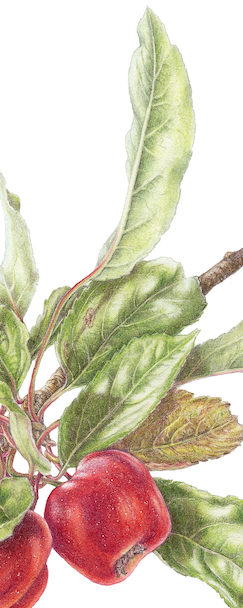
Malus x scheideckeri “Red Jade” in Colour pencil

Being a very impatient person I always wish I could get the perfect result first time around. When I started out painting plants, although I had drawn and painted most of my life, I was not very good at using sketch books. But I quickly understood that most of those who did botanical art also did a lot of work in sketch books. 

Sketches from my Crabapple pages.

Encompassing sketchbook work I felt was difficult as I paint directly from the plant in front of me. Why would I want to sketch it several times before painting the final piece? Surely the plant, or flower or leaf would at least have changed or even died before I got to the final painting!

For my second exhibit in 2014, ‘Small is beautiful; Crab apples explored’ I did six pictures from six different crab apple trees – also in my garden. As the title suggests I was doing an exploration of each crab apple  – again over the year. The final artwork displayed the fruit and flowers and dissections of both; I again needed my microscope and sketchbook to get together the necessary information about each of my plants. 

Malus x atrosanguinea ‘Gorgeous’ setup

But this time. I also worked out another way of using my sketches and my photographs. Yes, I take an awful lot of photographs which I use to confirm detail. I have painted three pictures using this photo; but each picture is completely different.

I used the same photo setup but picked different apples and leaves from the garden each time I painted a picture.

Below are sections from two of the paintings. Compare the difference.

But what has all this got to do with my work process towards my current RHS exhibit? 

I learnt a lot during the process of planning for my previous exhibitions and it has all come in very useful for planning this one.

My first exhibit was done in watercolour on paper and the second one was colour pencil on paper. This time it is watercolour and graphite on vellum. A completely different kettle of fish! 

Preparation and plenty of sketches is everything. 

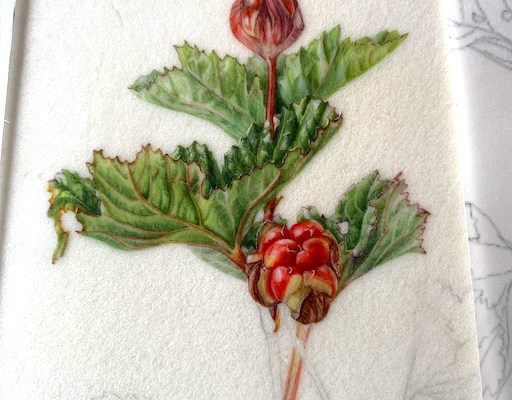
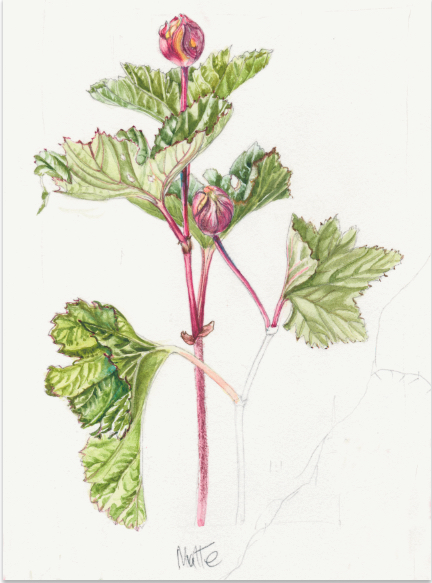
The main sketch that I used in the Cloudberry painting was the one below, drawn in 2017.  When working on my final artwork in 2022, I found appropriate plant pieces to paint from and the Work In Progress (WIP) is as you can see. The immature top fruit is rather different to the sketch, and the lower one has even started opening. This development is not on my original sketch, but I liked the layout of the sketch and wanted to incorporate it in my final piece. The final leaves were painted from several new ones, to include the ‘tatty’ nature of one of them from the sketch.

Rubus chamaemorusCloudberry WIP
Rubus chamaemorus – Cloudberry sketch.

Outside my comfort zone

I love painting small plants; plants that seem insignificant but are beautiful and worth noticing.

I love the challenge of painting the detail of these small plants so that everyone gets a chance to admire them and perhaps look out for them whilst out and about.

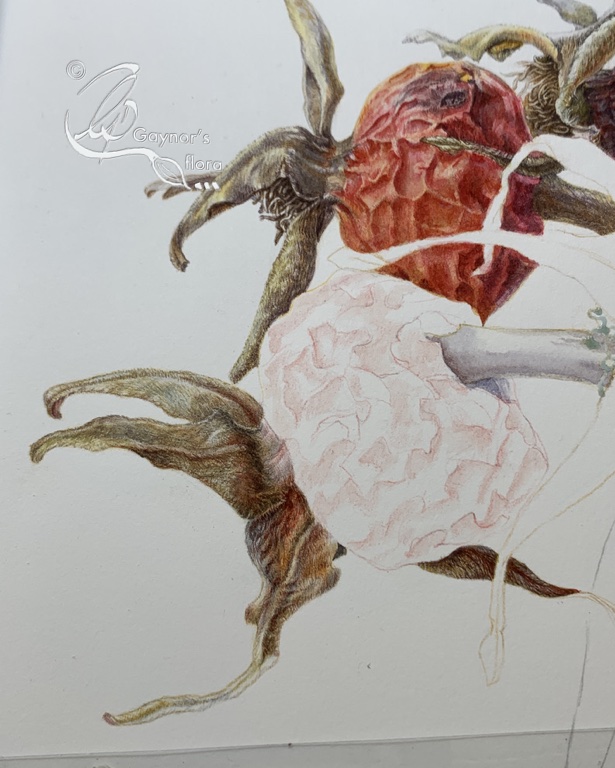
One day I was walking near the station in Tønsberg, Norway and saw some shrivelled Rosa rugosa hips in the snow. I picked one little branch thinking I might paint it on vellum. However my daughter thought I should accept a challenge outside my normal comfort zone; She felt I should portray it much enlarged on paper.

The thought of doing this felt very uncomfortable as I have noticed that some artists who suddenly go large do not increase the amount of detail and the picture doesn’t do the plant justice. I have drawn and painted parts of some compositions scaled up so that the viewer can actually see the detail, but have never done a whole painting like this. Was this going to work for me?

Sketching the Rosa rugosa

I started sketching the hips into my sketchbook, then once I had a good line drawing I transferred this to my Fabriano paper; Luckily I have quite a lot of the ‘old’ batches of both Artistico and Fab 5. This is done on Artistico Extra white.

Ready to start painting

You can see here that I really look after my paper whilst painting. It is so easy to get splashes or ‘dropped brush’ marks if one isn’t careful.

I normally cover the art paper with layout paper hung from the top. Then I cut it into about three strips so that I only have the part I’m painting, uncovered. On the lower part I tape clear acetate.

First stage of painting

I always lift out the graphite tracing before I start the first layer of paint and lay the clearest colours first. However, in this picture I decided to lay a neutral tint wash(made of three primaries) under my colours to indicate the direction of light and form.

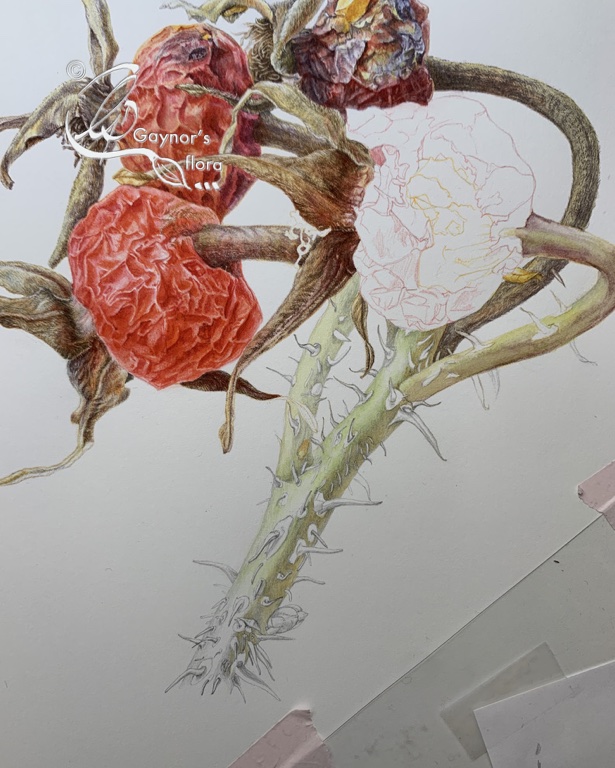
For the next rose-hip in the bunch of four, I decided to replace the graphite outline with a watercolour pencil. I sometimes do this if I am a little unsure of where I am going in the painting, but I use only a pale colour. I lift off the excess pigment with a putty rubber and using a slightly dampened brush I soften the watercolour pencil edge making sure no water goes outside the line of my subject.

… And so the third rose-hip….

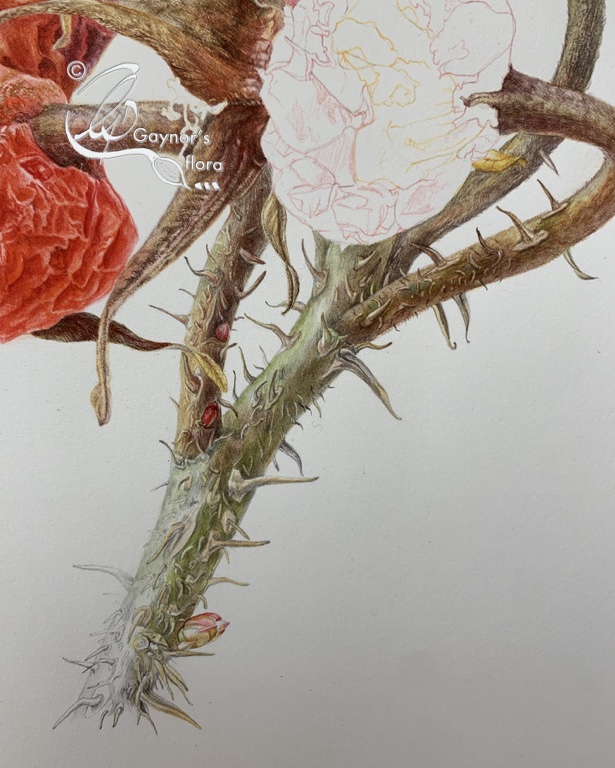
I wanted to do some of the picture in graphite, leading into the main part with the hips. Sometimes using graphite towards the background can reduce the heaviness of a picture. The stem of the Rose-hip is very prickly and therefore doing some of it with various graphite pencils made sense. I used graphite along the whole length of main stem and then colour washed part of it.

I did this picture five times life-size and it comfortably fits an A3 sheet of paper. Does it succeed?

One final comment; Rosa Rugosa grows everywhere in southern Norway and it is not a native species, therefore they are being removed wherever possible. This is because they take over the habitat from other species that belong here. I remember with shame that I was one of those people in the early seventies who planted a Rosa Rugosa hedge in the front garden – across the fjord from where I live now. My children were small at the time and I knew that the hips provided a lot of Vitamin C. But I know now that it is not a good enough reason to introduce a foreign species.

Dying Rosa rugosa