Friday in Pittsburgh

I don’t really know what ‘Homecoming’ means in the American University town environment, but I am sure the city put all this entertainment on just for us!

Today has been – what can I say – spectacular.

Last night I wrote to each of the other three Society of Botanical artists (SBA) (the UK version of the American one – ASBA), who had their paintings accepted at the Hunt this year. I sent each one a photo of their work hanging in situ. I have also asked if I can include their pictures and names on this blog. I have to admit, not all replied to my last request, so I have jumped the gun a little. But, their work is now in a prestigious place for all to see. Before I mention their names and show their pictures, I have a comment.

The Hunt have their international exhibition every three years only and, about 41 artists have work selected. To have four of us from the same organisation have our work selected, says something positive about the organisation. I know that the SBA has done a lot towards my development as a botanical artist.

The other three are:
Charlotte Linder

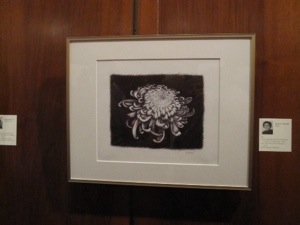
20130927-235427.jpg

20130927-235525.jpg
Gael Sellwood

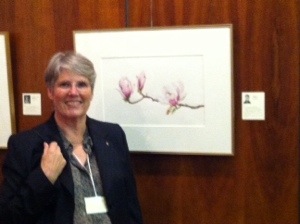
20130927-235706.jpg

20130927-235735.jpg
Roberta Mattioli

20130927-235944.jpg

20130928-000002.jpg

You have already seen my work in yesterday’s blog.

But, talking about prestigious, we were allowed a special viewing of pictures we wanted to see from the Hunt collection. First and foremost is the fact that our pictures are in the same collection as Rory McEwen! I can’t believe that. I saw two of his works – without glass between the picture and me. His work is perfect. I also saw work by Ehret, Redoute and several other fantastic artists.i was also amazed at the number of paintings on vellum. I think that the pressure I have got from friends here, means that I now have to bite the bullet and try using it.

I will stop going on about all the pictures I saw as I might bore everyone else to tears. It was a huge highlight though, and I feel as though I am floating with the excitement of it.

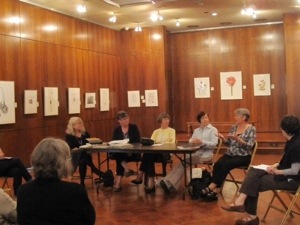
This afternoon was the talk given by five of the artists whose pictures were accepted. I was one of the five. It wasn’t bad at all as everyone was so interested. It was incredible to see that each of us had a singularity of purpose towards our botanical art and that some of us had fairly similar habits. Although there was a lot that divided us. At least my husband now knows that I am not unusually weird – it goes with the territory!
/>
20130928-005237.jpg

I was at a talk this evening, but as it ran late and I had a prior appointment, I had to leave early at 19:30. We again met my friend from nursing school and went out for a lovely meal. She explained to us a little about how food is ordered and shared out in America. It made much more sense. We had tried to eat two different things the night before, leaving a lot of it and still feeling too stuffed.

Towards the end of the meal, there were some huge explosions. We knew that something had been going on outside as there seemed to be a lot of prep for some festivities and loads of students were out and about. Everyone rushed out ( the waitresses didn’t try and get us back in as we hadn’t paid our.bill yet), and we watched an incredible (a lot) fireworks display. Most of it came from one side of the campus with short breaks allowing short,sharp bursts from the opposite direction. The sharp bursts were directed up the side of the Cathedral for Learning. This is an impressive building looming very high upwards. It looks like a cathedral but seemed never to have been intended for other than learning. The fireworks lasted over 30 mins and I am not exaggerating. They could be felt reverberating through you.

After they had finished we went back into the restaurant to pay the bill. At no time had the waitress come out after us. Very trusting.

We had a lovely time with my friend and I thanked her for putting on such a display for us!

To finish off. On the way back to the hotel, we saw a ‘sight’ crossing the road. There must have been about 30 pairs of legs crossing the road. They were LEGS. The type that stretch from ground to armpit – on hiiiiiigh heels. I have to say that I gawped as well as my husband. They were an impressive sight. Sorry, no pictures!

Thursday in Pittsburgh

A busy and exciting day. This is the first full day of the ASBA annual conference and the opening of the Hunt’s 14th International Exhibition of botanical art and illustration.

This morning started off with a Portfolio session where many members lay out their work for query, comment and I suppose critique. There was a huge variety of styles and it was very interesting. Many had done their work on vellum, but there were other techniques too. I was encouraged to try vellum although it is extremely expensive. Also suggested that I use the sort available in the UK as this is the best.

I am told that the latest ASBA magazine has a very good article on how to paint on vellum. For people out there who paint botanically, I recommend that you join this organisation. Membership has quite few benefits.

I saw some beautiful silver point work, and some very good pen and ink work. I wish I could describe some of it as it is obviously a new technique to try and learn. Unfortunately I didn’t take any pictures.

Towards the end of the Portfolio session I went to a talk on the history of Vellum. Unfortunately, it was more a history of the family who produced Vellum in the US. Parts of it definitely were interesting, but I feel that I know little more now than I did before I went into the talk.

We had a long lunch combined with AGM.

The afternoon was filled with a techniques showcase. Three different artists with three different techniques and materials demonstrated for us. The topics were Graphite, watercolour and coloured pencil. They were very good. Although other workshops were going on at the same time, the auditorium was pretty well full of interested artists.

20130927-000226.jpg

20130927-000245.jpg

Then the opening of the Hunt Exhibition. Several school buses picked us up at the hotel and drove us to the Hunt. We went to the top floor (walked!), where we were greeted with nibbles and punch. A friend of mine who started nursing at the same time as me 50 years ago in Set 231, now lives in Pittsburgh. She came to hep celebrate with her neighbour.it was lovely having them there too.

All the pictures were hung in a large room and some speeches were made to open the exhibition. Unfortunately I can’t repeat what was said as you couldn’t hear. But a good time was had by all, even when the fire alarm evacuated the building.

We were turfed out into the balmy evening air, but it didn’t deter any conversation.

20130927-001547.jpg

20130927-002312.jpg

Busy, busy – one!

The Antonia Rose
The Antonia Rose

Where to begin?

Since I came home after the fantastic course with Sarah Simblet I have been catching up in between family visits.

Some of our children stayed on and off with us throughout June and will be returning next week with other members of the family. All in all we will be eleven of us. They will be keeping out of my hair until Monday as I have a three-day workshop this coming weekend.

This workshop is well supported and the topic will be ‘Summer fruits’. However several of those taking part will be painting Roses. I suppose this is a form of lateral thinking. I had a think about any fruits that we have in the garden at the moment. There is in fact very little as we are between flushes of the usual varieties. The Raspberries and Strawberries are finished until a new lot arrive and it is too early for Blackberries, although they are now beginning to turn a beautiful black.

Normally Cobnuts look really beautiful to paint at this time of year with their curly green skirts and pixie hats. There isn’t a single one on our tree this year. The Rowan tree has a lot of fruit on it and it is ripening fast. The apples are still very small and of all the crab apple trees in the garden there is only one that is showing any hint of warmth in colour. Actually, thank goodness for that as I have been doing so many other things other than continuing the Crab apple series of paintings recently.

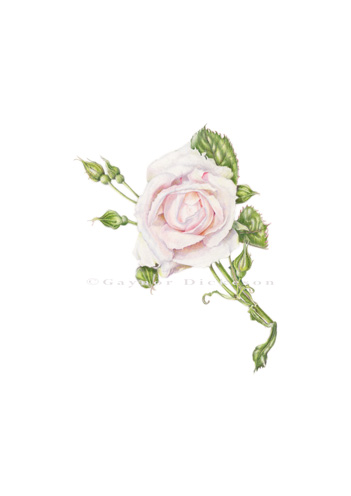
One of my students who will be painting roses during this coming workshop, will be continuing a picture she has been doing for the last three weeks. She has had several days with one-to-one tuition as the subject is very special. Her father was a Nurseryman and developed a rose which he named Antonia – the name of his first grandchild. As far as they are aware there are only three examples of the rose left and this is the reason she wanted to paint it. Not only that, she is using coloured pencil.

To demonstrate various relevant techniques to aid my student, I started painting the rose myself and have decided to use it as a step-by-step tutorial.

I don’t think that I have mentioned before that I am the Botanical Art Tutor for the London Art College. It is a very good organisation who provide art courses in various mediums and with many topics via the Internet or per correspondence. My predecessor wrote a fair amount of the course as it stands today, but it focuses on watercolour as well as a little graphite and pen&ink. I am now in the process of writing some tutorials for coloured pencil botanical artists to add to what is there already. Therefore in time we will have very good tuition to help botanical artists with their watercolour and coloured pencil studies.

The above

← Back

Thank you for your response. ✨

is my finished Antonia Rose which I will be using for the step-by-step studies with the London Art College. I hope you like it.

Sarah Simblet course

← Back

Thank you for your response. ✨

I came back nearly a week ago from a weeks course at the Ruskin School of Drawing with Sarah Simblet as the tutor. I had an amazing week away.

The course was Botanical drawing. Sarah has authored several art books, on drawing in general, anatomy for the artist, botany for the artist and is now working on a new book. She is a very good artist and also does a lot of research in the areas in which she chooses to teach. To cap it all, Sarah is a lovely person and very supportive of her students when struggling with new media.

The reason for going on the course was to draw in pen and ink. I have always been intimidated by this medium and therefore hoped that I would be less so once I had had a little expert tuition. Sarah constantly draws in black and white and in reality with her work you feel that you are looking at it in colour. Getting to that level of expertise would be something I would love to achieve, but it possibly won’t be in this lifetime.

Sarah got us to relinquish our feelings of control when drawing by using unusual implements. After this she encouraged us to build ourselves up again using the new medium (ink) and new implements (pen). It was exciting. I can’t show you pictures of the pulling down, but this is an example of learning to build up again. It is a plant I have never seen before – Molucella laevis. Very attractive. In fact whilst in Oxford I did see another painting of one.

We went to the Herbarium and were given a treat. All of Ferdinand Bauer’s work that went into the Flora Graeca was laid out for us. It was amazing. His sketch books and all his notes were there. He had a colour coding system that he used when doing his sketches in situ. He could spend years away from any studio and when he returned he used his notes to make his botanical paintings for the Florum. Therefore we were able to see his actual sketches, notes and final paintings before they were eventually published.

I made new friends on the course who are from around the world. Two I will be meeting again in a few weeks time at the opening of the Hunt Institute of Botanical Documentation Exhibition in Pittsburgh.

I am now coming down to earth and catching up on all I need to do. But  hopefully I will get my act together to keep the blog updated.

Thank you for reading this. I do recommend Sarah Simblet’s summer courses.

Molucella laevis 180713

Teaching with Fieldbreaks at Goodnestone Park Gardens

On Monday of this week I went to Kent to teach at Goodnestone Park Gardens. What a beautiful area. It is so peaceful and they are so welcoming there.

This is the second year that I have had classes at Goodnestone Park with Fieldbreaks and the workshops are seemingly more popular each time.

I had a lovely group of people with half of them using coloured pencil, one eventually chose to use graphite and the remainder watercolour.

I think that things were about a week behind in comparison to where I live. In some places you could almost see the green tips begin to appear on the hedging, there were loads of daffodils, no tulips, the Magnolia x soulangeana was still closed but nearly ready to burst although the Magnolia x stillata was fully open and the Camelias were glorious. There was in fact a lot to choose from if only you looked and were able to see. The flowers eventually chosen to paint were the above, plus Primroses, Periwinkle, Hellebore and Fritillary. The results were very good and as far as I can tell, all those taking part were pleased with their results.

I get quite chuffed when students achieve what they set out to do – and in some instances even exceed that.

The only thing I hadn’t been prepared for was the summer warmth. I had layers to keep me warm, but even so I hadn’t expected it to be as warm and lovely as it was.

I will be having another workshop at Goodnestone Park with Field Breaks in June. Come and join us in this peaceful environment.

Which make coloured pencils do I use?

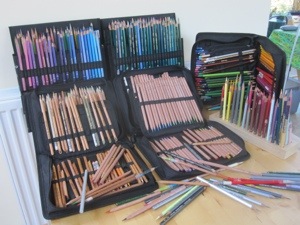
Many people have asked which pencils I use and which ones I prefer.

In reality, I use the pencil from the range which has the colour nearest to what I want. None are good on their own in one flat colour as it then becomes as dead as black does by itself.

I find that Derwent pencils have a slightly chalky feel, but you just can’t do without some of the colours, particularly very pale and very dark ones. I use mostly Artist in this brand, but sometimes I will use Studio as they are a little harder and you can get a finer point than with Artist.

Faber Castell Polychromos are very good as is their range of colours. as they are neither soft nor very hard and the consistency of the colour core is even. There never seems to be any scratchy bits in them as you might find occasionally in other brands. They seem to have the best range of greens for botanical art, although you have to be a bit careful in mixing some of those which lean over to a bluey green, as they might become an unnatural green for flora. But this applies to any brand.

A slightly softer pencil than Polychromos is Caran d’Ache Pablo. They like Polychromos are oil based and not wax based like Derwent and Prismacolour. Their range of colours is very useful and the Luminance range seems to cross over with Pablo, although the range is limited. I find that Pablo pencils are creamy, you can get some detail, although I haven’t managed to get as much as with Polychromos. They too are a lovely pencil to use. One positive thing about Pablo pencils is that you can see at a glance how lightfast they are.

One make that is very useful is the Prismacolour Verithins. I had a few older ones and one of my students gave me a whole set of them. Lucky me! They are a hard thin lead, so you can do very fine detail with them. I often use them for cleaning up the edge of what I am painting (in coloured pencil). However, the greens are all bluey or too sharp in colour for botanical art. I would love to find a toned down green in that range.

The softest coloured pencils are Prismacolour and Caran d’Ache Luminance. Some of the colours in the last range are limited, but cross over with Pablo. Prismacolour have a bigger range of colours Including quite a few useful light and dark colours. I find that the very soft pencils are good as the final layer of colour, particularly if you are trying to get a nice sheen to something.

Unfortunately I only have a few Coloursoft, so it is difficult for me to compare those with the other soft Colour pencil makes, but I understand that they were produced by Derwent to try and replace Prismacolour ( Karisma as was), when they could no longer be sold in the UK. Hopefully at some point I will have more of this range so that I can make a reasonable comparison to the other makes – at least in relation to how I use colour pencils in botanical art.

We all paint differently and use our materials in different ways, but I hope this was useful. Please comment.

20130328-153824.jpg

Tracing to art paper

I have done some art tutorials with ArtTutor.com and they are now live via my website. Look at the page on tutorials and follow the links to download the E-book showing you how to paint a Crab apple picture with coloured pencils. You can also link into one of the tutorials as a taster.

I have had some very positive feedback and essentially this blog is in response to one of these which asked how I transferred my image onto the final art paper.

An image can be transferred in so many ways depending upon how refined you need the transfer to be. The more you rub out on your art paper, the more you damage it’s surface no matter how careful you are. You can use tracing paper, a light-box, your window as a light box, or this way:

I compose a picture using various thumbnails. This leads to a general rough design which forms the basis of the final line drawing.

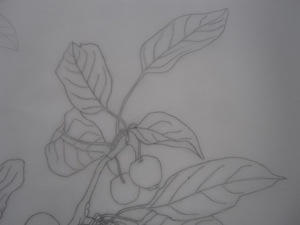
This is part of the line drawing of the picture I am in the process of doing now:

20130325-222407.jpg

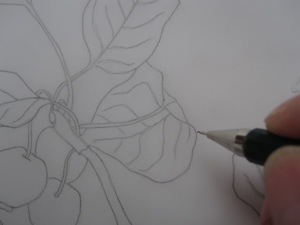
I trace the line drawing onto tracing paper, using a 0.3 clutch pencil.

20130325-222552.jpg

I turn the tracing paper over and draw the line again on the reverse side, being very careful to trace accurately.

20130325-222744.jpg

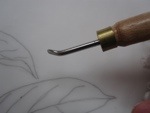
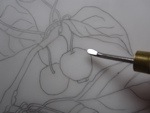
I then place the traced image right side up, on my art paper ( normally Fabriano HP) and, using a Decoupage tool, I rub across the lines. This transfers the graphite from the back side of the tracing paper to the art paper.

20130325-223611.jpg

20130325-223624.jpg

The image left on the paper can then easily be lightened with a putty rubber, without leaving any indentations on the paper.

20130325-223914.jpg

20130325-223923.jpg

I hope this helps those who wonder how best to transfer an image without damaging the art paper or leaving any indentations to get in the way.

Starting last picture again!

Well. I guess that any artist feels in a quandary when they feel a picture isn’t going as well as they want it to. But, starting a botanical art picture again, and at that, one in coloured pencil, needs some determination.

After starting the most recent Crab apple picture, nothing seemed straight forward with it. Each leaf was an effort and heavy going and I felt that its expression of lightness was compromised. Each one seemed to take forever and didn’t seem quite right. After I took breaks, going back with fresh eyes helped, but I still had the overall feeling that it wasn’t the best picture I had done to date.

Unfortunately I am a perfectionist and if what I am doing isn’t the best I can do, I’m not happy!

Anyway, I made the decision to start it again. This time the leaves seem to be developing much better and I am happy with the result so far. I just have to make sure I don’t mess it up over the rest of the picture. I have a long way to go, so anything can happen.

By the way, I have decided to say which crab apple I am doing at the moment. It is Malus Evereste. A beautiful stripy little apple. Some of them have double ‘bums’ underneath!

I decided on this one a couple of years ago as someone brought some branches to one of my workshops. I ended up doing sketches from the ones left behind after the workshop. Since then I have also found a source for a tree to paint in the village. But, as with the other five pictures in the series, I can only include the information I have already received.

Attached is the part of the painting completed before I ditched it!

20130318-233725.jpg

Painting green leaves

Today I have had the first of a two-day workshop on painting leaves.

I have to say that the challenge has been accepted and a page of very different leaves has been started in coloured pencil. Each of the leaves have different coloration and different textures from very smooth and shiny to hairy.

The morning was spent in designing and drawing the layout so that it could be transferred to the paper for the final work. The first leaf painted was hairy and I was incredibly proud of the result.

It is such fun seeing people develop their skills and ambitions in botanical art. Hopefully those taking part will be just as chuffed at the end of tomorrow.