Foraging plants in the norwegian mountains – 10. My working practice

Composition

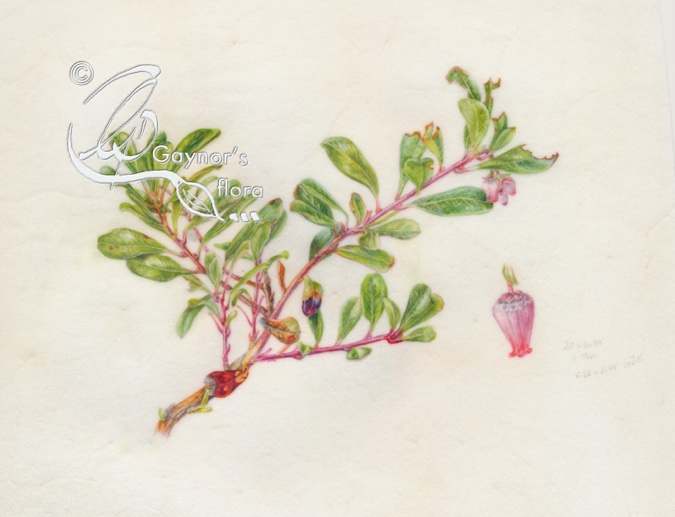
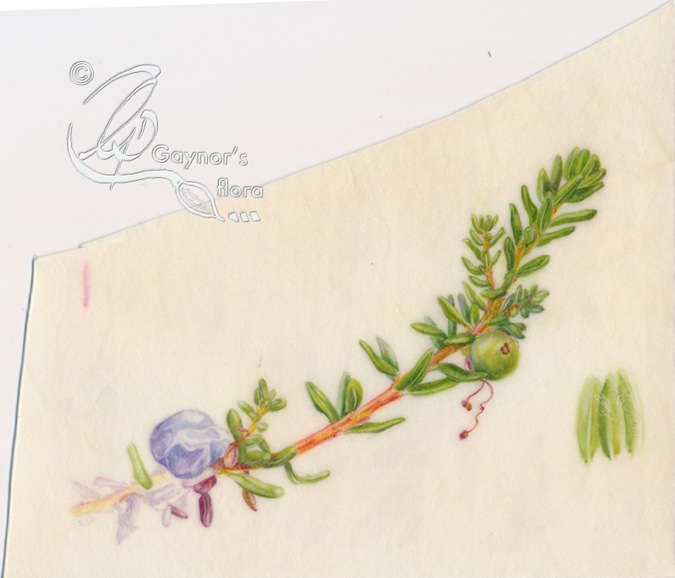
Do these three pictures have good compositions? It is not easy for you to judge from these as composition is the area within the mount edge – the image and background.

  • Benton Iris ‘Farewell’ is Watercolour and graphite. The painting is part of the Cedric Morris Florilegium.
  • Dying Rosa rugosa is in Watercolour. It was one of the first paintings I did after returning to Norway. The sprig was sticking up above the snow, so it shrivelled quite fast.
  • Rhododendron impeditum is also watercolour and graphite. This picture is part of the Chelsea Physic Garden Florilegium.

Composition in botanical art is not necessarily very straightforward. As botanical art is ‘art’ it should have a main focal point that draws you into the picture. Once your eye is drawn into the picture, something needs to lead it around within that picture and prevent it from being lead off elsewhere.

On top of this, botanical art must be botanically correct. 
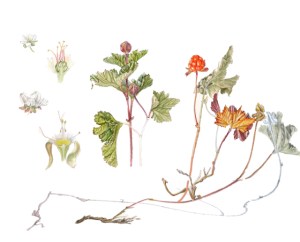
The first digital arrangement of my cloudberry sketches

Combining the art and botany for each picture is hugely difficult particularly when you have different sections telling a story about a plant. Having a series of plants in separate pictures that elaborate the story compounds the problem. 

To try and reduce the problem a little I started to arrange the pictures digitally. I scanned some of my sketches and moved them around within a 31 x 25cm area. It gave me something to think about when deciding what to include in each picture and how many more sketches I would need to get all the information I needed.

Scanning and arranging digitally gave me the opportunity to do something similar with my other species and the ability to compare them against each other. This composition looks nothing like the final one, but I kept rearranging until I was satisfied.

I worked hard to compose my set of pictures so that they looked a series. This can be quite difficult when some are from different families 

  1. Rubus chamaemorus – Rosaceae
  2. Vaccinium oxycoccus Subsp. microcarpum – Ericaceae
  3. Vaccinium uliginosum – Ericaceae
  4. Empetrum nigrum subsp. hermaphroditum- Ericaceae
  5. Vaccinium myrtillus – Ericaceae
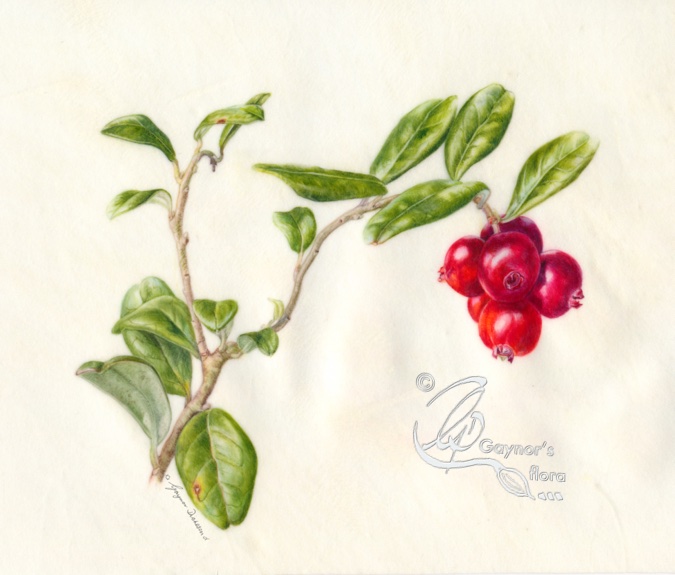
  6. Vaccinium vitis-idaea – Ericaceae
  7. Arctostaphylos uva-ursi – Ericaceae

The first word in each species is the Genus name from which the plant is derived. Four are Vacciniums from the same Genus.  Six of the plants are from the Ericaceae (heather) Family and you can see this by the similarity of the flowers. One is from the Rosaceae(rose) family, and the stipules on the leaves (tags at the base of the leaves) is a clear indication of this.

Deciding the enlargement was relatively easy with the plants from the Ericaceae Family where the fruit is comparable. But as everything was larger on the Cloudberry picture, only the scale bars can give the size.

My aim with all the pictures was to let people see and understand the incredible flora and edible fruit available in the mountains. Many look at plants and think them pretty, or know where to pick certain fruits, but not so many study the plant and understand how intriguing it really is. This is an opportunity.

What to include in each composition.

I went through my sketchbook and made sure that I had enough information about each plant to fit on my vellum, mounted on blocks by William Cowley’s. I didn’t want to overcrowd each picture. 

The focus was the plant and its fruit, but one can’t do this without highlighting its flowers. I decided to introduce a picture of the flowers and fruit but restrict dissections to the fruit only. That is until I got to the cloudberry which was going to be the most difficult to integrate into the series. But it isn’t called ‘Mountain Gold’ for nothing.

In the end, all but the cloudberry picture included a branch enlarged and branches actual size to indicate habit. Each had an enlarged flower, plus fruit with both longitudinal (LS) and transverse sections (TS). These are the finished longitudinal sections from each fruit; the largest being the Cloudberry.

In the next blog I will be talking about my transfer process. This comes 23 April 2023.

Only Eight weeks until the RHS Exhibition at the Saatchi Gallery in London;

https://www.saatchigallery.com/exhibition/rhs_botanical_art___photography_show_2023

Foraging plants in the norwegian mountains – 9. My working practice

By the lake Fjelløkteren at 1000metres – Ripe Cloudberries mid July

Imagine how the artwork might look if measuring various parts of a chosen species was not accurate. The photos above all contain the Vaccinium oxycoccus subsp. microcarpum – small cranberry. Click on the images to see them larger.

  1. Small cranberry flower in the moss with Bog bilberry leaves, bog rosemary leaves, and heather. Note the tiny leaves of the cranberry lying across the moss surface bottom right.
  2. Small cranberry flower with bog rosemary to the left, bog bilberry leaves and flowers. Note the woody stem that distinguishes it from the bilberry. Sprigs of mountain crowberry also clearly seen with the white line on the back of them – this is the leaf folded back.
  3. Two small ripe cranberry fruit lying on the top of the moss by the side of a larger cloudberry leaf. There is also heather and mountain crowberry leaves. The stems of the small cranberry can be seen across the moss if you know what to look for – narrower than the grass.
  4. Two ripe small cranberry fruit either side of a cloudberry leaf. The reddish stems of the cranberry with the tiny triangular leaves can be seen.
  5. The growing tip of the small cranberry.
  6. A stem and leaf of the small cranberry. A further series of well chosen photos would show the connections of leaves to the stem, the branching and flower connections.

Measuring for the sketches

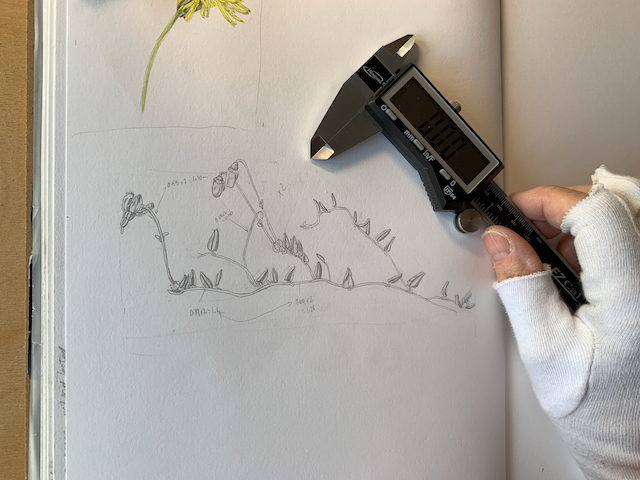
Amongst my original chosen plants for the 2023 exhibit were some very tiny flowers, but each of the species contained some tiny detail. I needed the facility for measuring accurately, particularly whilst sketching and of course for enlarging where needed. 

To the left is my trusty digital calliper in use for measuring the Cranberry. Whenever I take a measurement, I make a note of it with the drawing and additionally check it against the research done on books and the internet.

Unfortunately, I didn’t have this essential tool when initially sketching the Cloudberry and spent several years trying to catch up as already mentioned. As I wasn’t living in Norway at the time, I tried to coincide my visits with the months that I thought I might be able to get the missing detail, but either the plant flowered earlier or later than my visit. In fact, I didn’t get the missing dimensions until 2022 when I was again living in Norway. But even then, it still took several trips up into the mountains to hit the right time!

Another tool I use when making enlargements accurately is a technical divider. You can see it in use here when I did my Bilberry sketches. The divider allows me to measure exactly or enlarged by a specific amount. 

Technical divider adjusted to make a 1.5 enlargement.
Technical divider in use with bilberry sketch.

The other picture here shows the technical divider adjusted to create an enlargement of 1.5. In the ‘old days’ before digitalisation, one could write an enlargement of 1.5 (x1.5) on the illustration. Although this helps when doing the illustration, it will not work if showing artwork digitally on a website etc. 

In such a case one has no idea at which size the original drawing will be seen, therefore scale bars need to indicate exact measurements.

Example: When drawing x 2, or twice the size of the actual subject, one knows that 2cm of the illustration is actually 1cm in real life. So one could draw a 1cm long scale bar with 5mm written beside it to indicate that the 1cm line is in fact equal to 5mm. This means that when looking at the original enlarged illustration, if it measures 5cm, you know that the plant section is 2.5 cm in real life. 

But, these days if viewing an illustration digitally, there is no way of knowing what the size of the illustration is.

Scale-bars from bilberry illustration.

To overcome this if viewing on-screen or in a book, measure the scale bar marked as 5mm (our example) and note the measurement, then measure the whole section on-screen and multiply that measurement with the measurement of your scale-bar. This will give you the size in front of you on your screen or book. But you will want the real-life size and to do this, multiply again with the figure written by the scale bar – in this instance 5mm.

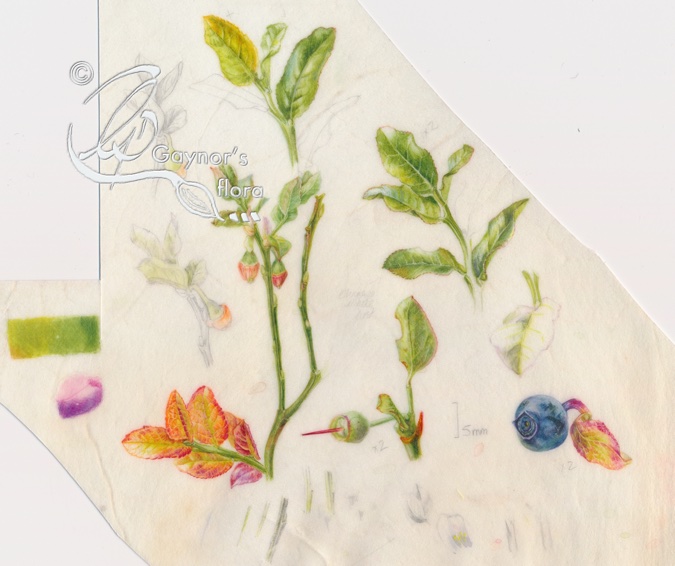
As an example use this picture from my bilberry illustration to work out the size of the finished detail and the size of the actual plant. The picture shows where I planned the scale-bars digitally to repeat in graphite on the artwork. But remember that the scale bar is in mm i.e. 4mm = 0.4cm.

On my screen, the scale bar measures 0.7cm and the section is 2cm high. Therefore 2 x 0.7 = 1.4 x 0.4cm= 0.56 cm. This means that the illustration is 1.4 cm tall, but as the scalebar is equal to 0.4 cm, the live flower is 0.56cm high.

My next blog is scheduled for 20 April 2023

Foraging plants in the norwegian mountains – 8. My working practice

A year in the life of a Magnolia x soulangeana tree. In watercolour and graphite.

In 2011 I did my first RHS exhibit – ‘A year in the life of a Magnolia x soulangeana tree’. The tree was in my front garden, so I had a good source for the material I would need. But to get my eight pictures completed in time, I needed to paint throughout the year. The main picture from which all the others derived contained all the phases the tree went through during the year. It was whilst I was doing this series that I became interested in the inner workings of plants and started using a microscope. Of course, to do this I also needed a sketchbook. 

Sketchbook work

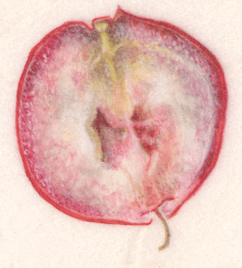
Malus x scheideckeri “Red Jade” in Colour pencil

Being a very impatient person I always wish I could get the perfect result first time around. When I started out painting plants, although I had drawn and painted most of my life, I was not very good at using sketch books. But I quickly understood that most of those who did botanical art also did a lot of work in sketch books. 

Sketches from my Crabapple pages.

Encompassing sketchbook work I felt was difficult as I paint directly from the plant in front of me. Why would I want to sketch it several times before painting the final piece? Surely the plant, or flower or leaf would at least have changed or even died before I got to the final painting!

For my second exhibit in 2014, ‘Small is beautiful; Crab apples explored’ I did six pictures from six different crab apple trees – also in my garden. As the title suggests I was doing an exploration of each crab apple  – again over the year. The final artwork displayed the fruit and flowers and dissections of both; I again needed my microscope and sketchbook to get together the necessary information about each of my plants. 

Malus x atrosanguinea ‘Gorgeous’ setup

But this time. I also worked out another way of using my sketches and my photographs. Yes, I take an awful lot of photographs which I use to confirm detail. I have painted three pictures using this photo; but each picture is completely different.

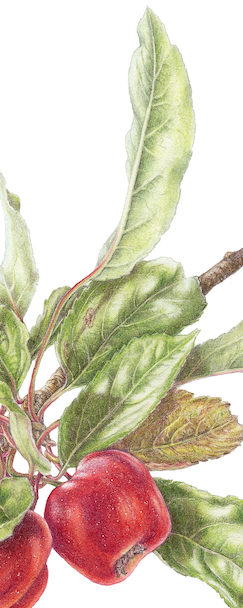
I used the same photo setup but picked different apples and leaves from the garden each time I painted a picture.

Below are sections from two of the paintings. Compare the difference.

But what has all this got to do with my work process towards my current RHS exhibit? 

I learnt a lot during the process of planning for my previous exhibitions and it has all come in very useful for planning this one.

My first exhibit was done in watercolour on paper and the second one was colour pencil on paper. This time it is watercolour and graphite on vellum. A completely different kettle of fish! 

Preparation and plenty of sketches is everything. 

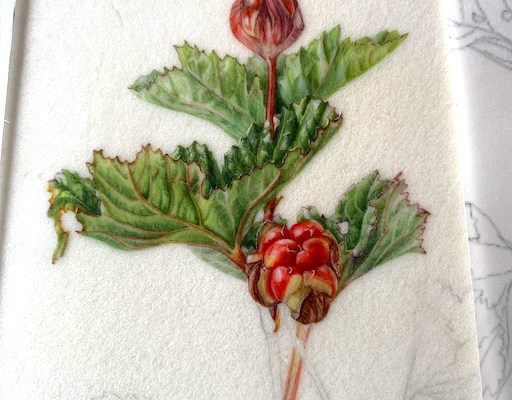
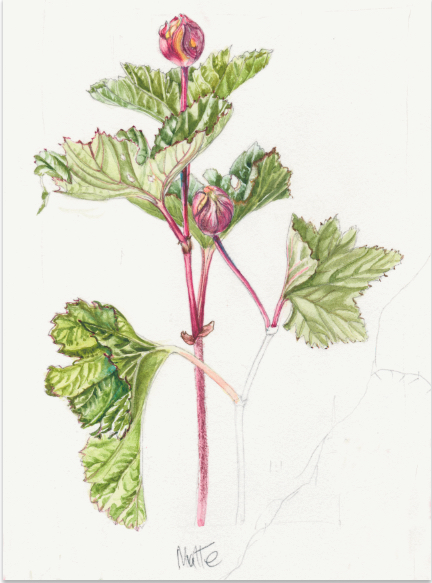
The main sketch that I used in the Cloudberry painting was the one below, drawn in 2017.  When working on my final artwork in 2022, I found appropriate plant pieces to paint from and the Work In Progress (WIP) is as you can see. The immature top fruit is rather different to the sketch, and the lower one has even started opening. This development is not on my original sketch, but I liked the layout of the sketch and wanted to incorporate it in my final piece. The final leaves were painted from several new ones, to include the ‘tatty’ nature of one of them from the sketch.

Rubus chamaemorusCloudberry WIP
Rubus chamaemorus – Cloudberry sketch.

Foraging plants in the norwegian mountains – 7. History of the project

Above are the seven plants I chose with trial pieces on vellum offcuts.

The species I chose, with common names also in English and Norwegian

  1. Rubus chamaemorus – cloudberry -multe
  2. Vaccinium oxycoccus subsp. microcarpum – small cranberry – tranebær
  3. Vaccinium uliginosum – bog bilberry – skinntryte
  4. Empetrum nigrum subsp. hermaphroditum– Mountain crowberry – krekling
  5. Vaccinium myrtillus – bilberry – blåbær
  6. Vaccinium vitis-idaea – cowberry/lingonberry – tyttebær
  7. Arctostaphylos uva-ursi – bearberry – melbær

I have listed the plants in the order according to the type of ground in which they grow – from boggy to sandy:

  • The cloudberry and small cranberry often found intertwined together in the boggy moss of a swampy lake edge. 
  • The bog bilberry is more of a bush and guards the very marshy plants perching on rocks in the marsh. 
  • The Mountain crowberry grows in various areas from rocky outcrops at the edge of a swamp, to tiny examples without much soil, clinging to the rock on mountain tops.
  • The bilberry and cowberry are generally in a similar habitat in damp woods and forests; the cowberry can be the main plant on an old wood ant heap often with bilberry and mountain crowberry.
  • Bearberry grows in sandy areas on the edge of forests or creeping down over smooth rock.

The next stage of this blog goes into my working practice for this series. After which I will talk a little about each of the species and how I painted the final pictures. I will use the above order of plants as I would love others to learn more about them, where to find them and their uses. 

The next blog will be on 13 April 2023.

Foraging plants in the norwegian mountains – 6. History of the project

My best view – Andersnatten at 23:00 in June.

Anyone would think I am trying to sell Norway. I am, it is a fantastically beautiful country. The picture above is in Sigdal, the valley below Haglebu. It is the view we had from the house we built in the late 1970’s. It is from here that I learnt to love Norwegian flora.

In the previous blog I finished off by saying that I still hadn’t seen any sign of one of the two species that got me going with this series of plants. This was the Bearberry (Arcostaphylos uva-ursi). I had already found out that they were not known to grow in the county I now live – along the west side of the Oslo Fjord; In fact locals didn’t seem to know about the plant!

In 2017, that very first summer of sketching, I managed to do some sketches of each of the five species already found. This gave me a feel for the plants but I still needed to do a lot of research into them. I had found that the cloudberry is dioecious – the male and female reproductive organs are separated in two different organisms; each plant is either male or female. My girlfriend from whom we had borrowed the cottage that year, was not aware of this. But, it seems, she was not alone in this as it was a surprise to many Norwegians with a cursory knowledge of the plants around them.

There was plenty of mountain crowberry ( Empetrum nigrum subsp. hermaphroditum) in the area round the cottage. The crowberry is a family of plants that isn’t quite straight forward in that the species at lower altitudes is dioecious like the Cloudberry, but at this altitude in the mountains is more generally a subspecies called ‘hermaphroditum’. This means it carries both male and female reproductive parts.

Finding plants and choices in 2018

The cottage at Flatvollen, near Haglebu. 906 metres over sea level.

As I realised I was going to need quite a few years to complete my series with only two weeks at a time when we could get to Norway, we decided to rent a cottage at a higher level in the mountains. We looked at an area where I had used to go skiing when younger – Haglebu at the top of the Sigdal valley where it goes over the mountain then steeply down into the next valley. This time we found a cottage at 906 metres over sea level and I could see that I would be near the plants I intended to paint. Although I still hadn’t found the one plant I had been looking for.

In front of the cottage there was quite a boggy plain and I knew that I could get plants such as Cloudberry there. Behind the cottage was steep mountain and I knew most of the other plants would be available to me there. 

We went for a short hike and explored. The marshy area was quite wet, but there were a lot of Cloudberry plants. Unfortunately, it was too late in the season to see any flowers but getting onto my hands and knees I got a real surprise. Weaving in and out of the boggy moss was the tiniest plant, with the smallest flowers and leaves. The plant was so insubstantial but lying on top of the moss were the remains of some red berries. This was Vaccinium oxycoccus Subsp. microcarpum (small Cranberry). The Cranberry bought in our shops is Vaccinium macrocarpum – large cranberry, and of course cultivated in large amounts in the US. 

I had just found my 6th plant, but still not the bearberry.

Below you see the small cranberry on top of the moss with sprigs of bog bilberry and mountain crowberry and a little Betula nana (Dwarf birch), often found as the last tree (no more than a low shrub) on the tree line.

I had to remind myself that the reason for getting interested in this series of plants was because the bearberry often got mixed up with the lingonberry (cowberry), and this often happened at lower elevations. I needed to continue my hunt for the species.

We went hunting and eventually I found quite a few plants in a dry sandy forest area in the next valley. This was Arctostaphylos uva-ursi (bearberry). I now had my seven species, although one of them was not in the immediate area where I was collecting my samples. That is, until I found some very near the cottage, growing down a rock face.

Finding the Arctostaphylos uva-ursi (bearberry)

More on the 9 April 2023

Foraging plants in the norwegian mountains – 5. History of the project

Since moving back to Norway there have been two bumper years for Cloudberry fruit and this is why we have so much in the freezer now.

But back to my sketches that were incomplete right up until last summer (2022). This plant in particular is not easy to find if you don’t know exactly where to look, and even then you might miss the right period of time.

We took a couple of long day trips into the mountains to look, and we eventually found what was missing. As well as a lot of driving, I extended the workday when I got back home. The flowers don’t last long and whilst I had them, I needed to dissect and sketch with measurements before going to bed. 

Robin birdwatching

The typical demands to a botanical artist. But luckily during the summer months we have a lot of daylight hours in southern Norway – in fact around mid-summer the sky doesn’t really go dark. Birdwatching at midnight is different to say the least! The picture to the left is Robin birdwatching at 5 mins past midnight on the 12 June – still over a week to mid-summer!

The lesson learned? Make sure when sketching that you have the where-with-all to measure various aspects of your plant and to make accurate colour swatches.

Equipment for sketching outside

As you will see from the pictures at the top, sketching on location can have various problems, from ants still defending their old anthill, a very hard bottom rest and a helpful cat.

The anthills in the Norwegian forests can be huge, but so too can the ants. They have a large territory to look after and a lot of old wood to turn into something future generations of trees and ants can live off. But they do have a painful bite! One often finds several of the plant species I was considering, growing on them. One often finds lingonberry, bilberry and mountain crowberry, well established on them. It also suggests what some of the ants transport to their home.

When I am out sketching in nature I minimise the amount of equipment I have with me. I try to keep everything in the same sketchbook and for watercolour use a Stillman & Birn, Zeta series. It has stood up well to the battering it has had and takes the watercolour washes well. 

Normally I use a bum-bag when walking not too far and it will contain this kit:

Of course I go nowhere in the mountains without my mobile phone, but these days they are much more than a phone or safety net. The Victsing 3-in-1 mobile phone camera lens was introduced to me many years ago by Sarah Morrish and I use this to get the details not normally seen very well. In particular it enabled me to get a picture and draw the growing tip with flowers of the Empetrum nigrum subsp. hermaphroditum (mountain crowberry) . I keep a small piece of mm paper with it to measure within the photos.

My palette is an old one with the original student colours removed and replaced with artist quality colours. I use transparent single pigment colours and normally have a couple of yellows and Quin Gold, Permanent Rose, Perylene Violet, Purple, A cold and warm blue and this time a single pigment green.

The pencils preferred are a 3B and HB as they are easy to lift if necessary, plus a single black fine liner pen. I only need to sharpen one of the pencils so have a sharpener to fit that. Otherwise travel brushes, ruler and erasers, magnifying glass, small water holder and kitchen towel. 

Sketching in the New Forest in the UK. I got a tick bite this time, but it wasn’t infected.
A dire warning; this is what happens when an infected tick bites. This is Robin’s leg last year.

If I take specimens with me, then I have a small plastic bag ready and can add some of my painting water. Sketching back in the cottage or at home means that I have all my equipment available.

I nearly forgot an important addition to the list above; Insect repellant because of the ticks, and sun screen, particularly here in Norway where the air is so clear.

The picture to the left is Robin’s leg last summer after a tick bite! We have a lot of dear and ticks, but doctors are very aware of the dangers and are quick to prescribe treatment.

A serious start on the series in 2017

My friend’s cottage at 800m over sea level.

By 2017 I still hadn’t decided which plants I was going to paint and this first year we borrowed a cottage from one of my oldest friends in Norway. The cottage was at about 850m over sea level. 

Around the cottage we found Rubus chamaemorus (cloudberry), bilberry (Vaccinium myrtillus), cowberry (Vaccinium vitis-idaea), bog bilberry (Vaccinium uliginosum)and mountain crowberry (Empetrum nigrum subsp. hermaphroditum). This was a pretty good start. 

Notice that three of them were Vacciniums – from the heather family. In fact the Blueberries you buy in the shops are yet another species (Vaccinium corymbosum) but they are farmed and not included in my choice.

Importantly I hadn’t found a bearberry (Arcostaphylos uva-ursi) which was partly the reason for choosing to do this series.

But there were loads of other lovely flowers such as Heath spotted orchids, geraniums and various insectivorous plants such as the Common butterwort. There was also plenty of Andromeda polifolia (bog rosemary) in the moss and amongst the new Cloudberry leaves. When seeing it growing at the Chelsea Physic Garden in London, I realised it was an opportunity to paint the species and the resulting picture resides in the Chelsea Physic Garden Florilegium collection.

Andromeda polifolia – Bog Rosemary

This continues on 6 April 2023

Foraging plants in the norwegian mountains – 4. History of the project

Weather is very changeable in the Norwegian mountains and although mid-summer, it can snow. This can make it difficult not only in choosing species to paint, but also finding them and making sketches in the open.

I still. hadn’t decided which species I was going to choose to follow up on, although I did have a rough idea. A lot depended on how easy it would be for me to access the plants and whether I could find them in the vicinity of the cottage we rented each year.

Several of the plants I had been thinking about had fairly small fruit and elements of the plants were also very small. How was I going to display this? One plant had large leaves and two had very tiny leaves. Some plants lived in very boggy areas, several had access to water but the roots weren’t lying in water, and one was happiest in dry areas such as sandy pine forests. Some of them intermingled.

How was I going to work this out? I wanted an exhibit that drew together seven different plants into a whole.

I started by just sketching mountain plants with fruit that were edible (not toxic). This started my several-year long period of ‘Constructive Procrastination’!

I started painting the final pieces in 2021 after moving back to Norway.

Sketching

First page in my sketchbook – Cloudberry sketches

Today, my sketch pages are rather a mess. They started out beautifully organised, but as time has progressed, I have added more sketches, more information, and more colour matching. This means that my sketch book is now not a beautiful work of art but a tool to get enough information for completing a final composition.

This is the first page in the sketchbook I kept for this series. You can see the very first sketch of the cloudberry leaf that I did in 2014 whilst teaching at Åsgårdstrand. In later years I was able to add both male and female flowers actual size and enlarged dissections. BUT, I was stupid enough to forget to get all the measurements and have spent the last two summers chasing to find the relevant pieces at the right time of year. 

I had other pages with Cloudberry sketches including research done on the net, and referencing different photos I had taken, but none gave me all the information I needed!

It took me years to catch up on this plant as every year is so different. One can’t guarantee that flowering will happen at the same time each year, or, as in this case that you find both sexes of flower. One year, we had planned our trip from the UK to coincide with a roughly general fruit picking time for this plant. But when we got up to the cottage, everything was long over as it had been a very hot summer. 

I am telling you this here as it shows how important it is to get all the necessary information when you are doing the sketches. 

Cloudberry fruit sketches from berries given to us by a kind couple who had found ripe fruit 200m above where we had looked.

Each year we rented the same cottage in the mountains for a two-week period. I spent the whole time sketching and painting, when we weren’t out hunting for specimens or picking fruit.

By 2018 I had not been lucky enough to find any fruit since starting the project in 2014.

One day we were out picking Bilberries when below me I saw a couple walking along a path with two bulging plastic bags full of something orange. I knew immediately what they were and rushed down to ask the stupid question ‘where did you find these’? I knew full well no-one gives up the location of their ‘mountain gold’ – a name used for Cloudberry fruit. But luckily enough when I explained what I wanted them for, they gave me two berries. The above sketch is those two berries. My husband had never even tasted them at that point, so they became a treat for him!

This will continue 2 April 2023

Foraging plants in the norwegian mountains – 3. History of the project

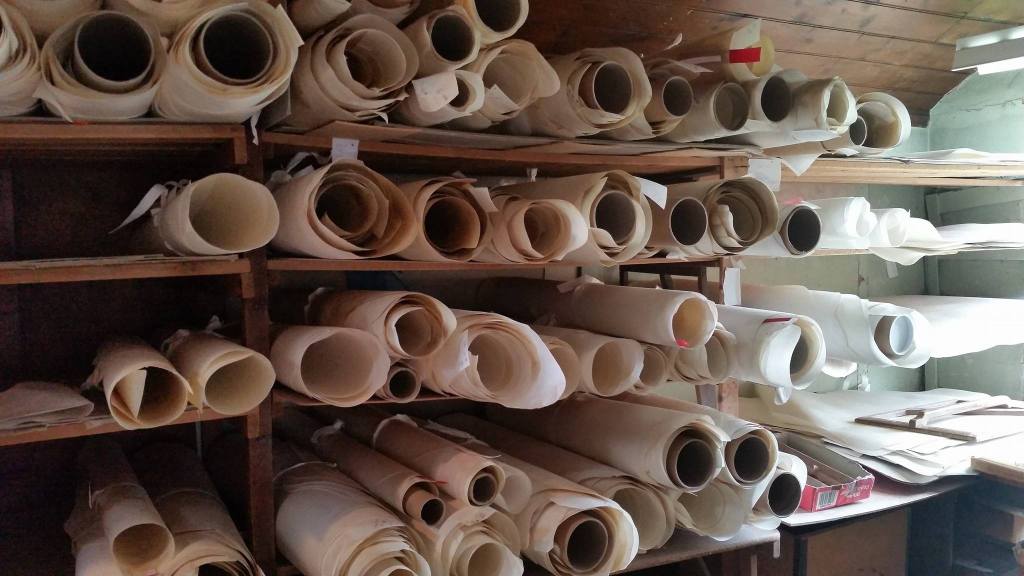
Rolls of hand-prepared calfskin vellum.

planning my choice of media

Deciding which plants to study and paint was only one of many decisions I needed to make. I also had to decide what material to paint on and with what!

I chose calfskin vellum.

I helped to scrape the skins clean of fur.

In November 2016 I met some friends at William Cowley’s and we were shown round the family business in Newport Pagnell. Cowley’s have produced parchment and vellum there since 1870. It is a smelly business, but they were able to assuage some of our concerns about using a material from animals. Apparently, no animal is killed to obtain the skin – it is a by-product from animals used for our food and milk.

The cattle, goat and sheep skins used for parchment are all obtained from farms where livestock has been reared for wool, milk or meat. No animals are bred to make parchment. 

William Cowley website

Cowley’s staff select the best skins available and transform them into beautiful pieces of parchment and vellum.

The transforming process of changing the skin into vellum and parchment used for artwork and legal documents, is hand-done and takes a long time. Cowley’s vellum is ‘worth its weight in gold’. I bought some fairly well matched skins so that I could get seven pieces from them each measuring 25 x 31 cm when mounted; Cowley’s also did the mounting for me. 

Vellum is a very special substrate and there are examples that go back hundreds of years. The Magna Carta was written on vellum 800 years ago. Today we have DNA testing and as vellum is skin, this can be a fantastic safeguard.

There are not many limitations as to what can be used on vellum with colour pigments in the form of watercolour paint, ink and gold foil well known. But graphite and waxy pencil can be a hindrance and not normally recommended because of their fatty nature and difficulty with adherence to the vellum. Whatever is used, lies on the surface and is not absorbed into the substrate as with paper. That is why the colours can appear more vibrant.

In botanical art it is customary to use watercolour on vellum, but I also wanted to introduce graphite which I knew could cause some difficulties. This was something else I needed to research.

Luckily, when I was teaching at the American Society of Botanical Artists (ASBA) conference in 2019, I watched two well known artists painting on vellum with watercolour and graphite graphite. I absorbed all the tips that they were able to give, and this helped enormously when adding the graphite sections to my pictures.

Composition contents

Golden section overlaid Vaccinium corymbosum leaves artwork. Note compositional use of ‘third’ lines and placement of main focal point.

Composition is a very difficult subject, and it is something many of my students struggle with. There are loads of ‘rules’, but the best design is by those who know the ‘rules’ and know how to break them; look at Rory McEwen’s work as an example.  When saying this, it sounds as though I have overcome the issue of composition – far from it. For every picture I paint, the result is my subjective view. For the person looking at the picture, their subjective view is likely to be slightly different. 

However, in modern times there is much research into the placement of the main focal point and some equipment can ‘see’ what the brain notices first when accessing a picture or view. As a baseline, the Golden section is not far out. Therefore, defining the placement of the focal point in a picture is important.

I have spoken to quite a few people about what they would like to see in my series of pictures. I had decided on the measurement of the mounted vellum piece, 31 x 25 cm, therefore I had limited space. 

I wanted to paint several elements of the plants, repeated across the series, demonstrating details of the plants not normally appreciated. I hoped that people taking their normal flora for granted would learn about these plants from my finished artwork.

As I was looking at edible fruits my main point of interest was the fruit. But, without overloading the composition I wanted to give information about the flower, its habit and habitat. I still hadn’t decided exactly which plants I would include, but I knew that they would normally live several meters over sea level, preferably in the mountains and probably have some sort of association with each other. 

Read on in the next blog due to be published 30 March 2023

Foraging plants in the Norwegian Mountains – 2. History of the project.

Preparing for rain – view from the cottage at Flatvollen near Haglebu.

As promised, this is the second part to the blog about my series of pictures – Foraging plants in the Norwegian Mountains. It will continue twice weekly until the RHS exhibition mid June 2023.

But what did make me choose this topic to study? It started at the workshop I had in Åsgårdstrand in 2014.

Cloudberry leaf and remnants of a male flowersketch 2014

There were students from Norway, the USA and the UK, and I wanted them to get a feel for and learn about some of the plants that mean a lot to Norwegians. Funnily enough, like me, Norwegians take a lot of their fruit for granted and don’t know too much about them. I asked a botanist friend to get some plants when she was at her cottage in the mountains; she arrived with several, including cloudberry (Rubus chamaemorus). This particular year she only found male flowers, but more about this later. At that point I didn’t know they were male flowers; I was just disappointed that none seemed to be fertilised and developing fruit.

As the students were mostly new to botanical art, it was unsurprising that no-one had any real interest in painting the cloudberry plant without the flowers in full bloom.

But all were thrilled by the range of wildflowers available and painted many they found whilst on walks in the neighbourhood. For my part, the cloudberry plant material was enough to kickstart my interest in studying it. Painting the sample available was the start of my obsession for Norwegian edible fruit; it continued until I finished the series of seven pictures in January 2023

Royal Horticultural Society (RHS) botanical exhibition planning

Magnolia x soulangeana flowers – 2011

Over the years the requirements for exhibiting with the RHS have changed. I had previously done two exhibits for the RHS botanical art shows and had medals from 2011 and 2014. In 2011, 8 pictures were required for each exhibit and in 2014 this was reduced to six although one could have more. When planning for my next exhibit I decided to do seven pictures as odd numbers are aesthetically more pleasing than even numbers.

I will be describing my progress with all seven pictures in my blog, although the exhibit requirements is now only six pictures. I felt Norwegian edible plants would be an ideal topic and had hoped to complete the series over the following three years, but ‘life’ got in the way. 

I was responsible for the UK representation during the Botanical Art Worldwide Exhibition in 2018. Scotland had their own exhibit.

My involvement in the worldwide exhibition happened quite suddenly when I realised that the UK would not be represented. I felt this was wrong as we had so many brilliant botanical artists. So I was determined to make it happen; Robin, my husband, suggested that if we got enough people interested, we should call ourselves the Association of British Botanical Artists (ABBA). Luckily, I was able to convince others and ABBA organised several successful events across the country representing UK botanical artists. 

During the build -up to the Botanical Art Worldwide exhibition, it became clear that there was a need for an organisation to welcome ‘Anyone, anywhere’ interested in botanical art. Up until then it could be quite expensive to learn about botanical art and membership of existing organisations was based on an individual’s level of expertise. Dr Shirley Sherwood OBE was also of a similar opinion and supported the idea – something that really meant a lot to me and my motivation for continuing my work to establish an organisation. 

The Association of Botanical Artists (ABA), now an international organisation, is still going strong. 

Malus ‘Gorgeous’ – 2014

Eventually, as I got back to planning my next RHS exhibit I recognised that there were some logistic problems. I lived in the UK and hadn’t planned to move back to Norway. Although some of the plants grew in high mountain areas in the UK, there were still some difficulties obtaining what I needed. For example, there were very few female cloudberry plants and therefore only a slim chance of getting material for either the female flowers or fruit. I therefore needed to get to Norway on a regular basis and knew that I could only do this once a year. 

I already had another workshop planned in Norway for 2015, so 2016 became the target for starting seriously with preparation sketches

Botanical art workshop at Åsgårdstrand

I realised that I wouldn’t be able to decide which part of the plants to focus on until I had done as many sketches as possible at different stages of development.

I would need to make careful notes about colour and size of specimens to aid my decision making. 

I will continue this story with a new blog on 26 March 2023.