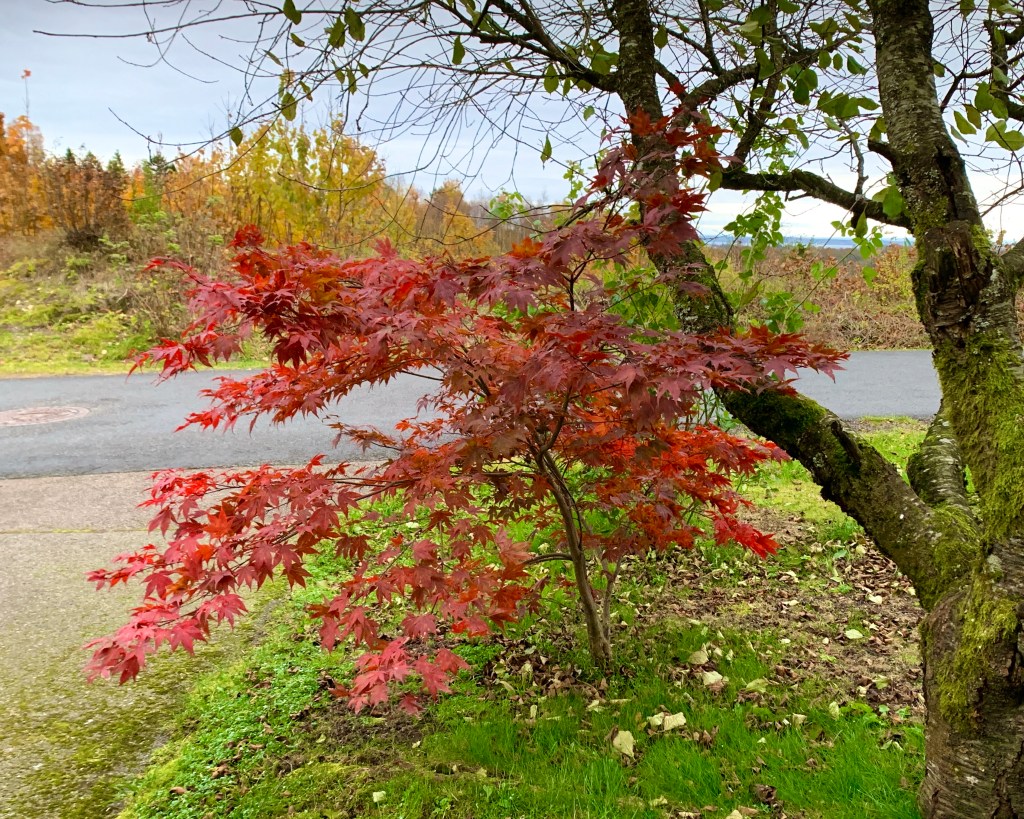
I have done ‘leaf-peeping’ in the Adirondack’s a couple of times – and it is fantastic. But this year, I only have to go outside my front door to see some absolutely amazing colours and scenery.
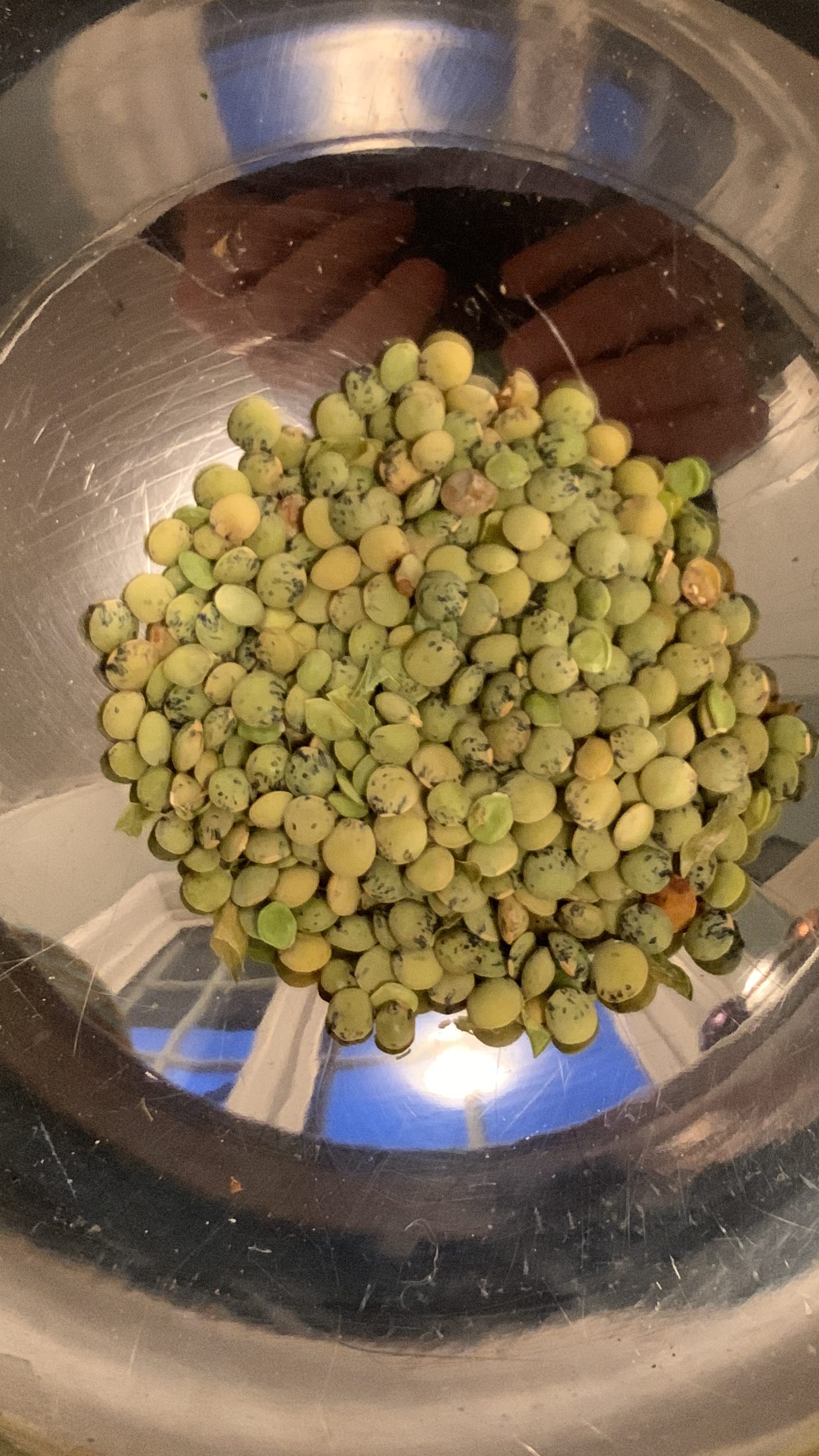
Puy lentils
I understand that it is a combination of rain, sun and temperature that helps to make the collars glowing. The rest of Europe has seen terribly high temperatures, fire and drought, but here in Norway the summer has been as I remember them from long ago – comfortable temperatures with just the right amount of rain (at night) and of course sun. This I believe gives us the colours we are seeing now.
I don’t think the beautiful coloured leaves will last too long though. I have done all I need to do to prepare for winter in the garden, protected some of the plants from foraging deer, weeded there it is beneficial to do so and filled the freezer with berries to last the long winter months. I even grew some puy lentils and shelled them ready to go into our Christmas meal. There aren’t too many, but it was fun to do.
Today we had snow flurries, not the first as there was also some earlier in the week; tomorrow’s forecast is for quite a bit of snow but I think the ground is just a little too warm for it to remain. The tyres are changed on the car ready to welcome the cold and ice. Inside we are warm and cosy with our heat pump and log fires in the evening.
November/ Christmas cactus – Schlumbergera Eva
As far as painting is concerned I have been trying out different papers to use with colour pencil. Normally I use my old stock of Fabriano 5 or Fabriano artistico, but I fancied trying it on colour paper. Unfortunately there does not seem to be the same choices here as I am used to, so I will make do with the few I have for the moment. I will just see if it is worth pursuing.
The last time I exhibited in Norway was 1990 in Stavanger when I exhibited on my own. At that time I was just painting birds and borrowed ‘skins’ from the Stavanger museum collection. It wasn’t until after I moved to the UK in 1996 that I started painting plants – and then not until about 2004. The garden was obviously the trigger.
Botanical art is not a big draw in Norway – I don’t know why! There are so many fantastic plants, even up at the North Cape in between the slate. Some of these plants may be very tiny, but they survive and are colourful – if you have eyes to see.
The series of plants I painted for my last RHS exhibit were all found in the Norwegian mountains and Norwegians love these species. Perhaps with time people might be interested in what I do and want to draw or paint themselves. Hopefully I will be able to help in that process.
The exhibition I have been asked to participate in is at the local Horten Art Society. Apparently several local artists will be taking part, therefore I am glad that I was asked to be one of them. I have no idea which pictures I will be exhibiting, so watch this space. I don’t know whether to just have plant portraits, or whether to include work typical of me with details and dissections. I think I will just have to feel my way around this.
By the way, for anyone living in the vicinity of Horten, Norway, the exhibition is at the Kihlegalleriet, Falkensteinsveien. 29, 3189 Horten. It starts Saturday 11 November, running until 3 December. but only open at the weekends.
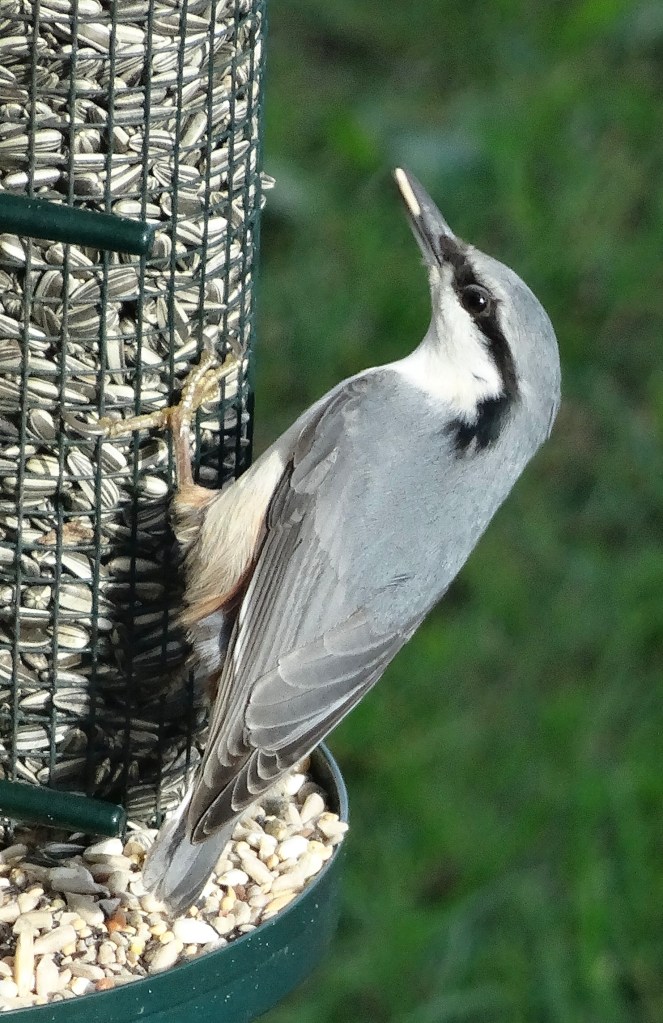
In the meantime we have a huge number of birds using our feeders, including Hawfinches, Woodpeckers and Bramblings. They are a wonderful and varied sight.
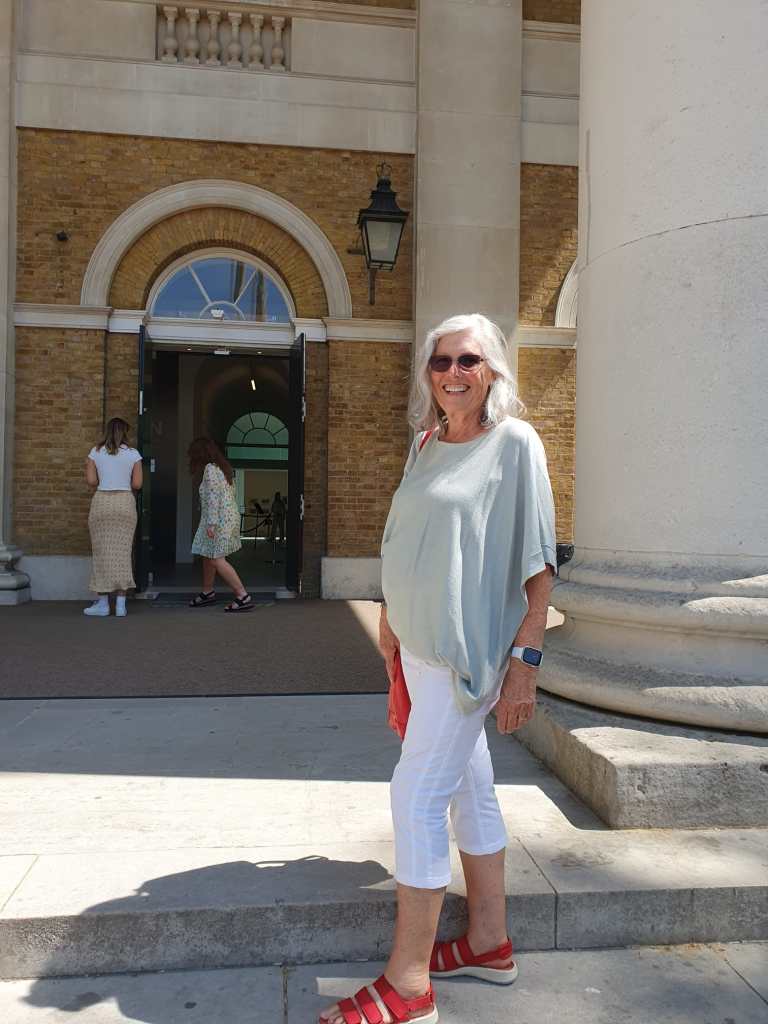
When the above picture was taken I had absorbed the judges feedback from a few hours earlier.
I had travelled from Norway the night before the exhibition and as soon as the plane landed I was able to access my emails. One of them was from the RHS telling me the results of the judging – a Silver Gilt award.
Before being invited to exhibit with the RHS one has to have ones work assessed by a panel of judges. The work, several pictures, needs to be of a consistent silver medal level.
If one is awarded a medal at the exhibition (this is not guaranteed), it is one of four in this order of merit:
Gold
Silver Gilt
Silver
Bronze
I, like everyone before me, hoped that my work was worthy of a Gold medal. It was not to be this time.
But having not got a Gold I can happily comment that this prestigious exhibition is international and the best artists from around the globe take part hoping to win this coveted award.
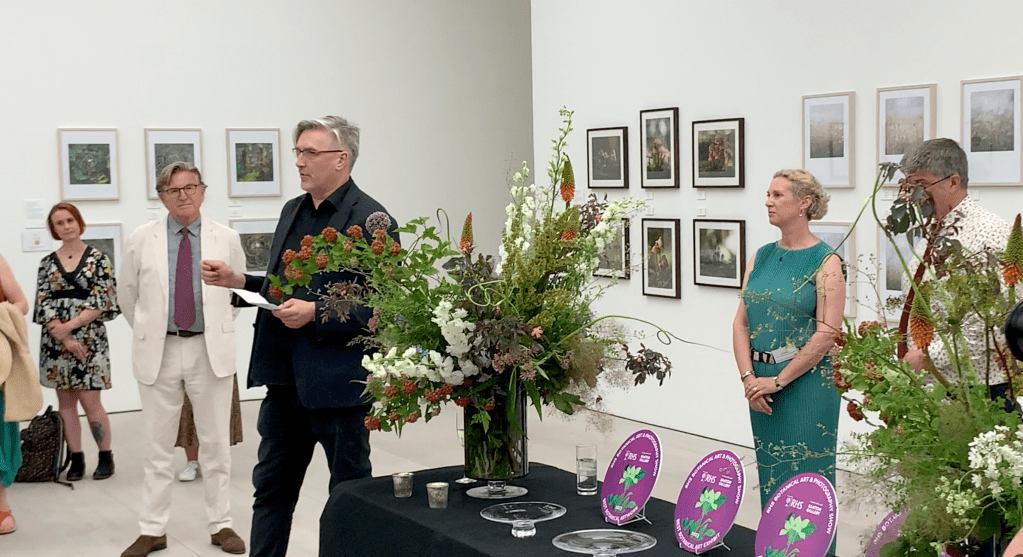
Arriving at the Saatchi Gallery on the morning of the preview.
I don’t have photos from the morning or afternoon sessions at the Saatchi gallery, but I was kindly and quickly nabbed as I arrived before lunch by someone who had taken the time to study my exhibit and wanted to understand my award. I was glad of this as it helped prepare me for my feedback due in the afternoon as the assumptions were correct.
Well what about the feedback?
Luckily I was well prepared.
I was extremely lucky as I was afraid that the judge(s) might not know my subjects. This was not the case as the judge given the task of my feedback had studied one of the species and had ‘gorged’ on most of the others! Apparently, my paintings were so convincing as to want to pick and eat them!
Therefore, it wasn’t the technical skills or quality of painting that was an issue.
Botanically, I was told that there were no holes in this area and they liked my use of graphite.
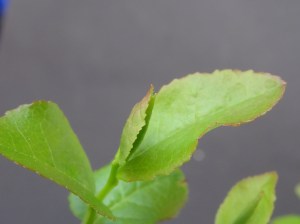
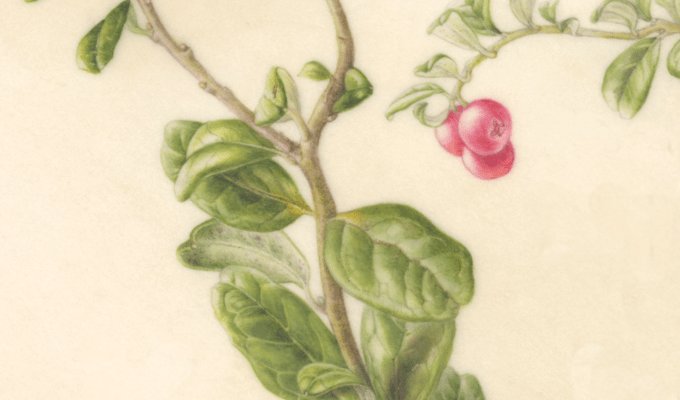
Young bilberry leaf
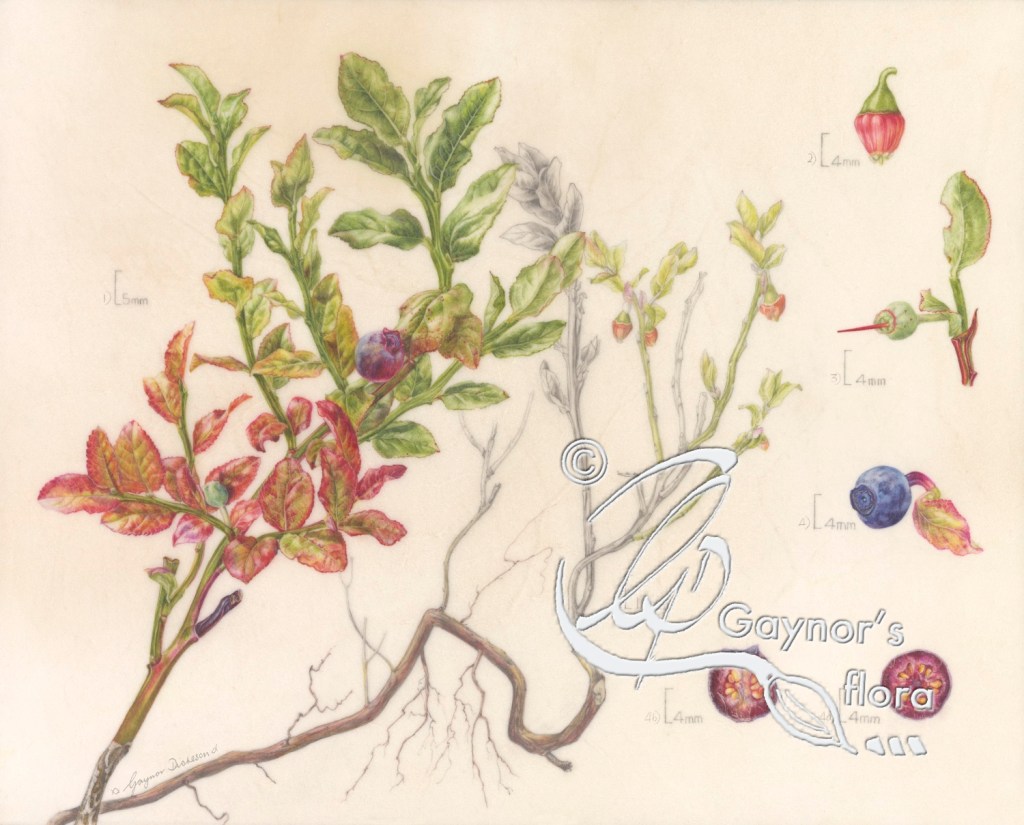
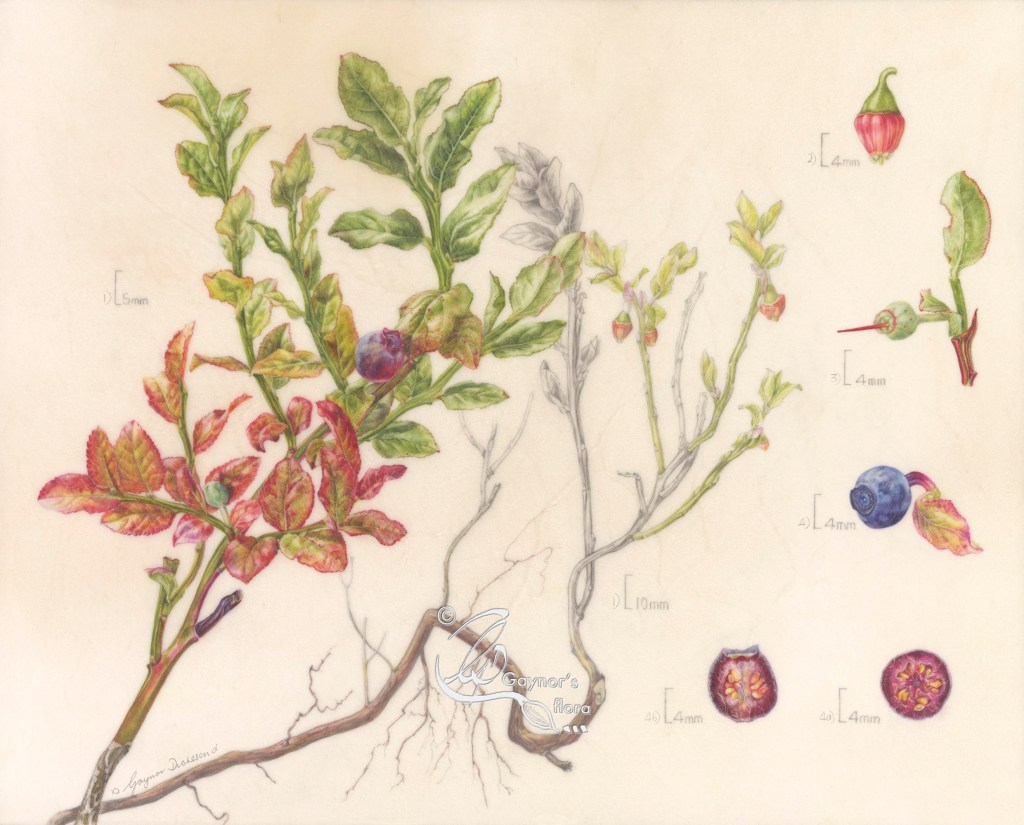
One of the judges had queried the nature of my Bilberry leaves as they thought them a little ‘wavy’. I commented that particularly young leaves are quite thin and often the edges were of a rather wavy nature.
Another query had been why I had chosen to paint on vellum rather than paper. I was readily able to say that the colours of the tiny fruit in the mountains are so intense that the way colours are reflected off vellum truly justifies that choice of support.
However, it seems that the issues the judges had with my pictures were my scale bars – again. It was my scale bars that were the issue in my last exhibit in 2014. But this time it was slightly different. Apparently, it was felt I had too many of them and that they had a tendency to dominate the picture making them intrusive.
I was told that the ‘judges decision was not unanimous and that there was gold in there’.
The judge who gave me the feedback felt that with the present exhibit format I was rather ‘hamstrung’. To explain that a little better, this was only in the way I had planned by exhibit without knowledge of the labelling restrictions now in place. I don’t know if I had missed some information sent out previously from the RHS, but as my exhibit took six years to prepare, plan and paint, things have changed as one would expect.
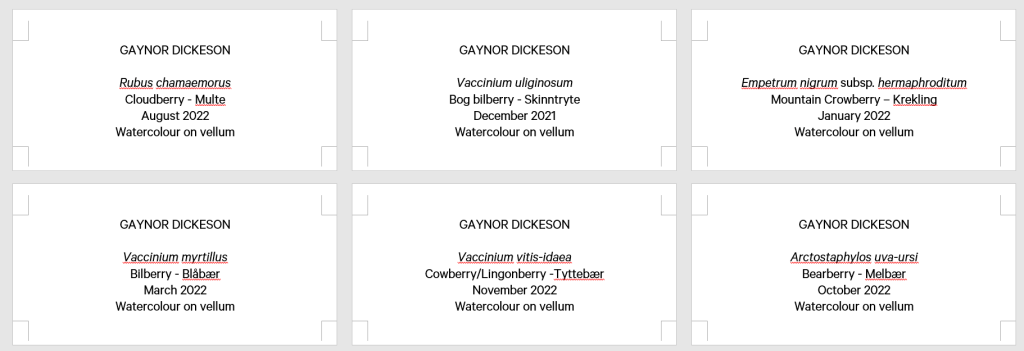
The way an exhibit is hung including the information given about each picture is the ultimate responsibility of the artist. This includes scientific names and common names used and their spelling. Previously, labelling included information about the species referring to parts on the picture. i.e. dissections were described in the legend and there might be additional information of interest. As such I wouldn’t have needed so many scale bars on each picture.
But now there was one overall description of the exhibit with the limitation of 100 words, plus an individual label giving the plant name.
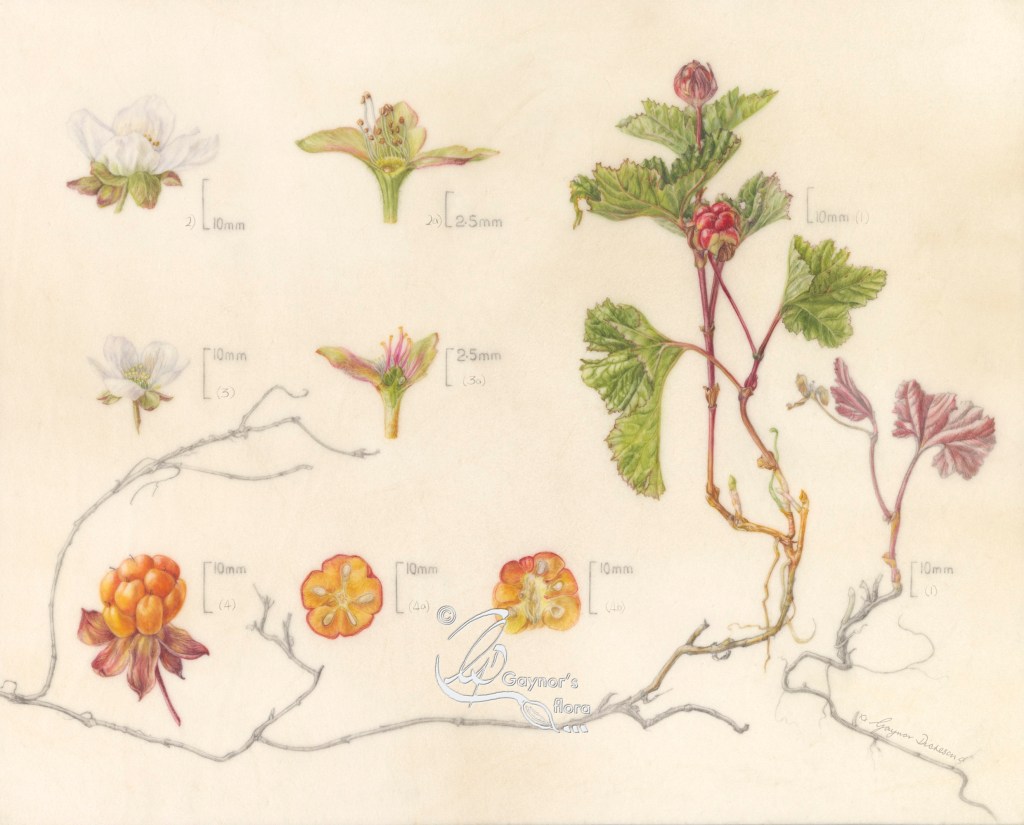
Rubus chamaemorus – Cloudberry
If one is looking at scale bars as a negative, this picture was probably the worst one!! I had three different sizes on the picture; the actual size of the plant to the right, the berry, dissection of the berry and whole flowers were the same enlargement and the dissections of the male and female flowers were enlarged further. Unless this distinction is made, no-one would actually understand that they were different sizes.
As it was, there was nowhere to inform that this fantastic species had separate male and female plants, therefore it also had separate male and female flowers! Furthermore, I was unable to show that the plant grew well in boggy areas.
The name of my exhibit included the phrase ‘ from bog to sand’. There was no indication in the exhibit that the six species grew in either sand or boggy areas and there was no room made to do so either.
Although my scale bars got in the way of the judging process, I was told that each of the pictures were valuable pieces of documentation.
How do I feel about this experience?
I have to say that overall it was fantastic. It wasn’t the same as previously where there was a special relationship between the exhibiting artists who put up their own exhibits – keeping their fingers and toes crossed that nothing would fall down. But it was different. We still developed good relationships as we were all in the same boat and just as unsure about ourselves and our work as we would ever be.
Thinking only of the exhibition and the run up to it, it seemed so well planned and disciplined. There was proper project management and information from the artists was needed in a timely fashion. We weren’t left in the dark about anything. What the RHS and the Saatchi Gallery wanted from us was clearly explained and they did their best to give us what we needed within the boundaries they had set. As an example, except for my pictures, all were on watercolour paper and needed to be framed with a mount. Right from the beginning I had asked for mine to be mounted behind perspex so that the whole vellum mounted block was visible. They did an absolutely beautiful job of this and for me this aspect of the exhibit was perfect.
The feedback from the judges was carried out in a sympathetic way. We were seated in front of our exhibit during this process and as far as I am aware no-one else was in the same gallery at the same time.
The preview was also done very well with speeches and the delivery of special awards.
Will I do this again?
Absolutely! But although I love tiny plants and dissections to discover the hidden life of the plant, I might actually keep it a little simpler next time!
Chatting with Diane Sutherland – my son absorbed in my paintingsAsuka Hishiki – JapanThe award ceremony – Paul Foster (Saatchi Gallery), Keith Weed (RHS), Charlotte Brooks (Lindley Library)Eunice Nugroho – IndonesiaGreat discussionsChatting with Julia TrickeyKeahyung Lee – KoreaSo good to see old friends again!Youngran Choi – KoreaYungin Park – UKEnd of a long and fruitful day
If you have seen the exhibition, do let me know what you think of it. And, If you have any queries about my previous blogs on the series of paintings or about my experience, also get in touch. I look forward to hearing from you.
The title of my exhibit at the “RHS Botanical Art & Photography Show” is as above:
Foraging Plants in the Norwegian Mountains – From Bog to Sand.
Six of my watercolour and graphite paintings are exhibited by order of habitat starting with those growing in the wettest environment to those in the dryest. Seven paintings were completed not just the six, therefore it was a difficult choice to remove one of them. The second one shown below, the small cranberry, is not in the exhibition.
1. Rubus chamaemorus – Cloudberry – Multe Watercolour & graphite on vellum. August 2022
1) Habit 2) Male flower – 2a) LS Male flower 3) Female flower – 3a) LS Female flower 4) Fruit 4a) TS fruit 4b) LS fruit
2. Vaccinium oxycoccus subsp. microcarpum – Small cranberry – Små tranebær Watercolour & graphite on vellum. January 2022
1). Habit 2). Flower 3). TS fruit 3a) LS Fruit 3b) Fruit
3. Vaccinium uliginosum – Bog bilberry – Skinntryte Watercolour & graphite on vellum. December 2021
1) Habit 2) Flower pair 3) Fruit 3a) TS fruit 3b) LS fruit
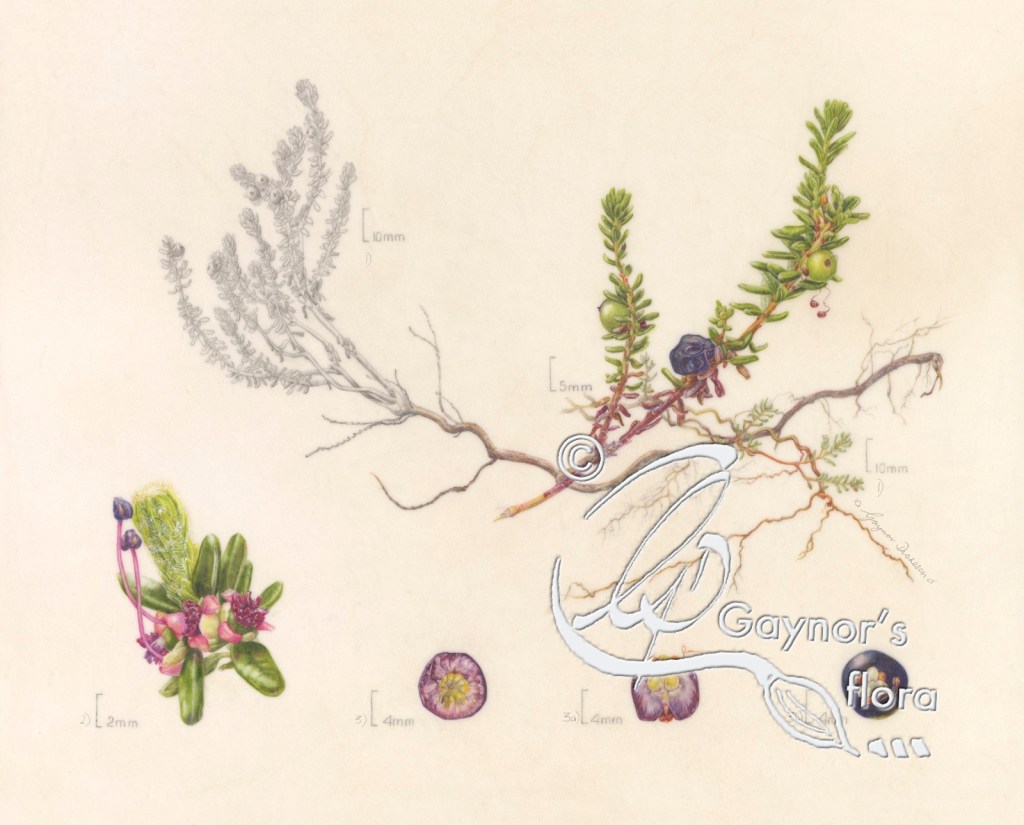
4. Empetrum nigrum subsp. hermaphroditum Mountain Crowberry – Krekling Watercolour & graphite on vellum. January 2022
1). Habit 2). Flower 3). TS fruit 3a) LS Fruit 3b) Fruit
5. Vaccinium myrtillus – Bilberry – Blåbær Watercolour & graphite on vellum. March 2022
1) Habit 2) Flower 3) Immature fruit 4) Fruit 4a) TS fruit 4b) LS fruit
6. Vaccinium vitis-idaea – Cowberry/Lingonberry -Tyttebær Watercolour & graphite on vellum. November 2022
1) Habit 2) Flower cluster 3) Fruit 3a) TS fruit 3b) LS fruit
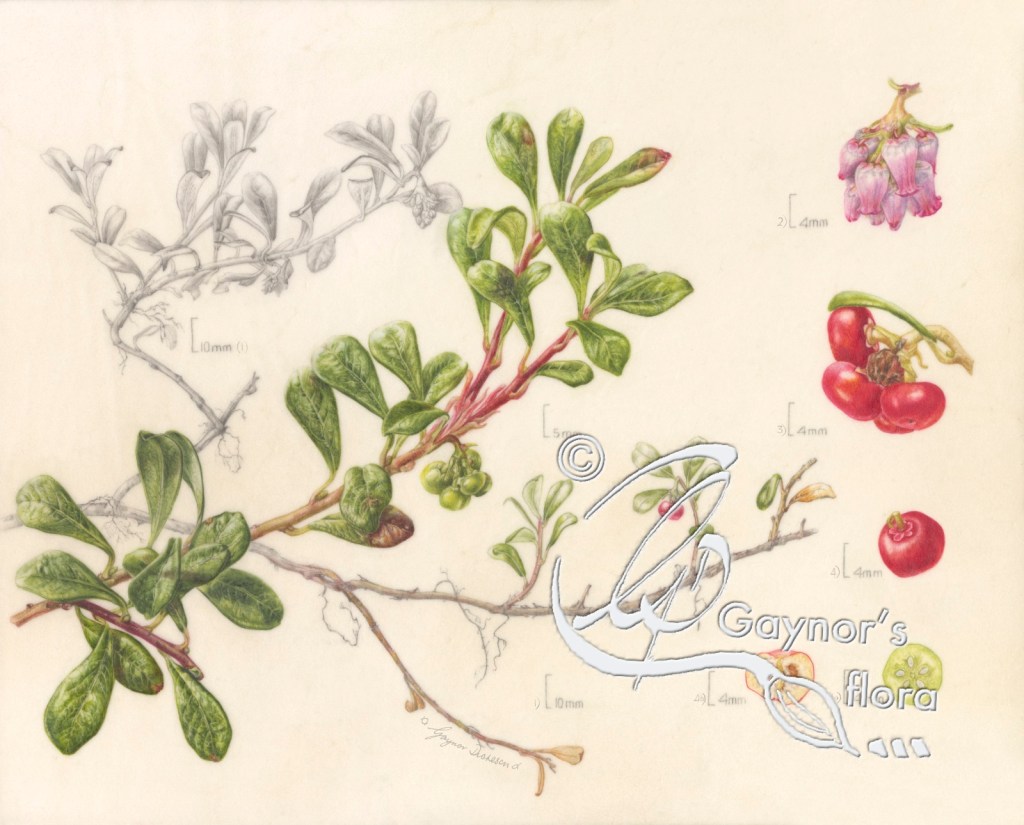
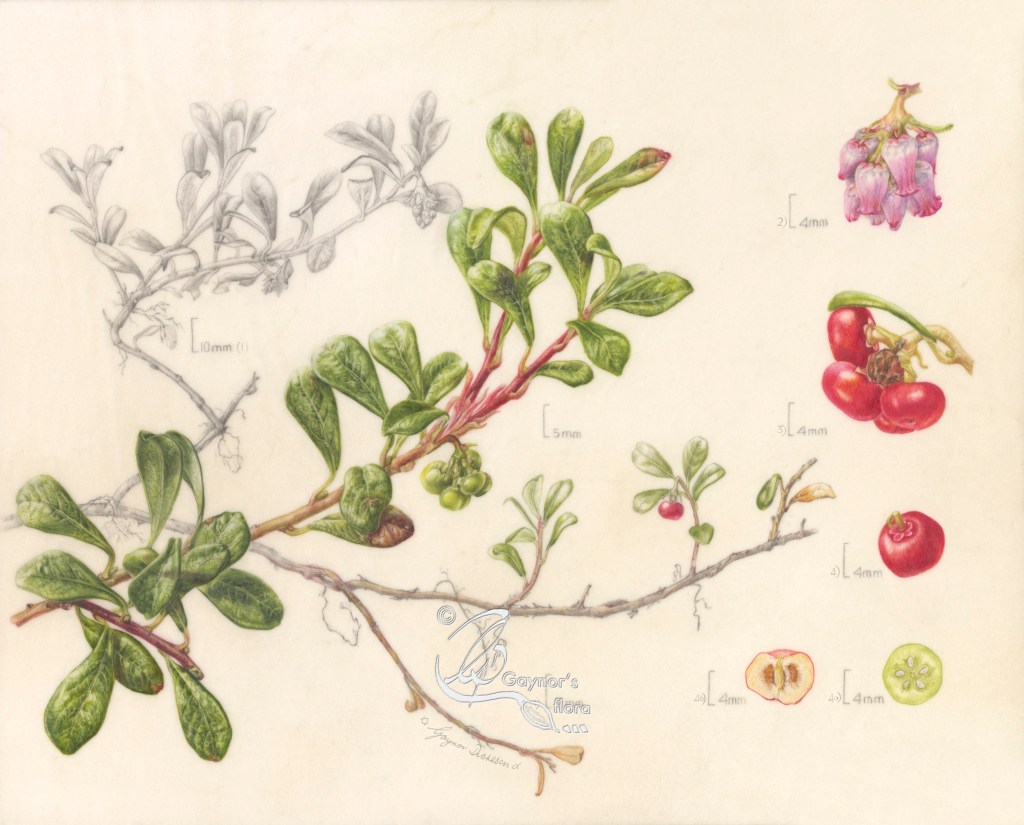
7. Arctostaphylos uva-ursi – Bearberry – Melbær Watercolour & graphite on vellum. October 2022
1) Habit 2) Flower cluster 3) Fruit cluster 4) Single fruit 4a) TS immature fruit 4b) LS ripe fruit
If you have read the blog series you will understand that the Cloudberry and Small cranberry enjoy the wettest environment – bogs and marshes, whilst the Bearberry is often found on a sandy forest floor. The other species are found in various types of environment from damp woods to harsh mountain tops. Some, like the Bog bilberry will grow very well just about anywhere as long as it has water and plenty of sun.
All of the plants in this series live in the Subarctic part of the world and have always provided a lot of nourishment for those living in the far north, the rest of us a little further south and of course animals that roam the area.
Some of the plants typically don’t grow in certain areas as witnessed by the difficulty I had finding the Bearberry. In very hot and dry years some plants produce next to nothing; Cloudberry and Small Cranberry are good examples. Can you imagine the risk that Global warming brings to these plants as well as to us. The warmer the planet gets, the more further north these plants are likely to move making it even harder for us and the animals they support, to find them. As it is, plants that can normally be found further south in Europe, are now beginning to appear in Norway; their pollinators moving with them and having a negative effect on the species that belong.
When choosing to study and paint these plants I didn’t realise how much I would learn about them. I loved the plants (and their fruit) before this, but now have so much respect for them and the environment in which they grow. I hope that I have been able to pass on at least a smidgen of this.
Thank you for following this series.
Latest news: I am really pleased to say that following the judging process yesterday, 14 June 2023, the judges decided to honour me with a Silver Gilt medal. The award ceremony will be held this evening at the Saatchi Gallery during the preview to the exhibition opening tomorrow.
I look forward to getting detailed feedback about my exhibit from the judges this afternoon.
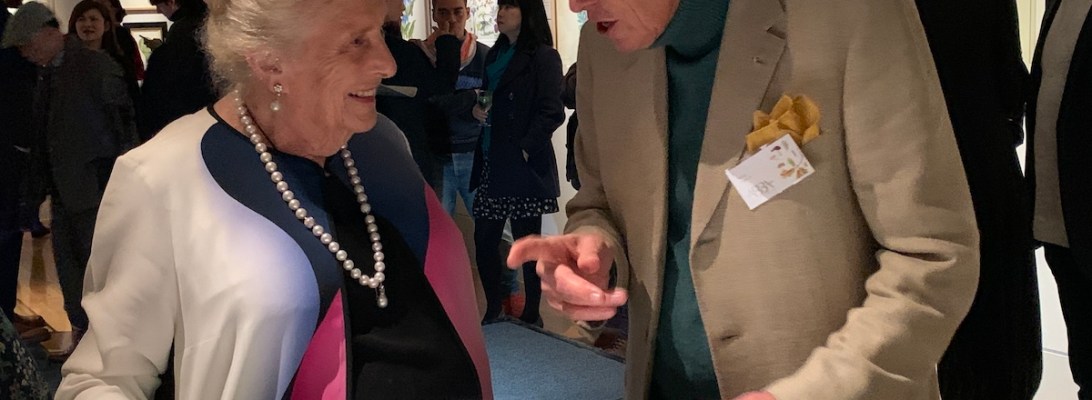
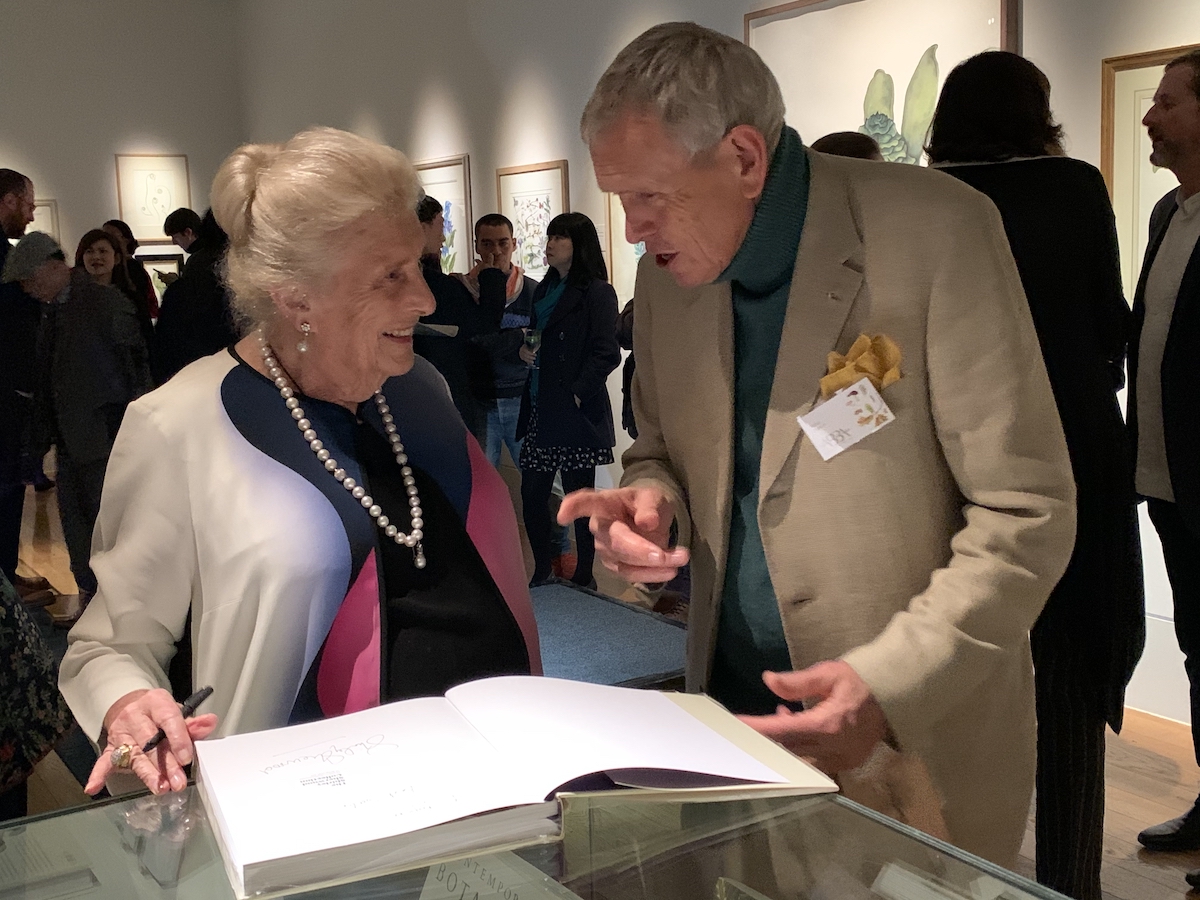
The above picture was taken last night by Charles Francis and the book was apparently meant to be a surprise Christmas present from Robin. Dr. Shirley Sherwood is in the process of signing her latest edition and I am told more was written, but I am not allowed to see this until Christmas Day.
Robin and I were invited to the preview of the latest exhibition at the Royal Botanic Gardens, Kew, in the Shirley Sherwood Gallery. Many people may know that this is the only purpose built botanical art gallery in the world. It introduces people to plants in a completely new way, encouraging people to look at and appreciate them with different eyes.
Dr Sherwood has over a 1000 botanical art pictures in her collection and as she said yesterday, this exhibition and the accompanying book is a retrospective of her collecting. She says that she had a huge problem in deciding which pictures should be included in the exhibition as of course she didn’t have room in the gallery to show them all.
It was a really lovely evening where we met artists from around the world. It was a really good time to catch up with old friends, make new acquaintances, but above all, study the artwork. There is some amazing work there which if possible you need to see with your own eyes. I know this isn’t possible for everyone and that is why the book is a good additional opportunity to see the pictures. Elaine Allison will be reviewing the book on the ABBA website in due course.
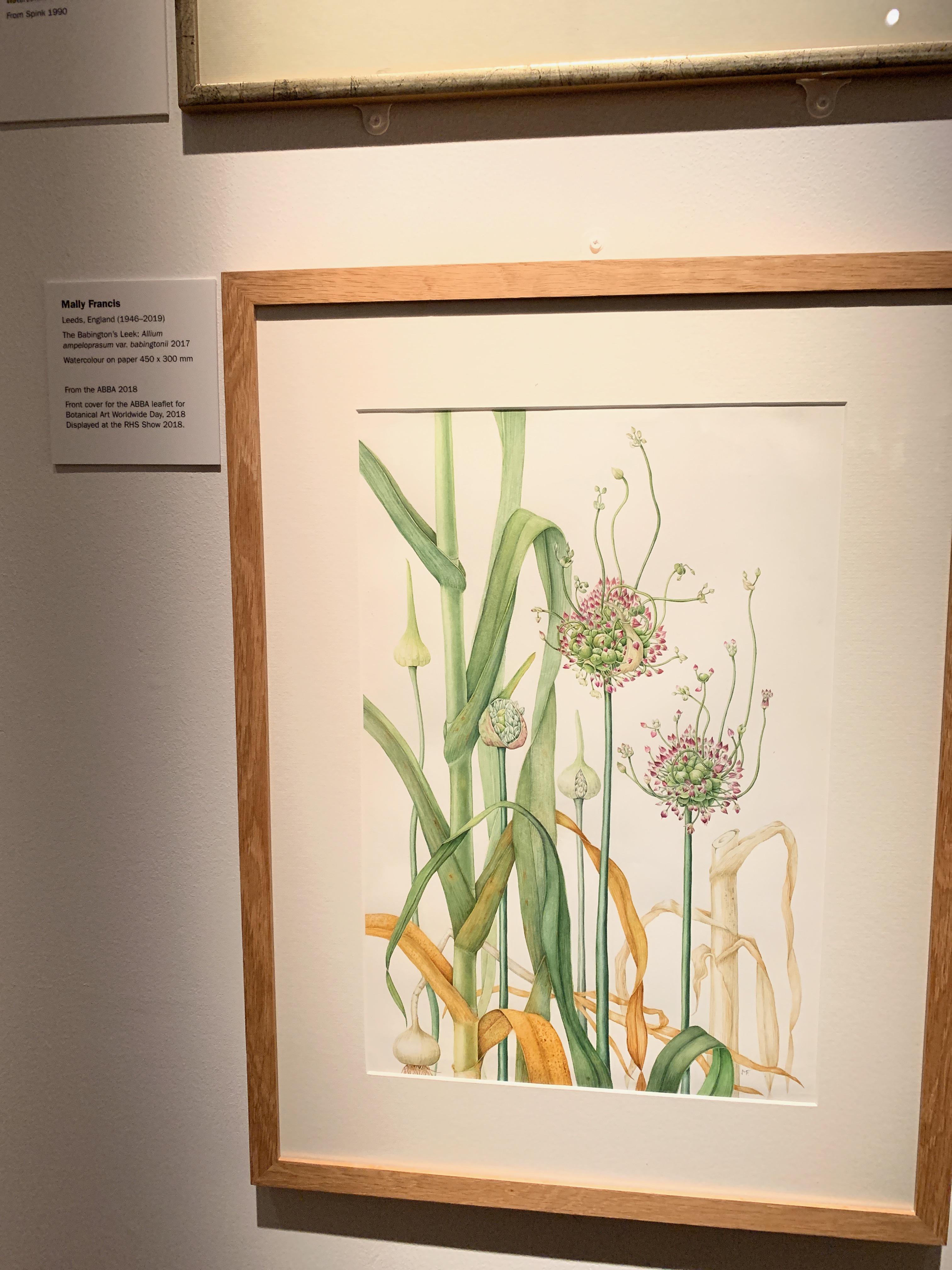
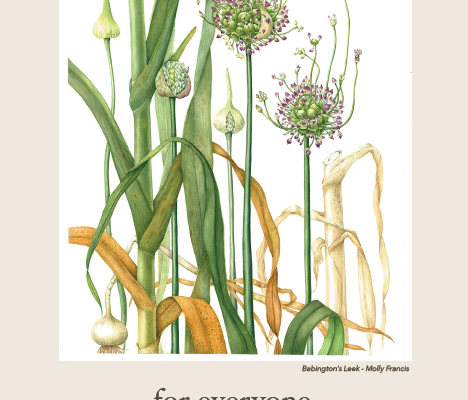
When we arrived at the gallery, we immediately saw Charles Francis and his daughter who were both there to represent Mally who had painted one of Dr Sherwood’s last acquisitions; Babbington’s Leek. It was so good to see them again as the last time I saw Mally and Charles was the day the picture was bought.
Now to the ‘more’ as promised above.
This weekend I will be taking part in the Bosham Christmas Craft Trail. We call it a craft trail because although we are all serious artists, the majority of those taking part are makers rather than fine artists. The only two fine artists on the trail are Tamsin Saunders and myself. Our styles are completely different ranging from my tight botanical art style, to her much looser more abstract style of painting. Tamsin is joining me at:
Saltings, Windmill Field, Bosham, West Sussex, PO 18 8LH.
Do come and join us and enjoy mince pies and mulled wine whilst you browse.
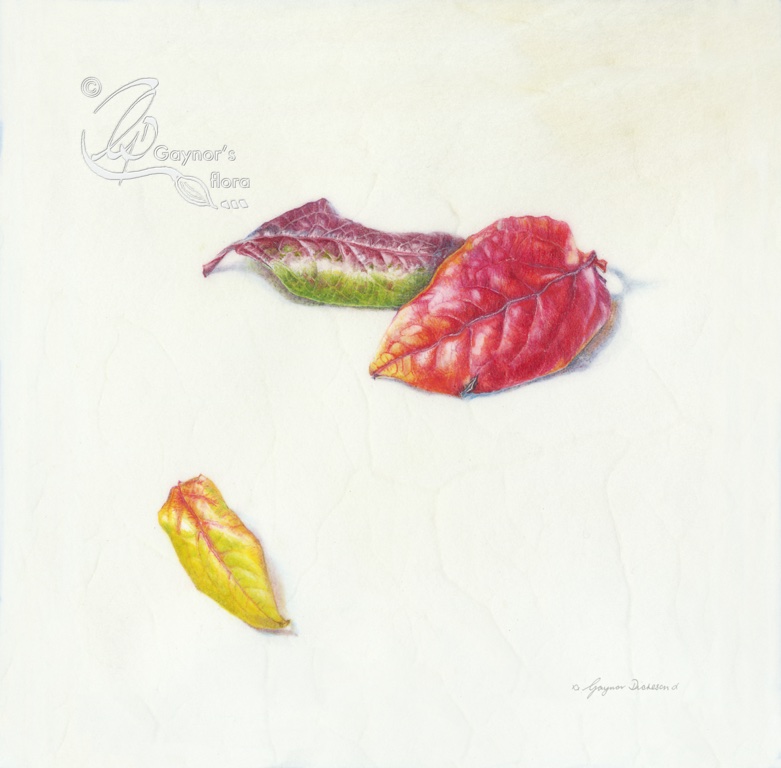
You will get to see my latest piece of work:
Three Blueberry Leaves painted on natural calfskin vellum.
I have been really bad at keeping on top of my own website because of all the work in relation to ABBA (Association of British Botanical Artists). Therefore this information about my participation in the RHS exhibition next week is not on the right page! Sorry about that, but I am telling you a little more about it now and hope that you will be able to make it.
Following on from the exhibition ‘In Ruskin’s Footsteps’ at Lancaster University, we (ABBA) have a stand this coming week at the RHS Plant and Art Fair, which for Botanical artists is a very important event. It is on 11th & 12th July at the RHS Halls in London. ABBA have a stand with the majority of Botanical artists, in the Lindley Hall. As I said in my last blog, Follow the Banner!
We are exhibiting five of the original pictures from the juried exhibition in Lancaster, giving everyone a further opportunity to study them. One of them is mine – Sea Thrift, painted on vellum. I mentioned that I would be demonstrating at the exhibition and now it is clear which medium I will be using, also which plant I will be painting.
I had intended getting my own exhibit finished for the RHS exhibition next year, but because of the amount of work that has gone into ABBA, I have decided to put this off until 2020. My topic is ‘Foraging plants of the Norwegian Mountains’.
It became very clear whilst going through the various phases of the Worldwide exhibition preparation, that although the UK is a distinct island it is still part of the European Continent. At one point in our history we were connected without needing to use a tunnel, boat or plane. Our plants bear witness to this in that many of the plants that are native in Northern Europe, are also native in the UK. However, some may not be so common these days.
Image being drawn on vellum
One of my series of plants is the Arctostaphylosuva—ursi, Common bearberry in English and Melbær in Norwegian. It looks similar to a Crowberry, but is white inside (floury), giving its Norwegian name. When picking Crowberries it is not popular to mix Bearberries in by mistake as they don’t taste quite as nice, although edible. Also it is a stone-fruit and not a berry!
ABBA wants to encourage botanical art in relation to our native flora. As I intend to paint the series on vellum, I will be using this medium on the ABBA stand at the RHS. I have a nice little plant of the Bearberry with the beginnings of small flowers. The image is already transferred to a small piece of vellum which will be ideal to practice on and make decisions about which colours to use.
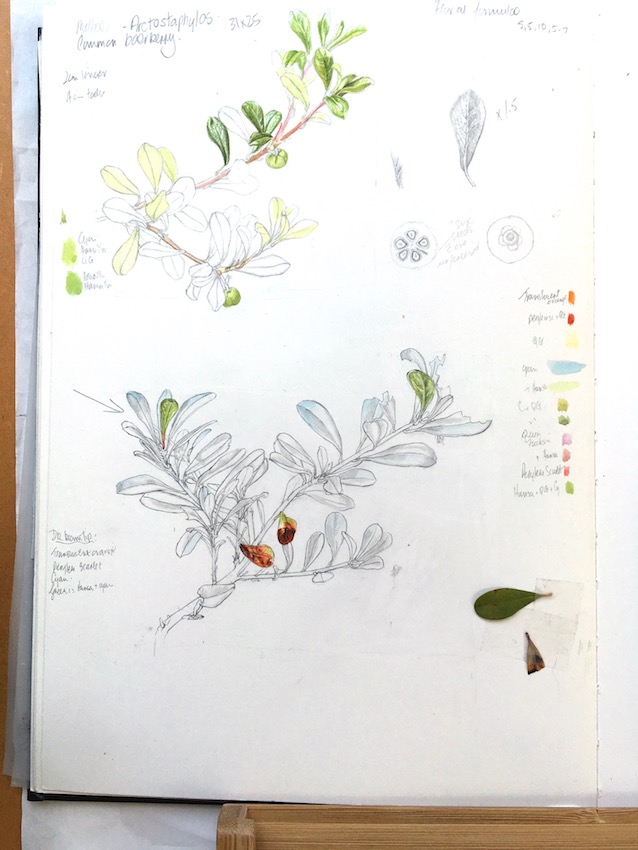
From my sketchbook.
You might be just able to see that in my sketchbook I have quickly done a rough tonal drawing, indicating where the light is coming from. I have also put in a little blue to indicate where the light of the sky has reflected on the leaves and started indicating the difference between the colour on the front and back of the leaves: but that is in my sketchbook. Which colours I will actually choose to use on the vellum, remembering that colours appear far more intense on vellum as it reflects the colour of the pigment better than on paper, will be the result of this trial piece.
In addition to my demonstrations we will be talking with people to find out what they want from ABBA in the future and whether they – you, want to be part of it. Our focus will be to help anyone, anywhere, interested in botanical art to learn more.
But there is a little icing on the cake: The RHS have agreed to show the Botanical Art Worldwide exhibition slideshow from 25 countries. This will happen in the talks area of the Lindley Hall, between and after the talks. But just in case you want to see it otherwise, we will be showing it on the ABBA stand.
This is the last opportunity to see the Worldwide Slideshow!
General Data Protection (GDPR)
If you want to follow my blog then please do sign up for it on this page. However, if you would like to get the occasional email from me about workshop availability or general information about my botanical art news, then you will need to sign up for this separately.
Below is a link to subscribe to either or both email lists. You can easily unsubscribe at any time.
You might very well wonder what the connection is particularly if you didn’t read my last blog a month ago! ABBA stands for Association of British Botanical Artists. For some of us working with ABBA during the last year, at times we have been so busy that we felt as though we could buzzzzzzzzz away to something more relaxing. But we stuck with it and had a lovely exhibition at the Peter Scott Gallery, Lancaster University.
That was the start of ABBA, formed to take part in the Botanical Art Worldwide Exhibition where we were one of 25 countries taking part. For my part, I co-ordinated the UK offering.
But, whilst doing this it became very clear that there was a wish for ABBA to develop into an organisation that catered for everyone interested in botanical art. We are now putting things together to develop ABBA. Do come to the RHS Art & Plant Fair at the RHS Lindley & Lawrence Halls in London 11-12th July where we have a stand. You will be able to talk with me and my colleagues about our plans for ABBA’s future. Hopefully we can encourage you to join.
If I get time, I will be having some work there to demonstrate on, but I haven’t decided in which medium. That can be a surprise!
So what has been going on with me since my last blog?
I had a very interesting workshop at the end of May, where we concentrated on colour mixing. This is the sort of workshop that everyone says they want to do, but when it actually happens, life has taken over. But some people did sign up with an attendee from a loooooooong way away.
Although there was the opportunity to work in watercolour, people chose colour pencil. The results were amazing and there were pencils everywhere! In fact, it became so thoroughly interesting that I continued with my weekly class on one colour found to be a real challenge.
See if you can find a solution. I have to say it was slightly easier in watercolour than colour pencil. But a lot of layers are necessary no matter what medium you choose.
Following on from that was the event at the Stansted Park Garden show. We again had a really super show and met a lot of lovely people and the weather was perfect.
I notice that I am listing up events, which is not what my blog has normally been about. I want to show you work that I have been doing, but everything has been done in small bites as we race around the country setting up, taking down and planning.
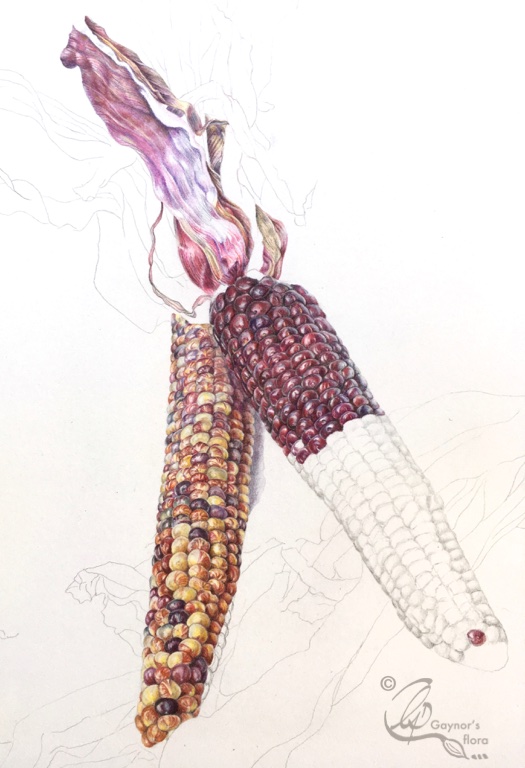
But I did work some more on my Indian Corn in colour pencil. Luckily the fruit part of the corn doesn’t change too much over time as long as you look after it and keep it away from the light and gnawing bugs. But it is different with the leaves. I do need fresh supplies of those if the colour is to remain vibrant.
I hope to see you at the RHS in a couple of weeks time. Do let me know if you have read my blog!
General Data Protection (GDPR
If you want to only follow my blog then please do sign up for it on this page. However, if you would like to get the occasional email from me about workshop availability or general information abut my botanical art news, then you will need to sign up for this separately.
Below is a link for you to subscribe to either or both email lists.
Tomorrow two of us are travelling up to London to set up the ABBA table in the RHS Lindley Hall, Vincent Square near Victoria Station. It will be the RHS botanical art show with the best of International botanical artists showing their work. Neither of us are exhibiting our own work this time, but we will be demonstrating different techniques.
The main reason for having the table at the exhibition is to talk about the plans for the Worldwide Botanical art day in May 2018 and to encourage British botanical artists to take part. A new Association of British Botanical Artists (ABBA) formed to do this has put an initial ‘call for entries’ on it
On Friday and Saturday this week, I have chosen to demonstrate a sketch book or study page in graphite and watercolour from one of the native plants I have packed to take with me. Come along and see how I do this.
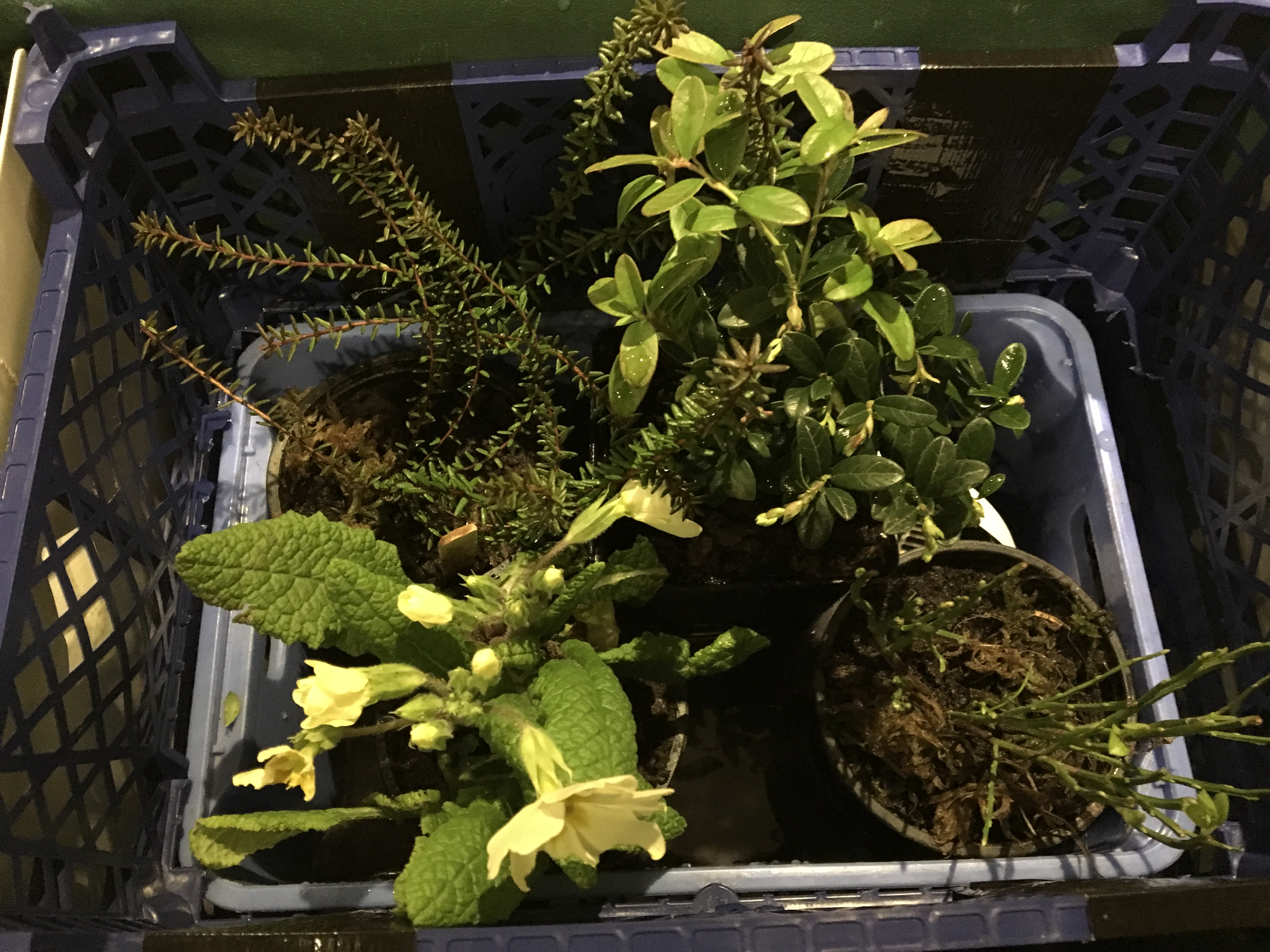
Apart from the Primrose, do you know what these plants are called?
The one on the right, with hardly any leaves just yet, is a Bilberry. This is a small wild blue berry. It doesn’ look very interesting at the moment, but if you are going to paint the portrait of a plant, including something from various stages in its life cycle, makes the resulting picture more interesting.
The plant above the Bilberry with the small oval leaves is Cowberry and has small red berries. You might know it as Lignonberry and has smaller and sharper tasting berries than cranberries. This plant has the beginnings of tiny flower buds.
The one above the Primrose is a Crowberry and will eventually have small, almost black berries. Again the plant doesn’t seem so interesting in this stage of its life, but I think might offer some challenges whilst painting its portrait.
Common for for all three species ( not the Primrose) is that they all produce fruit that is edible.
I am lucky enough to be able to do some sketches now, while the plants are only just coming out of their winter state. This will be particularly useful for me and for future work I have planned.
Do come and see us at the RHS, Lindley Hall, Vincent Square, Friday and Saturday.
I hope you now have an idea as to why I have been focusing on native plants recently?
For those who are still not aware, we have formed a new organisation for all UK botanical artists whether they belong to an organisation or not. It is called ABBA, the Association of British Botanical Artists, although slightly a misnomer as this also includes Norther Ireland.
Why was this started? Well, the American Society of Botanical Artists (ASBA) initiated a worldwide botanical art day for May 2018, inviting all nations to to join them in organising a botanical art exhibition in each country. Some of us felt it particularly important that the UK was represented because we have some brilliant botanical artists here. Some of them remain independent and have no allegiance to any organisation. Therefore having an association inviting everyone, was the answer.
For more information about the exhibition, please look on the ABBA website:
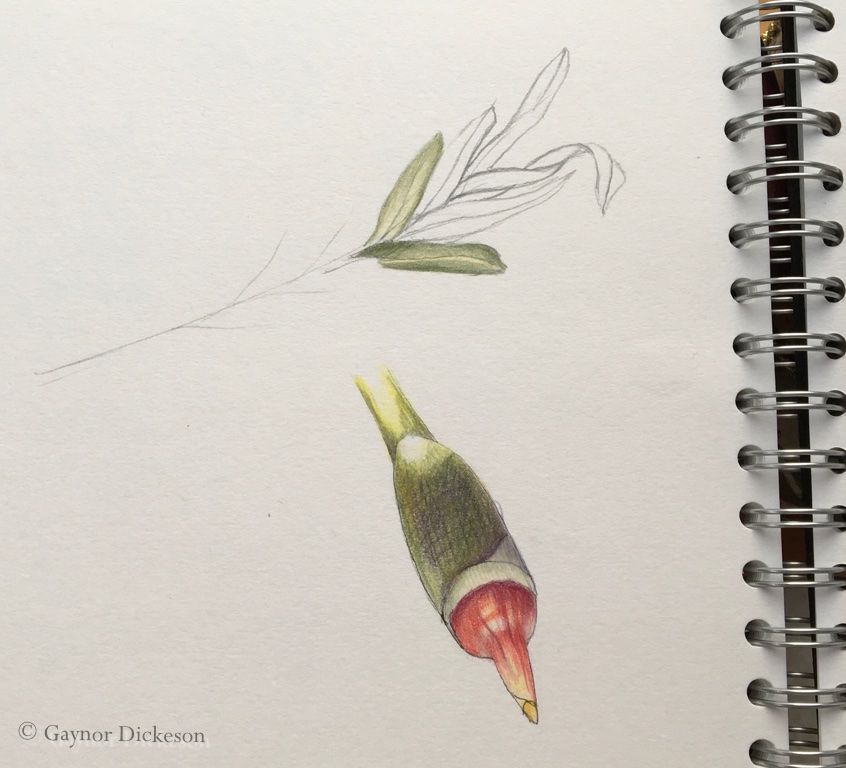
But, today during my latest workshop, I was looking through my sketchbook and found the following drawing. I know that I did it through a microscope at an Institute of Analytical Plant Illustrators (IAPI) meeting, about mosses and liverworts. The problem is I was stupid enough not to write what it was. Can anyone help me, and is it native to the UK?
? Bryophyte capsule
I have a strong suspicion that this is a Bryophyte capsule, but of course it doesn’t tell me which one and therefore I don’t know if it native.
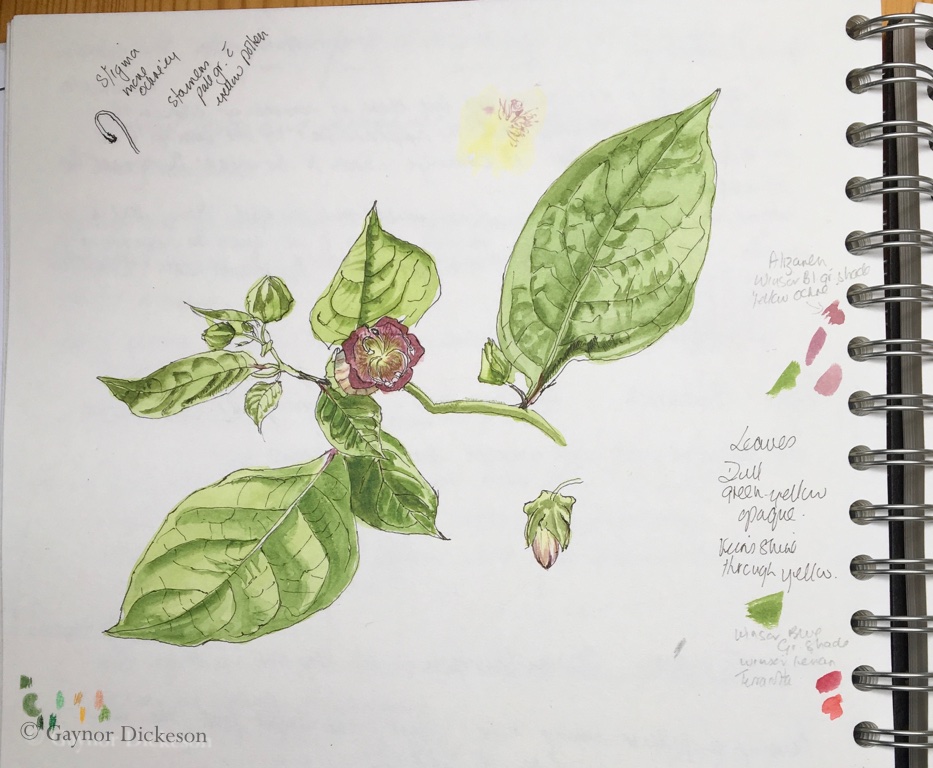
My next sketch is native and is Deadly Nightshade (Atropa belladonna). I think this is a really beautiful plant, although, if walking past it the colours of the flowers are rather dull. But of course the plant is often seen with flowers and large, shiny black berries at the same time. One day I hope to paint it, but I will have to be careful with it.
Atropa Belladonna – Deadly Nightshade.
Next week, 24 and 25 February, ABBA will have a table at the RHS botanical art exhibition in the Lindley Hall, Vincent Square, London. We are there to tell you about the exhibition in May 2018 and how you can take part. Additionally, over the two days, Sarah Morrish will be demonstrating on Vellum, Lucy Smith in pen and ink, and I will be doing a graphite and watercolour worksheet.
Please excuse some of the limitations with this blog as I am trying to write it with a very slow wifi connection. Added to which I am so tired that I am falling asleep.
Suffice it to say that I personally was extremely honoured by having my work accepted for the prestigious ASBA exhibition and being at the opening today was an experience I wouldn’t have missed.
Dr Shirley Sherwood opened the exhibition and all of the artists at the opening spoke for a few minutes about their work. It was interesting hearing about how their artwork came to fruition.
Although there was work from five British artists out of the 48 pictures selected for the exhibition, Dianne Sutherland and I were the only British artists present. However, three of the awards went to British artists including one to Dianne. Congratulations!
This slideshow requires JavaScript.
Unfortunately the last photo showing Lizzie Sanders picture did not turn out. I hope she will excuse the exclusion.


























 GAYNOR'S FLORA