The last SFP workshop and the next Gaynor’s Flora workshop

This seems a very busy time of year! Two weekends ago I had a pen and ink workshop with IAPI(Institute of Analytical Plant Illustrators), and this last Saturday I had my last workshop with SFP (Society of Floral Painters). This coming weekend will be a three-day workshop in Bosham – Colour in the Hedgerows. This will be the last workshop before I travel to Pittsburgh to teach a workshop at the ASBA (American Society of Botanical Artists) annual conference.

All of that was in one paragraph and one breath! As I said it is a busy time of year.

But before I tell you about the next workshop where there are places available, I will tell you about the lovely but sad time spent with members of the SFP in Pitton near Salisbury.

Unfortunately the SFP has had to make the decision to wind up the Society for the time being. In actual fact they were a really good Society, although I’m not too sure how many members there were. They were very good at producing a regular newsletter throughout the year, with a lot of useful information to help and support artists interested in developing their skills in floral painting or drawing. In addition to the newsletter, they offered workshops to members and one day a year was allotted to selection of applicants to full membership. It wasn’t left to a simple yes or no, but good feedback was given about the reasoning behind each decision that was made.

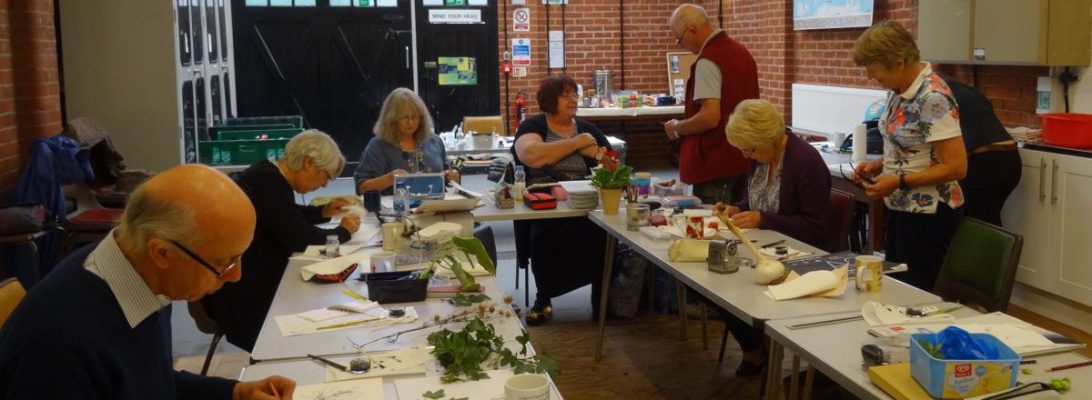
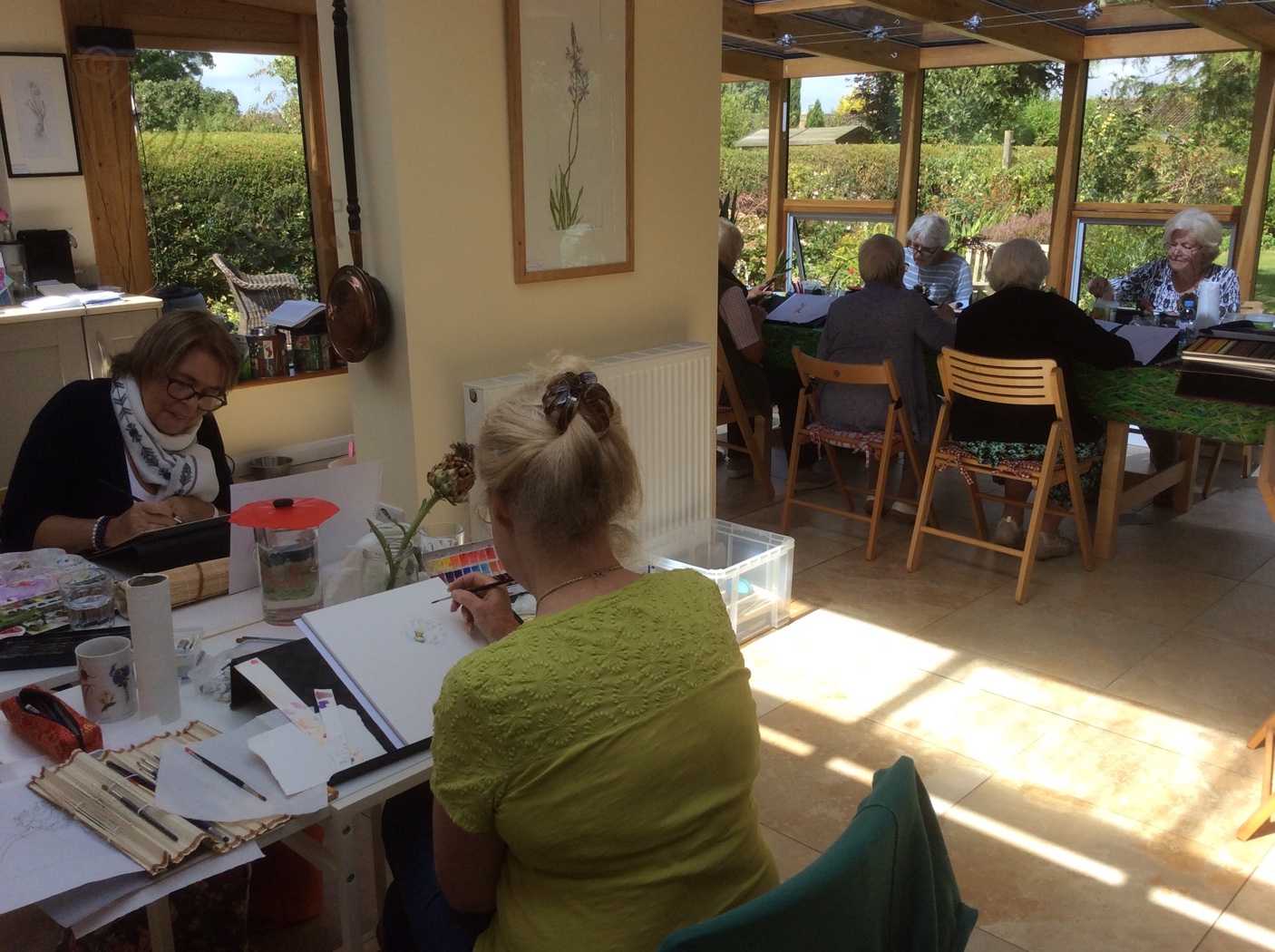
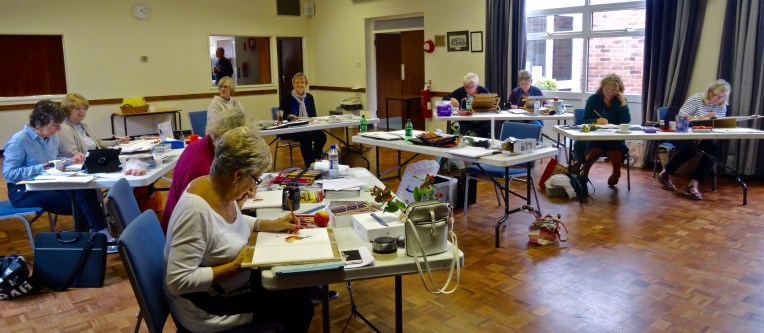
But I wanted to show you a little from the workshop near Salisbury. AS usual it was a lovely group of people who got along well and encouraged each other throughout the day. The rest can be shown in pictures rather than words. Although I will give you information about the next workshop in the UK.
Version 2
SFP coloured pencil workshop

After I return from the USA, there will be another three-day workshop in Bosham. The subject this time is Autumn colours. Wow! The date is Friday 28 – Sunday 30 October. For those who book in time, I will give you a recipe on preserving some of those gorgeous leaves so that they stay reasonably still to allow you to paint them. So book now!

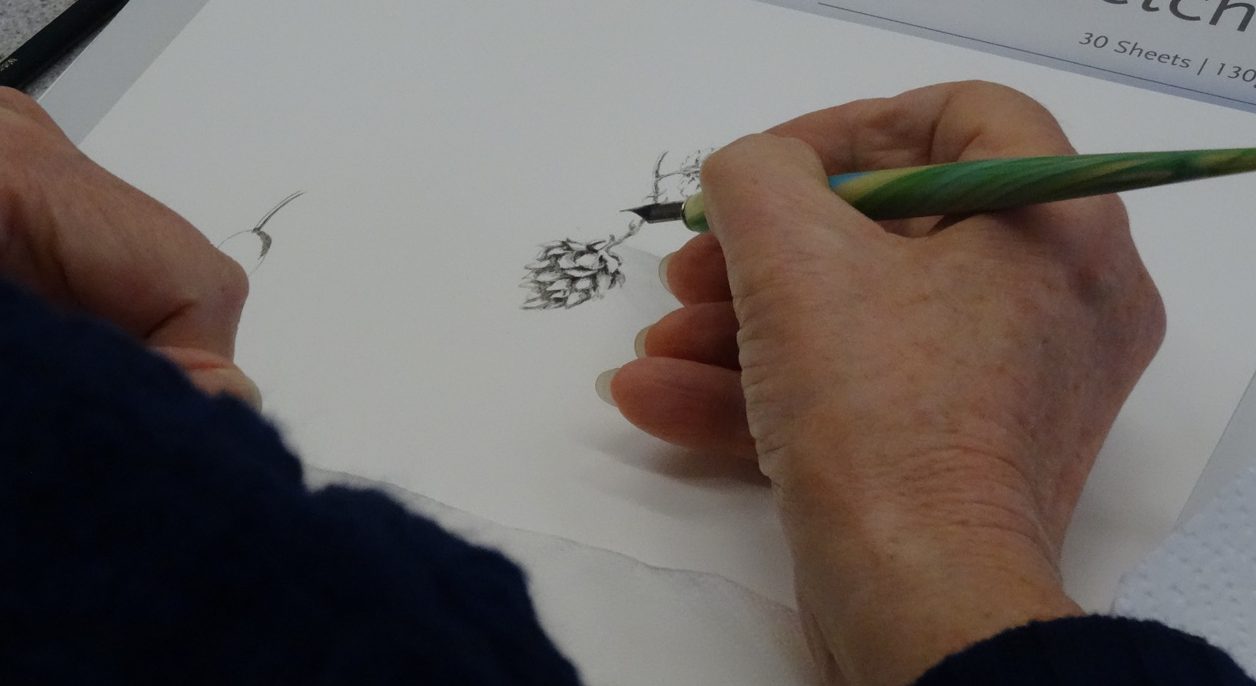
Look at some of the work being painted at the SFP workshop.

This slideshow requires JavaScript.


To book your place on the next workshop contact me via the form below.

← Back

Thank you for your response. ✨


Exciting news!

I have been seeing some amazing pictures on Instagram, of a fabulous looking 19th century house in France. They were posted by a friend, Alistair, who had been experiencing it first-hand. The house itself has beautiful architecture and was furnished in the style you might expect from that period.

In late spring this year I received an email from Simon and Nicholas, brothers who have restored Le Manoir to its former glory. They wanted me to consider running a botanical art workshop holiday in this splendid place. I hesitated!

There was much to consider here. I had seen the beautiful pictures, but there can be a lot of other things hiding behind beautiful pictures. Was it suitable? How did Simon and Nicholas envisage it would be? How many artists? Etc. Etc.

I got back to them, we had an initial meeting in London a few weeks ago and in the last 24 hours we experienced staying in this amazing house, being looked after by Simon and Nicholas. We now know that Le Manoir is very suitable for an exclusive botanical art workshop holiday.

Le Manoir
Le Manoir

I don’t use the term ‘exclusive’ lightly. Le Manoir is beautiful. Each bedroom is large, with a view and with a very well equipped bathroom (two of them in turrets). In addition to that the kitchen, dining room, sitting room and lounge are all extremely comfortable and very homely. The gardens and surrounding Dordogne countryside are lovely, although slightly baked following a long hot and dry summer. The swimming pool and large open-sided dining area with equipped kitchen completes the feeling of luxury. Actually, not quite; the peace and calm that pervades dots the i’ s and crosses the t’s.

We spent the time available going through details and deciding how together we can create the ideal botanical art workshop holiday. We concluded that the mornings should generally be devoted to tuition and the afternoons to trips to explore the area and meals to experience the regional cuisine, both at Le Manoir and local restaurants.

We do know that the workshop holiday will be one week at the end of September 2017, it will be all inclusive, from local airport transfer (Limoges or Bergerac), full board and lodging, tuition and all planned trips.

But, to make it even more exclusive, it is only available to an absolute maximum of seven students, ensuring a period of individual and undivided attention to everyone. Accompanying partners will be able to take part in all the trips or can be otherwise occupied by exploring the area, hanging out by the pool, visiting vineyards, or playing golf locally.

As time goes on I will give more information about this exclusive botanical art workshop holiday, but, watch this space.

le-manoirdaypool

For more information about Le Manoir visit: http://www.lemanoirstsulpice.com

Workshop last weekend and this weekend

Last weekend started off pretty laid back in comparison to how it developed. I had a botanical art workshop on pen and ink with IAPI (Institute of Analytical Plant Illustrators)at Leicester Botanical Gardens. Apart from getting there slightly later than planned, we had a lovely day and again with a lovely group of people. The group is composed of Botanical artists and Botanists. The aim is to work together to document botanical subjects. We learn from each other to produce the documentation needed to identify plants.

IAPI at Leicester Botanical gardens
Well into the subject in pen and ink

After the workshop, we took a plane directly to Amsterdam to watch my son and daughter do the Dam to Dam 16 km run.

It was a great privilege to see them take off. They are the ones with their arms in the air. Believe it or not, Robin and I cycled to meet them at the finish line, but they arrived there 15 minutes before we did! By the time we got there, worn out, they were full of beans and raring to go. It really put us to shame.
3-dsc03425

I don’t normally talk about things we do, keeping the blog mostly to botanical art. But I was very proud of them.

The trouble is, after the run, they got transport back to Amsterdam and we had to cycle – getting lost on the way! At 20:00 in the evening, they were about to send out a search party when we eventually got back.

Age is apparently taking its toll.

Now I am in the process of preparing for the last workshop with the SFP (Society of Floral painters). Unfortunately, it is now folding due to lack of offers to take on some of the committee roles. The Society has been spoilt for years with the same people doing the work. But after all this time they too need to take a breather.

I want to use this small opportunity to thank the SFP for all that they have done over the years.

Lovely people for the Fruit & veg botanical workshop

Sometimes I feel really privileged to meet so many lovely people in botanical art.

I love painting and often wish I could just sit and paint all day every day. But that would be boring in the end. I don’t think my husband would be too happy about that either!

However, as I teach regular botanical art workshops, I am pulled out of the shed at the bottom of the garden to meet these lovely smiley people who turn up at my front door. They are always so pleasant and wanting to learn, and it is such a pleasure to help them.© 02.IMG_2007


Who could be more blessed than that?

The Fruit and Veg workshop was no exception. For both days the weather had turned sour and rainy, but they still stood at the front door looking really happy. Luckily it didn’t rain too heavily whilst they were choosing their subjects in the garden and they were back in doors by the time the heavens opened.© 01.IMG_2005

But as you can see from the photos, we still had some sun.

We don’t have too many subjects in the kitchen garden, but funnily enough they all chose things that were completely inedible. The globe artichokes were pointing skyward in all their majesty, but even the purple petals on the top were now brown. However, half of the group were attracted to these and the other half with radishes that had long gone to seed and were all large and wonky. One person brought their own subject – a sweet corn still suitably jacketed.

This slideshow requires JavaScript.

But whilst all this was going on the cook was in the kitchen preparing lunch  and of course the Strawberries and cream for tea.© 03.IMG_2008

But these are what you are probably wondering about.

This slideshow requires JavaScript.

I am pleased to say that from emails I have since received, that those taking part in the workshop thought it was successful, they learnt a lot and had enjoyed it.

The next workshop is Friday to Sunday September 30 – October 2 (Colour in the Hedgerows), just before I head off to Pittsburgh in the US to take part in the  ASBA annual conference. Although there are no more places on the workshop in Pittsburgh, there are still some vacancies in the one in Bosham, West Sussex, so please do get in touch if you want to take part. You will find the booking form here: Workshop booking form, or you can send me a message in the form at the bottom of this page.

← Back

Thank you for your response. ✨


A new YouTube video – tomatoes in coloured pencil

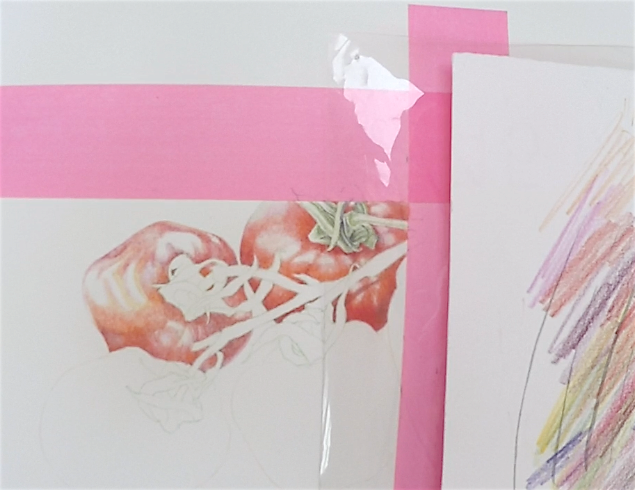
I mentioned previously that I had been trying out various papers to use with coloured pencil, rather than my favourite, Fabriano Classico. The trouble is that I kept on having to start my tomato picture again and the ultimate goal was to film the process to use with my online botanical art course.

In the end I gave up and the video is based on my fourth attempt, but with my favourite paper! I hope that this will make some people happier about their numerous attempts with whatever media they might be using.

Having read the above, you will think that I didn’t find any suitable replacements for the Fabriano, but that isn’t quite true. The problem was that I chose what seems to be a simple subject, which in reality wasn’t all that simple to do. The tomatoes are very red, smooth and shiny. The red was the problem.

For those who work with coloured pencil, they will know that the colours are translucent and therefore the colour or colours that you are aiming for are in fact a layered mix of different colours. The tomatoes were a yellowy red – simple; but they also had areas of deeper red, areas of pinky-red, colder areas and warmer areas.

I have also been painting a Crocosmia ‘Lucifer’ recently, and I encountered similar problems with that, because of the red.

I suppose what I am trying to say is that if is difficult, try and try again; it will be worth it. Particularly with coloured pencils it is worth trying out different mixes before you start and sometimes simpler is best.

I finished the series of videos for the course, starting off with tracing the line drawing, a separate short video for each of the tomatoes and then one for the sepals and truss. But unless you are signed up for the course you will only see this video which concentrates on the second tomato. It is speeded up considerably, therefore not going into huge detail about techniques. But you do see how the tomato develops and the list of colours I used for the whole picture is in the information section underneath the video.

Three tomatoes-2nd tomato

This is the Youtube video linkThe second of three tomatoes in coloured pencil.
This coming weekend is the ever popular Fruit and veg botanical art workshop. It looks as though it won’t be such glorious weather as has been for the last couple of days, so everyone will be able to concentrate on their painting, but be rewarded with strawberries and cream at the end of it!

Bad news and good news.

A few days ago we were walking round the garden and noticed that one of the Fuchsias seemed to have real problems with flowering. On closer examination the growing tips were curled up with the new flower buds curled into them. We then checked out another fuchsia in the front garden which had flowered. It was the only one we had with variegated leaves. But that too seemed to be infected. We had no idea what this was, so Robin had a look on the net.

Distorted growing tip of a Fuchsia plant

Apparently it is the Fuchsia gall mite and has been written about by the RHS. It had first been seen in Brazil in the late 1970’s and has since spread to areas with warm climates, reaching Fareham on the south coast of England only a short time ago.

The only thing to do with it is remove it completely as removing the distortions doesn’t get rid of the mite and neither do pesticides – which we wouldn’t want to use unless there was no other way. When removing the plant, it either has to be burnt or got rid of safely – not on the compost heap. The mode of transportation is you and I, birds and the wind. Therefore we have to be careful that we clean tools, change clothes and wash hands after handling it.

I have just found it in the back garden too, but so far it has only affected one of the fuchsias (all hardy). Therefore we have to get rid of it as soon as possible. However, before doing so I thought I would take some pictures. The mite is 0.25 mm long, therefore too small to be seen with the naked eye. But I have one or two microscopes and have taken some stills and a short video.

First, two stills so that you know what to look for:

Fuchsia gall mite still_1 copy


The same gall mites taken within seconds of the first picture.

I had hoped to show you a short video I took of a mite moving along a stem, but unfortunately I haven’t found a way to include it on a WordPress page. But needless to say, the mite is very bad news for those with Fuchsias at least living in the south of the UK . But perhaps this will be a warning to have a look at your Fuchsias and remove those infected as soon as you can.  This could minimise spreading.

Now the good news. The American Society of Botanical artist (ASBA) has its annual conference in Pittsburgh in October. I know I have mentioned this before. I was asked to teach and the online registration was opened on 23 July. I booked the workshops that I wanted to attend, but also checked out my own workshop.

I couldn’t believe it and I thought there was a difference between the meaning of the American and UK English words ‘waiting list’. I picked up the courage to ask and found that they meant the same thing. Already on the first day of registration, my workshop was fully booked with a waiting list! I have to keep my fingers crossed now that I can still get crab apples as subjects for the conference. At the moment, I have loads of different ones ripening here, but how they are ‘over there’ is another matter. Perhaps someone could tell me if they are likely to have any left at the time of the conference?

Screen Shot 2016-08-13 at 16.19.58

Places on botanical art workshop starting two weeks today.

Before I update a little more, there are still a few places on the ever popular botanical art workshop ‘Fruit and Veg’ or ‘Strawberries and Cream’. The last part isn’t intended to paint as we will be eating them. However, there is no reason why shouldn’t reserve some strawberries to paint.

Please do get in touch as soon as possible if you would like to attend the workshop, Friday and Saturday 19 & 20 August, between 10:00 and 16:00, including lunch.

The workshop is held in Bosham near Chichester. There are plenty of B&Bs in the vicinity and I have a list should you need it. But these days it is easy to find accommodation on the internet.

We have a kitchen garden, although not too much in it as we were away during a vital period. We took cucumber plants to my daughter in Norway; she has cucumbers, our plants died! But we do have exciting overgrown radishes, apples on the way and blackberries already here. The runner beans are beginning to produce, but the broad beans are few and far between. Our neighbours got plenty of Raspberries whilst we were away – all gone now, but you never know, some may pop up.

I will put a form at the end of this blog so that you can get in touch with me quickly should you decide you would like to join in the fund and games. More information and booking form at Gaynor’s Flora workshops.

In the last update on 1st of August, I mentioned that I had beens struggling with painting tomatoes in coloured pencil as I was trying out different papers. For my fourth attempt I used my trusty old supply of Fabriano and it is now finished. I will show it to you another time as in reality I only did it as a teaching video for my online botanical art course. I still have to edit the video.

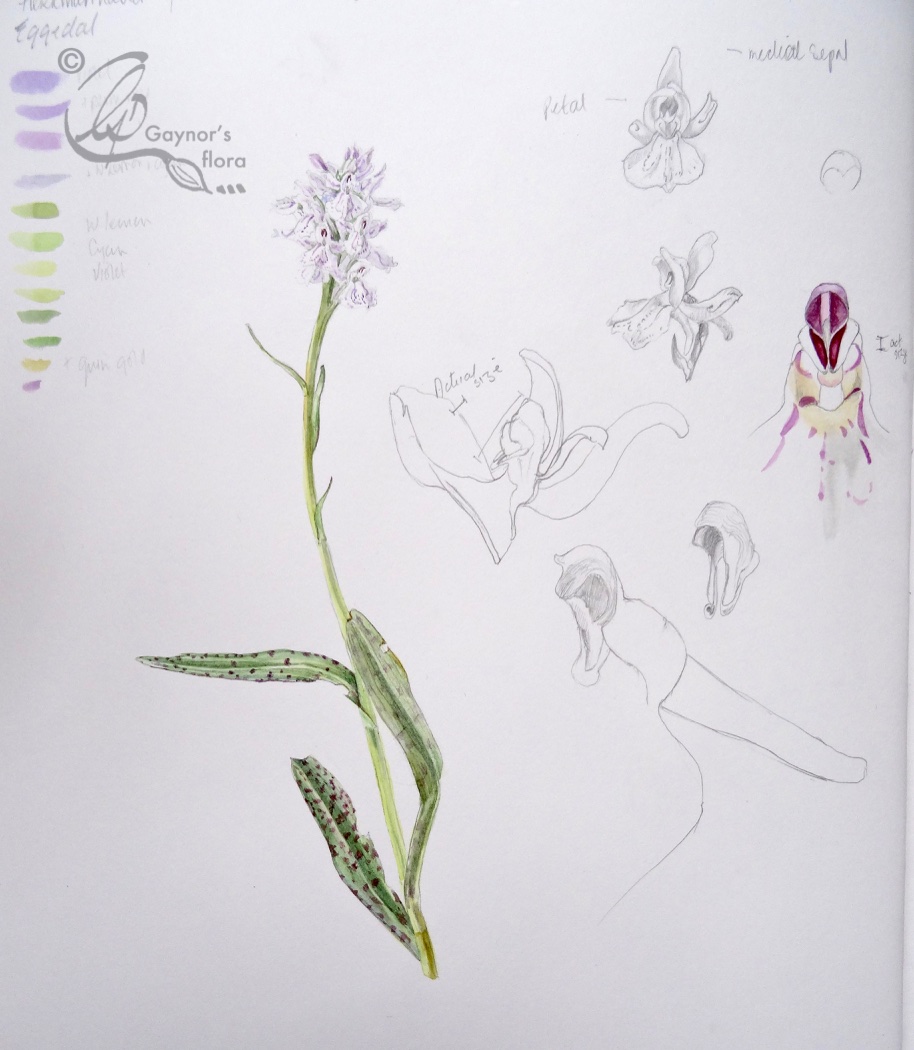
I also mentioned our trip into the mountains in Norway and showed you a list of plants that I might do for my next RHS submission. Here are a few sketches of the Heath spotted Orchid from my sketchbook.

Heath spotted Orchid sketchbook page
Heath spotted Orchid flower detail
Heath spotted Orchid leaf detail

They are in a Stillman & Bern Zeta sketchbook in watercolour.

Get in touch about the workshop in two weeks time.

← Back

Thank you for your response. ✨

New home for a picture.

This blog is particularly brief, although I still have plenty of news to catch up on.

I had a commission for a Fritillary earlier in the year. I showed you some of the preparatory drawings in my sketch book in a blog 25 February this year. The customer approved the composition and the final picture was painted in watercolour.

Because the picture was needed for a particular date, delivery waited until today. It has now gone to its new home.

Fritillaria meleagris

Fourth Gaynor’s Flora update

I am so glad that I have these blogs to look forward to each day. They are helping to remind me about the lovely things I have done over the last few weeks. Particularly as I am still catching up with all the undone things, including doing a coloured pencil video.

I am really struggling with the video. I expect that those who are just starting out in botanical art will be relieved to hear that someone who has been doing it for a while, continues to struggle in periods. But the reason that I am struggling is because I am trying out different papers to use with coloured pencils, so that I can advise my students. The subject is tomatoes.

I think that I am now on my third attempt. Its not that I don’t get good enough results, it’s just that I feel I have to adjust my technique for each of the different papers I use. But I suppose that is something new learnt.

First Tomato picture attempt on Strathmore 500 Bristol Plate.
Incomplete first tomato picture attempt on Strathmore 500 Bristol Plate.

Going back to catching up.

A lot had been going on over the last few months with a great deal of time spent on writing the online botanical art course, exhibitions, demonstrations and teaching. I felt I needed a break, but my head was still working ‘twenty to the dozen’. My workshop in Norway was unfortunately cancelled, therefore this time we would be taking a holiday there. I still had work to do on the botanical art course and informed family that this was the case.

I have a strong and determined family! After one day spent working, I was told that enough was enough. I was unhappy at the time as of course I still had to do the work. But since then I have every reason to be grateful to my daughter in particular. I had a holiday and had a proper rest. Maybe I was a pain to everyone else!

Whilst in Norway I didn’t get much painting done either. But we stayed with some friends at their cottage in the mountains and I think I now have a group of subjects to paint for an exhibition at the RHS. It won’t be next year, but if I get my act together, possibly the year after.

As here in the UK one is not allowed to pick certain plants. But I made a note of the plants around my friend’s cottage and I think they will make a very good subject series.

© Skinntryte page

I know that this page in my small Moleskin drawing book looks very boring. But this is how botanical art paintings start, particularly when planning a series of paintings. I’m afraid that I have written the Norwegian names, but you will also see the scientific names if you want to look them up.

Three of the plants are important for fruit picking in Norway –

  • The Vaccinum vitas-idaea is called Tyttebær in Norwegian and Lingon in Swedish (goes with your Ikea meatballs), but Cowberry in English. They are the same genus as the Cranberries we buy in the shops, but a smaller species.
  • Blåbær is Blueberry in English, but again a different and smaller species from the ones we buy in the shops.
  • Multe is Cloudberry in English. They are the most sought after and difficult to find – but generally one knows of a ‘spot’, and doesn’t tell anyone else! There are very special rules governing Cloudberries. One is not allowed to pick the flower and definitely not allowed to pick the fruit until it is fully ripe. If you are caught with red fruit you are fined.

In 1974 and long before I knew the importance of Cloudberries,  my parents visited me in Norway  and we took them into the mountains. My mother loved these delicate white flowers and picked a whole bunch of them!!

Skinntryte is also a form of blueberry. I have found several English names for it including Whortleberry and Bilberry. They grow with Blueberries and for those who don’t know the difference, they might also pick these.

Krekling is apparently becoming more interesting to harvest. It is Crowberry in English.

Of course Tettegras is the Common Butterwort, which is a carnivorous plant. When picking fruit in the mountains, I think one is very glad that there is something that digests all the buzzy, biting things!

Last of all, the Flekkmarihånd is the Marsh Orchid and just beautiful.

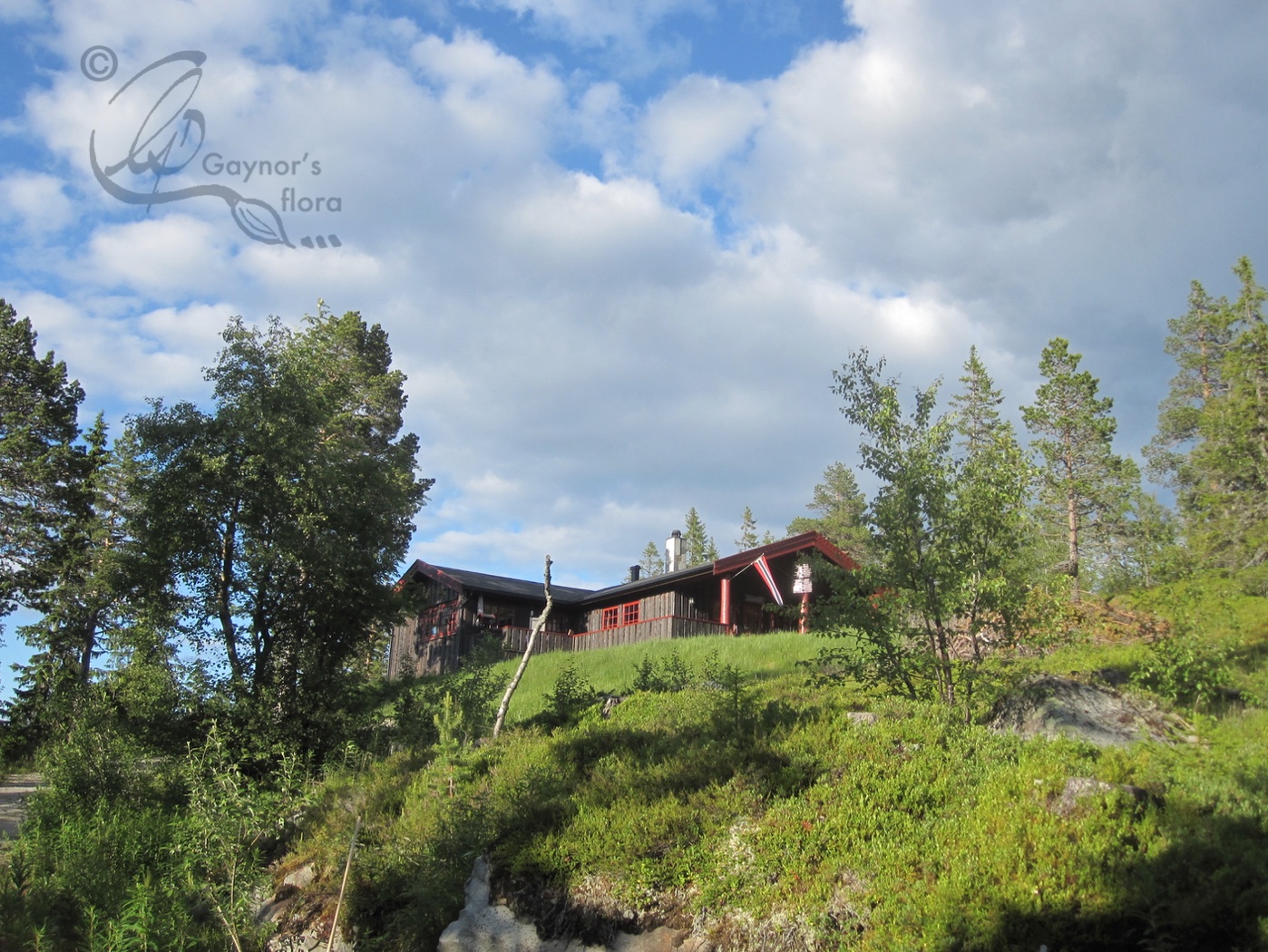
This is my friend’s cottage in the mountains. They have invited me back next year to continue painting the series. Thank you Eva and John.

© 1.Eva & John's hytte