

The above walk was with my children and husband. We went a little further south along the coast from where we live. It was on the edge of a beech wood, very cold and plenty of snow. However, the temperatures were not as low as the day we moved into our new home. On that day, it was minus 15 degrees Celsius!
I have had botanical art students from just as cold climates. They have asked what they should paint when there isn’t too much growing. For my course, I always suggested they might buy indoor plants to complete the course. Once they had finished the course, they could choose their favourite subjects.
A fair amount is still available in the countryside. This can be seen in the picture above, showing the edge of a Beech forest. My garden also contains rose-hips, beech, oak, Rowan, pine, hazel, all of which is accessible above the snow. It also has a lot of wild-life.
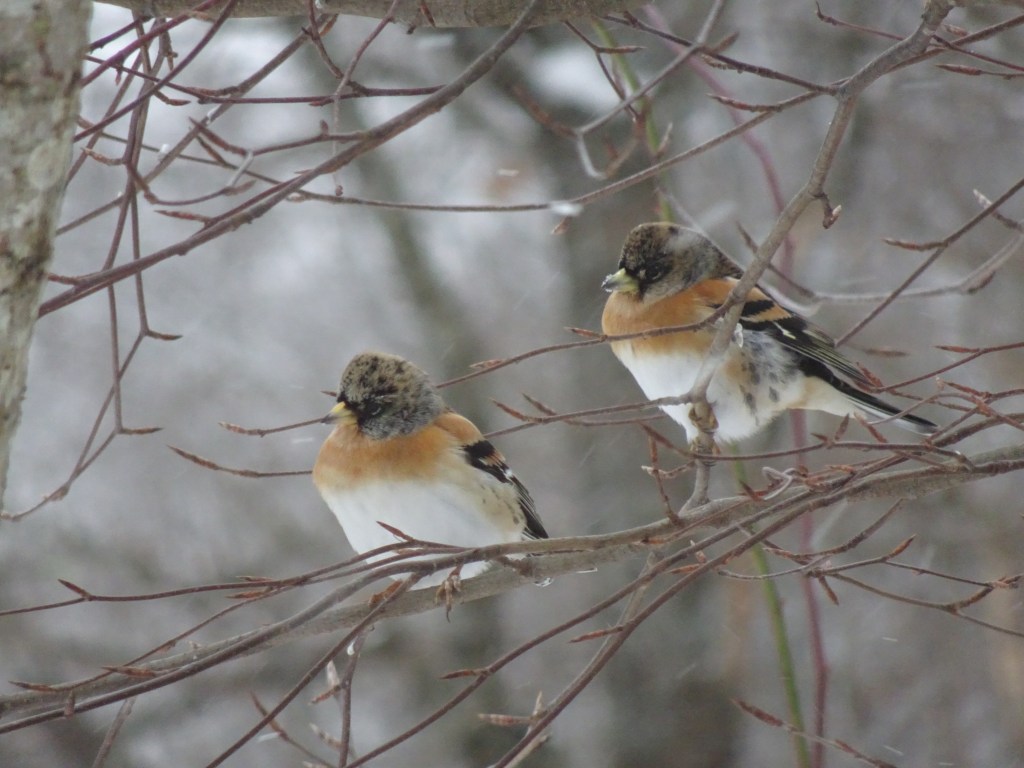

Many years ago, during my first 25 years in Norway, I focused on painting birds. At that time, I relied on photos taken with my SLR attached to my telescope. For additional detail I used skins from the museum. Since then, the equipment available to me has changed. It is more affordable now. I can get much better photographs from my trusty little camera than I did from my film reliant SLR.
Gradually we have moved the bird feeders nearer to the house. This allows me to get quite good photos. Feeding the birds in the garden also provides a plentiful supply of nuts and seeds generally. This attracts other animals during the winter when the supply of food is short. Deer are also welcome visitors and mop up after the birds. But we do have to try and protect our fruit trees a little!!
So what do I paint? I decided to combine my love of painting birds, with my love of botanical art?
Many of the bird species move from the mountains to lower lands searching for food during the winter. This includes the Bramling, Yellowhammer, Siskin, Bullfinch and Hawfinch. At the beginning of the winter, their colours can be a little drabber. As spring approaches, they get new plumage. and become very colourful.
Now I spend quite a bit of time photographing these beautiful birds from the comfort of my own lounge. The two pictures above are good examples.
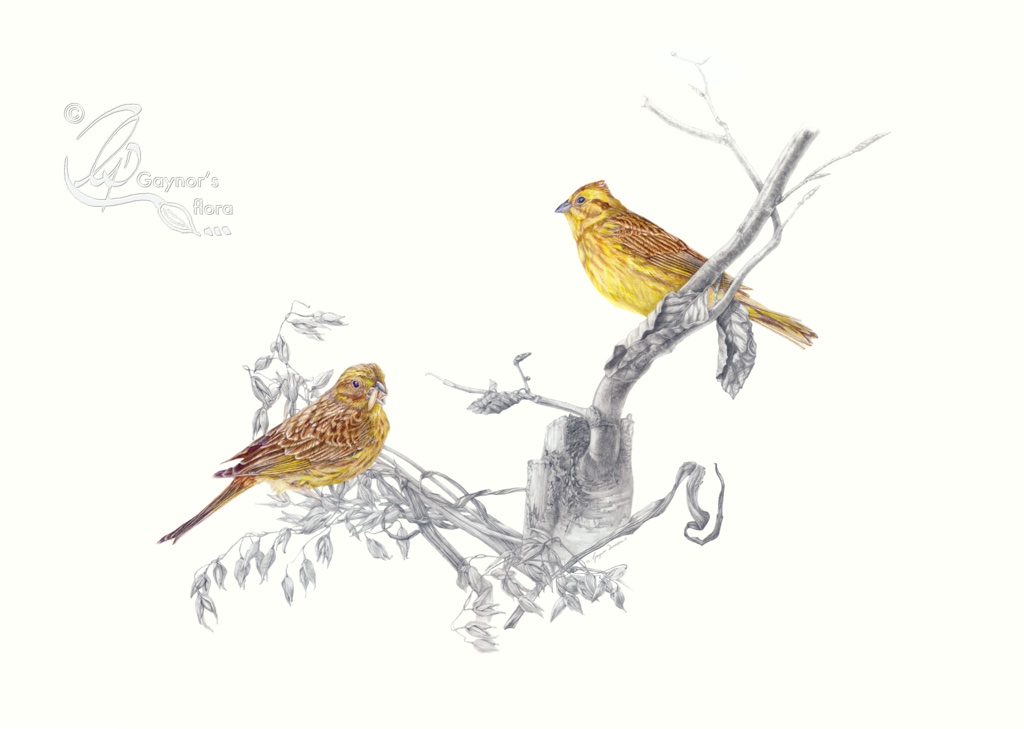
So where has this led me? It is traditional in Norway to put out sheafs of corn for the birds for Christmas. The Yellowhammers seems to be very interested in this food source and flock to the sheafs. This year, we have the corn hanging in a Beech tree, so I had both botanical subjects with the birds. Additionally, I always loved the use of graphite and didn’t start using colour in my artwork until my mid-twenties. So this picture is a combination of glowing colour for the birds and graphite for the botanical detail.
To confirm which is which in this Yellowhammer pair, the female is the more motley colour on the left. I do enjoy painting her more. The Male in striking yellow is on the right. He is very gentlemanly and making sure she is feeding un-molested. All is painted actual size. The finished painting is 52 x 37 cm. Enjoy!
 GAYNOR'S FLORA
Very beautiful post thanks
I’m glad you enjoyed it.